
Price check, week of September 14:
- Fed funds rate: 3.75% to 4.00%. Up for the first time since 2023.
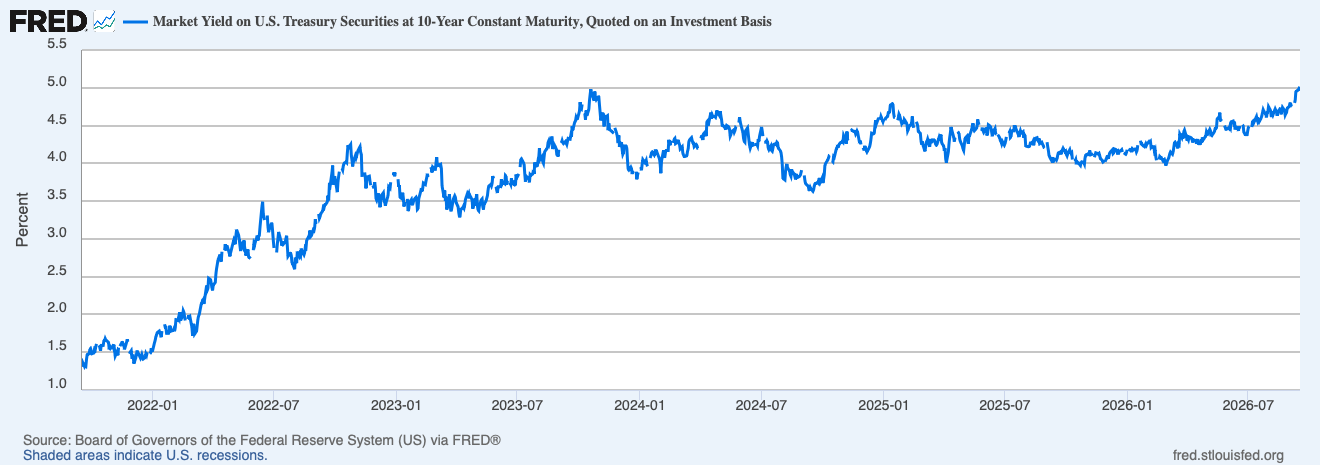
- 10-year Treasury: around 5%. Highest since 2007.
- Brent crude: above $109 at the week's peak.
- CLARITY Act: failed 49 to 50, short of the 60 votes needed to advance.
- Bitcoin: around $76,000. Still waiting.
Three things got more expensive this week: energy, money, and the wait for crypto's rules. Two of them arrived through the same channel. The third came straight from Washington.
Bitcoin took all three and is standing roughly where it started. That's the week's real story, and it's stranger than a selloff.
Oil Just Changed the Rate Story
The Federal Reserve raised its benchmark rate by 25 basis points on September 16, taking the target range to 3.75% to 4.00%. First increase in three years. First policy change under Chair Kevin Warsh. The vote was unanimous.
The hike itself was expected. The message underneath it wasn't.
16 of the 18 policymakers who submitted projections expect at least one more increase before the year ends. The Fed also lifted its inflation forecast, while Warsh pointed to resilient spending, strong productivity and capital investment as evidence the economy can take tighter policy.
And then there's oil.
Brent has come off the week's highs, down from above $109 toward the $100 line. The relief is real. It's also thin. Preliminary shipping data showed three commercial vessels transiting the Strait of Hormuz on September 16, against 12 the day before and a 10-day average of roughly 17.
Three ships.
That's the detail that makes this episode different. Markets know the usual pattern for geopolitical risk in oil: a strike, a spike, then a fade once traders decide the barrels will keep moving. This time the disruption is showing up in shipping lanes and damaged infrastructure, not just headlines. Harder to trade as noise when you can count the ships.
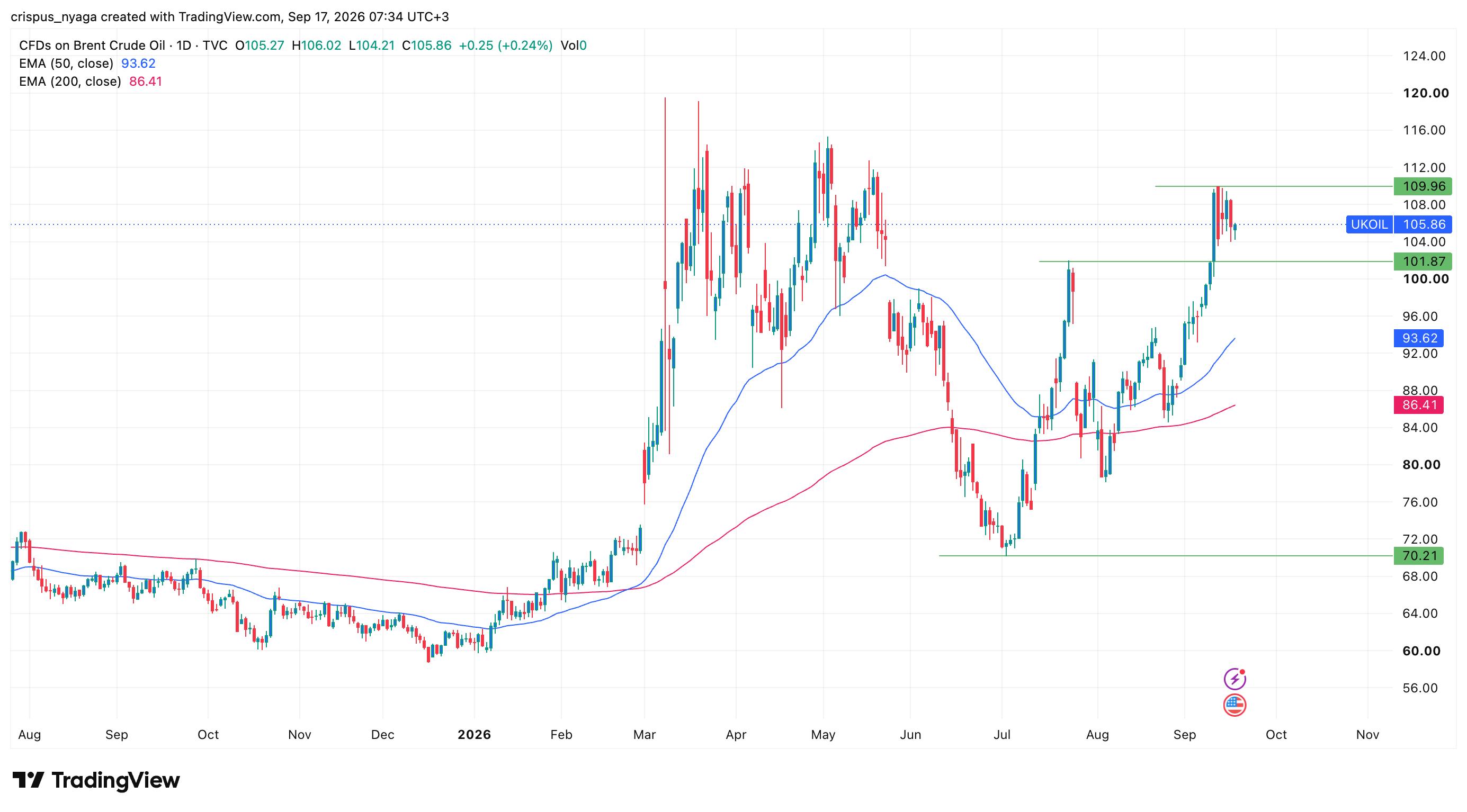
For the Fed, that's an awkward combination. Higher energy prices push up costs across transport, production and eventually the shelf, while pulling money out of households and slowing growth. A central bank can look through a temporary supply shock. Much harder when inflation is already above target and the shock refuses to be temporary.
Oil doesn't need to keep rising to change the macro picture. It only needs to stay expensive.
Which is why crude now matters to you even if you'll never touch a barrel. The chain runs from energy into inflation expectations, from inflation into rates, and from rates into the return you need before anything else is worth holding.
Bonds Set the Bar
The clearest version of that repricing is in bonds.
The 10-year Treasury yield briefly reached 5.041% on September 15, its highest since July 2007, before easing back. That's the number to watch, more than the Fed's 25 basis points. The Fed sets the overnight rate. The bond market sets what money costs everywhere else. A 5% Treasury doesn't suddenly make bonds and Bitcoin substitutes. Different assets, different holders, different reasons to own them.
But the risk-free rate sits underneath almost every valuation in the market.
When it rises, so does the bar.
Here's the plain version. If you can earn roughly 5% doing nothing, anything you buy instead has to be worth more than 5% of not worrying about it.
The same math is closing in on the AI trade, where enormous spending today is justified by profits expected years from now. Oracle is the clean example. More than $30 billion in new AI contracts signed last quarter, and free cash flow of negative $5.4 billion in the same three months. The demand is real. So is the bill for serving it, and lenders now want 5% to help pay it.
You run a faster version of that equation every day. Expected return, carrying cost, and how long you can afford to wait for the thesis to work.
Crypto Got the Bill Twice
Two very different tests in less than 48 hours.
The first came from Washington. The Senate needed 60 votes just to start debating the CLARITY Act. It got 49. Every Democrat present voted no, three Republicans joined them on the merits, and a fourth, Thom Tillis, switched his vote so he could file a motion to reconsider, which he did minutes later. Markets moved immediately. Bitcoin fell about 4% to around $75,900, dipping below $75,000 intraday, while Coinbase closed down 10% and Circle more than 11%.
The consequence outlasts the candle. Without legislation, the job of defining crypto's US framework stays with the SEC and CFTC, which leaves the rules exposed to changes in regulators, courts and politics.
That isn't the same as no rules. The SEC has proposed new exemptions for certain crypto-asset offerings, including a fundraising exemption of up to $75 million a year. The CFTC permitted the listing of U.S. bitcoin perpetual futures in May. The framework is still being built. It's just being built by agencies, one product at a time, instead of by Congress in one piece.
Then, a day later, the Fed raised rates.
Different shocks. CLARITY was crypto-specific, and it weakened the case for legislative certainty. The Fed was macro, raising the cost of capital everywhere and strengthening the argument for holding things that pay a yield.
Bitcoin took both and was trading around $76,500 on September 17.
That's not strength. It sold off hard on the vote, and there's been no convincing rebound. But there's been no larger breakdown either, and that's the more useful observation.
A market that rallies through bad news is showing you aggressive demand. A market that collapses is showing you where positioning was fragile. Bitcoin has done neither. It's sitting inside the damage, waiting for a reason to move.
One caveat worth keeping: a quiet range can mean patience, or it can mean absence. Volume and open interest will tell you which.
So the useful question isn't where BTC goes next. It's how much more pressure this range can absorb.
Watch These Three
Oil. The pullback shows how fast crude responds to even the possibility of more supply, with Saudi Arabia offering extra barrels to Asian refiners and repair work underway on the damaged East-West pipeline. Back below $100 and the inflation scare starts to fade. Settled above it, the question stops being how high oil spikes and becomes how long everyone has to live with it.
The 10-year. Not whether it prints 4.95% or 5.05% on a given afternoon, but whether the bond market keeps demanding this much to lend long. If yields climb further, financial conditions tighten without the Fed lifting a finger.
Bitcoin. It doesn't need to reclaim $80,000 to say something. Holding this range while crude stays expensive, policy tightens and safe assets pay 5% would tell you there's real risk appetite underneath. If the range fails, you'll know where the pressure found its outlet.
The Price of Doing Nothing
For years, "higher for longer" was shorthand for interest rates. This week made the phrase bigger.
None of this determines where Bitcoin trades next. Markets are rarely that clean. But together these moves raise the price of taking risk, and the patience a trade needs before it pays.
If your position only worked with money at 3.5%, you weren't long crypto. You were long cheap money.
Tuesday tested crypto's regulatory story. Wednesday tested its macro one. Bitcoin absorbed both.
Now the harder test: whether it can keep doing that while the price of waiting keeps going up.
New & Noteworthy
Two listings, two sides of this week's story.
GLD: the largest physical gold ETF, holding bars and tracking spot. The inflation side of the argument.
TLT: the largest long-term Treasury ETF, holding the part of the curve that moved this week. The rate side.
[Get Early Access]{https://www.mexc.com/announcements/new-listings}
Stay Updated
Follow us on Telegram to be notified whenever a new digest drops.
[Follow MEXC on Telegram]{https://t.me/MEXC_OfficialAnnouncements}
Translation
"The competition for capital is real."
- Fed Chair Kevin Warsh, September 16, 2026, on why the 10-year yield keeps climbing
There's only so much money to lend at any moment. When the companies building AI data centers borrow hundreds of billions, they're bidding for it against the US Treasury and everyone else. Borrowing gets more expensive for all of them.
The scale is the point: the five biggest hyperscalers issued $121 billion of US corporate bonds in 2025, against an average of $28 billion a year from 2020 to 2024.
Your funding costs and Oracle's are set in the same room.
Before You Go
This week every market moved for the same reason, and most people only watched one of them. Opportunity Compass is the fix: five seasons on the markets beyond crypto, starting with how the global picture fits together and why prices move when they do. Season 1 is live, new episodes every Tuesday and Thursday.
And if you want to know what kind of trader you are before you find out the hard way, the Wall Street DNA test sorts you into one of six types, with a share of $1,000,000 in rewards running to October 16.
Not financial advice. We describe, you decide.