

MEXC Futures Chase Limit Order FAQs
1. What is a chase limit order?
A chase limit order is a limit order placed at the best bid or ask price that dynamically adjusts the entry price in response to changing market conditions until the order is filled, canceled, or reaches the maximum chase distance. On the MEXC platform, this order mode is exclusively available under hedge mode, offering traders a method that balances execution speed with price control.
Simply put, when you place a chase limit order, the system automatically tracks the top of the order book and continuously updates your order price. Unlike traditional limit orders that wait for the market price to reach your set level, a chase limit order actively "chases" the market price, significantly improving execution efficiency.
2. What are the advantages of chase limit orders?
Chase limit orders combine the execution speed of market orders with the price control of limit orders, offering the following core benefits.
1) Fast Execution: These orders allow for execution at the immediate market price within a specified protective limit. This maximizes transaction speed, eliminating the need for traders to wait long periods for price pullbacks.
2) Seizing Opportunities: During periods of rapid market volatility, traders can buy or sell instantly to capture trading opportunities driven by price movements. This prevents missing out on trends due to a significant gap between a static limit price and the current market price.
3) Fee Savings: Since chase limit orders are typically executed as Maker orders rather than Taker orders, traders can often enjoy lower fee rates.
3. How is the execution price of a chase limit order determined?
The execution price of a chase limit order depends on the chase price setting method you select. On the MEXC platform, the chase price defaults to the Level 1 order book price. This means that when placing a buy order, the order price tracks the best bid price. When placing a sell order, the order price tracks the best ask price.
Once the order is submitted, the system places a limit order based on the current order book price. As the order book price changes. Any portion of the order that can be executed at the new price will be filled immediately. The remaining unfilled quantity will be re-quoted at the last price. This cycle continues until the entire order is filled or manually canceled.
4. What are the disadvantages and risks of chase limit orders?
While chase limit orders offer significant convenience, traders must be aware of their potential downsides and risks.
1) Price Uncertainty: Since the order price adjusts dynamically with the market, the final execution price may differ from your expectation at the time of placement. For buys, the execution price could be higher than the initial order book price. For sells, the execution price could be lower than expected.
2) Slippage Risk: In extreme market conditions with violent price fluctuations, even with a maximum chase distance set, there is a risk of partial fills or no fills at all. Furthermore, significant slippage, where the actual execution price deviates substantially from the expected price at the moment of ordering, can still occur.
3) Order Modification Restrictions: Chase limit orders generally do not support parameter modification after placement. If you need to adjust the price settings, order quantity, or maximum chase distance, you must first cancel the existing order and place a new one.
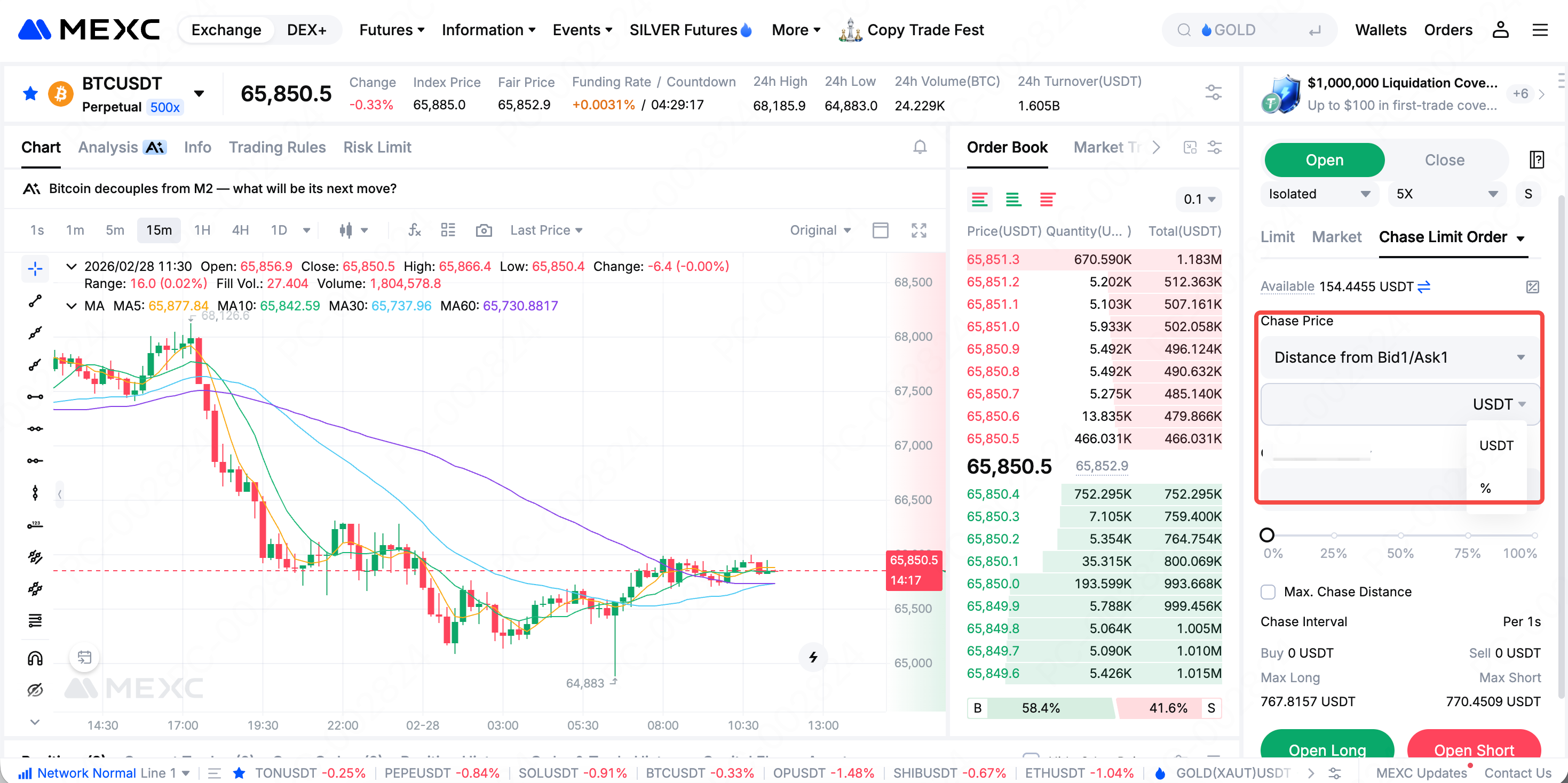
5. What is the maximum chase distance and how is it set?
The maximum chase distance is a crucial protection mechanism in chase limit orders, designed to limit the range within which the system tracks the price. When the gap between the current market price and your initial order price reaches the set maximum chase distance, the system will automatically cancel your order. This prevents unfavorable executions caused by prices deviating significantly from your entry point.
The maximum chase distance can be set as a specific numerical value or a percentage. For example, if you set the maximum chase distance for a buy order to 100 USDT, and the best bid price rises from an initial 40,000 USDT to exceed 40,100 USDT, chasing will automatically stop. Any unfilled portion will be canceled and will no longer chase the price.
Based on the maximum chase distance and the current order book price, the system calculates the highest chase price. For buy orders, the chase limit order is canceled when the last price is greater than or equal to the highest chase buy price. For sell orders, the chase limit order is canceled when the last price is less than or equal to the highest chase sell price.
6. What trading scenarios are suitable for chase limit orders?
Chase limit orders are particularly well-suited for fast-moving market conditions, allowing traders to pursue quick execution while setting price ceilings or floors to prevent excessive slippage. Here are three typical application scenarios:
1) When the market price breaks through key resistance or support levels, traders often want to enter quickly to capture the trend but worry about the significant slippage associated with market orders. In this case, using a chase limit order allows for rapid position opening while maintaining control over entry costs.
2) In short-term trading, opportunities can vanish in an instant. A chase limit order helps traders establish positions swiftly during rapid price fluctuations, avoiding the risk of missing the optimal entry point that often occurs when waiting for a traditional limit order to fill.
3) When executing large-volume orders, traders need to minimize wait times without sacrificing price quality. A chase limit order effectively controls potential slippage while reducing execution time, achieving a better overall fill rate compared to standard limit or market orders.
7. How to set up a chase limit order on MEXC?
Web: Log in to the MEXC official website and navigate to the Futures trading page. Set the position mode to Hedge mode. Select Chase Limit Order, choose the Trigger Price, enter the Quantity, and click Open Long or Open Short to place the order.
App: Go to the Futures trading page. Set the position mode to Hedge mode. Select Chase Limit Order, choose the Trigger Price, enter the Quantity, and click Open Long or Open Short to place the order.
8. Can a chase limit order be modified after placement?
No, users cannot manually modify the price settings, order quantity, or maximum chase distance of a chase limit order after it has been placed. If you need to adjust any order parameters, you must first cancel the current order and then place a new chase limit order.
This design is primarily intended to ensure the system executes the tracking logic stably and efficiently. Since the price of a chase limit order updates frequently in response to market conditions, allowing simultaneous parameter modifications by users could lead to system conflicts or delays. Therefore, it is recommended that traders carefully confirm all parameters before placing an order to ensure they align with their trading strategy.
9. What are the differences between chase limit orders and other order types?
Limit orders require the user to set a fixed price. The order only executes when the market price reaches this specific level. Pros include precise cost control and zero slippage, while cons include the fact that they may require a long waiting time, and execution is not guaranteed. Chase limit orders automatically track the market price (order book), resulting in faster execution. However, the final execution price carries a degree of uncertainty compared to a fixed limit order.
Market orders execute immediately at the current best available market price. They enjoy the fastest execution speed, but can result in significant slippage during periods of high volatility. Chase limit orders also aim for quick execution but do so via a limit order mechanism. They allow users to set a maximum chase distance as a protective measure, thereby offering lower slippage risk compared to pure market orders.
Trigger orders involve pre-setting a trigger price. The order is only submitted to the market once the market price reaches this trigger condition. They are suitable for planning entry or exit points in advance and do not occupy margin before being triggered. Chase limit orders begin execution immediately after placement, making them more suitable for scenarios requiring instant market entry.
10. In Conclusion
Chase limit orders serve as an advanced order tool in MEXC Futures trading, offering traders an effective solution to balance rapid execution with price control. By dynamically tracking market prices, it satisfies traders' demand for execution efficiency while enabling effective risk management through the maximum chase distance setting.
Mastering the use of chase limit orders, combined with other order types such as limit orders, market orders, and trigger orders, empowers traders to adapt more flexibly to various market conditions. This approach enables lower-cost, higher-efficiency trading experiences during position building. Beginner traders are advised to thoroughly understand the chase limit order mechanism before practicing with small capital amounts. Gradually familiarize yourself with its characteristics before integrating it into actual trading strategies.