

Gold Dips as Trump’s Iran Ultimatum Looms Over Hormuz Strait
Key Points
- Gold futures declined 0.4% to settle at $4,666.70 per troy ounce amid heightened geopolitical uncertainty
- President Trump issued an 8 p.m. ET Tuesday ultimatum for Iran to reopen the Strait of Hormuz or risk military action
- Approximately 20% of the world’s oil supply transits through the strategic waterway
- People’s Bank of China extended its gold purchasing streak to 17 consecutive months, now holding 74.38 million troy ounces
- Dollar index stands at 100.03, gaining approximately 0.8% over the past month and weighing on precious metals
Precious metals exhibited divergent price action on Tuesday across various trading venues. New York futures contracts slipped 0.4% to reach $4,666.70 per troy ounce, while spot gold gained 0.8% to trade at $4,685.54 per ounce during early trading hours. June delivery gold futures advanced 0.6% to $4,710.84 per ounce.
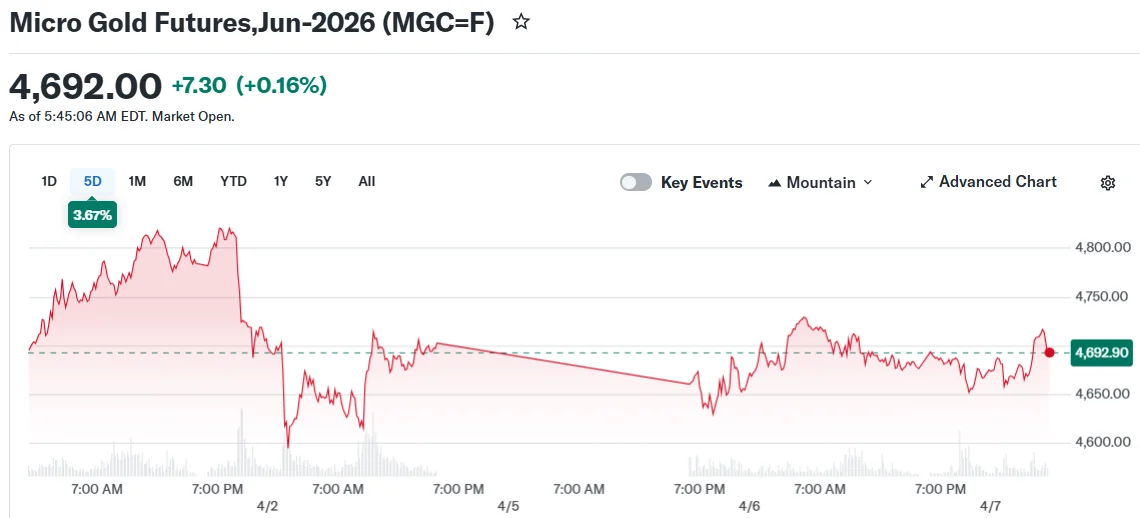 Micro Gold Futures,Jun-2026 (MGC=F)
The contrasting movements emerged as market participants focused on President Donald Trump’s ultimatum to Iran regarding the Strait of Hormuz. The president established an 8 p.m. ET Tuesday cutoff for Iran to accept an agreement or face devastating military strikes targeting its energy sector.
Trump warned he would obliterate “every bridge” and “power plant” throughout Iran should the deadline expire without resolution. He emphasized that reconstruction would require Iran “100 years to rebuild” following potential U.S. military operations.
The Strait of Hormuz represents a critical chokepoint for global energy markets. Roughly one-fifth of worldwide oil shipments navigate through this narrow waterway situated along Iran’s southern coastline.
Tehran has demanded a comprehensive agreement incorporating sanctions removal, security assurances, and financial compensation for damages sustained. Intelligence suggests the administration is improbable to accommodate these conditions.
Despite the aggressive rhetoric, Trump indicated diplomatic channels remain viable, stating a peaceful resolution to the confrontation remained achievable. The conflict originated with coordinated U.S. and Israeli military operations against Iran in late February.
Energy Markets and Currency Movements Create Headwinds
Brent crude maintained levels above $110 per barrel as the crucial deadline neared. Elevated oil prices amplify inflation concerns, potentially compelling monetary authorities to maintain restrictive interest rate policies for extended periods.
This dynamic carries significance for precious metals. Since gold generates no yield, its appeal diminishes when expectations suggest prolonged elevated interest rates. ANZ analysts noted Trump’s aggressive posturing “impacted risk appetite” and bolstered both the U.S. dollar and Treasury yields.
The U.S. dollar index registered 100.03, despite experiencing a 0.2% intraday decline on Tuesday. Throughout the preceding month, the greenback appreciated roughly 0.8%. During this identical timeframe, spot gold tumbled more than 8%.
Dollar appreciation increases gold’s cost for international buyers transacting in alternative currencies, potentially dampening global demand.
Chinese Central Bank Maintains Accumulation Strategy
One supportive element for gold emerged from China’s continued accumulation. The People’s Bank of China expanded its precious metal reserves for an unprecedented 17th consecutive month. Official holdings climbed to 74.38 million fine troy ounces by March’s conclusion, rising from 74.22 million in February.
Persistent central bank acquisitions represent a reliable foundation of demand for the yellow metal.
As of Tuesday morning, financial markets remained anxious awaiting the 8 p.m. ET deadline and Tehran’s potential response.
The post Gold Dips as Trump’s Iran Ultimatum Looms Over Hormuz Strait appeared first on Blockonomi.


You May Also Like

Solana Foundation to Help Secure DeFi Protocols Following $285 Million Drift Hack

LDO Price Prediction: Neutral Consolidation Targets $0.33 Resistance Retest by Mid-April




