Only 11% of banks have cracked the code on trustworthy AI
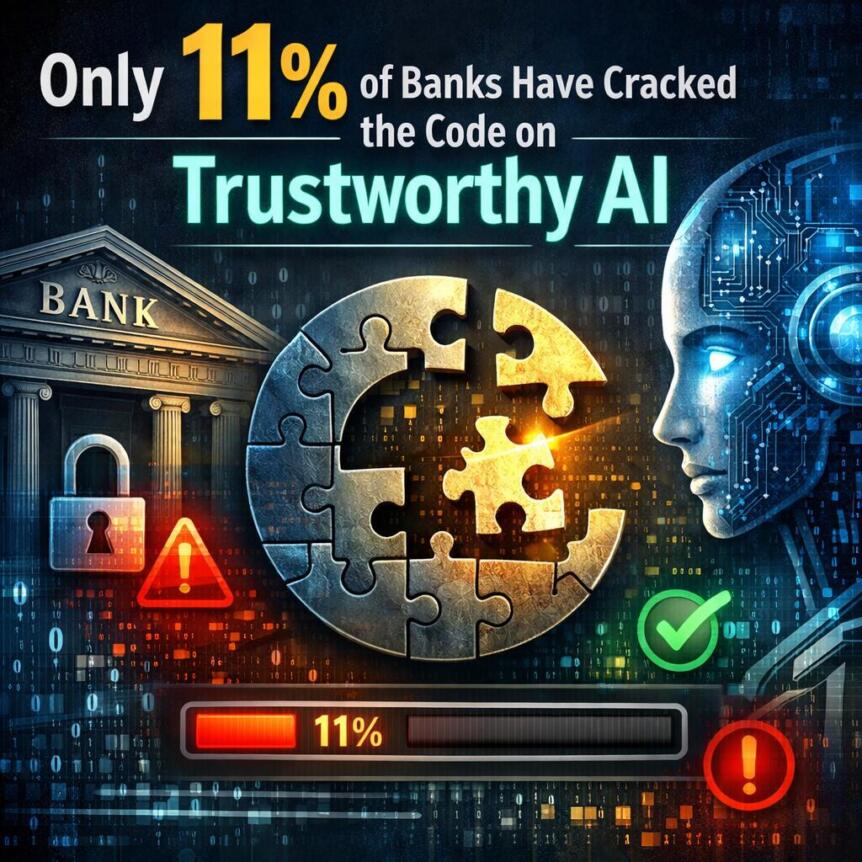
This release summarizes new findings from SAS and IDC regarding how banks deploy AI. It notes that rising AI spend has not yet translated into robust governance or guardrails, undermining trust in AI systems. The study finds that only 11% of banks achieve both high internal confidence in AI and demonstrable trust, while 47% sit in a trust dilemma between underuse and overreliance. With regional digital transformation advancing in the UAE and beyond, the report underscores the need for governance, transparency, and solid data foundations as banks scale AI. The rest of this article highlights key takeaways and near-term watchpoints.
Key points
- Only 11% of banks achieve both high internal confidence in AI and demonstrably trustworthy AI.
- 47% fall into the trust dilemma between underusing reliable AI and overrelying on unvalidated AI.
- 19% operate with siloed data infrastructure, the worst rate among the study’s focus industries.
- 45% lack effective data governance and 41% lack centralized or optimized data infrastructure.
- 60% expect AI spending growth between 4% and 20%.
Why it matters
These findings have practical implications for banks, regulators, and technology teams. Without strong data foundations, governance, and explainability, AI investments may fail to deliver reliable results or earn customer and regulator trust. The emphasis on responsible innovation indicates that meaningful ROI depends on aligning AI ambition with governance and transparent decision-making before scaling. For readers, the report signals where weaknesses exist and what foundational work should be prioritized as AI initiatives move from pilots to production.
What to watch
- 52% plan to expand their AI architecture; 43% plan to form or grow dedicated AI teams.
- 31% plan to focus on developing and tuning AI models themselves.
- Nearly one-third plan increases in trustworthy AI investment to support more autonomous systems.
- 60% expect AI spending growth between 4% and 20%.
Disclosure: The content below is a press release provided by the company or its PR representative. It is published for informational purposes.
Study: Only 11% of banks have cracked the code on trustworthy AI
Even as AI spending surges, few banks have established the necessary governance and guardrails – and nearly half misjudge their own AI readiness
Dubai, United Arab Emirates, 7 April 2026 – In banking, trust isn’t optional – it’s everything. Yet, even as banks accelerate AI investment faster than other sectors, most are deploying AI without the oversight and infrastructure needed to earn that trust. That’s the central tension revealed in new banking insights from SAS’ Data and AI Impact Report: The Trust Imperative, with research insights by IDC.
Among the four sectors examined in the study, banking outpaces government, insurance and life sciences both in AI spending and adoption of trustworthy AI practices. In fact, about one-quarter (23%) of banks operate at the highest level of IDC’s Trustworthy AI Index. But even with these advantages, most banking institutions fall far short of the report’s “ideal state,” which combines high trust with high trustworthiness. According to the report:
- Only 11% of banks have achieved both high internal confidence in AI and AI systems that are demonstrably trustworthy.
- Nearly half (47%) fall into what IDC calls the “trust dilemma” – either underusing reliable AI because they don’t sufficiently trust it or overrelying on AI systems that haven’t been adequately validated.
As the UAE’s Vision 2031 and wider digital transformation efforts continue to gain momentum, banks across the Middle East are increasingly adopting advanced technologies to improve efficiency, strengthen resilience, and deliver better customer experiences.
 Michel Ghorayeb Managing Director At Sas Uae
Investment is rising, but foundations remain fragile
The report, based on a global, cross-industry survey of 2,375 IT and business leaders, reveals a troubling pattern: Investment in AI capabilities is not being matched by investment in the responsible innovation pillars that make AI dependable. In an industry where a single model failure can trigger regulatory penalties or erode consumer confidence overnight, that’s a dangerous disconnect.
And the problem isn’t a lack of investment: Banks’ AI spending trajectory exceeds all other sectors in the study, with most banks (60%) expecting growth between 4% and 20%. A smaller subset (12%) anticipates even steeper increases. Despite this momentum, the study found significant foundational weaknesses remain, including:
- Data silos. Nearly one in five banks (19%) still operate with a siloed data infrastructure – the worst rate among the study’s focus industries.
- Insufficient data foundations. A significant portion of banks lack effective data governance (45%) and/or a centralized or optimized data infrastructure (41%).
- Talent gaps. Many banks (42%) also face shortages of specialized AI skills.
To address these issues, more than half (52%) of banks plan to expand their AI architecture; another 43% plan to form or grow dedicated AI teams. But fewer than one-third (31%) plan to focus on developing and tuning AI models themselves. The takeaway: These aren’t abstract or theoretical barriers; they’re structural.
“The banking sector clearly understands AI’s potential, but understanding and execution are not the same,” said Kathy Lange, Research Director of the AI and Automation Practice at IDC. “Without strong data architectures, governance frameworks and talent pipelines, banks risk pouring money into AI initiatives that can’t deliver ROI – or worse, that undermine the very trust they depend on.”
Responsible innovation, not cost savings, drives AI ROI
The report also challenges the assumption that AI’s primary value in banking is cost cutting. To the contrary, banking stands alone in ranking product and service innovation above process efficiency as the leading source of AI-driven value.
Cross-industry ROI figures show banks are onto something. Organizations using AI to improve customer experience reported the highest return – $1.83 for every dollar invested – followed closely by those centered on expanding market share ($1.74). Those focused on cost savings reported the lowest – $1.54 per dollar. Moreover, organizations that prioritized trustworthy AI were 60% more likely to report doubling overall return on their AI initiatives. That’s solid proof that responsible innovation is a growth accelerator that more than pays for itself.
Banks are also moving more decisively than other sectors toward agentic AI, with nearly one-third planning increases in trustworthy AI investment to support more autonomous systems. But as AI systems gain greater decision-making authority, the consequences of weak governance grow more significant.
To learn more and access the full Data and AI Impact Report, published in September 2025, visit SAS.com/ai-impact.
About SAS
SAS is a global leader in data and AI. With SAS software and industry-specific solutions, organizations transform data into trusted decisions. SAS gives you THE POWER TO KNOW®.
This article was originally published as Only 11% of banks have cracked the code on trustworthy AI on Crypto Breaking News – your trusted source for crypto news, Bitcoin news, and blockchain updates.


You May Also Like

ICE-involved shooting shuts down part of interstate as FBI launches investigation

Why Avalanche’s Broadridge integration fails to stop AVAX’s 10% slide