I built a product in 20 minutes with Projectmaven
In my short life on earth, I have started many businesses.
In 2020, I was making face masks. One year later, I was convinced skincare was my calling, so I started making black soap. Now, that idea never made it off the ground because I never quite mastered the craft, but for a while, I was all in.
Then there was the online restaurant, freelance gigs, a brief attempt at making clothes, and a handful of other ideas that felt just as promising at the time, but sometimes, translating those ideas into a product that actually worked was difficult.
Recently, I found myself once again sitting on a product idea that felt exciting but slightly out of reach. This time, I wanted to try something different instead of letting it sit in my notes like many others before it, and that was how I ended up on Projectmaven.
Founded in March 2026 by Olaotan Towry-Coker, a serial entrepreneur who previously founded AfriTickets, a ticketing platform, and Cranium One, a Coworking space, Projectmaven is designed to turn an idea into a product.
“I have been building in the tech space since 2011,” Towry-Coker told me when we spoke last Friday on the phone. “Non-technical founders who are trying to build technical products typically run into a layer of friction, which is that if you don’t understand the technical aspect of what you’re building, you’re going to run into problems when you have to describe it to your developer.”
Projectmaven is his attempt to remove that friction. The platform uses artificial intelligence (AI) to take a rough idea and turn it into a structured plan with proposed features, target users, third-party integrations, technical architecture, timelines, and cost estimates.
How Projectmaven works
I get a lot of messages—emails, SMS, WhatsApp—sometimes simultaneously. To reduce the overwhelm and make responding easier, I dreamt of an app that could notify me of a message with a summary of what the sender said and three possible replies I could tap to send. That was the idea that I took into Projectmaven.
When I loaded the website, it started with a single prompt asking for my idea, and I typed it in as it was in my head.
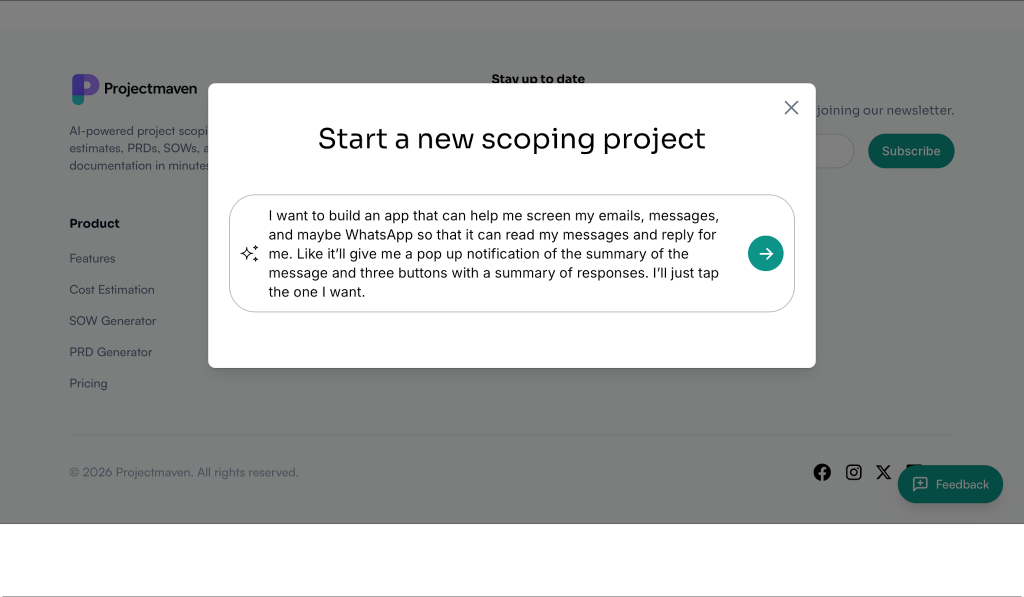 Typing my idea into Projectmaven. Image source: TechCabal
From there, Projectmaven began a nine-step process to help me figure out what my product was.
The first step is product description, where the AI agent reflected my idea to me in a more structured format. It broke down what it understood I was trying to build and how it would work. It also highlighted the parts of the app I had not thought about, such as access to third-party messaging apps, privacy concerns, and difficulties in accurate message summarisation. It showed me similar existing products and suggested ways my version could stand out.
Towry-Coker explained that Projectmaven uses a mixture of OpenAI and Gemini frontier models for its tasks.
“We’ve implemented fine-tuned prompts, custom prompts that allow the system to understand the client’s request,” he told me. “What it’s doing is that it takes the idea, does a web search, crunches all the data points, and then it presents the data in a fixed format.”
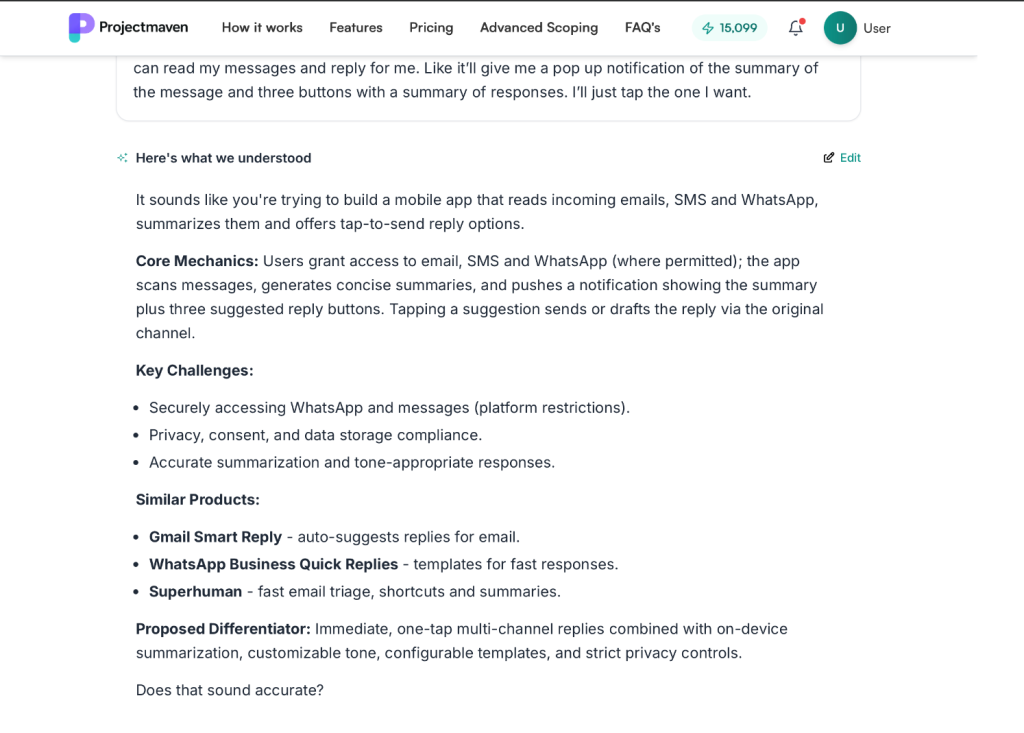 Projectmaven’s breakdown of my idea. Image source: TechCabal
The next step is selecting the product scale, where the AI agent prompted me to choose if I wanted the product to be extra small, small, medium, or large, depending on my goal. I selected a small-scale product, basically a Minimum Viable Product (MVP).
According to Olaotan, every choice a user makes at each step determines the result in subsequent ones.
“Every step has an output that we’re trying to achieve… when you’re speaking to an AI agent, the prompt essentially dictates the outcome that it gives you,” he said. “We fine-tuned our prompts to specifically focus on each step that we’re building upon.”
After selecting the scale of my product, the website prompted me to choose my target audience for the app.
The AI agent recommended options based on my idea, which included busy professionals, business owners, customer support agents, gig workers, and visually impaired users.
In the next step, I had to select features, out of a curated list, that made sense for the product I described. It allowed me to either accept them or tweak them. I didn’t have to do either because I hadn’t thought that far. I selected the agent’s recommendations and moved to the next step, integrations.
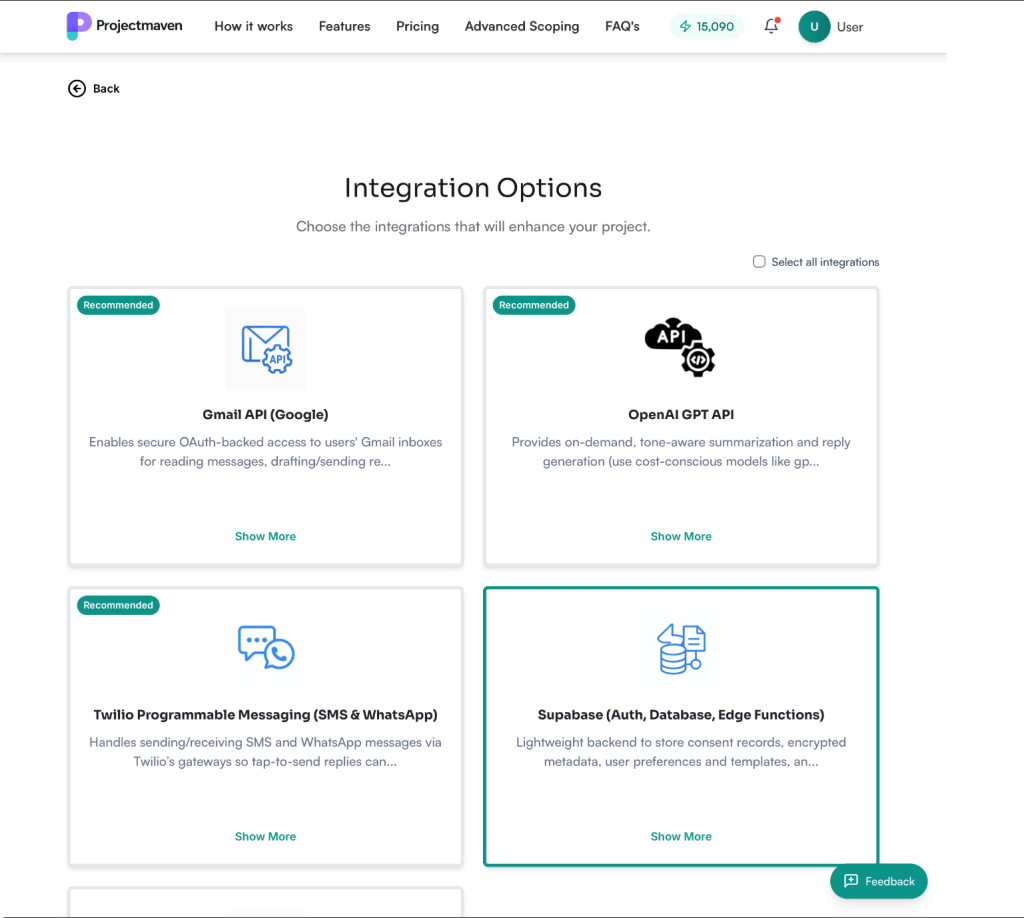 Step 5: Integration. Image source: TechCabal
At this stage, it was getting more technical as I had to select the external tools and Application Programming Interface (APIs) the product would need to function, such as Gmail APIs, AI models for summarisation, and messaging systems. After integrations, it moved into design preferences, where it displayed different visual directions the app could take, prompting me to pick one.
The next step was technical integration. This is where users start seeing things like React Native, Firebase, Flutter, and native iOS—mobile app development and backend service platforms.
The user could either choose themselves or let the platform decide for them. On any other day, this is where I would check out, but I let Projectmaven choose.
From there, it moved to the developer experience, which required me to select what level of developer I needed and showed estimated hourly rates. I chose a junior developer. I then selected a timeline, determined by how complex a product is and how fast a user wants it built.
Twenty minutes and nine steps later, Projectmaven generated a full project summary detailing cost estimates, a statement of work, a product requirements document, design direction, technical stack, and integrations.
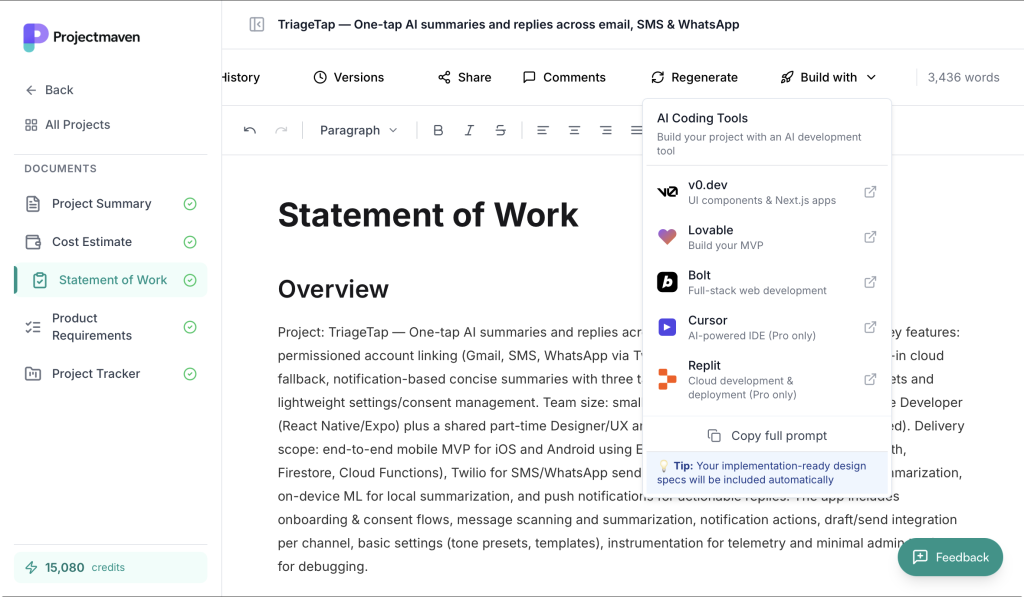 Product summary by Projectmaven. Image source: TechCabal
For my app, it estimated a cost of about $5,720 over 160 hours, and broke the cost estimate down by feature, hours required, and the developer rate I had selected.
Projectmaven goes a step further, allowing users to start building the app on rapid AI app builders such as Lovable, Replit, Bolt, Cursor, and v0.dev. Selecting an option provided a prompt that could be copied and pasted in the chatbox of these AI app builders. I was not going to let another of my ideas sit in a document, so I created a lovable account and ran the prompt.
It worked.
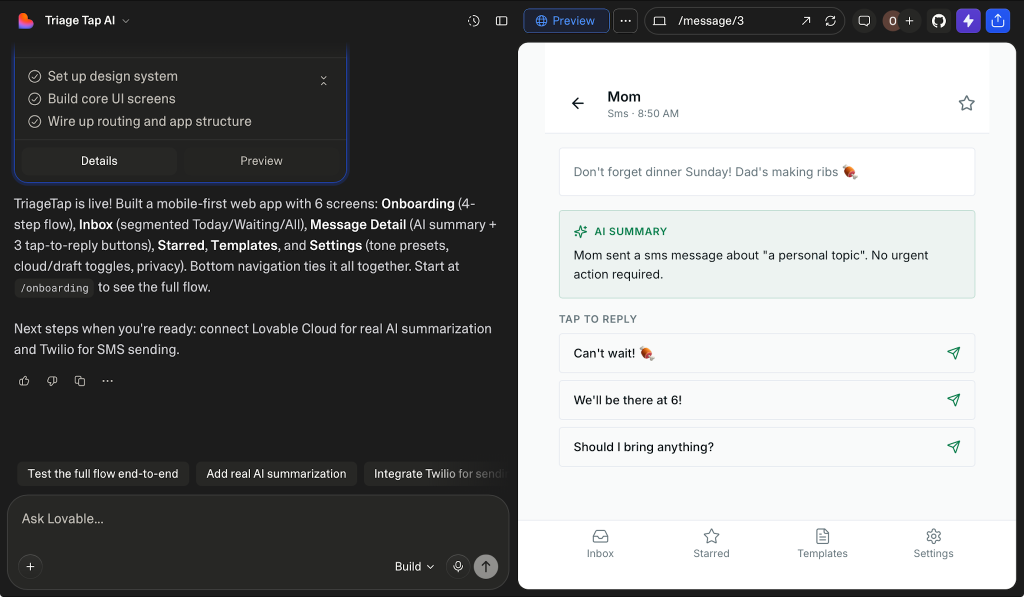 Lovable’s result of prompt copied from Projectmaven. Image source: TechCabal
The result wasn’t perfect because it still displayed my app as a messaging app rather than just being a pop-up notification (the whole point is that I don’t want to have to open a messaging app ever again). But it was enough to see the structure, the summarised version of messages, and short responses I could tap to send.
Who Projectmaven is for
Towry-Coker said Projectmaven was originally built for founders like himself, who had ideas but struggled to translate them into what developers could work with. The early use case was to help founders scope their ideas and get cost estimates, but that didn’t last long.
“What we found out was that founders typically have a one-off need,” he said. “They use it once for a project and move on. But the people who actually need it more are developers and agencies.”
This change mattered because if a core user only shows up when they have a new idea and disappears immediately after, then it is not a sticky product. The founder has a very useful tool. Developers could use Projectmaven to scope a founder’s idea and communicate it with them.
Towry-Coker described the developer workflow as involving hours of calls to understand a founder’s vision. In that context, Projectmaven compresses this lengthy process, which directly affects how developers make money.
Project Maven runs on a subscription model with tiered plans, all tied to a credit system. Every action undertaken on the platform, such as generating outputs and refining ideas, consumes credits. The more actions taken, the more credits are consumed. The Free Plan provides 100 credits, the Starter Plan is priced at $17 monthly and provides 3,000 credits, while the $39 monthly Pro Plan provides 15,000 credits.
Project Maven competes, loosely, with tools like ChatGPT or Gemini, even though it is built on the same underlying models, but the competition is about process. What Towry-Coker is trying to replace is the act of prompting itself, the trial-and-error of figuring out how to get those models to think through a product.
A user who knows what they are doing can replicate most of Projectmaven’s nine-step process using ChatGPT. What the platform does is remove the need to know how to do that. Instead of starting from a blank prompt box, users move through a guided sequence of decisions; the prompting still happens, but hidden under taps. This is helpful for non-technical users because it turns an open-ended question into a structured one, but it has the product’s limitations.
Projectmaven works best at the earliest stage, when an idea is still forming and needs shaping, but this is also the least technically difficult part of building a product. The platform does not build the product, validate whether it should exist, or solve what happens after it is launched.
This begs the question: Is structuring the idea of a product enough to sustain it? The advantage of guided and structured prompting that Projectmaven has today is not impossible to replicate. It is possible to imagine a future where this kind of structured prompting becomes built directly into larger AI tools, which could reduce Projectmaven’s edge.
The product works now: I used it, and in 20 minutes, I got a product that would have taken longer to figure out on my own. But Projectmaven’s long-term bet is that such a problem still exists and requires a separate tool to solve. If structured prompting becomes standard, Projectmaven becomes a feature inside larger AI models.


You May Also Like

WLD Price Prediction: Oversold Bounce Could Target $0.30 by May 2026

Top Crypto to Buy Right Now: BlockDAG, Ethereum, Avalanche, Hyperliquid, and Tron Offer Big Moves