

Nikon’s NEMO will launch on the ISS this week
Nikon has announced it will be providing its tech for a new mission project to the International Space Station to research the effect of microgravity in drug discovery, life science, and potentially elucidate the reason why humans age on Earth.
In a report on Wednesday, Nikon said its live cell observation system, known as Nikon Experimentation Microscope in Orbit (NEMO), was selected to launch on the ISS aboard NASA’s Northrop Grumman Commercial Resupply Services 24 mission this Friday.
NEMO was developed by Nikon and its U.S.-based subsidiary Nikon Instruments Inc. (NII). It comprises Nikon’s live cell observation microscope and an automated cell culture incubator from BioServe Space Technologies.
The launch of NEMO on the ISS could mark a big breakthrough in life science research. It was even signed off by the Center for the Advancement of Science in Space (CASIS), according to the announcement.
Why NEMO’s ISS launch matters for life science research
NEMO is going to help researchers understand the effects of microgravity on life sciences and drug discovery right on the ISS.
Microgravity has been found to act as an accelerator for certain biological processes that resemble aging or age-related diseases on Earth. In space, astronauts can lose 1–2% bone mineral density per month. There are also reports that a short spaceflight of 7 days can increase epigenetic acceleration by up to 1.91 years, although reversal upon return to Earth.
Hence, the mission is an important one that could help scientists observe better how microgravity affects cell behavior, tissue responses, drug interactions, and potentially accelerate insights into aging processes that are hard to obtain on the ground.
According to Nikon, there are actually two focuses with the microgravity research. Understanding its effects on biological tissues will not only elucidate the causes of diseases and aging in living organisms but also accelerate human extraterrestrial activities.
All of these observations, which will be done using MPS or Microphysiological Systems, will be conducted using NEMO, Nikon said in the announcement. MPS are advanced 3D cell culture models capable of closely modeling tissue changes more accurately than simple cell cultures.
So, you have a better cell culture model and a high-precision live-cell observation system in space, which only translates to a highly controlled study of cells and tissues under microgravity that is difficult to replicate on Earth.
NASA is taking 11,000 pounds of science to space
The Northrop Grumman CRS-24 mission is currently targeting liftoff this Friday, April 11th, and will deliver up to 11,000 pounds of science and supplies to the space station, which include Nikon’s NEMO.
The mission will debut several other scientific research projects, including a new module for the Cold Atom Lab to improve computing and advance quantum science. There will also be an investigation, dubbed Nanoracks-ITS, to understand how solar activity and space weather affect radio signals, such as GPS and radar, sent from Earth.
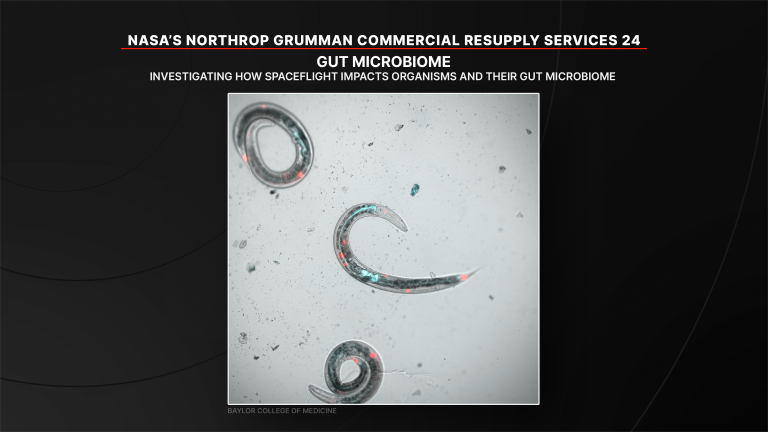 Gut microbiome. Source: NASA
Another separate investigation will uncover how spaceflight can alter the relationship between organisms and their gut microbiome to help identify ways to keep astronauts healthy for future Moon and Mars missions.
Don’t just read crypto news. Understand it. Subscribe to our newsletter. It's free.


You May Also Like

Japanese Yen slides as fragile US-Iran ceasefire supports USD

High-Stakes Legal Drama Sees Artist Barred from Using Iconic NFT Imagery




