Three of China’s largest Bitcoin hardware manufacturers are establishing production facilities in the United States as President Donald Trump’s tariff policies reshape the cryptocurrency industry. The three industry leaders, Bitmain, Canaan, and MicroBT, collectively control over 90% of the global mining rig market. These companies are the architects of Bitcoin’s physical infrastructure, manufacturing the specialized ASIC (Application-Specific Integrated Circuit) machines that form the backbone of the world’s most valuable cryptocurrency network. Every Bitcoin mined globally likely passes through hardware bearing Chinese engineering fingerprints. 95% Market Control Sparks “Digital Dependency Trap” and Security Risks According to a June 18 Reuters report, these Bitcoin mining giants are establishing U.S. operations to circumvent potential tariffs. However, critics have raised security concerns about Chinese involvement in sectors spanning semiconductor manufacturing and energy infrastructure. Guang Yang, chief technology officer at crypto technology provider Conflux Network, described the situation as extending beyond trade policy. “The U.S.-China trade war goes beyond tariffs,” Yang stated. “It’s a strategic pivot toward ‘politically acceptable’ hardware sources.” Bitmain, the largest of the three companies by revenue, initiated U.S. production of mining equipment in December , one month after Trump’s presidential election victory. Canaan began trial production in the United States on April 2 to avoid tariffs following Trump’s announcement of new trade levies. One of the largest manufacturers of #bitcoin mining machines, Canaan, has set up a base of operations outside of China. CEO Zhang says, Kazakhstan is essential to "expanding after-sales geographical coverage and providing […] support growing international customer base" pic.twitter.com/7D5Xh2ici5 — Documenting ₿itcoin 📄 (@DocumentingBTC) June 23, 2021 Third-ranked MicroBT announced in a statement that it is “actively implementing a localization strategy in the U.S.” to “avoid the impact of tariffs.” $11.9B by 2028: The Market These Giants Are Fighting for According to Frost & Sullivan’s “2024 Global Blockchain Hardware Industry White Paper,” the ASIC-based Bitcoin mining hardware market demonstrates substantial consolidation. When measured by computing power sold, these three Chinese companies command 95.4% of the global market share. The Bitcoin ecosystem encompasses five primary segments: hardware supply, mining farm operations, mining pool management, trading platforms, and payment processing services. Hardware manufacturers like Canaan, the first Bitcoin mining company to go public and the second-largest by computing power , focus exclusively on integrated circuit (IC) design, manufacturing, and equipment sales. Industry analysts project continued sector expansion, with the market expected to reach $11.9 billion by 2028, representing a compound annual growth rate of 15.3%, contingent on Bitcoin’s continued price appreciation driven by supply scarcity. Source: Frost & Sullivan China’s Historical Bitcoin Mining Advantage Understanding today’s migration requires examining how China achieved such overwhelming market control in the first place. The foundation was laid during the historic 2017 Bitcoin boom, when three key factors aligned to create Chinese mining supremacy. During the early expansion phase, Chinese officials recognized cryptocurrency mining as a profitable venture that attracted substantial foreign investment. Consequently, authorities initially overlooked the mining sector while simultaneously restricting Bitcoin trading and initial coin offerings. Hydro-power plants go on sale in China since #Bitcoin mining crackdown has reduced demand for electricity. – South China Morning Post pic.twitter.com/QKEbUzWN4g — Bitcoin Archive (@BTC_Archive) June 30, 2021 China’s extensive hydroelectric infrastructure further strengthened the country’s mining operations, providing the cheap energy essential for profitable Bitcoin production. Does Chinese Hardware Control America’s Bitcoin Network? While the United States leads global Bitcoin mining operations with over 38% of total network activity , American miners depend almost entirely on Chinese-manufactured equipment. America Leads Bitcoin Mining Operation/ Source: Bitbo This creates what security analysts describe as a “digital dependency trap,” a scenario where America’s cryptocurrency infrastructure relies fundamentally on hardware produced by its primary economic rival. Guang Yang, Conflux Network’s chief technology officer, frames this dependency in geopolitical terms that extend far beyond trade economics . “The U.S.-China trade war goes beyond tariffs,” Yang explains. “It’s a strategic pivot toward ‘politically acceptable’ hardware sources.” His assessment reflects growing concerns within the cryptocurrency community about supply chain vulnerabilities that could impact national economic security.Three of China’s largest Bitcoin hardware manufacturers are establishing production facilities in the United States as President Donald Trump’s tariff policies reshape the cryptocurrency industry. The three industry leaders, Bitmain, Canaan, and MicroBT, collectively control over 90% of the global mining rig market. These companies are the architects of Bitcoin’s physical infrastructure, manufacturing the specialized ASIC (Application-Specific Integrated Circuit) machines that form the backbone of the world’s most valuable cryptocurrency network. Every Bitcoin mined globally likely passes through hardware bearing Chinese engineering fingerprints. 95% Market Control Sparks “Digital Dependency Trap” and Security Risks According to a June 18 Reuters report, these Bitcoin mining giants are establishing U.S. operations to circumvent potential tariffs. However, critics have raised security concerns about Chinese involvement in sectors spanning semiconductor manufacturing and energy infrastructure. Guang Yang, chief technology officer at crypto technology provider Conflux Network, described the situation as extending beyond trade policy. “The U.S.-China trade war goes beyond tariffs,” Yang stated. “It’s a strategic pivot toward ‘politically acceptable’ hardware sources.” Bitmain, the largest of the three companies by revenue, initiated U.S. production of mining equipment in December , one month after Trump’s presidential election victory. Canaan began trial production in the United States on April 2 to avoid tariffs following Trump’s announcement of new trade levies. One of the largest manufacturers of #bitcoin mining machines, Canaan, has set up a base of operations outside of China. CEO Zhang says, Kazakhstan is essential to "expanding after-sales geographical coverage and providing […] support growing international customer base" pic.twitter.com/7D5Xh2ici5 — Documenting ₿itcoin 📄 (@DocumentingBTC) June 23, 2021 Third-ranked MicroBT announced in a statement that it is “actively implementing a localization strategy in the U.S.” to “avoid the impact of tariffs.” $11.9B by 2028: The Market These Giants Are Fighting for According to Frost & Sullivan’s “2024 Global Blockchain Hardware Industry White Paper,” the ASIC-based Bitcoin mining hardware market demonstrates substantial consolidation. When measured by computing power sold, these three Chinese companies command 95.4% of the global market share. The Bitcoin ecosystem encompasses five primary segments: hardware supply, mining farm operations, mining pool management, trading platforms, and payment processing services. Hardware manufacturers like Canaan, the first Bitcoin mining company to go public and the second-largest by computing power , focus exclusively on integrated circuit (IC) design, manufacturing, and equipment sales. Industry analysts project continued sector expansion, with the market expected to reach $11.9 billion by 2028, representing a compound annual growth rate of 15.3%, contingent on Bitcoin’s continued price appreciation driven by supply scarcity. Source: Frost & Sullivan China’s Historical Bitcoin Mining Advantage Understanding today’s migration requires examining how China achieved such overwhelming market control in the first place. The foundation was laid during the historic 2017 Bitcoin boom, when three key factors aligned to create Chinese mining supremacy. During the early expansion phase, Chinese officials recognized cryptocurrency mining as a profitable venture that attracted substantial foreign investment. Consequently, authorities initially overlooked the mining sector while simultaneously restricting Bitcoin trading and initial coin offerings. Hydro-power plants go on sale in China since #Bitcoin mining crackdown has reduced demand for electricity. – South China Morning Post pic.twitter.com/QKEbUzWN4g — Bitcoin Archive (@BTC_Archive) June 30, 2021 China’s extensive hydroelectric infrastructure further strengthened the country’s mining operations, providing the cheap energy essential for profitable Bitcoin production. Does Chinese Hardware Control America’s Bitcoin Network? While the United States leads global Bitcoin mining operations with over 38% of total network activity , American miners depend almost entirely on Chinese-manufactured equipment. America Leads Bitcoin Mining Operation/ Source: Bitbo This creates what security analysts describe as a “digital dependency trap,” a scenario where America’s cryptocurrency infrastructure relies fundamentally on hardware produced by its primary economic rival. Guang Yang, Conflux Network’s chief technology officer, frames this dependency in geopolitical terms that extend far beyond trade economics . “The U.S.-China trade war goes beyond tariffs,” Yang explains. “It’s a strategic pivot toward ‘politically acceptable’ hardware sources.” His assessment reflects growing concerns within the cryptocurrency community about supply chain vulnerabilities that could impact national economic security.

Chinese Bitcoin Hardware Titans Control 95% of Market, Now Coming to America to Dodge Trump Tariff War

Three of China’s largest Bitcoin hardware manufacturers are establishing production facilities in the United States as President Donald Trump’s tariff policies reshape the cryptocurrency industry.

The three industry leaders, Bitmain, Canaan, and MicroBT, collectively control over 90% of the global mining rig market.

These companies are the architects of Bitcoin’s physical infrastructure, manufacturing the specialized ASIC (Application-Specific Integrated Circuit) machines that form the backbone of the world’s most valuable cryptocurrency network.

Every Bitcoin mined globally likely passes through hardware bearing Chinese engineering fingerprints.

95% Market Control Sparks “Digital Dependency Trap” and Security Risks

According to a June 18 Reuters report, these Bitcoin mining giants are establishing U.S. operations to circumvent potential tariffs. However, critics have raised security concerns about Chinese involvement in sectors spanning semiconductor manufacturing and energy infrastructure.

Guang Yang, chief technology officer at crypto technology provider Conflux Network, described the situation as extending beyond trade policy.

“The U.S.-China trade war goes beyond tariffs,” Yang stated. “It’s a strategic pivot toward ‘politically acceptable’ hardware sources.”

Bitmain, the largest of the three companies by revenue, initiated U.S. production of mining equipment in December, one month after Trump’s presidential election victory.

Canaan began trial production in the United States on April 2 to avoid tariffs following Trump’s announcement of new trade levies.

Third-ranked MicroBT announced in a statement that it is “actively implementing a localization strategy in the U.S.” to “avoid the impact of tariffs.”

$11.9B by 2028: The Market These Giants Are Fighting for

According to Frost & Sullivan’s “2024 Global Blockchain Hardware Industry White Paper,” the ASIC-based Bitcoin mining hardware market demonstrates substantial consolidation. When measured by computing power sold, these three Chinese companies command 95.4% of the global market share.

The Bitcoin ecosystem encompasses five primary segments: hardware supply, mining farm operations, mining pool management, trading platforms, and payment processing services.

Hardware manufacturers like Canaan, the first Bitcoin mining company to go public and the second-largest by computing power, focus exclusively on integrated circuit (IC) design, manufacturing, and equipment sales.

Industry analysts project continued sector expansion, with the market expected to reach $11.9 billion by 2028, representing a compound annual growth rate of 15.3%, contingent on Bitcoin’s continued price appreciation driven by supply scarcity.
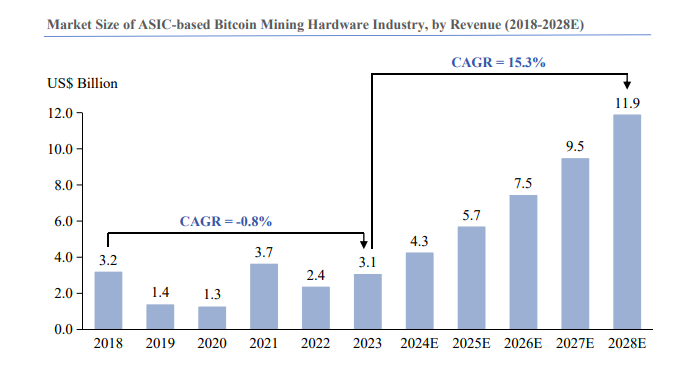
Chinese Bitcoin Hardware Titans Control 95% of Market, Now Coming to America to Dodge Trump Tariff WarSource: Frost & Sullivan

China’s Historical Bitcoin Mining Advantage

Understanding today’s migration requires examining how China achieved such overwhelming market control in the first place.

The foundation was laid during the historic 2017 Bitcoin boom, when three key factors aligned to create Chinese mining supremacy.

During the early expansion phase, Chinese officials recognized cryptocurrency mining as a profitable venture that attracted substantial foreign investment.

Consequently, authorities initially overlooked the mining sector while simultaneously restricting Bitcoin trading and initial coin offerings.

China’s extensive hydroelectric infrastructure further strengthened the country’s mining operations, providing the cheap energy essential for profitable Bitcoin production.

Does Chinese Hardware Control America’s Bitcoin Network?

While the United States leads global Bitcoin mining operations with over 38% of total network activity, American miners depend almost entirely on Chinese-manufactured equipment.

Chinese Bitcoin Hardware Titans Control 95% of Market, Now Coming to America to Dodge Trump Tariff WarAmerica Leads Bitcoin Mining Operation/ Source: Bitbo

This creates what security analysts describe as a “digital dependency trap,” a scenario where America’s cryptocurrency infrastructure relies fundamentally on hardware produced by its primary economic rival.

Guang Yang, Conflux Network’s chief technology officer, frames this dependency in geopolitical terms that extend far beyond trade economics.

“The U.S.-China trade war goes beyond tariffs,” Yang explains. “It’s a strategic pivot toward ‘politically acceptable’ hardware sources.”

His assessment reflects growing concerns within the cryptocurrency community about supply chain vulnerabilities that could impact national economic security.


Market Opportunity
Harvest Finance Logo
Harvest Finance Price(FARM)
$17.37
$17.37$17.37
+0.11%
USD
Harvest Finance (FARM) Live Price Chart
Disclaimer: The articles reposted on this site are sourced from public platforms and are provided for informational purposes only. They do not necessarily reflect the views of MEXC. All rights remain with the original authors. If you believe any content infringes on third-party rights, please contact service@support.mexc.com for removal. MEXC makes no guarantees regarding the accuracy, completeness, or timeliness of the content and is not responsible for any actions taken based on the information provided. The content does not constitute financial, legal, or other professional advice, nor should it be considered a recommendation or endorsement by MEXC.

You May Also Like

Japan’s Rate Hike Puts Bitcoin on Edge

Japan’s Rate Hike Puts Bitcoin on Edge

Japan's rate hike ends ultra-loose policies, impacting Bitcoin prices and global markets.
Share
CoinLive2025/12/22 07:43
How to earn from cloud mining: IeByte’s upgraded auto-cloud mining platform unlocks genuine passive earnings

How to earn from cloud mining: IeByte’s upgraded auto-cloud mining platform unlocks genuine passive earnings

The post How to earn from cloud mining: IeByte’s upgraded auto-cloud mining platform unlocks genuine passive earnings appeared on BitcoinEthereumNews.com. contributor Posted: September 17, 2025 As digital assets continue to reshape global finance, cloud mining has become one of the most effective ways for investors to generate stable passive income. Addressing the growing demand for simplicity, security, and profitability, IeByte has officially upgraded its fully automated cloud mining platform, empowering both beginners and experienced investors to earn Bitcoin, Dogecoin, and other mainstream cryptocurrencies without the need for hardware or technical expertise. Why cloud mining in 2025? Traditional crypto mining requires expensive hardware, high electricity costs, and constant maintenance. In 2025, with blockchain networks becoming more competitive, these barriers have grown even higher. Cloud mining solves this by allowing users to lease professional mining power remotely, eliminating the upfront costs and complexity. IeByte stands at the forefront of this transformation, offering investors a transparent and seamless path to daily earnings. IeByte’s upgraded auto-cloud mining platform With its latest upgrade, IeByte introduces: Full Automation: Mining contracts can be activated in just one click, with all processes handled by IeByte’s servers. Enhanced Security: Bank-grade encryption, cold wallets, and real-time monitoring protect every transaction. Scalable Options: From starter packages to high-level investment contracts, investors can choose the plan that matches their goals. Global Reach: Already trusted by users in over 100 countries. Mining contracts for 2025 IeByte offers a wide range of contracts tailored for every investor level. From entry-level plans with daily returns to premium high-yield packages, the platform ensures maximum accessibility. Contract Type Duration Price Daily Reward Total Earnings (Principal + Profit) Starter Contract 1 Day $200 $6 $200 + $6 + $10 bonus Bronze Basic Contract 2 Days $500 $13.5 $500 + $27 Bronze Basic Contract 3 Days $1,200 $36 $1,200 + $108 Silver Advanced Contract 1 Day $5,000 $175 $5,000 + $175 Silver Advanced Contract 2 Days $8,000 $320 $8,000 + $640 Silver…
Share
BitcoinEthereumNews2025/09/17 23:48
Stablecoins Get A Break? US Lawmakers Propose Tax Relief

Stablecoins Get A Break? US Lawmakers Propose Tax Relief

Lawmakers in the US have put forward a discussion draft that would ease tax reporting for small stablecoin payments and let some crypto earners delay taxes on staking
Share
Bitcoinist2025/12/22 07:00