

DEXScreener vs DEXRabbit 2026 Full Feature Comparison
Traders looking at DEX data in 2026 have two names that come up constantly: DEXScreener and DEXRabbit. Both track live prices, both cover major chains, and both show you what is moving right now. But once you look past that shared surface, the two platforms are built for different jobs, serve different users, and are powered by fundamentally different infrastructure.
This comparison goes through every meaningful dimension, including charting, data depth, market coverage, signals, chain-specific tooling, and underlying infrastructure, so you know exactly what you are working with on each side.
1. Charting: What Each Chart Actually Shows
DEXScreener pair chart view

DEXRabbit chart view with cross-DEX aggregated price data

Both platforms use TradingView chart libraries. The critical difference is in how the price data feeding those charts is computed.
Does DEXScreener filter outliers?
DEXScreener does not filter outliers algorithmically. Anomalous trades—wash trades, sandwich attacks, or price spikes from thin pools—are not removed before charting. What you see is the raw pair-level price feed. Volume spikes appear visually as oversized candles but carry no label or flag. Spotting them is left to the trader.
How DEXRabbit filters outliers
DEXRabbit uses Bitquery’s Price Index Algorithm to clean price data before it reaches the chart. The algorithm applies weighted-volume aggregation over multiple pools of a token and exponential decay to reduce the importance of older trades in an interval, producing a smoothed, manipulation-resistant price feed.
DEXRabbit’s charts are also cross-DEX aggregated: instead of showing the price on a single pool, the chart reflects the token’s price across all DEX markets where it trades. This means a thin-liquidity manipulation on one pool does not distort the visible price. DEXScreener charts are strictly pair-scoped—each chart shows one pool only.
2. Data Points Available: Trader, Trade, and Token Level
DEXRabbit’s Top Traders on Ethereum—50 wallets ranked by 24H volume, showing $1.62B combined, buy/sell trade breakdown, Behavior and Diversity tabs
Trader-level data
DEXScreener has trader-level data on individual pair pages. The Chart+Txns view shows maker wallet addresses per trade, and a Top Traders tab ranks the most active wallets for that specific pair. You can also click through to Bubblemaps for a concentration view. However, there is no network-wide trader ranking: you cannot ask “who are the top 50 wallets by volume across all of Ethereum” on DEXScreener.
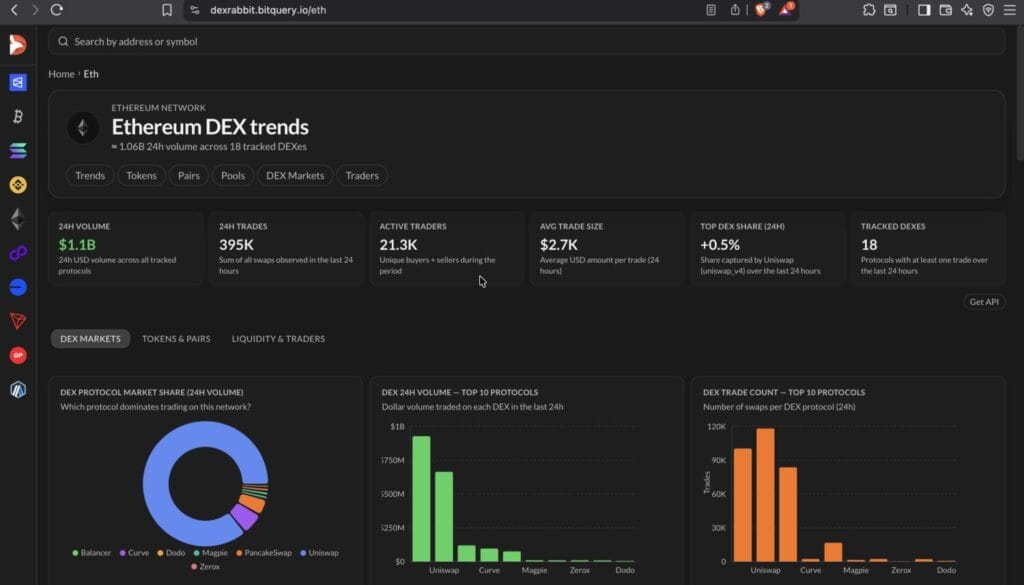
DEXRabbit has network-wide trader rankings as a dedicated page per chain. The Ethereum Traders page shows 50 wallets ranked by 24H DEX volume with three analysis tabs:
- Overview — total volume, total trades, buy/sell trade split (count and percentage), avg volume per wallet
- Behavior — trading pattern analysis per wallet (frequency, timing, size distribution)
- Diversity — token spread and protocol spread per wallet
Click any wallet address to open its full profile (e.g., example Base trader) with complete trade history, volume breakdown, and market activity. Trader pages are available across all 8 chains: Solana, Ethereum, BSC, Base, Tron, Arbitrum, Polygon, and Optimism. Every section has a “Get API” button exposing the live Bitquery GraphQL query, and a “Get Stream” button for Kafka stream access.
Trade-level data
DEXScreener shows individual trades per pair with buy/sell type, USD value, token amount, price, time, and maker wallet. Trade data is pair-scoped and rendered only in the UI with no API access.
DEXRabbit’s token pages show a live Last Trades feed across all DEX markets for that token, refreshing every 5 seconds. Each trade entry includes: DEX protocol, price at execution, token amount, USD amount, pool address (with copy button), and transaction hash (with direct Bitquery Explorer link). The data is available via both the UI and the Bitquery API—the “Get Stream” button exposes the underlying Kafka topic streaming the same trade events in real time.
Token-level data
DEXScreener shows per-token: price (USD and native), market cap, FDV, pair age, 24H volume, transaction count, maker count, liquidity, security info from third-party integrations (taxes, LP lock, mint authority), and social links.
DEXRabbit shows per-token: price, market cap, FDV, total supply, contract address, number of active pairs (with combined volume), number of DEX markets (with protocol count and trade count), number of top traders (with volume), and top trader volume total. A sparkline and full TradingView chart view are available. The token page also links to an FAQ section with 12 structured entries and provides “Get API” and “Get Stream” access on every data tab. Token pages are available per chain (e.g., Polygon token example, Solana tokens, Ethereum tokens).
3. Range of Markets Covered
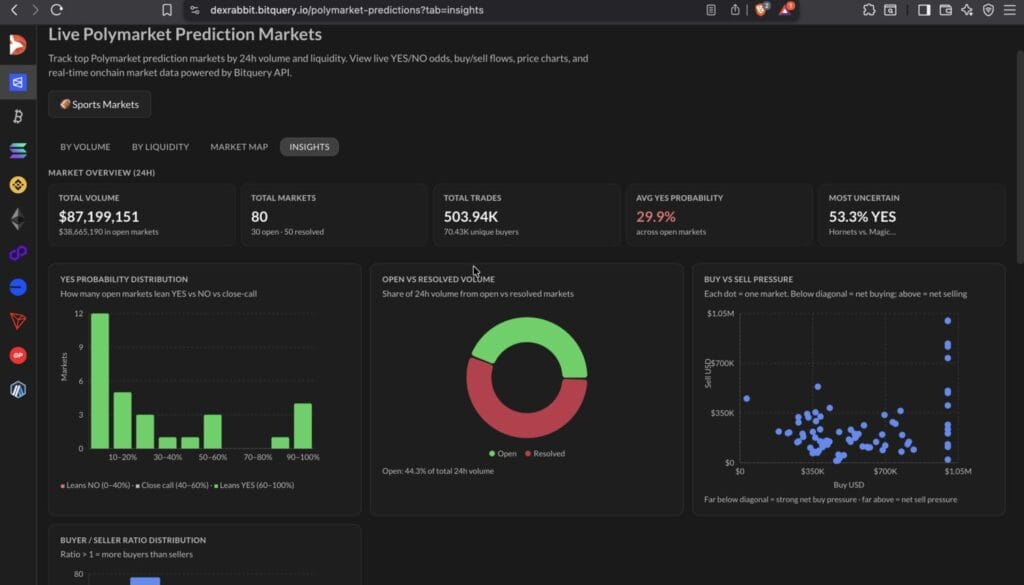
DEXRabbit Polymarket Predictions Insights
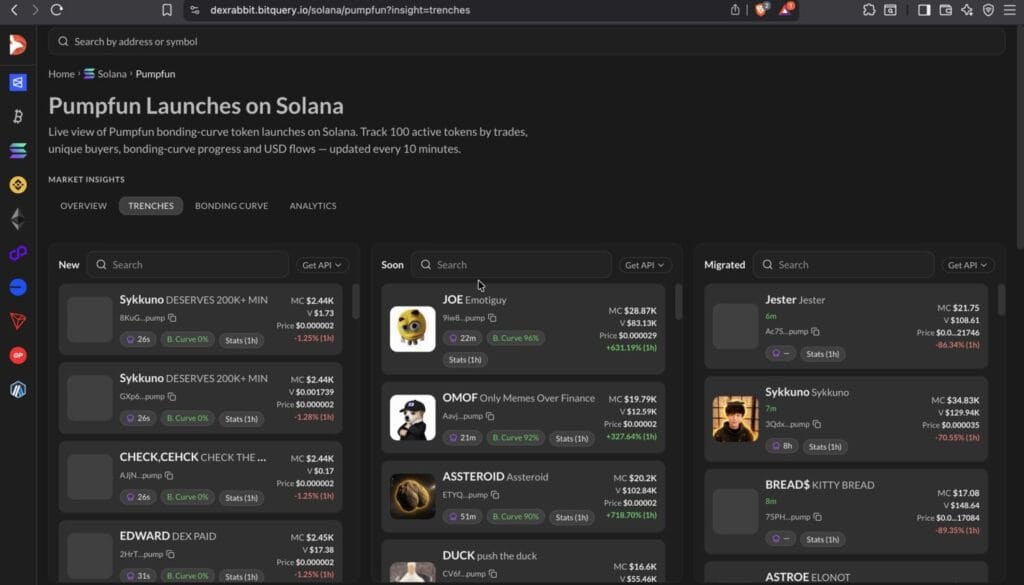
Pumpfun trenches
Prediction markets
DEXRabbit has a full Polymarket Predictions module with four distinct views:
- By Volume — markets ranked by 24H traded volume, with YES/NO odds, open/resolved status, bubble or card visualization, title search, and sort controls
- By Liquidity — markets ranked by liquidity activity showing Split (liquidity added, green) vs Merge (liquidity removed, red) flows as a bar chart
- Market Map — heatmap of all markets sized by volume
- Insights — aggregate stats ($156.7M total volume, 80 markets, 565.88K trades, 43.3% avg YES probability), most uncertain market, YES probability distribution, top markets by buy/sell flow
A Sports Markets tab filters to sports-only questions covering football, cricket, and esports. Each market opens a detail page with YES/NO price chart, trade history, top buyers and sellers, and API access.
This matters beyond just prediction market tracking. Polymarket odds on Fed rate decisions, geopolitical events, or commodity outcomes sit as real-money probability signals that traders and analysts use alongside spot or futures positions. DEXRabbit is the only DEX analytics platform covering both the AMM layer and this on-chain prediction market layer in the same dashboard.
Futures markets
Neither platform has a dedicated futures module in its current UI. DEXScreener is strictly spot AMM. DEXRabbit is also AMM-focused in its dashboard layer, though Bitquery’s underlying API covers perpetuals data—the JLP (Jupiter Perps LP) token appearing in the Signals Feed is a relevant indicator of perpetual activity on Solana, since JLP holds the collateral for Jupiter’s perpetuals protocol, and an RVOL spike in JLP signals elevated perpetuals usage.
AMM protocols covered
DEXScreener is the broadest tool by chain count, covering 80+ blockchain networks. DEXRabbit focuses on depth across 8 major chains.
DEXScreener Coverage:
- Covers 80+ blockchain networks
- Tracks all major DEX protocols including: Raydium (CLMM, CPMM, v4), Meteora (DLMM, DYN2), PumpSwap, Pumpfun on Solana; Uniswap v2/v3/v4, Curve, Balancer on Ethereum
DEXRabbit Coverage:
- Covers 8 chains: Solana, Ethereum, BSC, Base, Polygon, Tron, Optimism, Arbitrum
- Solana: 28 DEX protocols including Raydium, PumpSwap, Pumpfun, Orca Whirlpool, Meteora
- Ethereum: 18 protocols including Uniswap (v2/v3/v4), Curve, Balancer, Dodo, Magpie, ZeroX, PancakeSwap
- BSC: PancakeSwap v2/v3, Uniswap, Balancer, and others
- Tron: SunSwap, SunPump
- The per-network DEX Markets tab shows each protocol’s 24H volume, trade count, and buyer/seller breakdown—a level of protocol-level analytics not available on DEXScreener
DEXRabbit’s homepage heatmaps are explicitly segmented by AMM type: PumpSwap tokens, Pumpfun tokens, and Top Pairs are separate heatmap cards, so you can immediately distinguish memecoin launchpad volume from established pair liquidity.
4. Signals and Derived Metrics
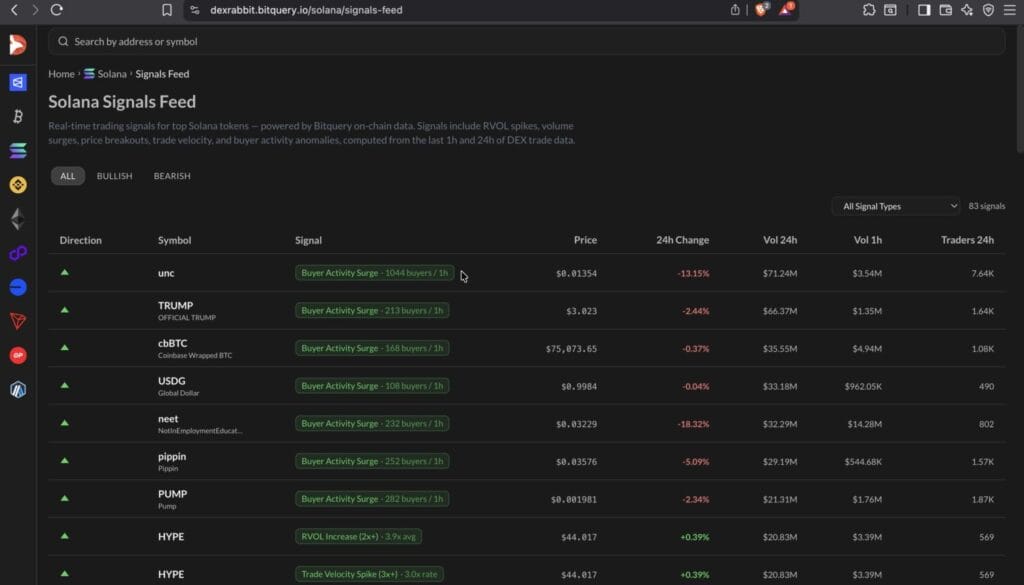
DEXRabbit Solana Signals Feed—120 live signals filtered by BULLISH/BEARISH and signal type, with quantified multipliers per row
DEXScreener signals
DEXScreener has no dedicated signals feed and does not compute derived metrics. The closest equivalent is the trending algorithm that surfaces tokens gaining traction by transaction count over short windows (5M, 1H, 6H, 24H), and the Gainers tab which shows top price movers. These are sorting functions, not computed anomaly signals—they tell you what has already moved, not that something unusual is happening relative to its own baseline.
DEXRabbit Signals Feed
DEXRabbit has a dedicated Signals Feed per network. The Solana Signals Feed runs 120 live signals computed from the last 1H and 24H of DEX trade data, refreshed every 3 minutes. Signal types include:
Each signal row shows: direction (bullish/bearish arrow), symbol with full name, signal label with quantified multiplier (e.g., “RVOL Spike (5x+) · 8.6x avg”), price, 24H change, Vol 24H, Vol 1H, and Traders 24H. You can filter the entire feed to BULLISH only, BEARISH only, or a specific signal type from the dropdown. Every row links directly to the token’s DEXRabbit page.
The full feed has a “Get API” button that opens the Bitquery GraphQL query powering the signal computation—meaning any quant or developer can pull the same derived metrics into their own system, run them on a schedule, or subscribe to them as a Kafka stream.
Summary: DEXScreener has no signals layer and no derived metrics. DEXRabbit’s Signals Feed is the only native anomaly detection layer across both platforms—computing 9 distinct signal types in real time from on-chain trade data, filterable by direction and type, and fully accessible via API.
5. Chain-Specific Tools: Beyond Generic Dashboards
One of DEXRabbit’s key differentiators is its chain-specific tooling—dedicated features built for the unique ecosystems on specific chains. DEXScreener uses a uniform interface across all 80+ chains. DEXRabbit builds purpose-built tools where the ecosystem demands it.
Pumpfun Token Explorer (Solana)
The Pumpfun Explorer is a dedicated module for tracking Pumpfun token launches on Solana—the single largest source of new token creation in crypto. For each token, it provides:
- Bonding curve progress visualization — see how close a token is to migration (1B total supply, 206.9M reserved for the bonding curve)
- Token migration status — whether the token has graduated to PumpSwap or remains on the bonding curve
- Top traders and holder analysis — who’s accumulating, who’s dumping
- 1H pool statistics — recent volume, trade count, and price action since listing
- Full OHLCV charts and real-time price data
This is powered by Bitquery’s PumpSwap API and the Solana DEX API. DEXScreener shows Pumpfun tokens but does not surface bonding curve mechanics, migration status, or the graduated-vs-active distinction that determines whether a token has real liquidity.
Liquidity Pools Page (All Chains)
The Pools page ranks liquidity pools by USD balance across all supported DEXs on each chain. Each pool detail page includes:
- Slippage curve visualizations — see the expected price impact at various trade sizes
- Token-level statistics per pool — supply data, reserve balances, volume metrics
- Real-time trade activity within the specific pool
- Pool contract address and DEX protocol identification
This is critical for LP providers evaluating pool depth and risk, and for traders assessing execution quality across different venues. DEXScreener shows pair-level data but does not have dedicated pool analytics with slippage modeling.
BagsFM (Solana)
The BagsFM page provides an interactive bubble cloud visualization of token holdings on Solana. Token bubbles are sized by value and can be explored interactively, giving a visual representation of portfolio concentration and token distribution that is not available on DEXScreener.
x402Scan (Base)
The x402Scan page is a Base-exclusive monitoring tool for x402 protocol services—tracking top users, service rankings, and real-time activity. This is an example of DEXRabbit building tooling for emerging on-chain protocols as they launch, something a generic multi-chain dashboard cannot do.
AI-Powered Market Summaries
DEXRabbit embeds AI market summaries on every major page—homepage, chain dashboards, token lists, pair lists, heatmap sections, and individual DEX market views. These are not generic labels. Each summary is computed from the live data visible on that page and includes:
- Market sentiment classification (bullish/bearish/neutral)
- Identification of opportunities and risk flags
- FDV/MCAP gap analysis to flag dilution risk
- Pump signal detection on high-momentum tokens
- Chain dominance breakdown (e.g., Solana’s share of total DEX volume)
- Gainers-vs-losers ratio across tokens, pairs, and currencies
DEXScreener has no AI-driven analysis layer.
6. Infrastructure: What Powers Each Platform
The biggest structural difference between the two platforms is not a UI feature—it’s the data infrastructure underneath.
DEXScreener
DEXScreener provides a public REST API with approximately 8 endpoints covering token profiles, pair search, and basic market data. There is no WebSocket streaming, no GraphQL flexibility, no ability to run custom queries, and no access to historical trade-level data. The API is read-only with rate limits and no pagination on search. If the API does not have an endpoint for what you need, you cannot get it.
DEXRabbit / Bitquery
DEXRabbit is a reference implementation built entirely on Bitquery’s data infrastructure, which exposes the full data pipeline to users:
- GraphQL API (docs) — 90+ query types across DEXTradeByTokens, DEXTrades, Tokens, Currencies, and Pairs datasets with built-in aggregations (sum, count, uniq, orderBy, limit), advanced filtering by chain, DEX, token, wallet, and time range
- WebSocket Subscriptions (docs) — ~1-second latency; any GraphQL query can be converted into a live stream
- Kafka Streams (docs) — enterprise-grade delivery at sub-500ms latency, streaming millions of events with no rate limits, guaranteed delivery, offset replay, and horizontal scaling. Available in JavaScript and Python
- Solana gRPC (docs) — sub-100ms latency for Solana-specific data, the fastest delivery option for trading bots and MEV applications
- GraphQL IDE (ide.bitquery.io) — browser-based query editor with autocomplete, docs, and saved queries
- Crypto MarketCap API (docs) — real-time MC, FDV, supply, and OHLCV/K-line data
Scaling: Bitquery supports up to 1,000+ concurrent streams with auto-scaling infrastructure, 99.9% uptime, and coverage across 40+ chains. This is the same infrastructure that powers DEXRabbit’s own real-time UI—and it’s fully available to developers building their own tools.
Every “Get API” button on DEXRabbit opens the exact query powering that view in the Bitquery IDE. Every “Get Stream” button exposes the Kafka topic. The platform is not just a dashboard—it’s a live reference for Bitquery’s entire API surface.
Full Feature Comparison
Which Tool Belongs in Your Stack
DEXScreener and DEXRabbit are not competing for the same user. Once you understand what each one actually does, the choice is not either/or—it depends entirely on what you are trying to build or track.
Choose DEXScreener when you need breadth
DEXScreener is the right tool when you need broad chain coverage. It covers 80+ chains, surfaces new token launches within minutes, lets you set price alerts, and gives retail traders the fastest path from “I heard about this token” to a chart with live transactions. The Metas strip, KOL wallet tracking, and Bubblemaps integration make it a strong discovery and social layer. If your workflow is token hunting, memecoin trading, or monitoring a watchlist across many chains simultaneously, DEXScreener is the tool you keep open all day.
Choose DEXRabbit when you need depth
DEXRabbit is the right tool when you need depth. It is the only platform that tells you:
- Which DEX protocol is gaining or losing volume share on a given chain (DEX Markets)
- Which wallets are driving the most activity network-wide (Top Traders)
- What the crowd on Polymarket is pricing for macro or geopolitical outcomes (Predictions)
- Which tokens are showing statistically anomalous RVOL or trade velocity right now (Signals Feed)
- How close a Pumpfun token is for migration (Pumpfun Explorer)
- What the slippage curve looks like for a specific liquidity pool (Pools)
Every data point it surfaces has a “Get API” button. Every real-time feed has a “Get Stream” button. The entire platform is a reference implementation of Bitquery’s API and Kafka streaming infrastructure, which supports up to 1,000 concurrent streams, making it viable for teams building live dashboards, alert pipelines, or institutional data products.
If you are a developer or data team, DEXRabbit is the starting point for understanding what Bitquery’s infrastructure can do, and every chart, table, and feed you see on the platform is a query you can take and run yourself.
Quick Links:
- DEXRabbit: dexrabbit.bitquery.io
- Bitquery API Docs: docs.bitquery.io
- GraphQL IDE: ide.bitquery.io
- Solana Signals Feed: dexrabbit.bitquery.io/solana/signals-feed
- Pumpfun Explorer: dexrabbit.bitquery.io/solana/pumpfun
- Kafka Streaming Docs: docs.bitquery.io/docs/streams/kafka-streaming-concepts
- PumpSwap API: docs.bitquery.io/docs/blockchain/Solana/Pumpfun/pump-swap-api


You May Also Like

Some grocers are using AI to cut food waste and boost profit margins

TFSF Ventures Publishes Open Specification for Agent-to-Agent Payment Infrastructure, Files Int’l Patent Protection




