

Prediction: These Top Robotics Stocks Which Will Soar in 2026

TLDR
- AeroVironment posted 143% revenue growth to $408M with a $1.1B funded backlog
- Rockwell Automation reported 12% sales growth and 36% rise in operating earnings
- Symbotic turned profitable with $630M revenue, up 29% year over year
- Tesla’s Optimus robot is drawing investor attention ahead of Q1 2026 earnings on April 22
- Honeywell and Teradyne are expanding automation product lines with upcoming earnings catalysts
Why Robotics Is Starting to Matter Again
Robotics has been talked about for years, but for a long time it remained more of a future theme than an immediate investment opportunity.
That is starting to change.
Across industries, companies are facing the same pressures. Labor is getting more expensive, supply chains are becoming more complex, and demand for efficiency continues to increase. At the same time, advances in artificial intelligence are making robots more capable, more flexible, and easier to deploy in real-world environments.
What used to be limited to simple, repetitive tasks in factories is now expanding into logistics, warehousing, healthcare, defence, and even consumer-facing applications.
This shift is important because it moves robotics from a niche sector into a broader, multi-industry growth trend.
Instead of a handful of experimental companies, we are now seeing established businesses generating real revenue from automation, alongside newer players scaling quickly as adoption increases.
Wall Street is starting to pay closer attention, but the focus has changed.
Investors are no longer chasing robotics purely on long-term potential. The attention is now on companies that are already showing measurable progress, whether that is through revenue growth, improving margins, strong backlogs, or clear near-term catalysts.
That makes it easier to identify which companies are worth watching now, rather than speculating on what might happen years into the future.
AeroVironment (AVAV)
AeroVironment gives investors robotics exposure through defense drones and unmanned systems. In its fiscal third quarter, revenue jumped 143% year over year to $408 million.
AeroVironment, Inc., AVAV
Funded backlog reached $1.1 billion, giving the company strong visibility into future demand. Management has set a fiscal 2026 revenue outlook of $1.85 billion to $1.95 billion.
Rockwell Automation (ROK)
Rockwell Automation is one of the steadiest names in industrial automation. In fiscal Q1 2026, it reported sales of $2.105 billion, up 12% year over year.
Rockwell Automation, Inc., ROK
Total segment operating earnings rose 36%, and annual recurring revenue increased 7%. Both hardware and software demand are holding up as manufacturers invest in factory modernization.
Symbotic (SYM)
Symbotic is one of the purest warehouse robotics plays available. Revenue came in at $630 million in fiscal Q1 2026, up 29% year over year.
Symbotic Inc., SYM
The company also turned profitable, posting net income of $13 million compared to a net loss of $17 million a year earlier. It guided for Q2 revenue of $650 million to $670 million.
Final Thoughts
Wall Street is no longer rewarding robotics stocks on excitement alone. The focus has shifted to companies showing real sales growth, improving profitability, strong backlogs, or a clear upcoming catalyst. All six names here currently meet at least one of those criteria.
Report: The Robotics Stocks We Didn’t Include in This Article
We actually looked at far more robotics companies than the ones included in this article.
The three mentioned here are just a small sample — several others stood out just as much, and in some cases even more, based on trend, growth, and overall market strength. 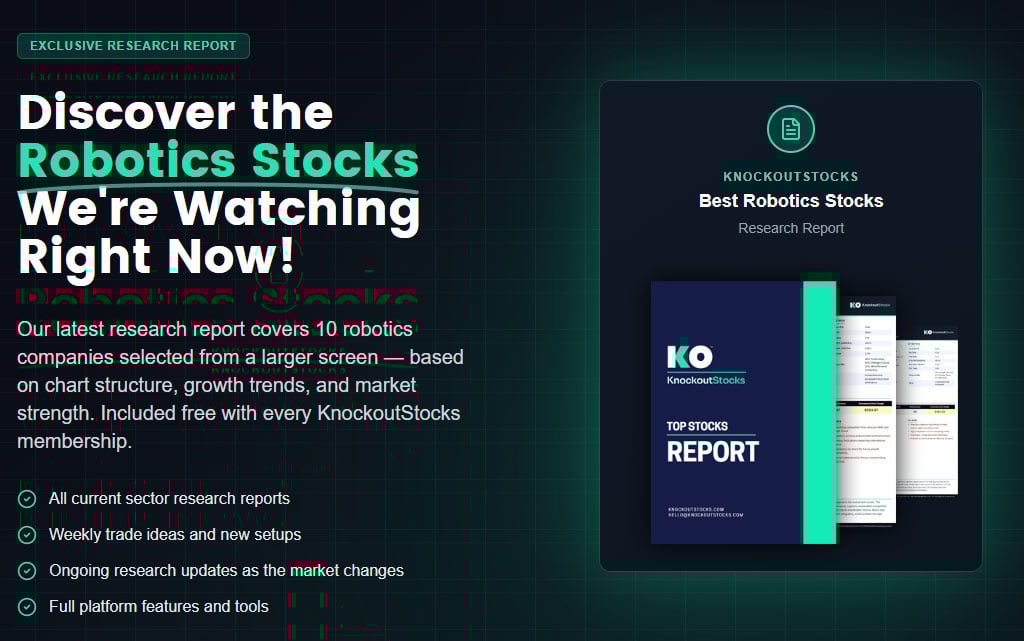 A few of these are not widely covered yet, which is exactly why they caught our attention during the screening process. Instead of publishing everything publicly, we put together a separate report covering 10 robotics stocks that currently look high-potential based on our internal rankings and latest research.
This is the same list we’re actively watching, with charts, key levels, and notes on each company.
 If you want to see the full list before it becomes more widely discussed, you can access the Robotics Stocks report here
Get The Robotics Stocks Report
The post Prediction: These Top Robotics Stocks Which Will Soar in 2026 appeared first on CoinCentral.


You May Also Like

Trump pours gas on GOP civil war with new attacks on MAGA icons: 'I should do a list'

Singapore Gulf Bank Unveils Stablecoin Mint and Redeem Service for Institutional Clients




