Texas man behind $20M crypto scam sentenced to 23 years in federal prison
In a federal court in Illinois, an alleged scammer who is a native Texan has been handed down a sentence of more than two decades in federal prison for a massive crypto scam worth $20 million.
Robert Dunlap, a 55-year-old Houston entrepreneur, spun a tale too good to ignore.
Between 2018 and 2023, Dunlap portrayed himself as the trustee of the Meta-1 Coin Trust, promoting his digital coin as one that was guaranteed by immense assets: $44 billion of gold, verified by an accounting firm, alongside another $1 billion of fine art by masters including Pablo Picasso, Vincent van Gogh, and Salvador Dalí.
Texan deception meets federal reckoning
According to reports, investors were assured that the investment would entail minimal risk and yield gains of up to 224,923%. Automated trading bots operating from his very own Meta Exchange platform created the false impression of rapidly rising prices and volume.
However, there were no gold bars locked in vaults and no paintings of value stored in the galleries. The fraudster, along with his accomplices, made up fake paperwork, lied consistently to investors, and siphoned off millions of dollars from over 1,000 victims who drained their IRAs and lifetime savings to buy their worthless assets into luxury items such as a Ferrari.
An emergency asset freeze issued by the SEC in 2020 attempted to stop the scam but failed to do so, and Dunlap’s scam continued until federal authorities untangled the deception.
On April 15, 2026, U.S. District Judge LaShonda A. Hunt delivered the verdict. Dunlap, already convicted last year by a federal jury in the Northern District of Illinois on two counts of mail fraud, received a 23-year federal prison sentence. He was also ordered to pay full restitution to his victims.
Prosecutors described him as “unrepentant,” noting that his fabrications only grew bolder over time.
Assistant U.S. Attorneys Jared Hasten and Paige Nutini warned in court filings that the sentence should send a clear message: “Would-be criminals planning to engage in similar conduct need to know that such actions will be met with a serious repercussion that includes loss of one’s liberty for an extended period of time.”
IRS Criminal Investigation Special Agent in Charge Adam Jobes added that Dunlap had not merely stolen money but had “upended lives,” stripping victims of years of hard-earned financial security.
Crypto fraud’s lingering shadow across Texas and the nation
Dunlap’s downfall arrives at a moment when crypto crime shows no signs of slowing. Just days earlier, on April 6, the FBI released its 2025 Internet Crime Report, which showed that U.S. citizens had fallen victim to cybercrimes totaling almost $21 billion.
The leading cause was crypto fraud, which accounted for 181,565 theft cases totaling more than $11 billion, a 22% increase from the previous year. In terms of total cybercrime losses nationwide, Texas ranked second at $1.8 billion.
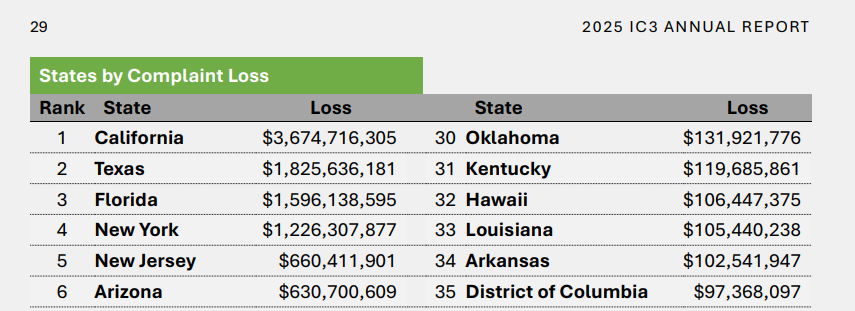 Texas ranks second in cybercrime losses. Source: FBI report
Earlier this year, a fugitive dual national received 20 years in absentia for his role in a $73 million international “pig-butchering” crypto investment scam that preyed on Americans through social media and fake trading platforms.
Second only to France, the U.S. has now become a crypto-crime nation. In a recent development, an international police action between the United States, Britain, and Canada has been initiated to curb any large-scale crypto theft schemes. Authorities have estimated that about $45 million in crypto assets was stolen, with $12 million frozen.
According to reports, Operation Atlantic targeted investors who had become victims of a process called approval phishing. Approval phishing is often used by fraudsters in connection with pig butchering, an internet-based financial fraud.
If you're reading this, you’re already ahead. Stay there with our newsletter.


You May Also Like

US-Israeli strikes hit Iran as Venezuela’s Maduro ousted

Trump prohibits Israel from bombing Lebanon, pushing for diplomatic solutions