Jimmy Song, a notable Bitcoin developer and industry advocate, has criticized the decision by Bitcoin Core developers to remove the OP_Return data size limit in the upcoming Bitcoin Core 30 upgrade. He denounces this move as reflective of a “fiat” mentality, implying a departure from Bitcoin’s core principles of decentralization and security. Song pointed out [...]Jimmy Song, a notable Bitcoin developer and industry advocate, has criticized the decision by Bitcoin Core developers to remove the OP_Return data size limit in the upcoming Bitcoin Core 30 upgrade. He denounces this move as reflective of a “fiat” mentality, implying a departure from Bitcoin’s core principles of decentralization and security. Song pointed out [...]

Jimmy Song: Why Fiat Arguments About OP_RETURN Must End


Jimmy Song: Why Fiat Arguments About Op_return Must End

Jimmy Song, a notable Bitcoin developer and industry advocate, has criticized the decision by Bitcoin Core developers to remove the OP_Return data size limit in the upcoming Bitcoin Core 30 upgrade. He denounces this move as reflective of a “fiat” mentality, implying a departure from Bitcoin’s core principles of decentralization and security.

Song pointed out that the Core team’s decision to eliminate the current 80-byte cap on OP_Return—used for embedding non-monetary data—ignores significant resistance from the Bitcoin community and node operators. He emphasized that the debate is rooted in definitional issues around what constitutes spam on the network, suggesting that non-monetary data embedded in Bitcoin now falls into a gray area.

He further argued that the claim of ambiguity around spam is a stalling tactic aimed at avoiding a discussion on the long-term implications of removing these limits. The debate over OP_Return’s unrestricted data size has been ongoing for nearly six months and echoes the historical Bitcoin block size wars of 2015-2017, which led to the creation of Bitcoin Cash (BCH). Some community members fear that this decision could spark a similar split in the network.

Node Runners Respond with Exodus to Bitcoin Knots

The unilateral removal of the OP_Return data limit has caused a notable shift among node operators. An increasing number are migrating to Bitcoin Knots, an alternative implementation of Bitcoin node software that enforces stricter data limits to support decentralization. This migration reflects growing concern over network centralization and data bloat.
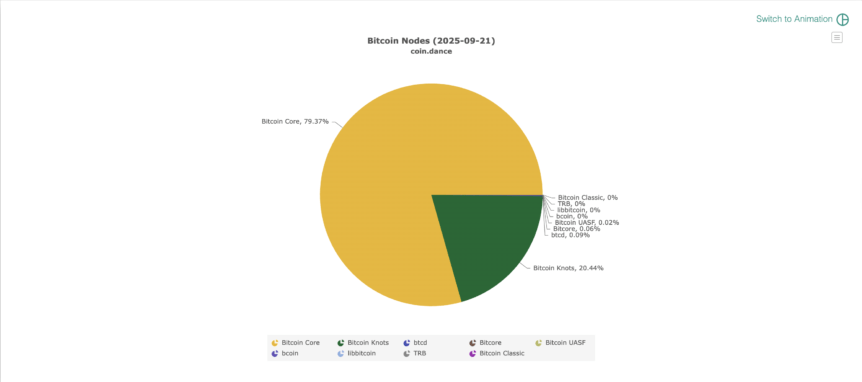
Bitcoin Core, Decentralization, Bitcoin Block Size, Nodes, Bitcoin Cash, Bitcoin OrdinalsA breakdown of different node software implementations on the Bitcoin network. Source: Coin Dance

Since February 2024, Bitcoin Knots nodes have surged from roughly 1% to approximately 20% of all active nodes—a tenfold increase in less than a year. Advocates argue that maintaining data size constraints is vital for preserving Bitcoin’s decentralization and allowing anyone to operate a node with affordable hardware.

Compared to other blockchain platforms that generate much larger data volumes—often requiring costly specialized hardware—Bitcoin’s lean design keeps running a full node accessible to retail users, thus promoting a more decentralized network. This setup minimizes the risk of centralization, where a small group of entities could influence or compromise consensus rules.

Related: Long-term security and the sustainability of Bitcoin’s economic model remain pivotal issues as debates around protocol upgrades unfold, shaping the future of cryptocurrency and blockchain regulation.

This article was originally published as Jimmy Song: Why Fiat Arguments About OP_RETURN Must End on Crypto Breaking News – your trusted source for crypto news, Bitcoin news, and blockchain updates.

Market Opportunity
Movement Logo
Movement Price(MOVE)
$0.03386
$0.03386$0.03386
-0.99%
USD
Movement (MOVE) Live Price Chart
Disclaimer: The articles reposted on this site are sourced from public platforms and are provided for informational purposes only. They do not necessarily reflect the views of MEXC. All rights remain with the original authors. If you believe any content infringes on third-party rights, please contact service@support.mexc.com for removal. MEXC makes no guarantees regarding the accuracy, completeness, or timeliness of the content and is not responsible for any actions taken based on the information provided. The content does not constitute financial, legal, or other professional advice, nor should it be considered a recommendation or endorsement by MEXC.

You May Also Like

The Surprising 2025 Decline In Online Interest Despite Market Turmoil

The Surprising 2025 Decline In Online Interest Despite Market Turmoil

The post The Surprising 2025 Decline In Online Interest Despite Market Turmoil appeared on BitcoinEthereumNews.com. Bitcoin Searches Plunge: The Surprising 2025
Share
BitcoinEthereumNews2026/01/21 14:56
Ethereum Name Service price prediction 2026-2032: Is ENS a good investment?

Ethereum Name Service price prediction 2026-2032: Is ENS a good investment?

Key takeaways: The Ethereum Name Service is a network that enables crypto enthusiasts to rename their cryptocurrency addresses into something simpler, making them
Share
Cryptopolitan2026/01/18 00:18
Cryptos Signal Divergence Ahead of Fed Rate Decision

Cryptos Signal Divergence Ahead of Fed Rate Decision

The post Cryptos Signal Divergence Ahead of Fed Rate Decision appeared on BitcoinEthereumNews.com. Crypto assets send conflicting signals ahead of the Federal Reserve’s September rate decision. On-chain data reveals a clear decrease in Bitcoin and Ethereum flowing into centralized exchanges, but a sharp increase in altcoin inflows. The findings come from a Tuesday report by CryptoQuant, an on-chain data platform. The firm’s data shows a stark divergence in coin volume, which has been observed in movements onto centralized exchanges over the past few weeks. Bitcoin and Ethereum Inflows Drop to Multi-Month Lows Sponsored Sponsored Bitcoin has seen a dramatic drop in exchange inflows, with the 7-day moving average plummeting to 25,000 BTC, its lowest level in over a year. The average deposit per transaction has fallen to 0.57 BTC as of September. This suggests that smaller retail investors, rather than large-scale whales, are responsible for the recent cash-outs. Ethereum is showing a similar trend, with its daily exchange inflows decreasing to a two-month low. CryptoQuant reported that the 7-day moving average for ETH deposits on exchanges is around 783,000 ETH, the lowest in two months. Other Altcoins See Renewed Selling Pressure In contrast, other altcoin deposit activity on exchanges has surged. The number of altcoin deposit transactions on centralized exchanges was quite steady in May and June of this year, maintaining a 7-day moving average of about 20,000 to 30,000. Recently, however, that figure has jumped to 55,000 transactions. Altcoins: Exchange Inflow Transaction Count. Source: CryptoQuant CryptoQuant projects that altcoins, given their increased inflow activity, could face relatively higher selling pressure compared to BTC and ETH. Meanwhile, the balance of stablecoins on exchanges—a key indicator of potential buying pressure—has increased significantly. The report notes that the exchange USDT balance, around $273 million in April, grew to $379 million by August 31, marking a new yearly high. CryptoQuant interprets this surge as a reflection of…
Share
BitcoinEthereumNews2025/09/18 01:01