

Succinct debuts iPhone app for cryptographic photo provenance
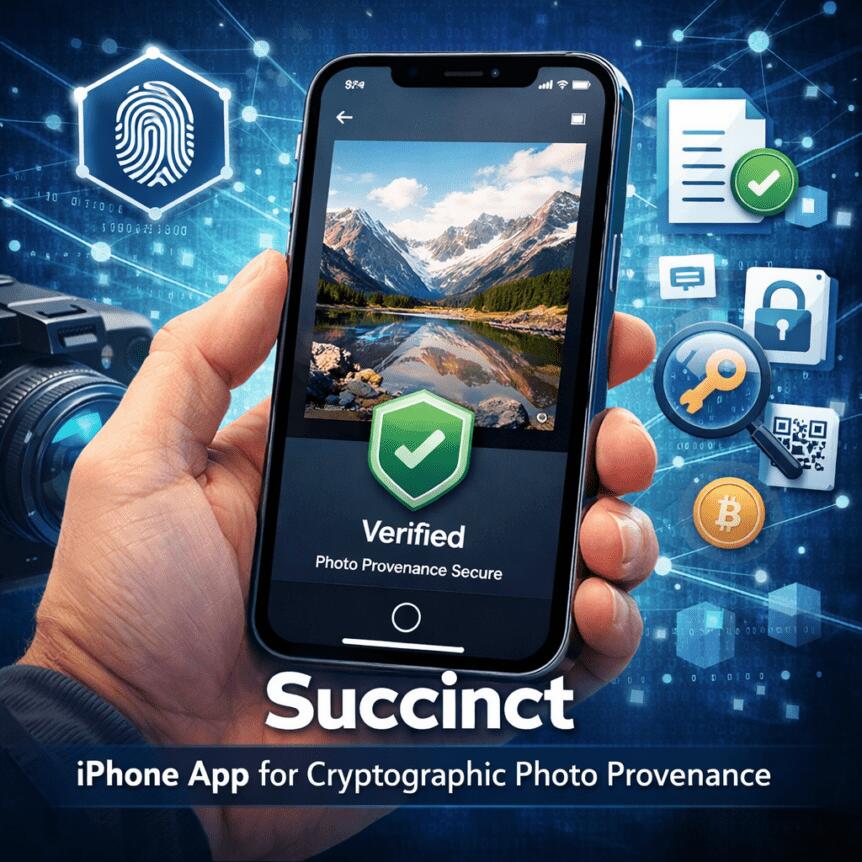
Succinct has introduced Zcam, an iPhone camera app designed to cryptographically sign photos and videos at the moment of capture, creating a verifiable link between the media and the device that produced it. The aim is to let viewers confirm that content has not been digitally altered or AI-generated, even as synthetic media becomes more prevalent.
According to Succinct, Zcam hashes the raw image data and signs the result with keys generated inside Apple’s Secure Enclave, a hardware-based security module. The resulting signature, along with capture metadata and attestation, is embedded into the file using the Coalition for Content Provenance and Authenticity (C2PA) standard, a framework for attaching tamper-evident provenance data to digital media.
How Zcam signs media at capture. Source: Succinct
Succinct notes that the process relies on a tamper-evident record that ties the media to the capture device, enabling readers to verify authenticity directly. The company’s blog explains that Zcam’s signing workflow is designed to deter manipulation and to establish a provable origin for each image or video file, leveraging existing hardware and open provenance standards.
The underlying concept is anchored in the Coalition for Content Provenance and Authenticity (C2PA) framework, which is described as an open technical standard that enables publishers, creators and consumers to establish the “origin and edits” of digital content. The standard allows metadata about how content was created, which tools were used, and how it changed over time to be attached to the media itself.
The move signals a broader push beyond traditional blockchain-based verifications, bringing cryptographic provenance tools closer to the point of creation. In an era where questions about AI-generated imagery and video content proliferate, having a cryptographic trail attached to media at capture could offer a complementary line of defense to post hoc AI-detection techniques.
Key takeaways
- Zcam signs media at capture by hashing raw data and using keys generated inside Apple’s Secure Enclave, then embeds the signature with metadata and attestation into the file.
- The signing and provenance data are embedded using the C2PA standard, which aims to provide a tamper-evident record of origin and edits directly within media files.
- Succinct positions Zcam as an early, practical step toward widespread cryptographic provenance, with potential use cases in journalism, insurance claims and identity verification.
- The project faces important caveats: the Zcam SDK is unaudited and not production-ready, and secure enclaves have faced past compromises, highlighting that a fully tamper-proof capture-to-signing chain remains an active area of research.
- Security researchers warn that AI-driven fraud and deepfakes could intensify crypto security threats in 2026, underscoring the value—and the limits—of provenance data as part of a layered defense.
Provenance at the source: how Zcam and C2PA fit into the crypto security landscape
At the heart of Zcam’s approach is a simple but increasingly consequential idea: trust in digital media should begin at creation. By hashing image data and sealing that hash with a device-bound key, Zcam intends to provide verifiable evidence that the media originated from the claimed device and was not altered after capture. The Secure Enclave, Apple’s isolated processing environment, is used to protect the signing keys and operations from tampering or extraction, while the C2PA metadata travels along with the media file, offering verifiers a practical provenance trail.
The C2PA standard itself is designed to be open and collaborative, with the goal of clarifying the origin and the evolution of content. It does not prescribe a single implementation but provides a framework for recording provenance data—such as capture tools, software versions, and subsequent edits—so that consumers and downstream systems can assess authenticity. For those assessing the technology, the formal description of C2PA clarifies that provenance data covers both the creation process and the edits it undergoes over time.
Succinct’s announcement positions Zcam as a reference point for a broader adoption of cryptographic provenance tools beyond the blockchain sphere. As media consumers increasingly encounter AI-generated content, having an auditable, tamper-evident record attached to files could help publishers and platforms respond to authenticity concerns in real time. That said, analysts caution that provenance data alone does not solve all risk vectors; it is one layer in an ecosystem that includes detection technologies, secure capture hardware, and robust verification workflows.
In assessing the security landscape, it’s worth noting that a recent briefing from CertiK—cited in coverage by Cointelegraph—suggests that deepfakes, phishing, and AI-assisted social engineering could fuel some of the largest crypto hacks in 2026. The report underscores the broader security stakes as attackers increasingly rely on convincing synthetic media to bypass human and automated defenses. Provenance tools like Zcam could help close gaps in trust, but their effectiveness will depend on end-to-end integration, independent audits, and continued advancements in tamper-resistant capture chains.
Limitations, next steps and what to watch
While Zcam represents a meaningful step toward “proveable” media, Succinct acknowledges it is still early in its evolution. The company notes that its software development kit (SDK) has not been audited and is not yet ready for production use. Moreover, even secure enclaves have vulnerabilities, and ensuring a fully tamper-proof capture-to-signing chain remains an active area of research and refinement. Real-world deployment will depend on broader ecosystem validation, independent security testing, and the development of reliable verification workflows for end users and platforms.
Nonetheless, the trajectory is clear: cryptographic provenance is moving from a theoretical construct into practical tools that can accompany content creation. If adopted widely, Zcam and similar approaches could reshape how publishers, advertisers, insurers and identity providers handle digital media—shifting the emphasis from post hoc detection to provenance-backed assurance at the moment of capture.
As the conversation around media trust evolves, watchers should monitor whether major manufacturers, media platforms and standards bodies embrace similar capture-time signing workflows, and whether independent audits verify the security and reliability of early implementations like Zcam. The next milestones will likely include formal audits of sign-then-verify workflows, expanded support within the C2PA ecosystem, and pilots across journalism and claim-verification use cases.
For readers and builders, the development signals a broader trend: trust in digital content may increasingly hinge on cryptographic proofs anchored at the moment of creation, not only on detection methods applied after publication. The coming months will reveal how quickly such provenance tools scale and how they coexist with other AI-authentication and anti-fraud measures.
Succinct’s Zcam approach is explained in more detail on the company’s blog: Introducing Zcam. For broader context on the provenance framework, see the Coalition for Content Provenance and Authenticity (C2PA) documentation, which describes how provenance data can be attached to media: C2PA content credentials. On the security frontier, CertiK’s analysis about AI-enabled threats is summarized in coverage linked to a Cointelegraph report: CertiK warning.
This article was originally published as Succinct debuts iPhone app for cryptographic photo provenance on Crypto Breaking News – your trusted source for crypto news, Bitcoin news, and blockchain updates.


You May Also Like

Bitcoin Believers Who Lasted 16 Months Just Sold Every Coin to Survive

China Nabs Another Huione Group Core Member in Cambodia Extradition




