U.S. lawmakers are pressing the Securities and Exchange Commission (SEC) to implement President Donald Trump’s recent executive order that opens the $12.5 trillion 401(k) retirement market to alternative assets, including cryptocurrency. In a letter dated September 22, House Financial Services Committee Chairman French Hill and Ranking Member Maxine Waters urged SEC Chair Paul Atkins to move swiftly in revising rules to align with the directive.Source: The White House The letter calls on the agency to recognize FINRA-certified professionals as accredited investors and to expand the scope of who qualifies for access to alternative assets within retirement plans. Trump’s 401(k) Executive Order Puts SEC at Center of Retirement Market Overhaul The push follows Trump’s August 7 executive order, which directs the Department of Labor to reconsider guidance under the Employee Retirement Income Security Act (ERISA). The order specifically tasks the Labor Secretary, in coordination with the Treasury Department, the SEC, and other regulators, to clear the path for 401(k) participants to allocate part of their portfolios to private equity, real estate, digital assets, and other alternatives. The policy is intended to broaden investment choices for the more than 90 million Americans who currently participate in employer-sponsored defined contribution plans. According to a White House fact sheet, total U.S. retirement assets reached $43.4 trillion as of March 31, 2025, but most savers remain restricted from accessing alternatives. Lawmakers argue that allowing measured allocations into these assets could enhance net risk-adjusted returns and modernize retirement investment strategies. The SEC is expected to play a central role in revising regulations, particularly around the accredited investor definition. Several bipartisan bills already before Congress seek to expand the criteria, including measures to recognize professional licenses, education, or SEC-administered examinations as pathways to accreditation. Hill and Waters urged Atkins to incorporate these legislative efforts into the agency’s rulemaking process. The move revives initiatives first introduced during Trump’s earlier term but later rolled back under President Biden. Industry groups have long lobbied for such reforms, arguing that retirement portfolios limited to stocks and bonds do not reflect the broader evolution of capital markets. The order also clarifies fiduciary obligations for plan administrators who choose to include alternative assets. Regulators are expected to outline how retirement plan sponsors can provide such exposure while maintaining safeguards for investors. For the cryptocurrency sector, the development marks a pivotal step toward mainstream adoption. While administrative hurdles remain, the inclusion of digital assets in retirement plans could create a new channel for capital inflows into the market, bringing crypto exposure to tens of millions of Americans saving for retirement. SEC Breaks With Gensler Era, Pledges Flexibility on Crypto and Corporate Disclosures The SEC is signaling a major policy shift, moving away from the lawsuit-driven approach of its previous administration and toward a more collaborative stance with the crypto industry and public companies. The SEC is preparing a sweeping shift in both corporate disclosure rules and its approach to crypto regulation, marking a break from years of rigid oversight. Speaking on CNBC on September 19, SEC Chair Paul Atkins confirmed that the agency is prioritizing reforms that could loosen quarterly earnings requirements. The proposal would allow companies, including those in the crypto sector, greater flexibility to set reporting cadences in consultation with investors and banks. Atkins noted that semiannual reporting is already standard for foreign issuers trading in U.S. markets and called the adjustment “a good way forward.” The move follows President Donald Trump’s revived call on September 15 to replace quarterly earnings with semiannual disclosures, a change he argued would cut costs and reduce short-term pressures on executives. With Republicans holding a 3-1 advantage at the SEC, the proposal faces a favorable political landscape. Atkins has also unveiled a new regulatory philosophy for crypto. In a report published September 15, he said the SEC would end its “regulation by enforcement” approach, a hallmark of his predecessor Gary Gensler’s tenure. Instead, firms will receive preliminary notices of potential technical violations and up to six months to address issues before enforcement is considered. Atkins rejected the broad classification of cryptocurrencies as securities, showing openness to tokenized stocks and bonds that mirror existing instruments. Since taking office in April, he has dropped several high-profile cases inherited from the Gensler era and launched a Crypto Task Force. That task force will hold a public hearing on October 17 to examine financial privacy and surveillance toolsU.S. lawmakers are pressing the Securities and Exchange Commission (SEC) to implement President Donald Trump’s recent executive order that opens the $12.5 trillion 401(k) retirement market to alternative assets, including cryptocurrency. In a letter dated September 22, House Financial Services Committee Chairman French Hill and Ranking Member Maxine Waters urged SEC Chair Paul Atkins to move swiftly in revising rules to align with the directive.Source: The White House The letter calls on the agency to recognize FINRA-certified professionals as accredited investors and to expand the scope of who qualifies for access to alternative assets within retirement plans. Trump’s 401(k) Executive Order Puts SEC at Center of Retirement Market Overhaul The push follows Trump’s August 7 executive order, which directs the Department of Labor to reconsider guidance under the Employee Retirement Income Security Act (ERISA). The order specifically tasks the Labor Secretary, in coordination with the Treasury Department, the SEC, and other regulators, to clear the path for 401(k) participants to allocate part of their portfolios to private equity, real estate, digital assets, and other alternatives. The policy is intended to broaden investment choices for the more than 90 million Americans who currently participate in employer-sponsored defined contribution plans. According to a White House fact sheet, total U.S. retirement assets reached $43.4 trillion as of March 31, 2025, but most savers remain restricted from accessing alternatives. Lawmakers argue that allowing measured allocations into these assets could enhance net risk-adjusted returns and modernize retirement investment strategies. The SEC is expected to play a central role in revising regulations, particularly around the accredited investor definition. Several bipartisan bills already before Congress seek to expand the criteria, including measures to recognize professional licenses, education, or SEC-administered examinations as pathways to accreditation. Hill and Waters urged Atkins to incorporate these legislative efforts into the agency’s rulemaking process. The move revives initiatives first introduced during Trump’s earlier term but later rolled back under President Biden. Industry groups have long lobbied for such reforms, arguing that retirement portfolios limited to stocks and bonds do not reflect the broader evolution of capital markets. The order also clarifies fiduciary obligations for plan administrators who choose to include alternative assets. Regulators are expected to outline how retirement plan sponsors can provide such exposure while maintaining safeguards for investors. For the cryptocurrency sector, the development marks a pivotal step toward mainstream adoption. While administrative hurdles remain, the inclusion of digital assets in retirement plans could create a new channel for capital inflows into the market, bringing crypto exposure to tens of millions of Americans saving for retirement. SEC Breaks With Gensler Era, Pledges Flexibility on Crypto and Corporate Disclosures The SEC is signaling a major policy shift, moving away from the lawsuit-driven approach of its previous administration and toward a more collaborative stance with the crypto industry and public companies. The SEC is preparing a sweeping shift in both corporate disclosure rules and its approach to crypto regulation, marking a break from years of rigid oversight. Speaking on CNBC on September 19, SEC Chair Paul Atkins confirmed that the agency is prioritizing reforms that could loosen quarterly earnings requirements. The proposal would allow companies, including those in the crypto sector, greater flexibility to set reporting cadences in consultation with investors and banks. Atkins noted that semiannual reporting is already standard for foreign issuers trading in U.S. markets and called the adjustment “a good way forward.” The move follows President Donald Trump’s revived call on September 15 to replace quarterly earnings with semiannual disclosures, a change he argued would cut costs and reduce short-term pressures on executives. With Republicans holding a 3-1 advantage at the SEC, the proposal faces a favorable political landscape. Atkins has also unveiled a new regulatory philosophy for crypto. In a report published September 15, he said the SEC would end its “regulation by enforcement” approach, a hallmark of his predecessor Gary Gensler’s tenure. Instead, firms will receive preliminary notices of potential technical violations and up to six months to address issues before enforcement is considered. Atkins rejected the broad classification of cryptocurrencies as securities, showing openness to tokenized stocks and bonds that mirror existing instruments. Since taking office in April, he has dropped several high-profile cases inherited from the Gensler era and launched a Crypto Task Force. That task force will hold a public hearing on October 17 to examine financial privacy and surveillance tools

US Push SEC to Open $12.5T 401k Market to Crypto

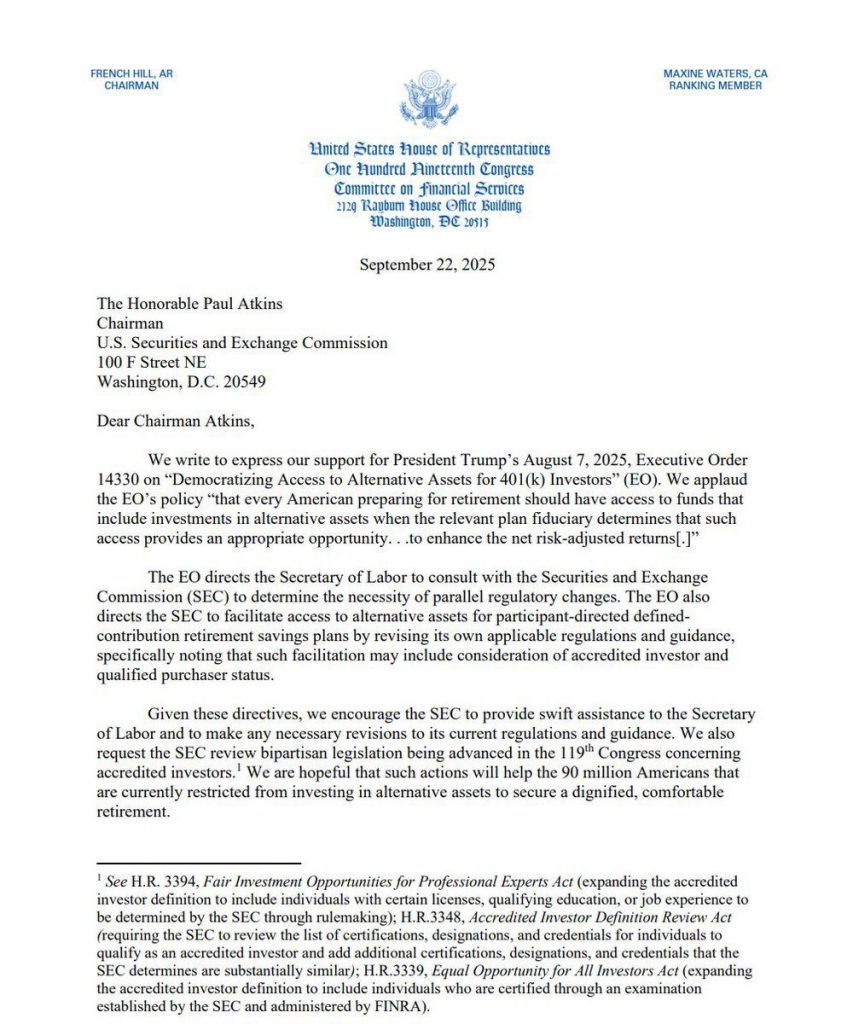
U.S. lawmakers are pressing the Securities and Exchange Commission (SEC) to implement President Donald Trump’s recent executive order that opens the $12.5 trillion 401(k) retirement market to alternative assets, including cryptocurrency.

In a letter dated September 22, House Financial Services Committee Chairman French Hill and Ranking Member Maxine Waters urged SEC Chair Paul Atkins to move swiftly in revising rules to align with the directive.
Source: The White House

The letter calls on the agency to recognize FINRA-certified professionals as accredited investors and to expand the scope of who qualifies for access to alternative assets within retirement plans.

Trump’s 401(k) Executive Order Puts SEC at Center of Retirement Market Overhaul

The push follows Trump’s August 7 executive order, which directs the Department of Labor to reconsider guidance under the Employee Retirement Income Security Act (ERISA).

The order specifically tasks the Labor Secretary, in coordination with the Treasury Department, the SEC, and other regulators, to clear the path for 401(k) participants to allocate part of their portfolios to private equity, real estate, digital assets, and other alternatives.

The policy is intended to broaden investment choices for the more than 90 million Americans who currently participate in employer-sponsored defined contribution plans.

According to a White House fact sheet, total U.S. retirement assets reached $43.4 trillion as of March 31, 2025, but most savers remain restricted from accessing alternatives.

Lawmakers argue that allowing measured allocations into these assets could enhance net risk-adjusted returns and modernize retirement investment strategies.

The SEC is expected to play a central role in revising regulations, particularly around the accredited investor definition. Several bipartisan bills already before Congress seek to expand the criteria, including measures to recognize professional licenses, education, or SEC-administered examinations as pathways to accreditation.

Hill and Waters urged Atkins to incorporate these legislative efforts into the agency’s rulemaking process.

The move revives initiatives first introduced during Trump’s earlier term but later rolled back under President Biden.

Industry groups have long lobbied for such reforms, arguing that retirement portfolios limited to stocks and bonds do not reflect the broader evolution of capital markets.

The order also clarifies fiduciary obligations for plan administrators who choose to include alternative assets. Regulators are expected to outline how retirement plan sponsors can provide such exposure while maintaining safeguards for investors.

For the cryptocurrency sector, the development marks a pivotal step toward mainstream adoption.

While administrative hurdles remain, the inclusion of digital assets in retirement plans could create a new channel for capital inflows into the market, bringing crypto exposure to tens of millions of Americans saving for retirement.

SEC Breaks With Gensler Era, Pledges Flexibility on Crypto and Corporate Disclosures

The SEC is signaling a major policy shift, moving away from the lawsuit-driven approach of its previous administration and toward a more collaborative stance with the crypto industry and public companies.

The SEC is preparing a sweeping shift in both corporate disclosure rules and its approach to crypto regulation, marking a break from years of rigid oversight.

Speaking on CNBC on September 19, SEC Chair Paul Atkins confirmed that the agency is prioritizing reforms that could loosen quarterly earnings requirements.

The proposal would allow companies, including those in the crypto sector, greater flexibility to set reporting cadences in consultation with investors and banks.

Atkins noted that semiannual reporting is already standard for foreign issuers trading in U.S. markets and called the adjustment “a good way forward.”

The move follows President Donald Trump’s revived call on September 15 to replace quarterly earnings with semiannual disclosures, a change he argued would cut costs and reduce short-term pressures on executives.

With Republicans holding a 3-1 advantage at the SEC, the proposal faces a favorable political landscape.

Atkins has also unveiled a new regulatory philosophy for crypto. In a report published September 15, he said the SEC would end its “regulation by enforcement” approach, a hallmark of his predecessor Gary Gensler’s tenure.

Instead, firms will receive preliminary notices of potential technical violations and up to six months to address issues before enforcement is considered.

Atkins rejected the broad classification of cryptocurrencies as securities, showing openness to tokenized stocks and bonds that mirror existing instruments.

Since taking office in April, he has dropped several high-profile cases inherited from the Gensler era and launched a Crypto Task Force.

That task force will hold a public hearing on October 17 to examine financial privacy and surveillance tools.


Market Opportunity
EPNS Logo
EPNS Price(PUSH)
$0.00991
$0.00991$0.00991
-0.70%
USD
EPNS (PUSH) Live Price Chart
Disclaimer: The articles reposted on this site are sourced from public platforms and are provided for informational purposes only. They do not necessarily reflect the views of MEXC. All rights remain with the original authors. If you believe any content infringes on third-party rights, please contact service@support.mexc.com for removal. MEXC makes no guarantees regarding the accuracy, completeness, or timeliness of the content and is not responsible for any actions taken based on the information provided. The content does not constitute financial, legal, or other professional advice, nor should it be considered a recommendation or endorsement by MEXC.

You May Also Like

Lovable AI’s Astonishing Rise: Anton Osika Reveals Startup Secrets at Bitcoin World Disrupt 2025

Lovable AI’s Astonishing Rise: Anton Osika Reveals Startup Secrets at Bitcoin World Disrupt 2025

BitcoinWorld Lovable AI’s Astonishing Rise: Anton Osika Reveals Startup Secrets at Bitcoin World Disrupt 2025 Are you ready to witness a phenomenon? The world of technology is abuzz with the incredible rise of Lovable AI, a startup that’s not just breaking records but rewriting the rulebook for rapid growth. Imagine creating powerful apps and websites just by speaking to an AI – that’s the magic Lovable brings to the masses. This groundbreaking approach has propelled the company into the spotlight, making it one of the fastest-growing software firms in history. And now, the visionary behind this sensation, co-founder and CEO Anton Osika, is set to share his invaluable insights on the Disrupt Stage at the highly anticipated Bitcoin World Disrupt 2025. If you’re a founder, investor, or tech enthusiast eager to understand the future of innovation, this is an event you cannot afford to miss. Lovable AI’s Meteoric Ascent: Redefining Software Creation In an era where digital transformation is paramount, Lovable AI has emerged as a true game-changer. Its core premise is deceptively simple yet profoundly impactful: democratize software creation. By enabling anyone to build applications and websites through intuitive AI conversations, Lovable is empowering the vast majority of individuals who lack coding skills to transform their ideas into tangible digital products. This mission has resonated globally, leading to unprecedented momentum. The numbers speak for themselves: Achieved an astonishing $100 million Annual Recurring Revenue (ARR) in less than a year. Successfully raised a $200 million Series A funding round, valuing the company at $1.8 billion, led by industry giant Accel. Is currently fielding unsolicited investor offers, pushing its valuation towards an incredible $4 billion. As industry reports suggest, investors are unequivocally “loving Lovable,” and it’s clear why. This isn’t just about impressive financial metrics; it’s about a company that has tapped into a fundamental need, offering a solution that is both innovative and accessible. The rapid scaling of Lovable AI provides a compelling case study for any entrepreneur aiming for similar exponential growth. The Visionary Behind the Hype: Anton Osika’s Journey to Innovation Every groundbreaking company has a driving force, and for Lovable, that force is co-founder and CEO Anton Osika. His journey is as fascinating as his company’s success. A physicist by training, Osika previously contributed to the cutting-edge research at CERN, the European Organization for Nuclear Research. This deep technical background, combined with his entrepreneurial spirit, has been instrumental in Lovable’s rapid ascent. Before Lovable, he honed his skills as a co-founder of Depict.ai and a Founding Engineer at Sana. Based in Stockholm, Osika has masterfully steered Lovable from a nascent idea to a global phenomenon in record time. His leadership embodies a unique blend of profound technical understanding and a keen, consumer-first vision. At Bitcoin World Disrupt 2025, attendees will have the rare opportunity to hear directly from Osika about what it truly takes to build a brand that not only scales at an incredible pace in a fiercely competitive market but also adeptly manages the intense cultural conversations that inevitably accompany such swift and significant success. His insights will be crucial for anyone looking to understand the dynamics of high-growth tech leadership. Unpacking Consumer Tech Innovation at Bitcoin World Disrupt 2025 The 20th anniversary of Bitcoin World is set to be marked by a truly special event: Bitcoin World Disrupt 2025. From October 27–29, Moscone West in San Francisco will transform into the epicenter of innovation, gathering over 10,000 founders, investors, and tech leaders. It’s the ideal platform to explore the future of consumer tech innovation, and Anton Osika’s presence on the Disrupt Stage is a highlight. His session will delve into how Lovable is not just participating in but actively shaping the next wave of consumer-facing technologies. Why is this session particularly relevant for those interested in the future of consumer experiences? Osika’s discussion will go beyond the superficial, offering a deep dive into the strategies that have allowed Lovable to carve out a unique category in a market long thought to be saturated. Attendees will gain a front-row seat to understanding how to identify unmet consumer needs, leverage advanced AI to meet those needs, and build a product that captivates users globally. The event itself promises a rich tapestry of ideas and networking opportunities: For Founders: Sharpen your pitch and connect with potential investors. For Investors: Discover the next breakout startup poised for massive growth. For Innovators: Claim your spot at the forefront of technological advancements. The insights shared regarding consumer tech innovation at this event will be invaluable for anyone looking to navigate the complexities and capitalize on the opportunities within this dynamic sector. Mastering Startup Growth Strategies: A Blueprint for the Future Lovable’s journey isn’t just another startup success story; it’s a meticulously crafted blueprint for effective startup growth strategies in the modern era. Anton Osika’s experience offers a rare glimpse into the practicalities of scaling a business at breakneck speed while maintaining product integrity and managing external pressures. For entrepreneurs and aspiring tech leaders, his talk will serve as a masterclass in several critical areas: Strategy Focus Key Takeaways from Lovable’s Journey Rapid Scaling How to build infrastructure and teams that support exponential user and revenue growth without compromising quality. Product-Market Fit Identifying a significant, underserved market (the 99% who can’t code) and developing a truly innovative solution (AI-powered app creation). Investor Relations Balancing intense investor interest and pressure with a steadfast focus on product development and long-term vision. Category Creation Carving out an entirely new niche by democratizing complex technologies, rather than competing in existing crowded markets. Understanding these startup growth strategies is essential for anyone aiming to build a resilient and impactful consumer experience. Osika’s session will provide actionable insights into how to replicate elements of Lovable’s success, offering guidance on navigating challenges from product development to market penetration and investor management. Conclusion: Seize the Future of Tech The story of Lovable, under the astute leadership of Anton Osika, is a testament to the power of innovative ideas meeting flawless execution. Their remarkable journey from concept to a multi-billion-dollar valuation in record time is a compelling narrative for anyone interested in the future of technology. By democratizing software creation through Lovable AI, they are not just building a company; they are fostering a new generation of creators. His appearance at Bitcoin World Disrupt 2025 is an unmissable opportunity to gain direct insights from a leader who is truly shaping the landscape of consumer tech innovation. Don’t miss this chance to learn about cutting-edge startup growth strategies and secure your front-row seat to the future. Register now and save up to $668 before Regular Bird rates end on September 26. To learn more about the latest AI market trends, explore our article on key developments shaping AI features. This post Lovable AI’s Astonishing Rise: Anton Osika Reveals Startup Secrets at Bitcoin World Disrupt 2025 first appeared on BitcoinWorld.
Share
Coinstats2025/09/17 23:40
SHIB Price Drops as Leadership Concerns Grow

SHIB Price Drops as Leadership Concerns Grow

The post SHIB Price Drops as Leadership Concerns Grow appeared on BitcoinEthereumNews.com. Shiba Inu investors uneasy as Kusama’s silence fuels leadership concerns. SHIB slid 13% in three days, retracing from $0.00001484 to $0.00001305. Shibarium exploit and Kusama’s absence have weighed on investor trust. Shiba Inu investors are voicing concerns about the project’s long-term direction as leadership uncertainty and slow ecosystem progress erode confidence.  The token, which rallied from its meme-coin origins to become the second-largest meme asset by market cap, counts more than 1.5 million holders worldwide. But as SHIB matures, the gap between early hype and current delivery has widened.  The project’s transition into an “ecosystem coin” with spin-off projects and Shibarium, its layer-2 network, once raised expectations. Analysts now point to internal challenges as the main factor holding SHIB back from fulfilling that potential. Kusama’s Silence Adds to Instability Central to the debate is the role of Shytoshi Kusama, Shiba Inu’s pseudonymous lead developer. Investors are concerned about the intermittent disappearance of the project’s lead developer, who repeatedly takes unannounced social media breaks.  For instance, Kusama went silent on X for over a month before resurfacing this week amid growing speculation that he had abandoned the Shiba Inu project.  Kusama returned shortly after the Shibarium bridge suffered an exploit worth around $3 million. However, he did not directly address the issue but only reassured Shiba Inu community members of his commitment to advancing the project.  Although most community members didn’t complain about Kusama’s anonymity in the project’s initial stages, his recent behavior has raised concerns. Many are beginning to develop trust issues, particularly because nobody could reveal the SHIB developer’s identity for the past five years. He has conducted all communications under pseudonyms. SHIB Price Action Reflects Sentiment Shift Market reaction has mirrored the doubts. SHIB, which spiked 26% at the start of September, has since reversed. Over the last…
Share
BitcoinEthereumNews2025/09/18 04:13
Q2 Market Insights: Bitcoin regains dominance in risk-averse environment, ETFs remain critical to market structure

Q2 Market Insights: Bitcoin regains dominance in risk-averse environment, ETFs remain critical to market structure

The market will show a downward trend in the short term, and then rebound and set new highs in the second half of the year.
Share
PANews2025/04/28 19:40