

Why the WEF says ‘Technology Convergence’ is the new global gold rush
The technology industry has spent the last decade obsessed with the silver bullet. Founders and investors alike have consistently chased the single, proprietary breakthrough, a smarter generative AI model, a better spatial computing headset, or a novel blockchain infrastructure, hoping it would single-handedly capture market dominance.
But a new joint report from the World Economic Forum (WEF) and Capgemini forcefully argues that this strategy is now obsolete.
The research, Technology Convergence: The New Logic for Competitive Advantage, outlines a stark reality for the global market: competitive advantage no longer belongs to those who invent the smartest standalone tool.
It belongs to the orchestrators who can weave multiple technologies together across physical and digital operations.
The central thesis of the WEF’s findings is that the bottleneck for scaling innovation has fundamentally shifted. We are no longer waiting for the technology to catch up. Instead, the friction lies entirely in deployment.
The modern challenge is connecting a complex mesh of artificial intelligence, robotics, and next-generation energy systems with real-world infrastructure, and doing so without breaking operational continuity.
According to Cathy Li, Head of the WEF’s Centre for AI Excellence, “Breakthrough technologies are advancing rapidly and value is created when they are applied together. The real differentiator is not who owns the most advanced tools, but who can combine them across systems and applications at scale.”
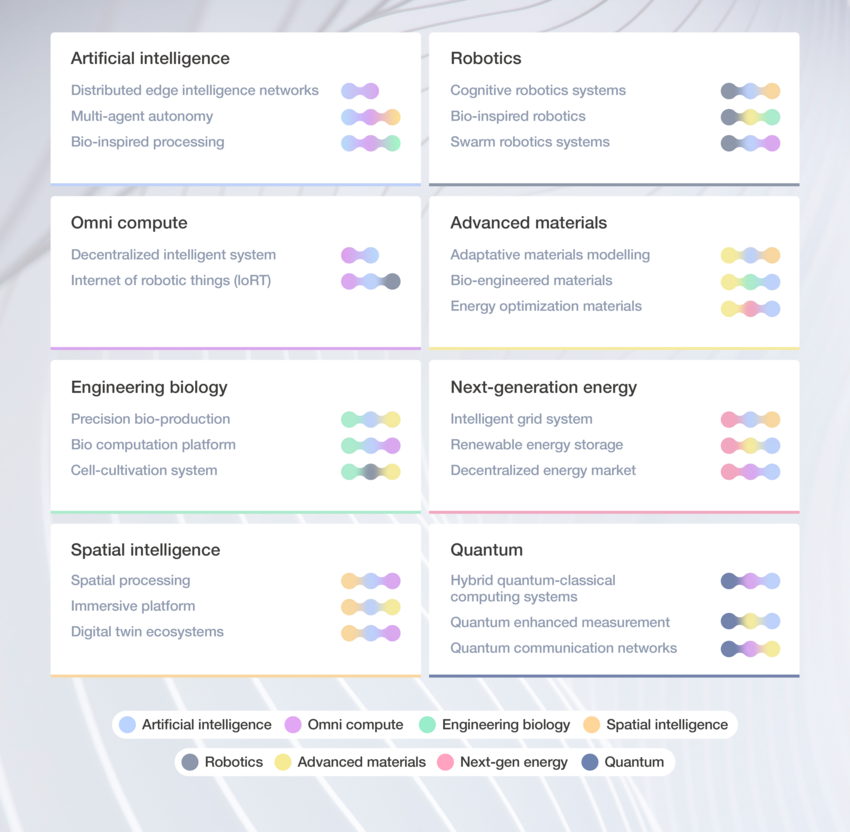 Patterns of technology domain combinations
Value, in other words, is found in the connective tissue. The report highlights how this is currently playing out on the ground. In the UK, healthcare providers are integrating surgical robots in ways that actively preserve the workflow of human care teams rather than disrupting them.
Meanwhile, in China, automated laboratories are linking AI platforms with robotics to accelerate research discovery across vast, multi-site networks.
Also read: “Never trust, always verify”: South Africa’s costly lesson after AI hallucinations taint National AI Policy
WEF: From Adoption to Orchestration
For regions currently building out their technology infrastructure, from Silicon Valley down to the rapidly maturing digital economies and fintech hubs across Lagos and Nairobi, the implications of this report are massive. It permanently moves the conversation from simple tech adoption to structural orchestration.
It is no longer enough to procure an AI model; companies must figure out how that model interacts with their data pipelines, human workforce, and supply chain logistics.
Aiman Ezzat, CEO of Capgemini Group, points out that technology convergence has evolved from a technical discussion into a strategic leadership mandate with direct operational impact.
“Competitive advantage increasingly depends on an organisation’s ability to integrate technologies, teams, partners and operating processes into coherent systems that deliver value at scale. Leaders who master orchestration, not just adoption, are the ones translating convergence into sustained performance and growth”, she said.
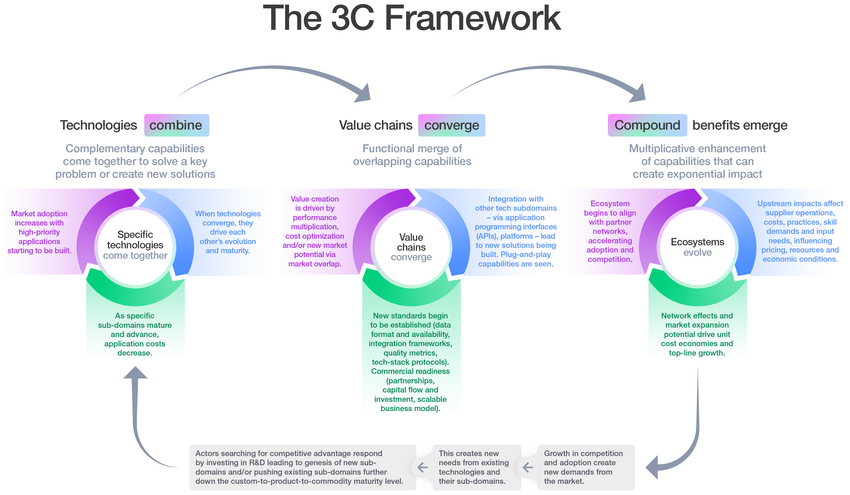 The 3C
This reality extends beyond corporate boardrooms and directly into industrial policy. As Jeremy Jurgens, WEF managing director, warns, national economies that fail to align their talent, data, and regulations with this convergence will simply be outpaced.
“This shift has implications not only for companies but also for national growth strategies and industrial policy. Economies that align talent, infrastructure, data and policy will be better positioned to capture the benefits of converging technologies amid a fast-shifting global landscape.”
To help organisations track this transition, the WEF has introduced the “3C framework,” combination, convergence, and compounding, alongside a technology maturity index. It is a highly practical tool designed to measure exactly how experimental technology domains move from pilot programmes into tangible market impact.
Ultimately, the WEF report is a necessary reality check for an industry historically blinded by hype. It confirms that the future does not belong to the company with the most impressive patents, but very well belongs to the system builders.


You May Also Like

Stablecoin Transfer Volume Falls 19.18% to $831B

Today’s Wordle #1775 Hints And Answer For Wednesday, April 29




