5 Brokers for Crypto Options Trading
Crypto options trading sits at the harder end of the derivatives spectrum. The product itself is unforgiving: pricing is non-linear, Greeks shift with every tick, and a margin model that makes sense in calm markets can liquidate you in a violent one. In this article, we will explore 5 Brokers for Crypto Options Trading.
What to look for in a crypto options broker?
1) Order book depth and tightness
Options pricing is sensitive to spread. A 10 to 20 vol point bid-ask on a thin strike will eat your edge before the trade even starts working. Look for venues where near-the-money strikes on weekly and quarterly expiries actually trade, not just quote. Deribit which is covered in 5 Brokers for Crypto Options Trading article, for example, currently holds a dominant share of BTC and ETH options open interest, which compounds into tighter pricing as more market makers commit capital.
2) Settlement currency and collateral mix
Some venues settle options in the underlying asset (BTC or ETH), others in stablecoins. The settlement choice changes how your PnL is accounted for and how clean your hedges are. If you think in dollars but the contract pays you in BTC, you carry an embedded delta you may not have priced. Check whether stablecoins can be posted as margin even when settlement is in coin.
3) Margin model and portfolio netting
Standard margin treats each position individually. Portfolio margin runs a risk simulation across the whole book and credits offsets between positions that hedge each other. For multi-leg strategies, condors, calendars, ratios, the difference is significant. A venue without portfolio margin will tie up two to five times more collateral on the same risk profile.
4) Liquidation mechanics
Read how the venue actually liquidates. Some platforms attempt delta-hedge first using futures or perps before unwinding the option leg, which preserves more of the trader’s value. Others dump positions directly into the book. The difference shows up as slippage on the way out, and it is the single biggest hidden cost of running short volatility.
5) Total fee load
Headline maker-taker rates are only part of the cost. Add exercise or settlement fees, the option fee cap, withdrawal costs, and the funding drag if you hedge with perps on the same venue. Sophisticated venues publish a per-trade fee cap so a deep in-the-money option does not become uneconomic to settle.
6) Greeks, vol surface, and analytics
If the platform does not give you a clean vol surface, term structure view, and live Greeks at the position level, you are flying blind. Serious options traders need fast visibility into delta, gamma, vega, and theta exposure across the whole book.
7) Order types and execution controls
Limit, post-only, reduce-only, stop, and trigger orders are the bare minimum. For multi-leg execution, check whether the venue supports combo orders or block trades through an RFQ channel. RFQ access matters once your size is large enough to move the public book.
8) API quality and latency
Systematic traders should evaluate websocket stability, rate limits, timestamp consistency, and whether market data and order entry are co-located. The cleanest venues publish detailed API documentation and have FIX or low-latency endpoints for institutional flow.
9) Insurance fund and counterparty risk
Crypto options venues can experience auto-deleveraging when a liquidation cannot be filled cleanly. Insurance funds backstop counterparty default and are typically funded by liquidation fees. The size and history of the fund tell you how seriously the venue takes its own risk engine.
10) Jurisdiction, custody, and compliance
Onboarding rules, restricted regions, and KYC requirements all affect access. For onchain venues, the question shifts to smart contract risk, governance arrangements, and whether settlement is genuinely self-custodial. Both centralised and onchain models are legitimate, but the risks live in different places.
5 best brokers for crypto options trading
1. Deribit
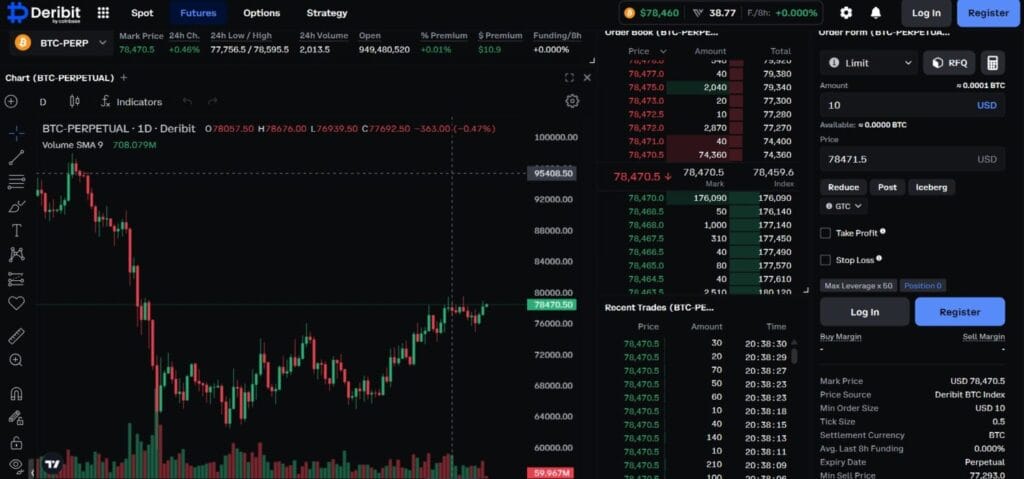
Deribit is the gravity well of the crypto options market. Founded in 2016 and now operating under the Deribit by Coinbase brand, the venue concentrates the deepest BTC and ETH options liquidity in one place, with weekly, monthly, and quarterly expiries listed across hundreds of strikes. For active volatility traders, this depth is the entire reason to be there. Tight spreads, continuous market making, and a mature options chain are not nice-to-haves on a vol desk, they are the platform.
- Options-first design: Deribit’s product surface is built around options. The trading screen, position builder, Greeks display, and risk dashboard all assume options are your primary instrument rather than an afterthought.
- Linear and inverse contracts: BTC and ETH options are quoted in the underlying with USD reference pricing. Deribit also offers linear USDC-settled options on BTC, ETH, SOL, AVAX, TRX, and XRP, giving traders a cleaner stablecoin PnL path on supported markets.
- Portfolio margin and cross-collateral: The venue supports segregated portfolio margin and cross portfolio margin, with BTC, ETH, USDC, USDT, and stETH all usable as collateral. This makes hedged books materially more capital efficient than isolated margin would allow.
- Hedging tools next door: Perpetuals and dated futures sit on the same screen, so delta hedging and rolling positions does not require moving collateral across venues.
- Insurance and risk engine: Each settlement currency has its own insurance fund, and liquidations follow a published incremental reduction process rather than a market dump.
- Restricted jurisdictions: Retail access is closed for users resident in the United States, Canada, and the United Kingdom, among others. Always check the live restricted list before onboarding.
2. Derive.xyz
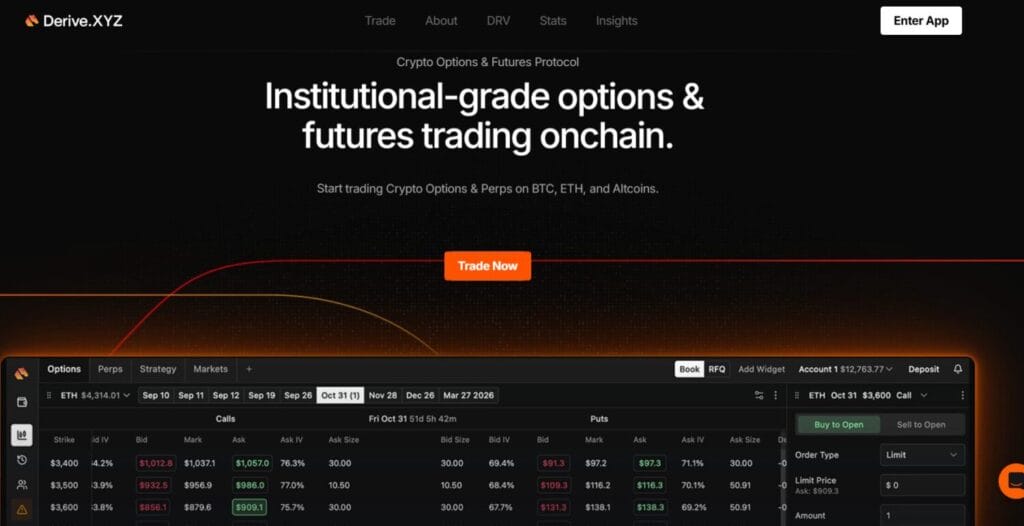
Derive.xyz, the rebranded continuation of Lyra Finance, is the most credible onchain alternative to centralised options venues. The platform sits on Derive Chain, an OP Stack rollup secured by Ethereum, with the Derive Protocol smart contracts handling margin, clearing, and settlement. The UX deliberately mimics a centralised exchange while keeping custody of funds in a smart contract wallet that the trader controls.
- Onchain settlement, CEX-like execution: Orders are matched off-chain for speed and settled onchain for transparency. The result feels closer to Deribit than to a typical AMM.
- Cross-margin and multi-asset collateral: USDC, ETH, wBTC, wstETH, and other ERC20 assets can be used as collateral. A single cross-margin account nets exposures across options and perpetuals.
- Options plus perps: Derive lists European-style BTC and ETH options alongside perpetual swap markets covering 12 or more major assets, with leverage up to 15x on perps. Combining the two on one account unlocks covered calls, protective puts, and gamma scalping without bridging.
- DRV token and DAO governance: The Derive DAO governs the protocol. Twenty five percent of protocol revenue is allocated to weekly DRV buybacks, and staked holders earn rewards funded initially by emissions and later by buybacks.
- Off-exchange custody for institutions: A Strands Finance integration lets funds trade on Derive while assets remain at a regulated custodian. This is a meaningful answer to the custody question that has historically kept institutional capital out of onchain derivatives.
- Trade-offs to weigh: Liquidity is materially smaller than Deribit, and the platform is unambiguously aimed at experienced options traders rather than first-timers.
 5 Brokers for Crypto Options Trading
3. OKX
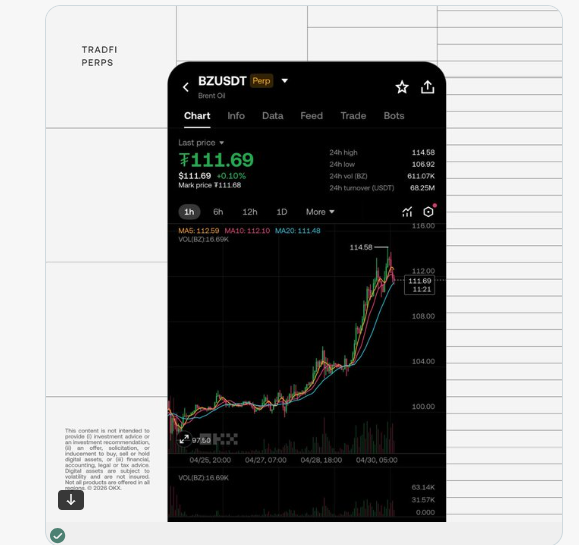
OKX positions options inside a full-suite derivatives stack that also covers spot, margin, perpetuals, and dated futures. The defining feature for options traders is the Unified Account, which lets a single pool of collateral support positions across product types. Combine that with portfolio margin, and you have a venue that rewards traders running cross-product books.
- Settlement in BTC or ETH: OKX options are settled in the underlying coin rather than stablecoins. Stablecoins can still be posted as margin in portfolio margin or multi-currency cross modes, with auto-borrow handling the FX leg.
- Portfolio margin requires net equity above 10,000 USD: This threshold is published in the OKX docs and gates access to the most capital-efficient mode. Below that, traders use single-currency or multi-currency margin.
- Risk-based liquidation: Portfolio margin liquidations begin with delta hedging via perpetuals or futures rather than direct option unwinds, which protects against slippage on illiquid strikes.
- Block trades and RFQ: OKX runs a Liquid Marketplace for larger size, useful when a trade is big enough to disturb the public book.
- Standard contract sizes: BTC options carry a 0.01 multiplier and ETH options a 0.1 multiplier, with a minimum RFQ size of 1,000 USD.
- Regional access: Derivatives access is restricted in the United States, the United Kingdom, Canada, and parts of the EU. The US entity launched in April 2025 supports spot only.
 5 Brokers for Crypto Options Trading
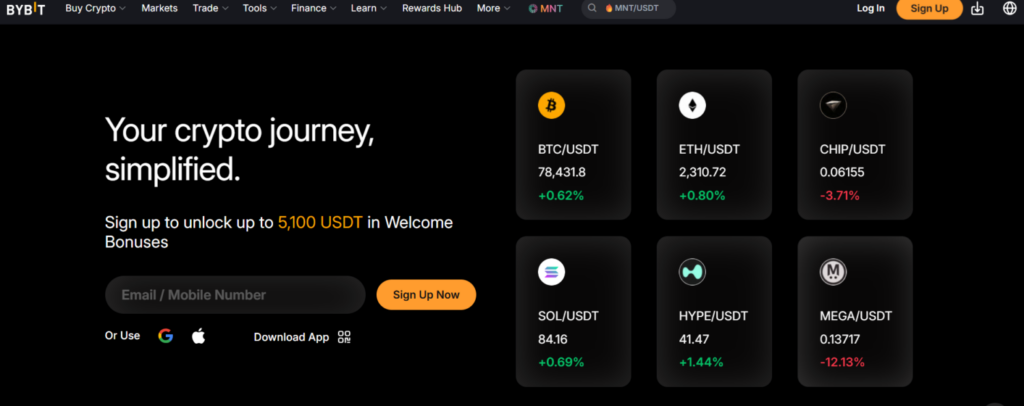
4. Bybit
Bybit lists European-style, cash-settled options on BTC, ETH, SOL, and a growing roster of altcoins, with both USDT-settled and USDC-settled product lines. The Unified Trading Account ties options to perpetuals, futures, and spot in a single collateral pool. For traders who want options without leaving a high-volume general-purpose exchange, Bybit is one of the cleanest fits.
- European-style, cash-settled: Auto-exercise at expiry. The settlement price is the average index price over the 30 minutes preceding expiration, which limits manipulation risk in the final minutes.
- USDT and USDC product lines: Newer USDT-settled options sit alongside the original USDC product. Choice of line affects collateral handling and which of your existing balances you can use directly.
- Portfolio margin under UTA: Hedged books receive lower initial margin than under cross margin, while same-direction positions receive higher. The trade is genuinely risk-based.
- Margin call mechanics: Bybit emails a margin warning once UTA maintenance margin utilisation exceeds 70 percent, with alerts capped at one every 15 minutes. Traders should not rely on the alert as a primary risk control.
- Liquidation flow: Order book fills come first, with OTC market makers stepping in if liquidity is insufficient. The procedure is documented in the help centre, which is more than many competing venues offer.
- Coverage breadth: Bybit has expanded options to cover XRP, DOGE, SOL, and others over the last year, broadening the venue beyond the BTC and ETH duopoly that defines most CEX options books.
 5 Brokers for Crypto Options Trading
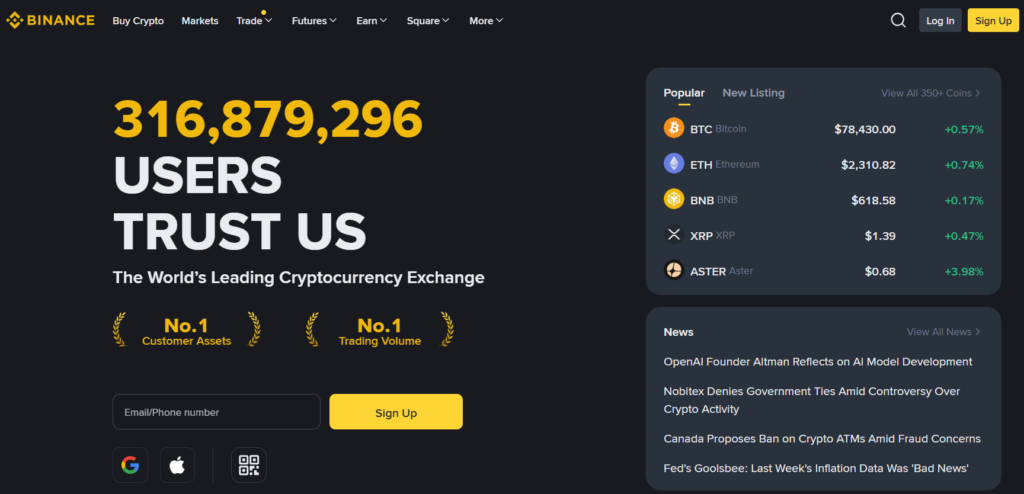
5. Binance
Binance Options is the highest-volume general-exchange options product, offering European-style vanilla contracts on BTC, ETH, BNB, SOL, and XRP. Contracts are priced and settled in USDT, which keeps PnL accounting in stablecoin terms throughout. For traders who already operate across Binance spot and futures, options sit naturally inside the same wallet.
- European-style, USDT-settled: Auto-exercise at expiry, with settlement based on the average spot index price during a defined window before expiration.
- Multiple expiry buckets: Daily contracts with a three-day trading life, weekly contracts expiring Friday, monthly contracts on the last Friday, and quarterly contracts in March, June, September, and December.
- Capped fees: Transaction fees run at 0.03 percent of notional with a 10 percent of option value cap. Exercise fees are 0.015 percent, also capped at 10 percent. The cap protects deep ITM contracts from settlement becoming uneconomic.
- BVOL volatility index: Binance publishes a proprietary implied volatility measure derived from its own options book, useful as a sentiment and term structure reference.
- Buyer risk is bounded: Option buyers cannot be liquidated. The maximum loss is the premium paid. Sellers face standard margin call and liquidation logic.
- Restricted jurisdictions: Options are not offered in the United States, Canada, and certain European jurisdictions. Retail access depends on the local Binance entity.
 5 Brokers for Crypto Options Trading
5 Brokers for Crypto Options Trading: Comparative analysis
5 Brokers for Crypto Options Trading: Conclusion
In choosing among 5 Brokers for Crypto Options Trading, there is no universal answer to which crypto options venue is best, only better fits for different trading styles. Our take, after working through the architecture of each platform, breaks roughly into three buckets.
If your strategy lives or dies by depth and execution quality, Deribit remains the default. The combination of dominant BTC and ETH options market share, mature portfolio margin, and an options-native interface makes it hard to displace for serious volatility trading.
OKX and Bybit are the strongest centralised alternatives when you want options as one product among many, with cross-product margin offsetting and a single collateral pool. Binance brings the same all-in-one logic with a USDT-only PnL stream that keeps accounting clean for traders who prefer stablecoin denomination throughout.
Derive.xyz is the right answer to a different question. If your priorities include self-custody, smart contract transparency, and the option to keep assets at an external custodian via Strands, the platform offers an onchain venue that does not feel like a downgrade in trader experience. The trade-off is liquidity, which is real but improving as institutional flow migrates onchain.
Match the venue to the strategy, size the position to the liquidity available, and read the margin and liquidation rules before the volatility shows up rather than after.
Are all crypto options European-style?
Most crypto options on major venues are European-style, meaning exercise happens only at expiry. Always confirm whether a contract is European or American and whether settlement is cash or physical, because the difference affects how you manage the position into expiration.
Can I use stablecoins as collateral on every venue?
Not always in the same way. Some venues settle in BTC or ETH but accept stablecoins as margin under portfolio margin or multi-currency modes, with auto-borrow handling the conversion. Others run fully stablecoin-settled product lines. The settlement currency drives PnL accounting, so check both before opening a position.
Is onchain options trading safe enough for serious size?
Onchain venues replace counterparty risk with smart contract and bridge risk. The risk is genuinely different rather than smaller, and it should be evaluated as carefully as you would evaluate any centralised venue’s insurance fund and risk engine. Off-exchange custody integrations like the Strands setup on Derive.xyz reduce one specific failure mode by keeping assets at a regulated custodian while execution stays onchain.


You May Also Like

TRON Powers 500% Surge in Crypto Card Spending as Stablecoin Payments Hit $600M Monthly

Trump's 'rupture' with two key allies has pushed him into 'lame duck' territory: analyst