Midterms Spur Regulatory Scrutiny Over Crypto and AI Super PACs
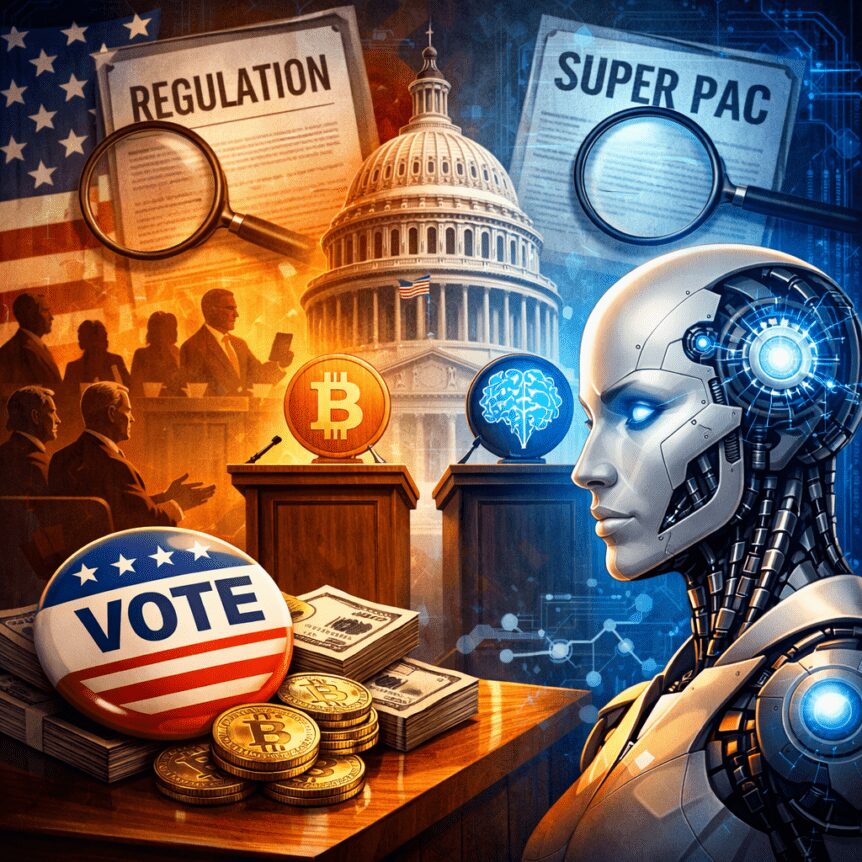
In the run-up to the 2026 midterm elections, industry groups aligned with crypto and artificial intelligence are channeling tens of millions of dollars into political committees, even as a new survey indicates broad skepticism among Americans toward both sectors. According to an April 2026 poll conducted by Public First for Politico, 45% of Americans say investing in cryptocurrency is not worth the risk, and 44% believe AI is developing too fast. The survey also found that nearly half of respondents trust traditional banks more than crypto platforms, and two-thirds want Congress to impose strict regulations or broad oversight on AI.
The findings pose a regulatory and political challenge for candidates accepting money from industry-aligned super PACs. In hypothetical matchups, respondents were notably less likely to back candidates supported by groups pushing looser AI regulations than those backed by groups advocating tighter tech rules. The report warned that public skepticism could translate into voter backlash if Americans grow weary of heavy industry spending.
The poll sampled 2,035 U.S. adults online between April 11 and 14, 2026, with results weighted for age, race, gender, geography and education. The margin of sampling error was ±2.2 percentage points. Source: Politico via Public First.
Key takeaways
- Crypto investments: 45% say investing in cryptocurrency is not worth the risk.
- AI development: 44% think AI is developing too fast.
- Trust in institutions: nearly 50% favor traditional banks over crypto platforms.
- Regulatory preference: about 66% want Congress to impose strict regulations or broad oversight on AI.
- Electoral impact of funding: voters favor candidates backed by groups backing tighter AI rules over those backed by groups seeking looser regulation.
- Awareness gap: a minority of voters are aware of industry-aligned PACs, signaling potential rapid shifts if voters connect donor ties to industries.
- Sample size and rigor: the survey encompassed 2,035 online adults with a ±2.2-point margin of error.
AI and crypto in the campaign finance landscape
Industry-aligned political action committees are deploying substantial funds to influence primaries and general election outcomes. Leading the Future, a pro-AI super PAC launched in August 2025, has raised more than $75 million and has deployed resources across primaries in North Carolina, Texas, Illinois and New York. Fairshake, the pro-crypto PAC backed by major industry players including Coinbase, Andreessen Horowitz and Ripple Labs, has already spent about $28 million across competitive races.
Beyond direct contributions, lobbying activity underscores intensifying policy work. OpenAI and Anthropic reported record lobbying expenditures in the first quarter of 2026 as AI policy became a central congressional agenda item. In the crypto policy arena, industry advocates are pressing the CLARITY Act in the U.S. Senate, a measure aimed at providing regulatory clarity for digital assets and their market structure.
The policy milieu includes a historical thread of industry influence on legislation. For instance, Fairshake-linked activity in 2024 contributed to efforts that helped defeat Ohio Senator Sherrod Brown, a noted crypto skeptic who is stating a run for office again. This context highlights how PAC funding intersects with regulatory narratives and election outcomes. Cointelegraph has previously reported on the crypto policy agenda and regulatory proposals such as the CLARITY Act, which lawmakers have discussed as a pathway to clearer market rules.
Public awareness and potential electoral implications
Despite the notable sums behind AI and crypto advocacy, public recognition of these groups remains low. Polling showed that only about 9% of respondents have heard of the Leading the Future AI PAC, and roughly 3% recognize Fairshake. Observers cited by Politico noted that once voters connect the money to the industries behind it, backlash could be swift and meaningful.
Former Ohio Representative Jim Renacci, quoted by Politico, suggested that voters may view candidates backed by crypto fundraising as a political liability once donor affiliations are understood. This dynamic underscores how campaign finance transparency and regulatory narratives can influence electoral perceptions, independent of the underlying technology’s merits.
The policy conversation surrounding these factions sits within a broader regulatory framework that includes U.S. and global considerations. While the EU’s MiCA framework seeks harmonized rules for crypto markets, U.S. regulators—led by agencies such as the SEC, CFTC and DOJ—continue to refine guidance on registration, compliance, customer due diligence (AML/KYC) and licensing requirements. The ongoing lobbying and proposed statutes like the CLARITY Act demonstrate the high-stakes contest over how digital assets and AI-enabled services will be overseen in a rapidly evolving market structure.
Looking ahead, the convergence of public sentiment, policy proposals and campaign finance will shape how crypto and AI ecosystems interact with traditional financial systems and regulators. For institutions, this means heightened attention to compliance risk, licensing trajectories, and cross-border regulatory differences as lawmakers weigh stricter oversight against innovation and capital formation.
In the near term, observers will watch for clarity on how AI oversight and crypto market rules are harmonized at the legislative level, how regulators define permissible activities for crypto platforms and AI-assisted services, and how political fundraising disclosures influence voter trust and candidate viability in key battleground districts.
What to watch next: the trajectory of the CLARITY Act in the Senate, ongoing lobbying activity from AI and crypto interests, and the potential for voter backlash as campaign finance visibility increases. These developments will inform institutional risk assessments, regulatory monitoring programs, and compliance planning across crypto firms, exchanges and financial entities engaged in AI-enabled services.
This article was originally published as Midterms Spur Regulatory Scrutiny Over Crypto and AI Super PACs on Crypto Breaking News – your trusted source for crypto news, Bitcoin news, and blockchain updates.


You May Also Like

Amkor Technology (AMKR) Stock Surges as Analyst Hikes Target to $90 Following Strong Q1 Results

Massive 331 Million USDT Transfer to Kraken Sparks Whale Alert and Market Speculation