

Bookmap vs. GoCharting vs. ATAS vs. Jigsaw vs. Quantower: Best Order Flow Tool for Futures Traders
Futures traders operate in a world where milliseconds and limit order placement matter more than candlestick patterns. The best order flow tool futures traders need is not the one with the most features — it is the one that shows the right information clearly, fast, and without getting in the way of execution. This comparison puts five serious platforms side by side: Bookmap for live heatmap liquidity, GoCharting for browser-based accessibility, ATAS for cluster analysis depth, Jigsaw for DOM-first order flow education, and Quantower for multi-broker modular flexibility. Each platform earns its place here. None of them is for casual traders.
Comparison Table
Bookmap
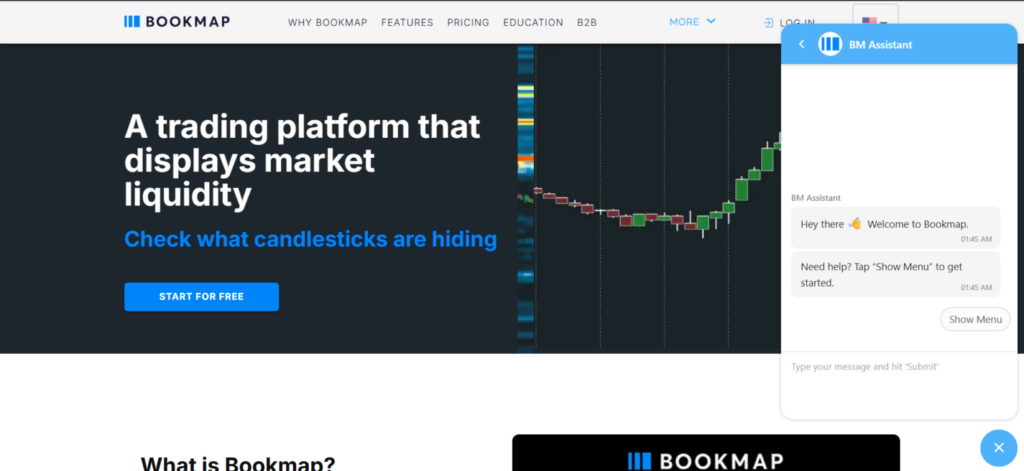
Bookmap is the most visually distinctive order flow platform in this comparison. Instead of a standard chart, it renders the full limit order book as a live colour-coded heatmap updating at 40 frames per second. Dark areas represent thin liquidity. Bright orange and red zones represent heavy concentrations of resting buy or sell orders. Watching price move toward a thick wall of liquidity and either absorb through it or bounce off it is a level of market visibility that no standard candlestick chart can replicate.
For futures scalpers, Bookmap’s edge is pre-trade awareness. Resting walls signal where institutional players have placed large orders. When those walls suddenly disappear, pulled before price reaches them, experienced Bookmap users recognise that as a potential spoofing signal. The iceberg order detector adds another layer, flagging large positions being executed in small tranches to disguise true order size. Bookmap runs on Windows only and requires separate data subscriptions.
Pricing starts at a free Digital plan, $49 per month for Global, and $99 per month for Global+.
Key Features:
- 40fps Liquidity Heatmap — Renders the full limit order book in real time as a colour-coded heatmap at 40 frames per second, making resting institutional orders, liquidity walls, and order book shifts visible before price arrives.
- Iceberg Order Detector — Identifies large institutional positions being broken into smaller tranches to hide true size, surfacing hidden smart money activity that standard charts and most order flow tools cannot detect.
- Cumulative Volume Delta (CVD) — Tracks the running net difference between aggressive buying and selling volume to confirm whether price moves are backed by genuine participation or vulnerable to reversal.
GoCharting
GoCharting is the only browser-based platform in this comparison, and that distinction is more significant than it sounds. Every other tool here requires a Windows desktop installation, data feed subscriptions configured through separate software, and hardware capable of running resource-intensive desktop applications. GoCharting delivers footprint charts, Market Profile, cumulative delta, heatmap visualisation, and depth of market entirely through a modern web browser. Mac users, Chromebook users, and traders who prefer not to manage local software environments can access the same class of order flow analysis.
In a GoCharting vs Quantower comparison, the gap shows up most clearly in data depth and market coverage. Quantower with Rithmic data delivers faster and more granular futures tick data for CME instruments. GoCharting is strongest on crypto and Indian market data — NSE, BSE, Binance, Bybit, and Deribit — where it offers retail-accessible institutional-grade tools that most desktop platforms do not focus on. The Orderflows Trader integration adds 21 proprietary order flow indicators, including exhaustion prints, absorption zones, and delta ratio signals.
For futures traders who primarily trade crypto or Indian derivatives, GoCharting is a compelling choice. For US CME futures scalpers needing the tightest possible data quality, desktop platforms retain an edge.
Key Features:
- Browser-Based Footprint Charts — Fully interactive cluster charts built in HTML5 Canvas supporting Bid x Ask, Delta, Total Volume, and Imbalance display modes, accessible without software installation on any device.
- Market Profile (TPO) — Automatic TPO profile generation identifying Value Area High, Value Area Low, Point of Control, single prints, and poor highs and lows, supporting both individual and composite session profiles.
- 21-Indicator Orderflows Trader Integration — Proprietary order flow indicator suite covering exhaustion prints, absorption patterns, delta ratio analysis, and extreme delta signals usable directly within the GoCharting interface.
ATAS
ATAS (Advanced Trading Analytical Software) is the deepest cluster analysis platform available to retail futures traders. Where Bookmap specialises in showing the live order book, and Jigsaw specialises in DOM execution, ATAS is built to show traders everything that happened inside every single candle — every bid, every ask, every imbalance, every institutional footprint — through over 400 footprint chart variants and more than 300 built-in indicators.
For serious futures traders focused on CME instruments like ES, NQ, CL, and GC, ATAS with a Rithmic or CQG data feed is a professional-grade analytical environment. The Smart Tape filters the raw time-and-sales feed to surface meaningful institutional prints while ignoring the noise from small retail trades. Cluster Search automatically identifies bars that meet user-defined criteria for volume, delta, or trade count, eliminating the need to manually scan for unusual activity. Market Replay is one of ATAS’s most valuable features for development: it replays full historical sessions with complete tick-by-tick order flow data at real-time speed, allowing traders to practice reading market microstructure without risking capital. The honest tradeoff is complexity: most traders report needing a month or more of daily practice before ATAS tools become intuitive.
Pricing starts at a free tier, $24.95 per month for Plus, with higher Pro and Ultra tiers available.
Key Features:
- 400+ Footprint Chart Variants — The most extensive cluster chart customisation at retail level, from numerical Bid x Ask grids to heatmap-colored profiles, delta-dominant views, and hybrid display modes for any analytical preference.
- Smart Tape — A filtered time and sales feed that cuts through low-significance retail prints to surface large institutional trades, absorption events, and aggressive directional activity as it happens.
- Cluster Search — Automatically flags bars matching user-defined volume, delta, or trade count criteria, highlighting areas of unusual institutional activity without requiring manual chart-by-chart review.
Jigsaw Trading
Jigsaw Trading occupies a unique position in this comparison. While every other platform here is primarily an analytical tool, Jigsaw is simultaneously a professional-grade execution platform, an order flow education system, and a trading journal — and it does all three deliberately. Founded by Peter Davies in 2011, Jigsaw has grown to over 6,000 traders with 23% trading full-time. Its educational materials are used by actual proprietary trading firms, including London-based Axia Futures for intern trader training.
The Daytradr platform is built around a single central insight: the price ladder tells you things the chart never will. Its depth of market is widely considered the best retail implementation of institutional price ladder techniques available. The Reconstructed Tape filters the time and sales data to remove the noise created by order splitting, showing trades as they were genuinely intended rather than artificially fragmented. Auction Vista adds historical context to the live order flow, helping traders identify high-volume nodes and hidden iceberg activity.
Jigsaw’s pricing model is a one-time purchase ranging from $579 to $1,379, depending on the tier, plus $50 per month for live trading data. In any honest Jigsaw Trading review, the education is consistently flagged as one of its biggest differentiators — the 10-hour foundational course alone is more substantive than most paid trading courses on the market.
Key Features:
- Professional Price Ladder DOM — Purpose-built depth of market tool designed around institutional price ladder techniques, widely regarded as the best retail implementation of professional DOM trading available at any price point.
- Reconstructed Tape — Filters the time and sales feed to recombine artificially split orders back into their true form, showing the actual size and intent of each trade rather than fragmented prints created by execution algorithms.
- Auction Vista — Adds historical order flow context to the live DOM, identifying high-volume price nodes, hidden iceberg zones, and historical market structure to inform real-time trade decisions.
Quantower
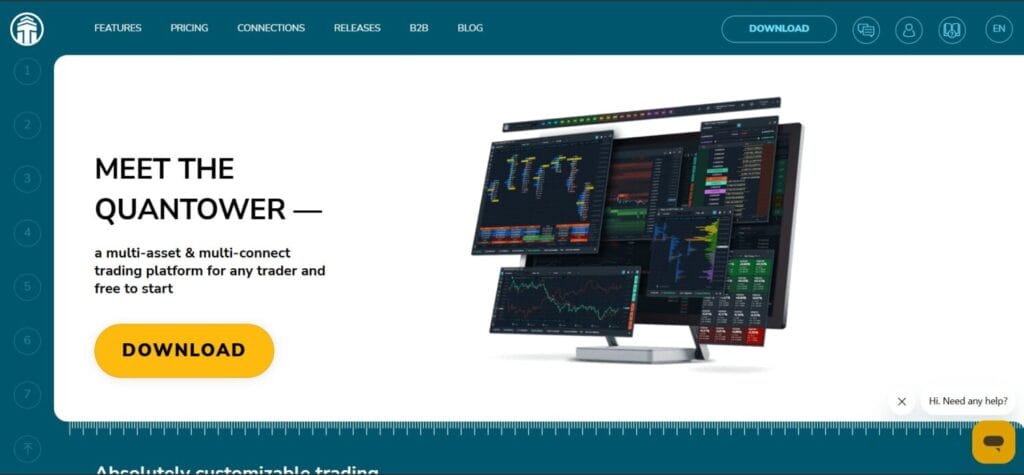
Quantower is the most versatile platform in this comparison. Where Bookmap is laser-focused on heatmap visualisation, and Jigsaw is laser-focused on DOM execution, Quantower is designed to be a modular trading toolkit that connects to over 60 brokers, exchanges, and data feeds and allows traders to configure every panel independently. Footprint charts, DOM Surface heatmap, Volume Profile, TPO charts, Market Replay, and automated strategy deployment all exist within the same workspace, arranged however the trader needs them.
For prop firm traders in particular, Quantower has become a go-to platform. It connects to Rithmic and CQG data feeds used by most futures prop firms, supports simultaneous multi-account monitoring, and delivers execution speeds ranging from 12 to 25 milliseconds depending on the broker. The full platform costs $70 per month or $1,590 for a lifetime license, but AMP Futures and Optimus Futures offer it free through their white-labeled Optimus Flow version, making it one of the most cost-effective professional-grade order flow environments available. In any Quantower review, the modular architecture and broker-neutral design are consistently highlighted as its strongest differentiators from single-broker or single-style platforms.
Key Features:
- DOM Surface Heatmap — A live liquidity heatmap layered over the depth of market panel, visualizing order flow concentration and real-time shifts in buy and sell pressure across price levels for futures and crypto markets.
- Footprint Cluster Charts — Bid x Ask volume displayed at every price level inside each candle, with configurable imbalance ratios and delta overlays, showing exactly where aggressive buyers overwhelmed sellers and vice versa.
- 60+ Broker & Exchange Connections — Direct connectivity to Rithmic, CQG, Interactive Brokers, AMP Futures, Binance, and dozens more within a single platform, enabling multi-account and multi-market monitoring without switching applications.
Conclusion
The best order flow tool for futures traders, there is depends on the type of trader. Bookmap vs ATAS splits between those who want to watch the live order book evolve in real time versus those who want to dissect what happened inside every candle after the fact. Jigsaw is the strongest pick for traders who want to develop genuine DOM-reading skills, backed by prop-firm-level education. GoCharting vs Quantower comes down to platform access — GoCharting for crypto and Indian futures in a browser, Quantower for CME futures with multi-broker flexibility and prop firm Rithmic support. No single tool wins every category. The right platform depends on what you trade, how you trade it, and how deep into market microstructure you are ready to go.
Frequently Asked Questions (FAQs)
Which is better for CME futures — Bookmap or ATAS?
Both are strong for CME futures. Bookmap excels at visualizing the live order book and detecting resting liquidity. ATAS is better for post-trade cluster analysis and footprint reading. Many serious futures traders use both together for complementary views of market microstructure.
Is Jigsaw Trading worth the one-time cost?
For committed futures day traders, yes. The $579 base price includes a 10-hour order flow course used by professional prop firms. The DOM is widely considered the best retail implementation of institutional price ladder techniques. The cost is high but the quality matches it.
Can Quantower be used for free?
Yes. AMP Futures and Optimus Futures offer a white-labeled version of Quantower called Optimus Flow at no additional cost to their clients. This gives access to the full platform, including footprint charts, DOM Surface, and volume profiles without a separate subscription.
Is GoCharting suitable for US futures traders?
GoCharting works for US futures but is strongest for crypto and Indian market traders. For US CME futures requiring the highest quality tick data through Rithmic or CQG feeds, desktop platforms like ATAS, Quantower, or Jigsaw offer more reliable and granular data depth.
What is the learning curve for these order flow platforms?
Jigsaw and GoCharting have the most structured onboarding. ATAS requires the most time — typically one month or more to use effectively. Bookmap is visually intuitive but interpreting the heatmap correctly takes practice. Quantower is modular and approachable but overwhelming without a defined workflow.


You May Also Like

AT&T (T) Stock: J.P. Morgan Keeps It as a Top Pick on Fiber and 5G Strength
XRP News: Ripple Healthcare’s XRPL-Base Integration – What Next?




