

How Will Clarity Act Affect Cardano (ADA)?
Cardano is back in the picture after new updates from Charles Hoskinson, the founder of ADA. He talked about scaling and how decisions get made on the network. He confirmed that the Leios protocol is still on track for late 2026. There’s also Hydra, a second-layer solution. On top of that, people have submitted requests for $46.8 million from the treasury to pay for development.
Cardano is also pushing itself as a blockchain that puts governance first. That matters because debates about Bitcoin upgrades are showing how hard it can be to coordinate when things get big.
Right now, the ADA price is trading near $0.265 up 2.66% in 24 hours, with spot volume rising 36.76% to $678.6 million. The derivatives market looks strong too. Open interest climbed 18% to $2.17 billion ADA. Funding rates are near 9%. All of that shows traders are more confident in the move.
Why the CLARITY Act Could Be Bullish for the ADA Price
The CLARITY Act could end up being a big deal for crypto in the US. It sets clear rules for exchanges, token sales, DeFi, and stablecoins. But the most important part is how it decides what’s a commodity and what’s a security. That decision is based on how decentralized the project is.
Cardano fits well here. Cardanians shared on X that its Ouroboros system runs on more than 3,000 stake pools. No single group controls the block production. Voting power is also spread out, with over 900 delegates making decisions. All of this helps make the case that ADA should be treated as a digital commodity.
There’s also some history here. In earlier talks, the SEC and CFTC have already called ADA a commodity. If the CLARITY Act makes that official, it would remove a lot of legal uncertainty. And that uncertainty has been one of the biggest reasons big money stayed away from altcoins.
That said, the bill is still pending Senate approval. Until that process is complete, the impact remains forward-looking. Even so, the positioning alone is shaping how investors view the ADA price, especially in comparison to assets that face higher regulatory risk.
What the Cardano Chart Is Showing Right Now
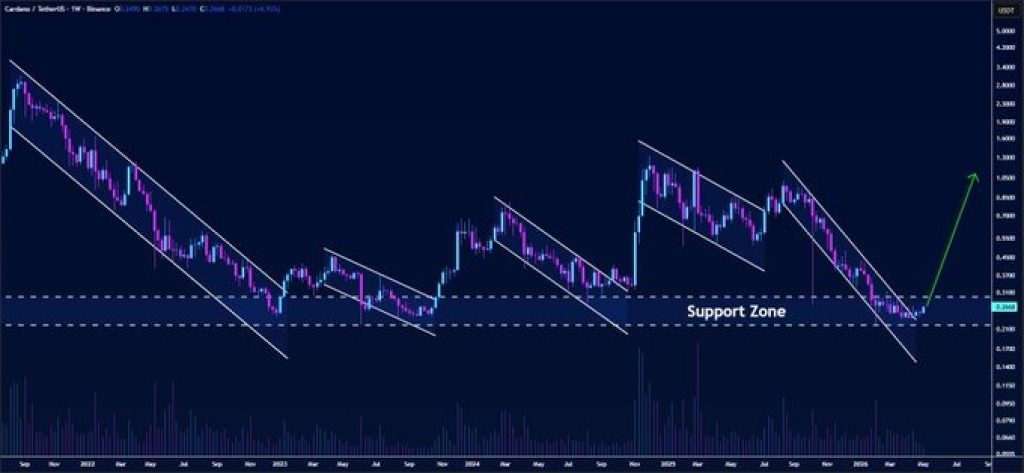
We had a look at the chart, and the structure lines up closely with the bullish narrative. On the weekly chart, price finally broke out of a long downward channel. That channel had been there since the last cycle peak. Breaking out of it turns the bigger picture from down to flat or up. That’s a real change in how the chart looks.
The chart also shows the ADA price holding steady above a clear support area. This area has been tested multiple times, and each time buyers stepped in quickly. That kind of reaction often shows strong demand at those levels, especially when it follows a breakout.
 Source: X/Butterfly
Analyst Butterfly points to growing pressure beneath the surface, and that is visible in the way price is compressing above support instead of falling back into the channel. When price holds above a breakout level like this, it increases the probability of continuation toward higher targets.
If the Cardano price confirms a bounce from this zone, the next upside targets come into view quickly. The structure indicates room for a move toward the $0.30 region first, with further upside depending on how volume develops. A loss of the support zone would weaken this setup, but for now, buyers remain in control.
Read Also: 52% of Crypto Voters Chose Zebec (ZBCN) Over ONDO & LINK to Lead RWA Narrative in 2027
What’s Next on the Cardano Roadmap
Cardano has a few upgrades planned for 2026 that could make the network more useful. That might also affect the price of ADA.
Around Q2 of 2026, the Protocol Version 11 hard fork should arrive. It adds new functions to Plutus, like support for arrays and more advanced calculations. Those changes give developers better tools and make building on Cardano less of a headache.
Then June 2026 brings the Leios testnet. This one is big. It’s designed to push the main network past 1,000 transactions per second. If that pans out, Cardano will have solved something a lot of blockchains trip over: scaling up without giving up decentralization.
On top of that, Cardano keeps moving forward with Midnight. That’s a sidechain built for privacy. And tools like LayerZero, which connects different blockchains, and Pyth, which brings in real-world data, are also on their way. All of this helps bring more money and better DeFi apps to Cardano.
Each of these developments ties back to utility. Better scalability, stronger developer tools, and improved interoperability can increase network usage. If adoption follows, demand for ADA could strengthen, especially as the network becomes more competitive with other Layer 1 platforms.
Still, the Cardano price is moving with support from fundamentals and market structure, backed by rising volume and derivatives activity. The CLARITY Act could give Cardano a regulatory advantage if its commodity status is confirmed, easing concerns for larger investors.
Another thing is, the chart shows a breakout with buyers defending key support, keeping the bullish setup intact. Upcoming upgrades like Leios and Protocol Version 11 add to the long-term case by improving scalability and utility. If these elements align, the ADA price has room to push higher in the coming months.
Frequently Asked Questions

ADA is rising mainly on strong trading activity, with a sharp jump in 24-hour volume showing real buying pressure behind the move rather than weak liquidity-driven spikes. At the same time, it’s outperforming Bitcoin as some capital rotates into altcoins during a mildly risk-on market phase. There’s no single major news catalyst, but the combination of high volume and broader market strength is supporting the upside.
Cardano is often viewed as a long-term play thanks to its research-focused design, proof-of-stake system, and gradual but steady ecosystem growth. However, it remains highly volatile and its development pace is slower compared to faster-moving competitors like Ethereum and Solana. That mix of potential and risk makes it more suitable for patient investors who can handle uncertainty.
XRP tends to appeal more to investors focused on real-world payment utility and stronger institutional use cases, while Cardano is more about long-term blockchain development and research-driven growth. In terms of near-term momentum and adoption clarity, XRP often has the edge, while ADA is more speculative and slower to prove large-scale utility. The better choice depends on whether you prefer established utility or longer-term development potential.
Subscribe to our YouTube channel for daily crypto updates, market insights, and expert analysis.
The post How Will Clarity Act Affect Cardano (ADA)? appeared first on CaptainAltcoin.


You May Also Like

Bitcoin Exchange Binance Announces New Listings on its Futures Platform! Here Are the Details

Flex Stock Surges 35% After Earnings Beat and Cloud Spin-Off Plan




