

The WEF Wants to Put a Market Price on Nature
The WEF claims that Larry Fink & Andre Hoffmann’s work on the board ‘do not represent any personal or professional interests,’ but they stand everything to gain: perspective
With billionaires Larry Fink and Andre Hoffmann as the new co-chairs, the World Economic Forum (WEF) publishes a 50-page blueprint on how to monetize everything in nature.
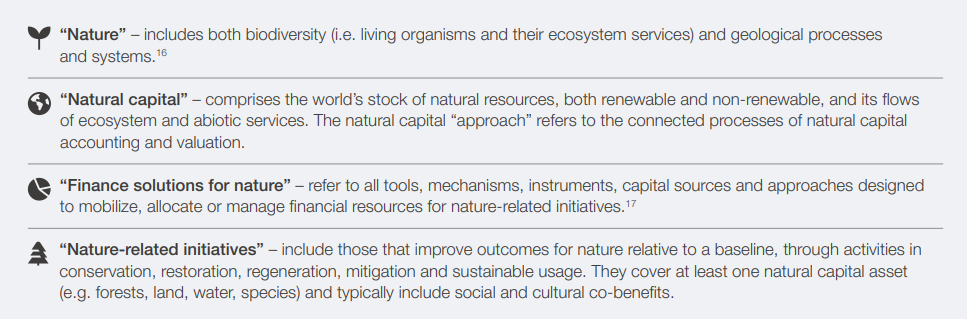
The WEF’s latest insight report “Finance Solutions for Natures: Pathways to Returns and Outcomes” provides “stakeholders” with dozens of financial solutions for monetizing everything in nature.
Nature pricing, biodiversity crediting schemes, natural asset companies, debt-for-nature swaps, and so much more are all packed into this agenda to overhaul the global financial system with nature-based activities.
\
\
\ The WEF leadership page says that in their work on the board of trustees, “members do not represent any personal or professional interests.”
However, the target audiences for latest WEF insight report are “institutional investors, banks, asset managers, and development actors” — the very business interests that Hoffmann and Fink represent.
WEF interim co-chairs Larry Fink and Andre Hoffmann stand everything to gain in their business dealings should the documentation, monetization, and tokenization of everything in nature ever come to full fruition.
And they are well on their way.
Fink’s BlackRock manages over $11 trillion in assets, and last year BlackRock said it was “conducting proprietary research on natural capital investment signals, identifying companies poised for financial advantage in avoiding nature-related risks or leaning into opportunities. Those signals cover themes such as energy management, water management, waste management and biodiversity – and can feed into portfolio construction or support custom exposures.”
Hoffmann is also a key player in a whole host of so-called green financing initiatives, including biodiversity crediting schemes, through his various roles as founder, president, and chairman at several companies and NGOs such as: Innovate 4 Nature — the “accelerator for nature-positive solutions” and Systemiq — the “system change company” established specifically to advance UN Agenda 2030.
\
https://x.com/wideawake_media/status/1894689120833753273?embedable=true
\
\
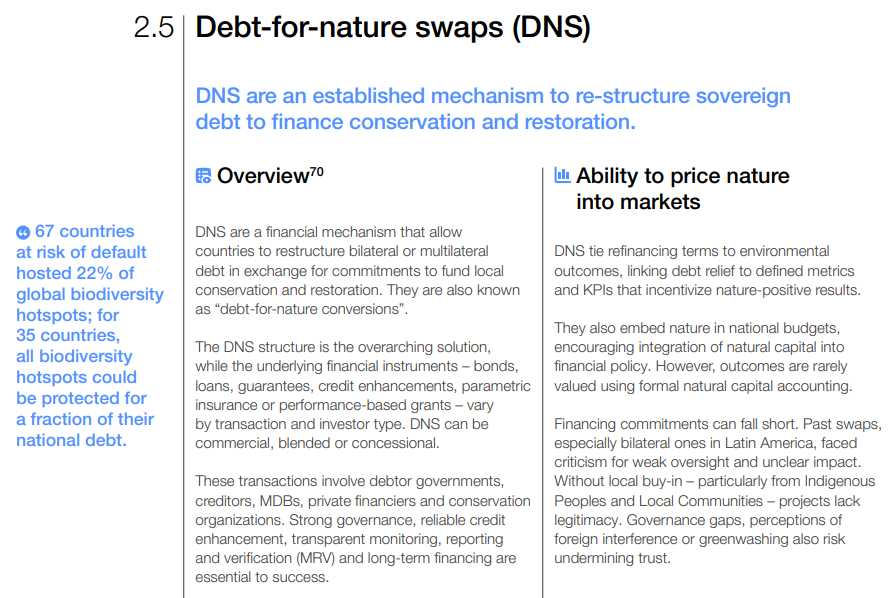
\ Is your country millions, billions, or trillions in debt? No problem!
With debt-for-nature swaps, you can restructure your nation’s debt just by letting somebody else come in and take control of your natural resources under the guise of conservation and restoration, but what they’ll really be doing is forcing you to “take out private insurance policies to ‘mitigate the financial impact of natural disasters‘ as well as ‘political risk,'” as investigative journalists Whitney Webb and Mark Goodwin report in Bitcoin Magazine.
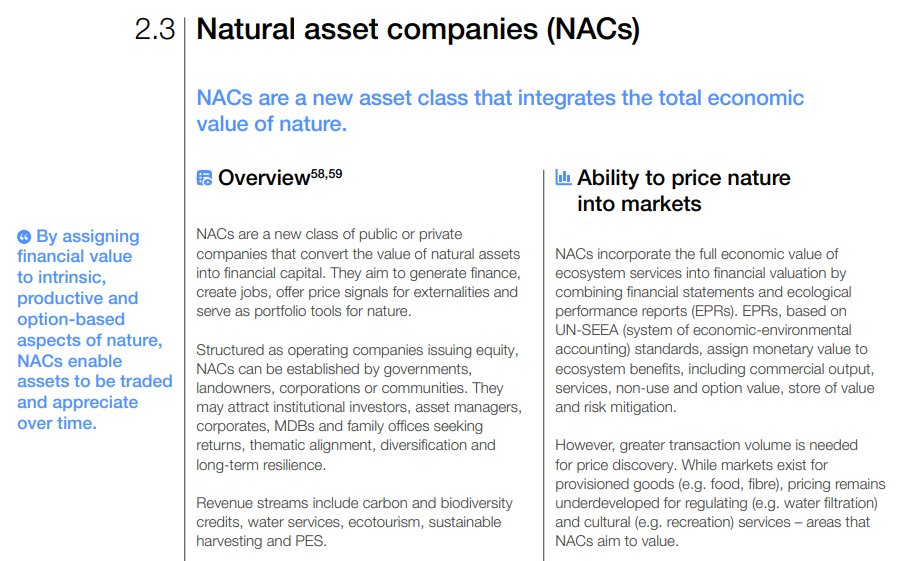
Don’t have any money, but want to create value out of thin air, water, soil, or trees? You can set up natural asset companies that can “convert the full economic value of nature into financial flows via equity models.”
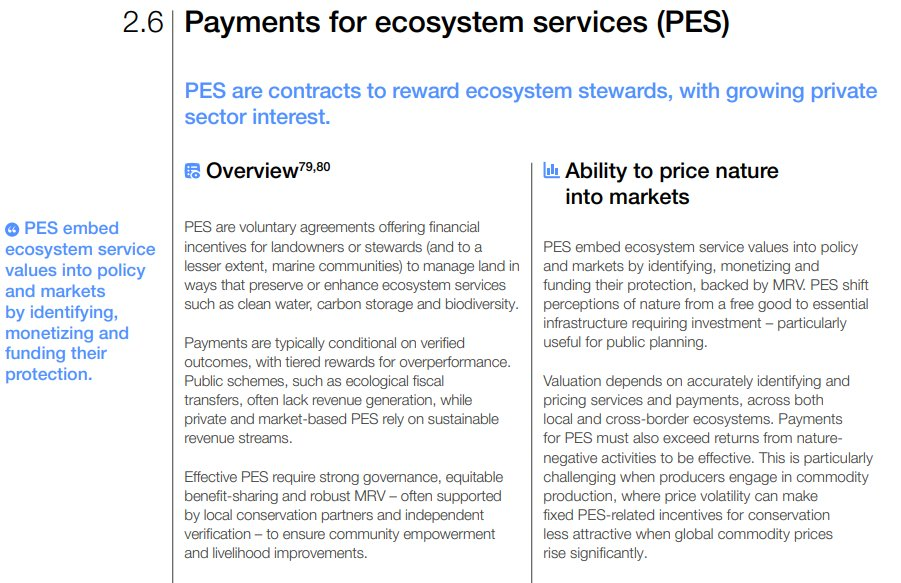
\ Want to help asset managers, bankers, and hedge fund execs get extremely rich while leaving you with only a tiny fraction? Go ahead and get involved in a Payment for Environmental Services (PES) scheme, where financial incentives are provided to individuals or communities in exchange for maintaining or restoring ecosystem services, like carbon sequestration or biodiversity conservation.
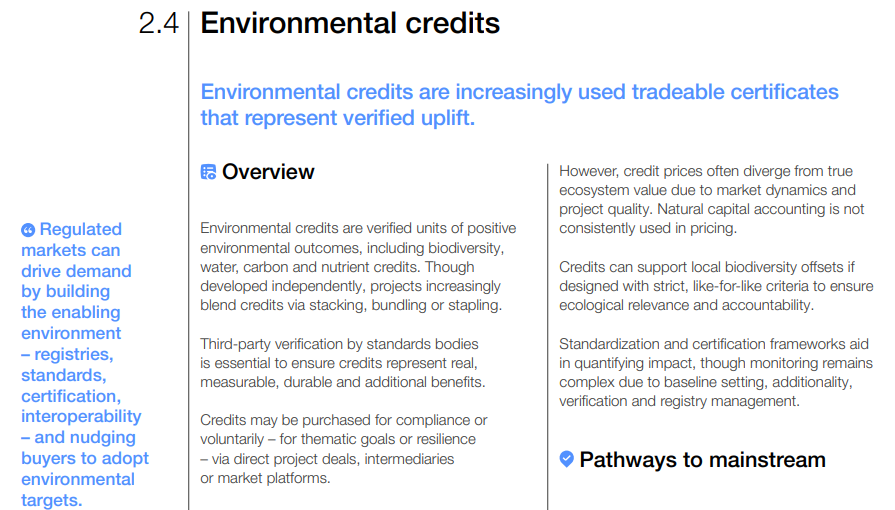
And if you’re compliant with their rules, you can be rewarded by producing “positive nature and biodiversity outcomes (e.g. species, ecosystems and natural habitats) through the creation and sale of either land or ocean-based biodiversity units over a fixed period” with biodiversity credits, aka “environmental credits.”
Prefer to be left alone and live on the property that you worked hard for all your life? You better be compliant with all the environmental regulations that are coming in the name of preserving biodiversity, so that the $44 trillion of economic value generated by nature doesn’t diminish.
https://x.com/TimHinchliffe/status/1965945155850314234?embedable=true
\
\
\
\ In keeping with the own self-interests of the co-chairs and their business relations, the report highlights “10 priority financial solutions” for these stakeholders to implement:
- Sustainability-linked bonds (SLBs):
- Commercial bonds tying coupon rates to nature-related targets for corporates or governments.
- Thematic (or use-of-proceeds) bonds:
- Bonds with proceeds earmarked for nature projects. Scaling-up requires clearer guidance and aggregation to improve outcomes for issuers and investors.
- Sustainability-linked loans (SLLs):
- Flexible debt, linking interest rates to nature-related targets. SLLs need simpler verification, standardized metrics and stronger triggers to drive nature-positive lending.
- Thematic (or use-of-proceeds) loans:
- Loans for specific nature-related projects. Greater clarity on taxonomies and aggregation is needed to enhance capital flows.
- Impact funds:
- Funds investing in nature-positive outcomes, often accepting higher risk or longer pathways to returns.
- Natural asset companies (NACs):
- Publicly and privately listed companies that convert the full economic value of nature into financial flows via equity models. NACs hold significant potential but need more transactions for price discovery and replicable investment blueprints.
- Environmental credits:
- Tradeable certificates for verified environmental benefits, used in compliance or voluntary markets.
- Debt-for-nature swaps (DNS):
- Mechanisms to restructure sovereign debt in exchange for conservation or restoration commitments, with investable components including bonds and loans.
- Payments for ecosystem services (PES):
- Contracts rewarding conservation for specific ecosystem services, driven by the public sector. Private sector schemes require longer contracts, aggregation and supply chain integration to scale up.
- Internal nature pricing (INP):
- Unexplored, voluntary shadow pricing or fee-based tools to incentivize nature-positive performance in companies or across investment portfolios, similar to internal carbon pricing (ICP).
- \
\
\
\ Putting prices on water, air, and soil is a hot topic among globalists at the UN, the G20, the World Economic Forum (WEF), and the COP meetings.
At the WEF Annual Meeting in Davos this year Singapore’s President Tharman Shanmugaratnam said that water credits and biodiversity credits should be “stapled” on to carbon credits.
The year prior, at the 2024 WEF Annual Meeting of the New Champions, aka “Summer Davos” meeting in communist China, University of Cambridge Institute for Sustainability Leadership CEO Lindsay Hooper told the panel on “Understanding Nature’s Ledger” that every part of the economy depends on nature, and that in order to protect natural systems, one solution would be to “bring nature onto the balance sheet.”
In addition to putting “nature on the balance sheet,” another proposal coming at the end of the panel discussion suggested putting a tax on natural systems like water in the same vein as carbon taxes.
With putting prices on nature comes tokenization and derivatives.
At least that’s what former Bank of England adviser Michael Sheren said at COP27 in November 2022.
“Carbon, we already figured out, and carbon is moving very quickly into a system where it’s going to be very close to a currency, basically being able to take a ton of absorbed or sequestered carbon and being able to create a forward-pricing curve, with financial service architecture, documentation,” said Sheren.
And with carbon being close to a currency, “There are going to be derivatives.”
https://x.com/TimHinchliffe/status/1958157022693597186?embedable=true
Now, under the newfound leadership of Fink and Hoffmann, whose personal business dealings stand everything to gain, the WEF is plowing full-steam ahead with the globalist agenda to monitor and monetize everything in nature, including the air we breathe, the water we drink, and the very earth that we walk upon.
:::info Tim Hinchliffe, Editor, The Sociable
:::
\


You May Also Like

Robinhood (HOOD) Stock Surges 6% as the $25K Trading Wall Finally Comes Down

Immutep (IMM) Stock Doubles on FDA Orphan Drug Win for Rare Cancer Drug




