How the Tour of Luzon medical team ensures rider safety for grueling 14-stage spectacle
MANILA, Philippines – To finish a demanding 14-stage race like the 2026 Tour of Luzon, participating cyclists have to be in tip-top shape.
They have to endure not only the long route totaling 1,825.1 kilometers and passing through 13 provinces, but also the sweltering summer heat, physical exhaustion, and the danger of injuries.
So, it is the mission of the Cardinal Santos Medical Center (CSMC) team to aid the cyclists in their bid to complete all stages and cross the 14th and last finish line in Baguio City.
“We’re here, we’re capable, and the main thing is our athletes are able to concentrate on the race and compete at the highest level,” said Dr. Mys Tirol, the Tour of Luzon medical team co-lead and CSMC assistant vice president.
Considering that it is the second straight year that the Tour of Luzon tapped CSMC as its medical provider, Tirol said the team is armed with better experience in ensuring cyclists’ safety and dealing with on-ground emergencies.
The CSMC deployed a 34-strong medical team and three ambulances, which are embedded within the race caravan.
Each ambulance is manned by emergency medical personnel. There are doctors and nurses stationed at the start and finish areas, as well. Trauma specialists are also on standby for specialized care in case of serious injuries.
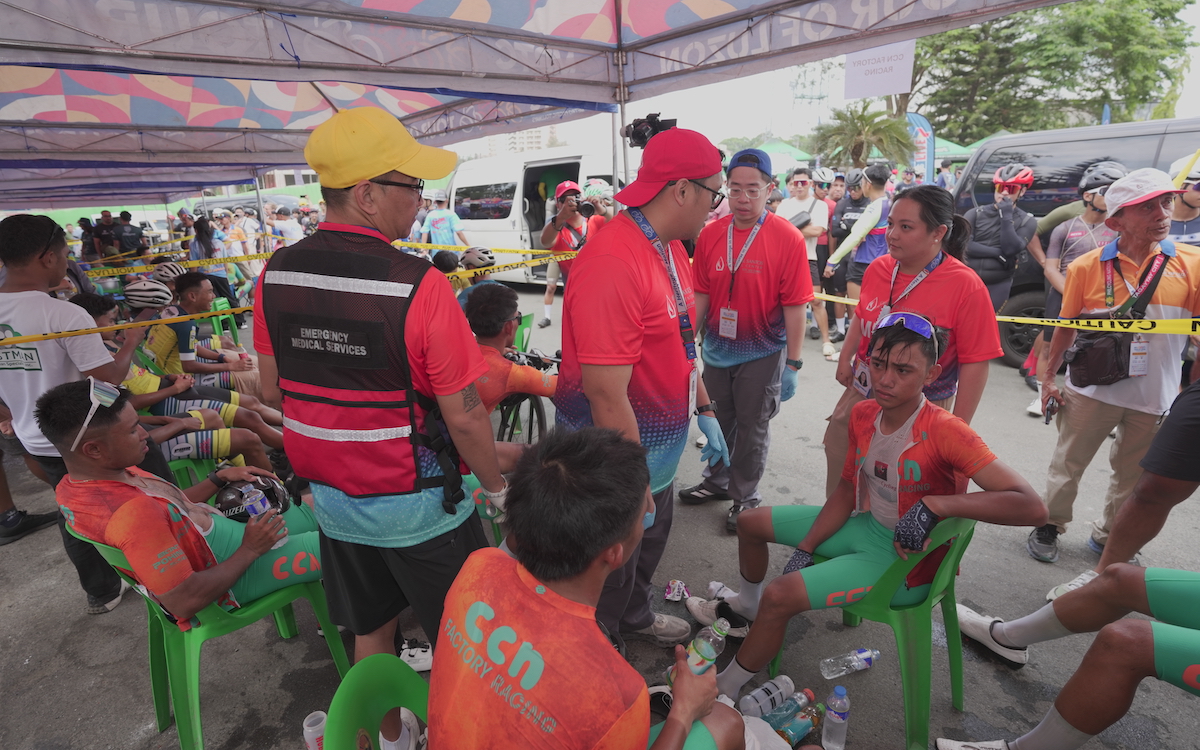 AID. The 2026 Tour of Luzon medical team attending to members of CCN Factory Racing. Photo courtesy of Cardinal Santos Medical Center
“Because last year was our first run, our only experience was from research, from watching [the] Tour de France [documentary] on Netflix, and our other research. But now that we’ve already experienced it, we’re coming in with even more knowledge, knowing better how to communicate, more prepared with the supplies that we need, looking towards anticipating the injuries that might happen, all the while still hoping that there are none,” said Tirol.
Tirol said one of the main concerns is the punishing weather as the route crosses some of the hottest regions in the country, with the Tour of Luzon starting in Batangas, then moving to Cavite, Pampanga, Tarlac, Nueva Ecija, Nueva Vizcaya, Isabela, Cagayan, Ilocos Norte, Ilocos Sur, La Union, Pangasinan, and ending in Benguet.
In the Ilocos Region, where six stages are held, the five-day computed heat index by the Philippine Atmospheric, Geophysical, and Astronomical Services Administration for May 4 to 8 exceeded 40 degrees Celsius — posing a challenge to cyclists who need to stay not only physically strong but also mentally sharp from start to finish of each stage.
“Hydration is key, nutrition is key,” said Tirol.
From 89 riders of the 13 participating teams (seven local and six foreign) who left the Stage 1 starting line at the Calatagan South Beach in Batangas, the field has been reduced to 75 at the conclusion of the 137.6-kilometer Stage 9 from Laoag City, Ilocos Norte, to Candon City, Ilocos Sur, on Friday, May 8.
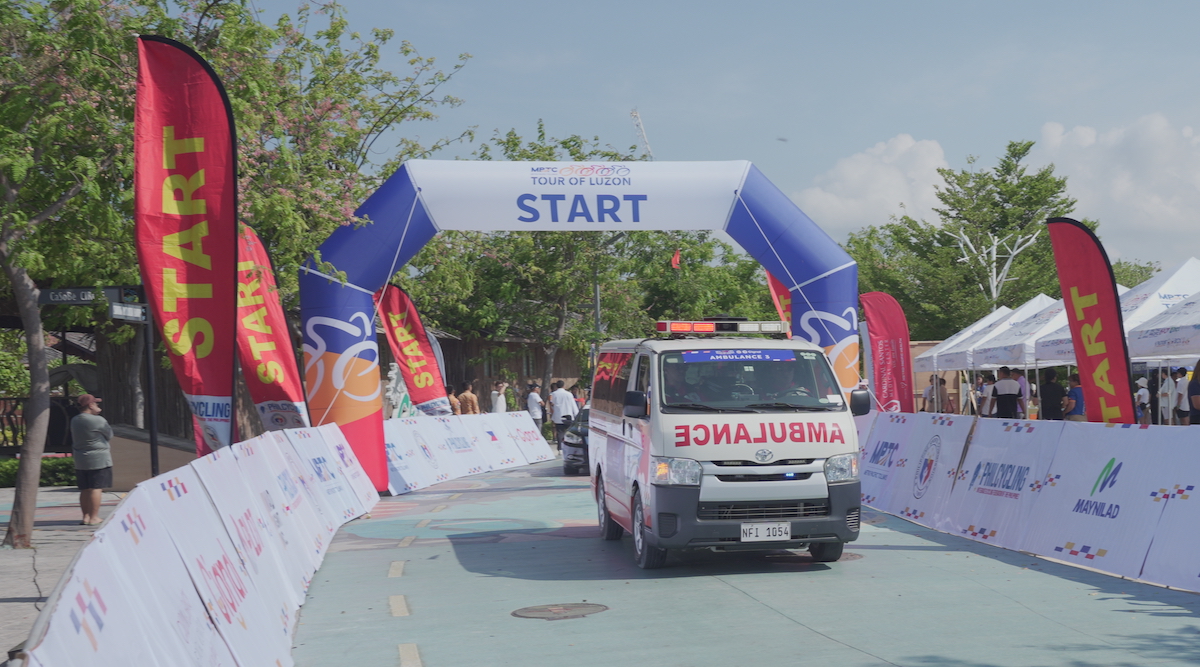 STANDBY. An ambulance passes through the starting line of Stage 1 of the 2026 Tour of Luzon. Photo courtesy of Cardinal Santos Medical Center
The 14 who have either bowed out or been disqualified include Excellent Noodles Cycling Team standout Mar Sudario, who suffered a broken collarbone from a crash in Stage 6 — the longest road race of the Tour of Luzon that spanned 223.7 kilometers from Tuguegarao City, Cagayan, to Pagudpud, Ilocos Norte.
“The moment that something happens, we need to respond quickly. If the injury is very severe, we have a couple of ambulances that will bring [the cyclists]. If they are only bruises, road rashes, which are the most common, we treat on the spot, and then we let the racers continue,” said road physician Francis Ismael.
“You need to know immediately whether the racer can continue or not, whether they need to be taken to the hospital or not, and whether their injuries are only minor or not.”
“If it’s threatening their well-being, of course, we won’t allow them to continue.”
While this year’s Tour of Luzon is almost doubly bigger than the previous edition, which featured only eight stages, Ismael said he and his colleagues are up to the task.
“Since this is not the first time the Tour of Luzon is being held, everyone already has experience with how things will flow. Last year, as a medical team, we had never encountered an event as dynamic as the Tour of Luzon, where everything is constantly moving, and there are many moving parts. Experience is key,” said Ismael. – Rappler.com


You May Also Like
TON Surges 90% in a Week, Flips XLM and SUI in Market Cap

Solana price confirms bearish crossover following Drift exploit, will it crash?