Solana Price Outlook: SOL Price Takes a Hit After a Heavy Leveraged Flush
The SOL price is trading near $90.69, down about 3.85% in 24 hours, and it’s been weaker than the broader crypto market over the same stretch. The move wasn’t random. Data shows about $143 million in Solana longs were liquidated, which means a lot of leveraged traders got forced out as price dropped.
Macro conditions didn’t help either. Higher-than-expected U.S. inflation data and ongoing U.S.–China tensions added pressure across risk assets. In that kind of environment, higher-volatility coins like Solana usually react more sharply, and the SOL price followed that pattern.
Market Structure Breaks After Losing Key Support
We had a look at the chart shared by Crypto Patel, and the key issue is the break below the $92–$94 support zone. That level had been acting as a short-term floor, and once it gave way, sellers took more control. The liquidation data fits that move, with $143 million in forced long exits adding extra downside pressure.
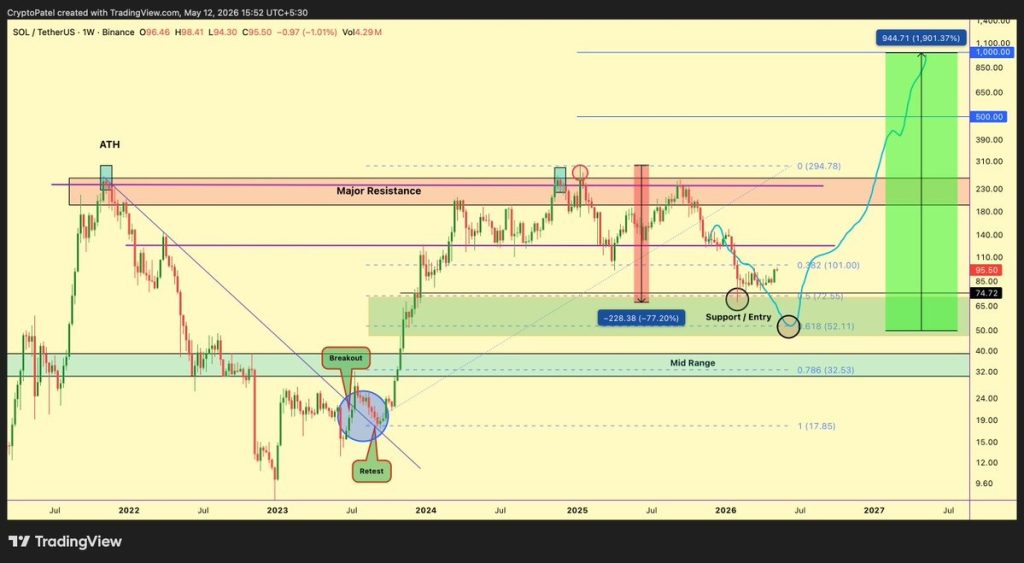 Source: X/@cryptopatel
Right now, the SOL price is trying to stabilise above $88, which is the next important level traders are watching. If that area holds, the price can settle into a tighter range and rebuild the structure. If it fails, the next area of interest sits closer to $85, where previous liquidity exists.
Even with this short-term weakness, the bigger picture hasn’t fully broken. Solana still has a broader cycle structure built from its recovery after the 2022–2023 bear market, followed by breakout attempts through 2024 and consolidation into 2026.
Read Also: AI Agent’s Clarity Act Portfolio: XRP, LINK, and 8 Other Tokens Ready for Regulation
Institutional Exposure and Staking Still Play a Big Role
There’s also a strong institutional layer in the background. Forward Industries, one of the largest publicly listed Solana holders, reported owning about 6.97 million SOL, bought at an average cost of roughly $232 per token. With the SOL price now near $90, that position is sitting deep in unrealized losses, estimated close to $1 billion, based on data reported by TheCryptoBasic.
Even so, most of that SOL is staked, generating around a 6.73% annual yield, which shows these positions are still being actively managed rather than fully exited. The company also reported a quarterly net loss of about $585 million, with over $560 million tied to digital asset valuation losses, partially offset by staking income.
The drop comes down to a combination of factors. First, macro pressure reduced risk appetite across markets after inflation data came in hotter than expected. Second, the $143 million liquidation event forced leveraged positions out quickly, speeding up the move. Third, the break below $92–$94 support confirmed that buyers lost control of that short-term zone.
When you combine macro pressure, leverage unwind, and a technical breakdown, moves like this tend to happen fast, and that’s exactly what played out in the SOL price action.
What Traders Are Watching Next
The next key level is $88. If buyers defend it, Solana could stabilize and trade between roughly $88 and $92, giving the market time to reset. A move back above $100–$110 would be the first real sign that momentum is returning and sellers are losing control of the recent breakdown.
On the bigger picture side, Solana still has strong long-term catalysts in play, including growing real-world asset adoption and ETF speculation with approval odds estimated around 90% by analysts. For now though, the SOL price is mainly reacting to macro pressure and leverage unwinding, and the next move will depend on whether $88 holds or breaks.
FAQs

Solana became popular because of its high transaction speed, relatively low fees, and growing ecosystem of decentralized apps and real-world asset projects.
Many analysts believe a spot Solana ETF could attract institutional capital into the ecosystem, similar to what happened with Bitcoin ETFs.
Subscribe to our YouTube channel for daily crypto updates, market insights, and expert analysis.
The post Solana Price Outlook: SOL Price Takes a Hit After a Heavy Leveraged Flush appeared first on CaptainAltcoin.


You May Also Like

The Chemistry of UV Resistance: How Titanium Dioxide Protects Against the California Sun

Stablecoin yield negotiations are pretty much done, Coinbase CLO Grewal says