BNB Chain Says Post-Quantum Signature Test Cut BSC TPS 40%
BNB Chain published a post-quantum cryptography migration report on May 14 showing that swapping BSC’s transaction signatures to a quantum-resistant scheme cut native-transfer throughput by roughly 40%, from 4,973 TPS to 2,997 TPS in cross-region testing.
What BNB Chain tested on BSC
The experiment, detailed in BNB Chain’s BSC Post-Quantum Cryptography Migration Report, migrated both transaction signatures and consensus vote signatures from classical schemes to ML-DSA-44, a lattice-based digital signature algorithm standardized under NIST FIPS 204. Consensus votes were further aggregated using pqSTARK proofs.
This was a proof-of-concept test, not a confirmed network-wide deployment. The PoC introduced a new post-quantum transaction type (PQTxType 0x05) and an on-chain PQ registry contract at address 0x70, as documented in the project’s GitHub PR #3660.
One immediate cost of the larger post-quantum signatures: individual transaction size jumped from roughly 110 bytes to about 2.5 KB. At a sustained 2,000 TPS native-transfer workload, block size rose from approximately 130 KB to around 2 MB.
How the test affected BSC throughput
TPS, or transactions per second, is the standard measure of how many operations a blockchain can process in a given time window. In BNB Chain’s cross-region benchmark, the non-PQ baseline reached 4,973 TPS for native transfers, while the post-quantum configuration managed 2,997 TPS, a reduction of roughly 40%.
Mixed-workload testing, which combines native transfers with smart-contract calls, showed a similar pattern: 3,695 TPS without post-quantum signatures versus 2,406 TPS with them. Gas throughput also declined, from 513 megagas per second to 403 megagas per second under the mixed workload.
The results give a concrete, numbers-backed picture of the overhead that quantum-resistant cryptography adds to a high-throughput EVM chain. For context on how blockchain infrastructure upgrades can ripple through an ecosystem, large treasury movements by protocol operators often reflect confidence in a network’s long-term technical direction.
Why the result matters for blockchain security tradeoffs
NIST published FIPS 204, the Module-Lattice-Based Digital Signature Standard that covers ML-DSA, on August 13, 2024. BNB Chain’s report is one of the first public benchmarks showing what adopting that standard costs a production-grade blockchain in raw performance.
A 40% throughput hit is significant but not fatal for a chain that still cleared nearly 3,000 TPS in the post-quantum configuration. The tradeoff is straightforward: stronger resistance to future quantum attacks in exchange for lower transaction capacity today. Infrastructure teams weighing similar migrations, whether on BSC or other EVM-compatible chains, now have a reference point for the performance budget they would need to absorb.
BNB itself traded at $639.85 at press time, with a market capitalization of roughly $86.2 billion. The token showed a modest 0.28% gain over the prior 24 hours on light volume of $752 million.
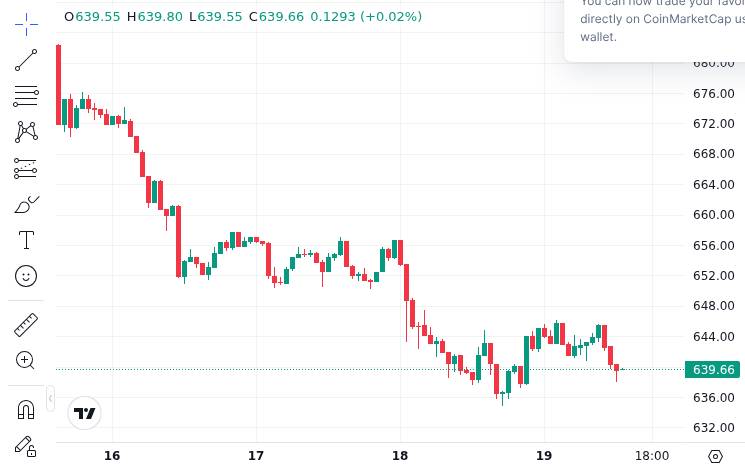 CoinMarketCap market snapshot used to anchor the spot-price section for bnb.
The broader crypto market sat in “Extreme Fear” territory, with the Fear & Greed Index at 25 out of 100. That backdrop suggests the market is not yet pricing quantum-readiness upgrades as a near-term catalyst, positive or negative. As regulatory frameworks like the proposed Clarity Act evolve alongside technical standards, chains that can demonstrate compliance with post-quantum benchmarks may gain a structural edge.
BNB Chain’s report frames the migration as a phased roadmap rather than an imminent hard fork. The 40% TPS reduction is an engineering baseline, not a final outcome, and future optimizations to signature aggregation and block propagation could narrow the gap. For now, the data establishes that post-quantum security on a live EVM chain is feasible, with a quantifiable cost that infrastructure planners across the industry can use to calibrate their own timelines.
Disclaimer: This article is for informational purposes only and does not constitute financial or investment advice. Cryptocurrency and digital asset markets carry significant risk. Always do your own research before making decisions.


You May Also Like

EUR/GBP Exchange Rate Surges as Bank of England Rate Hike Expectations Intensify – Market Analysis

USDC Treasury mints 250 million new USDC on Solana