Crypto treasury companies that raised capital through private investment in public equity (PIPE) deals face a growing risk of their stock prices crashing by as much as 50%, according to a new market report from analytics platform CryptoQuant. The firm said PIPE-backed companies have already suffered steep declines, with share prices often gravitating toward their PIPE issuance levels. Researchers noted that when lock-up periods expire, investors frequently exit positions to secure profits, creating heavy selling pressure. PIPE Issuances Create Overhang Across Crypto Treasury Sector, Analysts Warn PIPE deals allow private investors to buy new shares below market price, offering companies fast access to liquidity in a competitive sector. While effective for raising cash, CryptoQuant warned that these arrangements dilute existing shareholders and leave an overhang of shares that weighs on stock performance. One of the starkest examples is Kindly MD (NAKA), a medical company that pivoted into Bitcoin treasury holdings earlier this year. Its stock surged from $1.80 in late April to nearly $35 by late May after announcing a PIPE raise. However, once PIPE shares unlocked, the stock collapsed 97%, falling to $1.16, almost identical to its PIPE offering price of $1.12. CryptoQuant described the retracement as a case of “PIPE price gravity.”Source: CryptoQuant Other crypto treasury firms may now be following the same path. Strive Inc. (ASST) peaked at $13 in May but has since dropped 78% to $2.75. CryptoQuant said its PIPE was priced at $1.35, implying the stock could face another 55% decline as investors prepare to sell when the lock-up ends next month. Cantor Equity Partners (CEP), a special purpose acquisition company merging with Twenty One Capital, also conducted a PIPE priced at $10. CEP’s shares have already slipped nearly 70% from their highs to below $20. CryptoQuant suggested the stock could fall another 50% from current levels once PIPE investors begin to sell. The report noted that even well-established crypto treasuries are under pressure as the value of their digital asset holdings approaches parity with their overall company valuations. This dynamic could further accelerate sell-offs if investors perceive limited upside in stock performance compared to direct crypto exposure. CryptoQuant concluded that only a strong and sustained Bitcoin rally is likely to counteract the downward pressure facing treasury stocks tied to PIPE deals. Without such a rebound, it warned that many companies are likely to continue trending toward or below their PIPE issuance levels. At present, the trend has already left PIPE-funded crypto treasury stocks exposed to sharp losses, with investors closely watching how upcoming unlocks will impact market sentiment in the weeks ahead. Small-Cap Firms Turn to Borrowing as Crypto Treasury Strategy Falters On the other hand, the crypto treasury strategy that surged across small-cap firms in 2024 is showing signs of strain as companies turn to debt-funded share buybacks to support collapsing valuations. According to a CryptoNews report, at least seven firms, including gaming, biotech, and electric vehicle companies, have launched repurchase programs despite trading below the value of their crypto holdings. Analysts say the trend reflects investor skepticism and undermines the premise that digital assets alone can boost stock performance. One high-profile case is ETHZilla, formerly 180 Life Sciences, which rebranded after buying ether. Its stock has fallen 76% since August. The company recently secured $80 million in debt from Cumberland DRW to finance a $250 million buyback. Critics argue the move signals distress. “They’re borrowing money to buy time, not tokens,” said Kaiko analyst Adam Morgan McCarthy. Similar tactics are emerging elsewhere. Empery Digital, once Volcon, expanded its debt facility to $85 million despite holding $476 million in Bitcoin, more than its $378 million market value. SharpLink Gaming, Ton Strategy, and CEA Industries are pursuing comparable measures. Research from K33 shows one in four public Bitcoin treasuries now trade below their net asset value, with the average NAV multiple falling to 2.8 from 3.76 in April. Smaller firms such as NAKA and Semler Scientific face mounting pressure, while larger players like MicroStrategy continue to command premiums. The slowdown in BTC accumulation suggests the once-celebrated crypto treasury playbook may be nearing its limitsCrypto treasury companies that raised capital through private investment in public equity (PIPE) deals face a growing risk of their stock prices crashing by as much as 50%, according to a new market report from analytics platform CryptoQuant. The firm said PIPE-backed companies have already suffered steep declines, with share prices often gravitating toward their PIPE issuance levels. Researchers noted that when lock-up periods expire, investors frequently exit positions to secure profits, creating heavy selling pressure. PIPE Issuances Create Overhang Across Crypto Treasury Sector, Analysts Warn PIPE deals allow private investors to buy new shares below market price, offering companies fast access to liquidity in a competitive sector. While effective for raising cash, CryptoQuant warned that these arrangements dilute existing shareholders and leave an overhang of shares that weighs on stock performance. One of the starkest examples is Kindly MD (NAKA), a medical company that pivoted into Bitcoin treasury holdings earlier this year. Its stock surged from $1.80 in late April to nearly $35 by late May after announcing a PIPE raise. However, once PIPE shares unlocked, the stock collapsed 97%, falling to $1.16, almost identical to its PIPE offering price of $1.12. CryptoQuant described the retracement as a case of “PIPE price gravity.”Source: CryptoQuant Other crypto treasury firms may now be following the same path. Strive Inc. (ASST) peaked at $13 in May but has since dropped 78% to $2.75. CryptoQuant said its PIPE was priced at $1.35, implying the stock could face another 55% decline as investors prepare to sell when the lock-up ends next month. Cantor Equity Partners (CEP), a special purpose acquisition company merging with Twenty One Capital, also conducted a PIPE priced at $10. CEP’s shares have already slipped nearly 70% from their highs to below $20. CryptoQuant suggested the stock could fall another 50% from current levels once PIPE investors begin to sell. The report noted that even well-established crypto treasuries are under pressure as the value of their digital asset holdings approaches parity with their overall company valuations. This dynamic could further accelerate sell-offs if investors perceive limited upside in stock performance compared to direct crypto exposure. CryptoQuant concluded that only a strong and sustained Bitcoin rally is likely to counteract the downward pressure facing treasury stocks tied to PIPE deals. Without such a rebound, it warned that many companies are likely to continue trending toward or below their PIPE issuance levels. At present, the trend has already left PIPE-funded crypto treasury stocks exposed to sharp losses, with investors closely watching how upcoming unlocks will impact market sentiment in the weeks ahead. Small-Cap Firms Turn to Borrowing as Crypto Treasury Strategy Falters On the other hand, the crypto treasury strategy that surged across small-cap firms in 2024 is showing signs of strain as companies turn to debt-funded share buybacks to support collapsing valuations. According to a CryptoNews report, at least seven firms, including gaming, biotech, and electric vehicle companies, have launched repurchase programs despite trading below the value of their crypto holdings. Analysts say the trend reflects investor skepticism and undermines the premise that digital assets alone can boost stock performance. One high-profile case is ETHZilla, formerly 180 Life Sciences, which rebranded after buying ether. Its stock has fallen 76% since August. The company recently secured $80 million in debt from Cumberland DRW to finance a $250 million buyback. Critics argue the move signals distress. “They’re borrowing money to buy time, not tokens,” said Kaiko analyst Adam Morgan McCarthy. Similar tactics are emerging elsewhere. Empery Digital, once Volcon, expanded its debt facility to $85 million despite holding $476 million in Bitcoin, more than its $378 million market value. SharpLink Gaming, Ton Strategy, and CEA Industries are pursuing comparable measures. Research from K33 shows one in four public Bitcoin treasuries now trade below their net asset value, with the average NAV multiple falling to 2.8 from 3.76 in April. Smaller firms such as NAKA and Semler Scientific face mounting pressure, while larger players like MicroStrategy continue to command premiums. The slowdown in BTC accumulation suggests the once-celebrated crypto treasury playbook may be nearing its limits

Crypto Treasury Stocks at Risk of 50% Crash After PIPE Deals — CryptoQuant Warns

2025/09/26 20:47
4 min read
For feedback or concerns regarding this content, please contact us at crypto.news@mexc.com

Crypto treasury companies that raised capital through private investment in public equity (PIPE) deals face a growing risk of their stock prices crashing by as much as 50%, according to a new market report from analytics platform CryptoQuant.

The firm said PIPE-backed companies have already suffered steep declines, with share prices often gravitating toward their PIPE issuance levels.

Researchers noted that when lock-up periods expire, investors frequently exit positions to secure profits, creating heavy selling pressure.

PIPE Issuances Create Overhang Across Crypto Treasury Sector, Analysts Warn

PIPE deals allow private investors to buy new shares below market price, offering companies fast access to liquidity in a competitive sector.

While effective for raising cash, CryptoQuant warned that these arrangements dilute existing shareholders and leave an overhang of shares that weighs on stock performance.

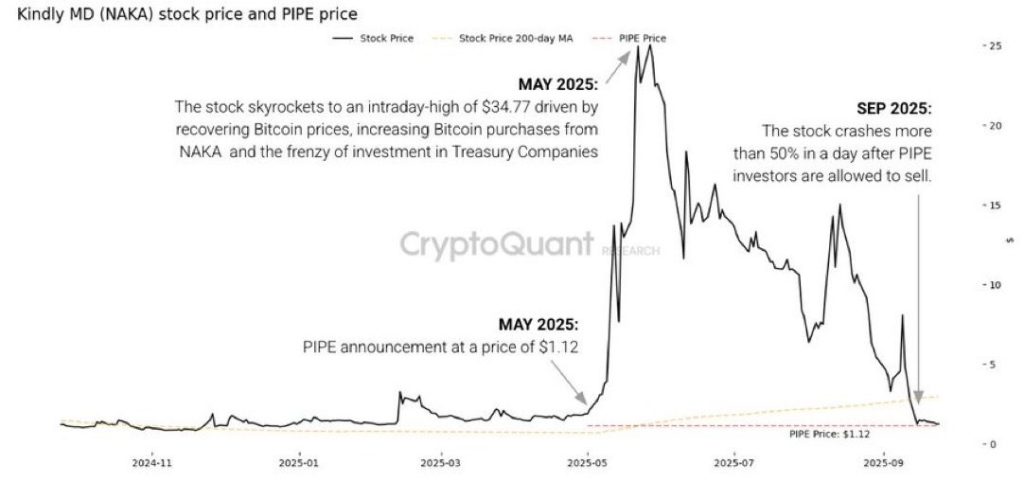
One of the starkest examples is Kindly MD (NAKA), a medical company that pivoted into Bitcoin treasury holdings earlier this year.

Its stock surged from $1.80 in late April to nearly $35 by late May after announcing a PIPE raise. However, once PIPE shares unlocked, the stock collapsed 97%, falling to $1.16, almost identical to its PIPE offering price of $1.12.

CryptoQuant described the retracement as a case of “PIPE price gravity.”
Source: CryptoQuant

Other crypto treasury firms may now be following the same path. Strive Inc. (ASST) peaked at $13 in May but has since dropped 78% to $2.75.

CryptoQuant said its PIPE was priced at $1.35, implying the stock could face another 55% decline as investors prepare to sell when the lock-up ends next month.

Cantor Equity Partners (CEP), a special purpose acquisition company merging with Twenty One Capital, also conducted a PIPE priced at $10. CEP’s shares have already slipped nearly 70% from their highs to below $20.

CryptoQuant suggested the stock could fall another 50% from current levels once PIPE investors begin to sell.

The report noted that even well-established crypto treasuries are under pressure as the value of their digital asset holdings approaches parity with their overall company valuations.

This dynamic could further accelerate sell-offs if investors perceive limited upside in stock performance compared to direct crypto exposure.

CryptoQuant concluded that only a strong and sustained Bitcoin rally is likely to counteract the downward pressure facing treasury stocks tied to PIPE deals.

Without such a rebound, it warned that many companies are likely to continue trending toward or below their PIPE issuance levels.

At present, the trend has already left PIPE-funded crypto treasury stocks exposed to sharp losses, with investors closely watching how upcoming unlocks will impact market sentiment in the weeks ahead.

Small-Cap Firms Turn to Borrowing as Crypto Treasury Strategy Falters

On the other hand, the crypto treasury strategy that surged across small-cap firms in 2024 is showing signs of strain as companies turn to debt-funded share buybacks to support collapsing valuations.

According to a CryptoNews report, at least seven firms, including gaming, biotech, and electric vehicle companies, have launched repurchase programs despite trading below the value of their crypto holdings.

Analysts say the trend reflects investor skepticism and undermines the premise that digital assets alone can boost stock performance.

One high-profile case is ETHZilla, formerly 180 Life Sciences, which rebranded after buying ether. Its stock has fallen 76% since August.

The company recently secured $80 million in debt from Cumberland DRW to finance a $250 million buyback.

Critics argue the move signals distress. “They’re borrowing money to buy time, not tokens,” said Kaiko analyst Adam Morgan McCarthy.

Similar tactics are emerging elsewhere. Empery Digital, once Volcon, expanded its debt facility to $85 million despite holding $476 million in Bitcoin, more than its $378 million market value.

SharpLink Gaming, Ton Strategy, and CEA Industries are pursuing comparable measures.

Research from K33 shows one in four public Bitcoin treasuries now trade below their net asset value, with the average NAV multiple falling to 2.8 from 3.76 in April.

Smaller firms such as NAKA and Semler Scientific face mounting pressure, while larger players like MicroStrategy continue to command premiums.

The slowdown in BTC accumulation suggests the once-celebrated crypto treasury playbook may be nearing its limits.


Disclaimer: The articles reposted on this site are sourced from public platforms and are provided for informational purposes only. They do not necessarily reflect the views of MEXC. All rights remain with the original authors. If you believe any content infringes on third-party rights, please contact crypto.news@mexc.com for removal. MEXC makes no guarantees regarding the accuracy, completeness, or timeliness of the content and is not responsible for any actions taken based on the information provided. The content does not constitute financial, legal, or other professional advice, nor should it be considered a recommendation or endorsement by MEXC.

You May Also Like

Franklin Templeton CEO Dismisses 50bps Rate Cut Ahead FOMC

Franklin Templeton CEO Dismisses 50bps Rate Cut Ahead FOMC

The post Franklin Templeton CEO Dismisses 50bps Rate Cut Ahead FOMC appeared on BitcoinEthereumNews.com. Franklin Templeton CEO Jenny Johnson has weighed in on whether the Federal Reserve should make a 25 basis points (bps) Fed rate cut or 50 bps cut. This comes ahead of the Fed decision today at today’s FOMC meeting, with the market pricing in a 25 bps cut. Bitcoin and the broader crypto market are currently trading flat ahead of the rate cut decision. Franklin Templeton CEO Weighs In On Potential FOMC Decision In a CNBC interview, Jenny Johnson said that she expects the Fed to make a 25 bps cut today instead of a 50 bps cut. She acknowledged the jobs data, which suggested that the labor market is weakening. However, she noted that this data is backward-looking, indicating that it doesn’t show the current state of the economy. She alluded to the wage growth, which she remarked is an indication of a robust labor market. She added that retail sales are up and that consumers are still spending, despite inflation being sticky at 3%, which makes a case for why the FOMC should opt against a 50-basis-point Fed rate cut. In line with this, the Franklin Templeton CEO said that she would go with a 25 bps rate cut if she were Jerome Powell. She remarked that the Fed still has the October and December FOMC meetings to make further cuts if the incoming data warrants it. Johnson also asserted that the data show a robust economy. However, she noted that there can’t be an argument for no Fed rate cut since Powell already signaled at Jackson Hole that they were likely to lower interest rates at this meeting due to concerns over a weakening labor market. Notably, her comment comes as experts argue for both sides on why the Fed should make a 25 bps cut or…
Share
BitcoinEthereumNews2025/09/18 00:36
Microsoft Corp. $MSFT blue box area offers a buying opportunity

Microsoft Corp. $MSFT blue box area offers a buying opportunity

The post Microsoft Corp. $MSFT blue box area offers a buying opportunity appeared on BitcoinEthereumNews.com. In today’s article, we’ll examine the recent performance of Microsoft Corp. ($MSFT) through the lens of Elliott Wave Theory. We’ll review how the rally from the April 07, 2025 low unfolded as a 5-wave impulse followed by a 3-swing correction (ABC) and discuss our forecast for the next move. Let’s dive into the structure and expectations for this stock. Five wave impulse structure + ABC + WXY correction $MSFT 8H Elliott Wave chart 9.04.2025 In the 8-hour Elliott Wave count from Sep 04, 2025, we saw that $MSFT completed a 5-wave impulsive cycle at red III. As expected, this initial wave prompted a pullback. We anticipated this pullback to unfold in 3 swings and find buyers in the equal legs area between $497.02 and $471.06 This setup aligns with a typical Elliott Wave correction pattern (ABC), in which the market pauses briefly before resuming its primary trend. $MSFT 8H Elliott Wave chart 7.14.2025 The update, 10 days later, shows the stock finding support from the equal legs area as predicted allowing traders to get risk free. The stock is expected to bounce towards 525 – 532 before deciding if the bounce is a connector or the next leg higher. A break into new ATHs will confirm the latter and can see it trade higher towards 570 – 593 area. Until then, traders should get risk free and protect their capital in case of a WXY double correction. Conclusion In conclusion, our Elliott Wave analysis of Microsoft Corp. ($MSFT) suggested that it remains supported against April 07, 2025 lows and bounce from the blue box area. In the meantime, keep an eye out for any corrective pullbacks that may offer entry opportunities. By applying Elliott Wave Theory, traders can better anticipate the structure of upcoming moves and enhance risk management in volatile markets. Source: https://www.fxstreet.com/news/microsoft-corp-msft-blue-box-area-offers-a-buying-opportunity-202509171323
Share
BitcoinEthereumNews2025/09/18 03:50
CME to launch Solana and XRP futures options on October 13, 2025

CME to launch Solana and XRP futures options on October 13, 2025

The post CME to launch Solana and XRP futures options on October 13, 2025 appeared on BitcoinEthereumNews.com. Key Takeaways CME Group will launch futures options for Solana (SOL) and XRP. The launch date is set for October 13, 2025. CME Group will launch futures options for Solana and XRP on October 13, 2025. The Chicago-based derivatives exchange will add the new crypto derivatives products to its existing digital asset offerings. The launch will provide institutional and retail traders with additional tools to hedge positions and speculate on price movements for both digital assets. The futures options will be based on CME’s existing Solana and XRP futures contracts. Trading will be conducted through CME Globex, the exchange’s electronic trading platform. Source: https://cryptobriefing.com/cme-solana-xrp-futures-options-launch-2025/
Share
BitcoinEthereumNews2025/09/18 01:07



