The Polkadot community has opened a vote on a proposal for pUSD, a native stablecoin backed entirely by DOT tokens, through a governance referendum currently underway on the network’s “Wish for Change” track. The proposal, detailed in RFC-155 and authored by Bryan Chen, would deploy the stablecoin on Polkadot Asset Hub using the Honzon protocol previously employed by Acala’s failed aUSD project. At the time of writing, Aye holds 74.62%, while Nay holds 25.40%, against an 80.40% approval threshold.Source: Polkadot Community Split Over Acala’s Technical Legacy The initiative seeks to reduce Polkadot’s dependence on USDT and USDC, which currently dominate the ecosystem with a combined market cap of $74.05 million, with USDC at 56.79% dominance.Source: DefiLlama The proposal has generated strong controversy due to its connection with Acala, whose aUSD stablecoin collapsed following a 2022 exploit that damaged trust across the ecosystem. Multiple prominent community members have voted against the proposal, specifically citing concerns about Acala’s involvement. TheGlobedotters stated that “no one from Acala should be involved with any stablecoin in the ecosystem, especially a strategic one like this, ever again,” while noting that aUSD’s failure stemmed from liquidity pool misconfiguration rather than Honzon protocol flaws. The White Rabbit shared similar concerns, voting against the proposal while supporting the concept of a native stablecoin in principle. The voter outlined two conditions for potential support. First, a clear assurance that no Acala team members would be involved in development; second, explicit Technical Fellowship oversight of governance and risk management. Another community member noted that “Acala is dead because of AUSD” and warned that rushing implementation could damage Polkadot’s reputation. Gavin Wood Pushes Multi-Track Stablecoin Strategy On September 10, Polkadot founder Gavin Wood outlined his vision for the ecosystem’s stablecoin approach, which preceded the pUSD proposal. Wood emphasized that “Polkadot would be remiss not to have its own native stablecoin” and specified requirements including full DOT collateralization, Polkadot governance control, and DAI-level security guarantees. He expressed support for Hydration’s upcoming HOLLAR stablecoin while maintaining that a protocol-level DOT-backed stablecoin remains strategically necessary. Wood also introduced the concept of a “stable-ish” DOT asset that would accept some volatility while avoiding massive collateral requirements. This middle-ground approach between hyper-volatile DOT and strict dollar pegs would seek to “soften volatility” for users seeking partial stability without full collateralization costs. Until a pure DOT stablecoin exists, Wood indicated a preference for HOLLAR over USDT and USDC, though he acknowledged that centralized stablecoins may still be needed for validator payouts and practical integrations. The pUSD proposal arrives as Polkadot implements major tokenomics changes, having approved a 2.1 billion DOT hard cap in September through Referendum 1710 with 81% support. The network is shifting from its inflationary model of 120 million annual DOT issuance to a declining schedule that will reduce minting to below 20 million by the early 2030s. The current circulating supply stands at 1.6 billion DOT, with the total supply projected to stabilize near 1.91 billion by 2040 under the new framework. Global Stablecoin Market Exceeds $300B as Regulatory Framework Solidifies The pUSD debate unfolds against surging global stablecoin adoption, with total market capitalization surpassing $300 billion for the first time in September.Source: DefiLlama During this time, Circle’s NYSE debut saw shares rise 400% post-IPO, valuing the USDC issuer at $30 billion, while Tether introduced a U.S.-compliant stablecoin and is seeking $500 billion in funding. Given the fast-paced growth of the sector, Treasury Secretary Scott Bessent projects that the sector will reach $3 trillion by 2028 as stablecoins integrate into global payments and decentralized finance. Citigroup also forecasts a stablecoin market cap between $1.6 trillion and $3.7 trillion by 2030, driven by clearer regulation and institutional participation. The bank warned that leading issuers could become among the largest U.S. Treasury holders by the end of the decade, potentially disrupting traditional banking through deposit substitution. The GENIUS Act, signed in July, has provided federal oversight for stablecoin issuers, which has largely aided this growth. Meanwhile, a consortium of nine European banks, including ING, UniCredit, and Deutsche Bank, is exploring a euro-denominated stablecoin launch to compete with dollar dominance. As Mark Aruliah of Elliptic stated, European banks need to “move quickly to adopt and scale credible euro-denominated stablecoins” or risk ceding ground to U.S. and Asian competitorsThe Polkadot community has opened a vote on a proposal for pUSD, a native stablecoin backed entirely by DOT tokens, through a governance referendum currently underway on the network’s “Wish for Change” track. The proposal, detailed in RFC-155 and authored by Bryan Chen, would deploy the stablecoin on Polkadot Asset Hub using the Honzon protocol previously employed by Acala’s failed aUSD project. At the time of writing, Aye holds 74.62%, while Nay holds 25.40%, against an 80.40% approval threshold.Source: Polkadot Community Split Over Acala’s Technical Legacy The initiative seeks to reduce Polkadot’s dependence on USDT and USDC, which currently dominate the ecosystem with a combined market cap of $74.05 million, with USDC at 56.79% dominance.Source: DefiLlama The proposal has generated strong controversy due to its connection with Acala, whose aUSD stablecoin collapsed following a 2022 exploit that damaged trust across the ecosystem. Multiple prominent community members have voted against the proposal, specifically citing concerns about Acala’s involvement. TheGlobedotters stated that “no one from Acala should be involved with any stablecoin in the ecosystem, especially a strategic one like this, ever again,” while noting that aUSD’s failure stemmed from liquidity pool misconfiguration rather than Honzon protocol flaws. The White Rabbit shared similar concerns, voting against the proposal while supporting the concept of a native stablecoin in principle. The voter outlined two conditions for potential support. First, a clear assurance that no Acala team members would be involved in development; second, explicit Technical Fellowship oversight of governance and risk management. Another community member noted that “Acala is dead because of AUSD” and warned that rushing implementation could damage Polkadot’s reputation. Gavin Wood Pushes Multi-Track Stablecoin Strategy On September 10, Polkadot founder Gavin Wood outlined his vision for the ecosystem’s stablecoin approach, which preceded the pUSD proposal. Wood emphasized that “Polkadot would be remiss not to have its own native stablecoin” and specified requirements including full DOT collateralization, Polkadot governance control, and DAI-level security guarantees. He expressed support for Hydration’s upcoming HOLLAR stablecoin while maintaining that a protocol-level DOT-backed stablecoin remains strategically necessary. Wood also introduced the concept of a “stable-ish” DOT asset that would accept some volatility while avoiding massive collateral requirements. This middle-ground approach between hyper-volatile DOT and strict dollar pegs would seek to “soften volatility” for users seeking partial stability without full collateralization costs. Until a pure DOT stablecoin exists, Wood indicated a preference for HOLLAR over USDT and USDC, though he acknowledged that centralized stablecoins may still be needed for validator payouts and practical integrations. The pUSD proposal arrives as Polkadot implements major tokenomics changes, having approved a 2.1 billion DOT hard cap in September through Referendum 1710 with 81% support. The network is shifting from its inflationary model of 120 million annual DOT issuance to a declining schedule that will reduce minting to below 20 million by the early 2030s. The current circulating supply stands at 1.6 billion DOT, with the total supply projected to stabilize near 1.91 billion by 2040 under the new framework. Global Stablecoin Market Exceeds $300B as Regulatory Framework Solidifies The pUSD debate unfolds against surging global stablecoin adoption, with total market capitalization surpassing $300 billion for the first time in September.Source: DefiLlama During this time, Circle’s NYSE debut saw shares rise 400% post-IPO, valuing the USDC issuer at $30 billion, while Tether introduced a U.S.-compliant stablecoin and is seeking $500 billion in funding. Given the fast-paced growth of the sector, Treasury Secretary Scott Bessent projects that the sector will reach $3 trillion by 2028 as stablecoins integrate into global payments and decentralized finance. Citigroup also forecasts a stablecoin market cap between $1.6 trillion and $3.7 trillion by 2030, driven by clearer regulation and institutional participation. The bank warned that leading issuers could become among the largest U.S. Treasury holders by the end of the decade, potentially disrupting traditional banking through deposit substitution. The GENIUS Act, signed in July, has provided federal oversight for stablecoin issuers, which has largely aided this growth. Meanwhile, a consortium of nine European banks, including ING, UniCredit, and Deutsche Bank, is exploring a euro-denominated stablecoin launch to compete with dollar dominance. As Mark Aruliah of Elliptic stated, European banks need to “move quickly to adopt and scale credible euro-denominated stablecoins” or risk ceding ground to U.S. and Asian competitors

Polkadot Community Backs Proposal for DOT-Backed Algorithmic Stablecoin pUSD

The Polkadot community has opened a vote on a proposal for pUSD, a native stablecoin backed entirely by DOT tokens, through a governance referendum currently underway on the network’s “Wish for Change” track.

The proposal, detailed in RFC-155 and authored by Bryan Chen, would deploy the stablecoin on Polkadot Asset Hub using the Honzon protocol previously employed by Acala’s failed aUSD project.

At the time of writing, Aye holds 74.62%, while Nay holds 25.40%, against an 80.40% approval threshold.
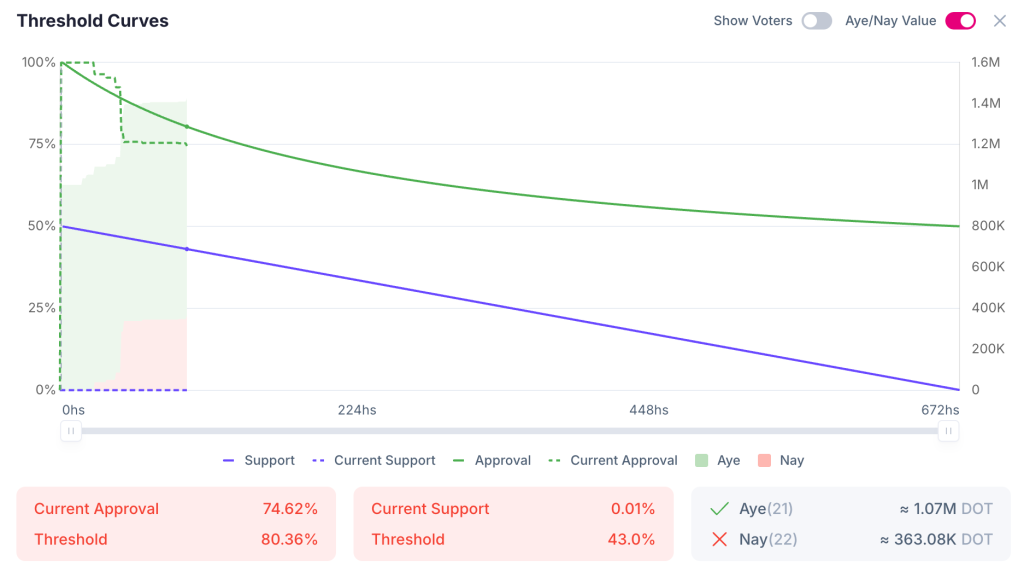
Polkadot Community Backs Proposal for DOT-Backed Algorithmic Stablecoin pUSDSource: Polkadot

Community Split Over Acala’s Technical Legacy

The initiative seeks to reduce Polkadot’s dependence on USDT and USDC, which currently dominate the ecosystem with a combined market cap of $74.05 million, with USDC at 56.79% dominance.

Polkadot Community Backs Proposal for DOT-Backed Algorithmic Stablecoin pUSDSource: DefiLlama

The proposal has generated strong controversy due to its connection with Acala, whose aUSD stablecoin collapsed following a 2022 exploit that damaged trust across the ecosystem.

Multiple prominent community members have voted against the proposal, specifically citing concerns about Acala’s involvement.

TheGlobedotters stated that “no one from Acala should be involved with any stablecoin in the ecosystem, especially a strategic one like this, ever again,” while noting that aUSD’s failure stemmed from liquidity pool misconfiguration rather than Honzon protocol flaws.

The White Rabbit shared similar concerns, voting against the proposal while supporting the concept of a native stablecoin in principle.

The voter outlined two conditions for potential support. First, a clear assurance that no Acala team members would be involved in development; second, explicit Technical Fellowship oversight of governance and risk management.

Another community member noted that “Acala is dead because of AUSD” and warned that rushing implementation could damage Polkadot’s reputation.

Gavin Wood Pushes Multi-Track Stablecoin Strategy

On September 10, Polkadot founder Gavin Wood outlined his vision for the ecosystem’s stablecoin approach, which preceded the pUSD proposal.

Wood emphasized that “Polkadot would be remiss not to have its own native stablecoin” and specified requirements including full DOT collateralization, Polkadot governance control, and DAI-level security guarantees.

He expressed support for Hydration’s upcoming HOLLAR stablecoin while maintaining that a protocol-level DOT-backed stablecoin remains strategically necessary.

Wood also introduced the concept of a “stable-ish” DOT asset that would accept some volatility while avoiding massive collateral requirements.

This middle-ground approach between hyper-volatile DOT and strict dollar pegs would seek to “soften volatility” for users seeking partial stability without full collateralization costs.

Until a pure DOT stablecoin exists, Wood indicated a preference for HOLLAR over USDT and USDC, though he acknowledged that centralized stablecoins may still be needed for validator payouts and practical integrations.

The pUSD proposal arrives as Polkadot implements major tokenomics changes, having approved a 2.1 billion DOT hard cap in September through Referendum 1710 with 81% support.

The network is shifting from its inflationary model of 120 million annual DOT issuance to a declining schedule that will reduce minting to below 20 million by the early 2030s.

The current circulating supply stands at 1.6 billion DOT, with the total supply projected to stabilize near 1.91 billion by 2040 under the new framework.

Global Stablecoin Market Exceeds $300B as Regulatory Framework Solidifies

The pUSD debate unfolds against surging global stablecoin adoption, with total market capitalization surpassing $300 billion for the first time in September.

Polkadot Community Backs Proposal for DOT-Backed Algorithmic Stablecoin pUSDSource: DefiLlama

During this time, Circle’s NYSE debut saw shares rise 400% post-IPO, valuing the USDC issuer at $30 billion, while Tether introduced a U.S.-compliant stablecoin and is seeking $500 billion in funding.

Given the fast-paced growth of the sector, Treasury Secretary Scott Bessent projects that the sector will reach $3 trillion by 2028 as stablecoins integrate into global payments and decentralized finance.

Citigroup also forecasts a stablecoin market cap between $1.6 trillion and $3.7 trillion by 2030, driven by clearer regulation and institutional participation.

The bank warned that leading issuers could become among the largest U.S. Treasury holders by the end of the decade, potentially disrupting traditional banking through deposit substitution.

The GENIUS Act, signed in July, has provided federal oversight for stablecoin issuers, which has largely aided this growth.

Meanwhile, a consortium of nine European banks, including ING, UniCredit, and Deutsche Bank, is exploring a euro-denominated stablecoin launch to compete with dollar dominance.

As Mark Aruliah of Elliptic stated, European banks need to “move quickly to adopt and scale credible euro-denominated stablecoins” or risk ceding ground to U.S. and Asian competitors.


Market Opportunity
Polkadot Logo
Polkadot Price(DOT)
$1,901
$1,901$1,901
-0,93%
USD
Polkadot (DOT) Live Price Chart
Disclaimer: The articles reposted on this site are sourced from public platforms and are provided for informational purposes only. They do not necessarily reflect the views of MEXC. All rights remain with the original authors. If you believe any content infringes on third-party rights, please contact service@support.mexc.com for removal. MEXC makes no guarantees regarding the accuracy, completeness, or timeliness of the content and is not responsible for any actions taken based on the information provided. The content does not constitute financial, legal, or other professional advice, nor should it be considered a recommendation or endorsement by MEXC.

You May Also Like

Is Putnam Global Technology A (PGTAX) a strong mutual fund pick right now?

Is Putnam Global Technology A (PGTAX) a strong mutual fund pick right now?

The post Is Putnam Global Technology A (PGTAX) a strong mutual fund pick right now? appeared on BitcoinEthereumNews.com. On the lookout for a Sector – Tech fund? Starting with Putnam Global Technology A (PGTAX – Free Report) should not be a possibility at this time. PGTAX possesses a Zacks Mutual Fund Rank of 4 (Sell), which is based on various forecasting factors like size, cost, and past performance. Objective We note that PGTAX is a Sector – Tech option, and this area is loaded with many options. Found in a wide number of industries such as semiconductors, software, internet, and networking, tech companies are everywhere. Thus, Sector – Tech mutual funds that invest in technology let investors own a stake in a notoriously volatile sector, but with a much more diversified approach. History of fund/manager Putnam Funds is based in Canton, MA, and is the manager of PGTAX. The Putnam Global Technology A made its debut in January of 2009 and PGTAX has managed to accumulate roughly $650.01 million in assets, as of the most recently available information. The fund is currently managed by Di Yao who has been in charge of the fund since December of 2012. Performance Obviously, what investors are looking for in these funds is strong performance relative to their peers. PGTAX has a 5-year annualized total return of 14.46%, and is in the middle third among its category peers. But if you are looking for a shorter time frame, it is also worth looking at its 3-year annualized total return of 27.02%, which places it in the middle third during this time-frame. It is important to note that the product’s returns may not reflect all its expenses. Any fees not reflected would lower the returns. Total returns do not reflect the fund’s [%] sale charge. If sales charges were included, total returns would have been lower. When looking at a fund’s performance, it…
Share
BitcoinEthereumNews2025/09/18 04:05
Crypto Casino Luck.io Pays Influencers Up to $500K Monthly – But Why?

Crypto Casino Luck.io Pays Influencers Up to $500K Monthly – But Why?

Crypto casino Luck.io is reportedly paying influencers six figures a month to promote its services, a June 18 X post from popular crypto trader Jordan Fish, aka Cobie, shows. Crypto Influencers Reportedly Earning Six Figures Monthly According to a screenshot of messages between Cobie and an unidentified source embedded in the Wednesday post, the anonymous messenger confirmed that the crypto company pays influencers “around” $500,000 per month to promote the casino. They’re paying extremely well (6 fig per month) pic.twitter.com/AKRVKU9vp4 — Cobie (@cobie) June 18, 2025 However, not everyone was as convinced of the number’s accuracy. “That’s only for Faze Banks probably,” one user replied. “Other influencers are getting $20-40k per month. So, same as other online crypto casinos.” Cobie pushed back on the user’s claims by identifying the messenger as “a crypto person,” going on to state that he knew of “4 other crypto people” earning “above 200k” from Luck.io. Drake’s Massive Stake.com Deal Cobie’s post comes amid growing speculation over celebrity and influencer collaborations with crypto casinos globally. Aubrey Graham, better known as Toronto-based rapper Drake, is reported to make nearly $100 million every year from his partnership with cryptocurrency casino Stake.com. As part of his deal with the Curaçao-based digital casino, the “Nokia” rapper occasionally hosts live-stream gambling sessions for his more than 140 million Instagram followers. Founded by entrepreneurs Ed Craven and Bijan Therani in 2017, the organization allegedly raked in $2.6 billion in 2022. Stake.com has even solidified key partnerships with Alfa Romeo’s F1 team and Liverpool-based Everton Football Club. However, concerns remain over crypto casinos’ legality as a whole , given their massive accessibility and reach online. Earlier this year, Stake was slapped with litigation out of Illinois for supposedly running an illegal online casino stateside while causing “severe harm to vulnerable populations.” “Stake floods social media platforms with slick ads, influencer videos, and flashy visuals, making its games seem safe, fun, and harmless,” the lawsuit claims. “By masking its real-money gambling platform as just another “social casino,” Stake creates exactly the kind of dangerous environment that Illinois gambling laws were designed to stop.”
Share
CryptoNews2025/06/19 04:53
U.S. Banks Near Stablecoin Issuance Under FDIC Genius Act Plan

U.S. Banks Near Stablecoin Issuance Under FDIC Genius Act Plan

The post U.S. Banks Near Stablecoin Issuance Under FDIC Genius Act Plan appeared on BitcoinEthereumNews.com. U.S. banks could soon begin applying to issue payment
Share
BitcoinEthereumNews2025/12/17 02:55