Solana’s performance push picked up fresh momentum this week as engineers behind Firedancer, the alternative high-performance validator client spearheaded by Jump, filed a new Solana Improvement Document (SIMD-0370) to remove the network’s block-level compute unit (CU) limit—a change they argue is now redundant after Alpenglow and would immediately translate into higher throughput and lower latency […]Solana’s performance push picked up fresh momentum this week as engineers behind Firedancer, the alternative high-performance validator client spearheaded by Jump, filed a new Solana Improvement Document (SIMD-0370) to remove the network’s block-level compute unit (CU) limit—a change they argue is now redundant after Alpenglow and would immediately translate into higher throughput and lower latency […]

Solana Could Get A Turbo Boost As Firedancer Targets Block Restrictions

2025/09/30 10:00

Solana’s performance push picked up fresh momentum this week as engineers behind Firedancer, the alternative high-performance validator client spearheaded by Jump, filed a new Solana Improvement Document (SIMD-0370) to remove the network’s block-level compute unit (CU) limit—a change they argue is now redundant after Alpenglow and would immediately translate into higher throughput and lower latency when demand spikes.

Next Turbo Boost For Solana

The pull request, authored by the “Firedancer Team” and opened on September 24, 2025, is explicitly framed as a “post-Alpenglow” proposal. In Alpenglow, voter nodes broadcast a SkipVote if they cannot execute a proposed block within the allotted time. Because slow blocks are automatically skipped, the authors contend that a separate protocol-enforced CU ceiling per block is unnecessary.

“In Alpenglow, voter nodes broadcast a SkipVote if they do not manage to execute a block in time… This SIMD therefore removes the block compute unit limit enforcement,” the document states, describing the limit as superfluous under the upgraded scheduling rules.

Beyond technical cleanliness, the authors pitch a sharper economic alignment. The current block-level CU cap, they argue, breaks incentives by capping capacity via protocol rather than hardware and software improvements. Removing it would let producers fill blocks up to what their machines can safely process and propagate, pushing client and hardware competition to the forefront.

“The capacity of the network is determined not by the capabilities of the hardware but by the arbitrary block compute unit limit,” they write, before outlining why lifting that lid would realign incentives for both validator clients and program developers.

Early code-review comments from core contributors and client teams underline both the near-term user impact and the boundaries of the change. One reviewer summarized the practical upside: “Removing the limit today has tangible benefits for the ecosystem and end users… without waiting for the future architecture of the network to be fleshed out.” Another emphasized that some block constraints would remain, citing a “maximum shred limit,” while others suggested the network should likely retain per-transaction CU limits for now and treat any change there as a separate, more far-reaching discussion.

Security and liveness considerations feature prominently. Reviewers asked the proposal to explicitly spell out why safety is preserved even if a block is too heavy to propagate in time; the Alpenglow answer is that such blocks are simply not voted in, i.e., they get skipped—maintaining forward progress without penalizing the network. The Firedancer authors concur that the decisive guardrail is the clock and propagation budget, not a static CU ceiling.

The proposal also addresses a frequent concern in throughput debates: coordination. If one block producer upgrades hardware aggressively while others lag, does the network risk churn from skipped blocks? One reviewer notes that overly ambitious producers already self-calibrate because missed blocks mean missed rewards, naturally limiting block size to what peers can accept in time. The document further argues that, with the CU limit gone, market forces govern capacity: producers and client teams that optimize execution, networking, and scheduling will win more blocks and fees, pushing the frontier outward as demand warrants.

Crucially, SIMD-0370 is future-compatible. Ongoing designs for multiple concurrent proposers—a long-term roadmap item for Solana—sometimes assume a block limit and sometimes do not. Reviewers stress that removing the current limit does not preclude concurrent-proposer architectures later; it simply unblocks improvements that “can be realized today.”

While the GitHub discussion supplies the technical meat, Anza—the Solana client team behind Agave—has also amplified the proposal on social channels, signaling broad client-team attention to the change and its user-facing implications.

What would change for users and developers if SIMD-0370 ships? In peak periods—airdrops, mints, market volatility—blocks could carry more compute as long as they can be executed and propagated within slot time, potentially raising sustained throughput and smoothing fee spikes.

For Solana developers, higher headroom and stronger incentives for client/hardware optimization could reduce tail latency for demanding workloads, albeit with the continuing need to optimize programs for parallelism and locality. For validators, the competitive edge would tilt even more toward execution efficiency, networking performance, and smart block-building policies that balance fee revenue against the risk of producing a block so heavy it gets skipped.

As with all SIMDs, the change is subject to community review, implementation, and deployment coordination across validator clients. But the direction is clear. Post-Alpenglow, Solana’s designers believe the slot-time budget is the real limiter.

At press time, Solana traded at $205.38.
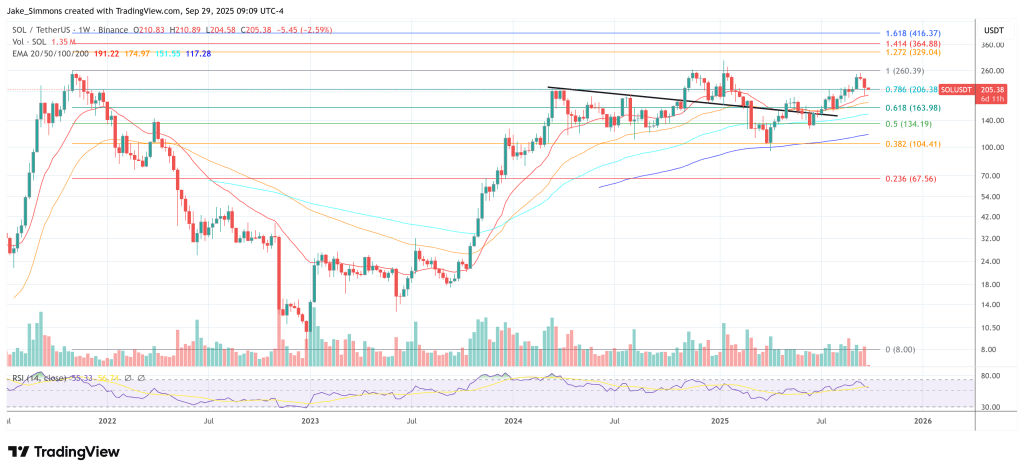
Solana price
Disclaimer: The articles reposted on this site are sourced from public platforms and are provided for informational purposes only. They do not necessarily reflect the views of MEXC. All rights remain with the original authors. If you believe any content infringes on third-party rights, please contact service@support.mexc.com for removal. MEXC makes no guarantees regarding the accuracy, completeness, or timeliness of the content and is not responsible for any actions taken based on the information provided. The content does not constitute financial, legal, or other professional advice, nor should it be considered a recommendation or endorsement by MEXC.

You May Also Like

CME Group to launch options on XRP and SOL futures

CME Group to launch options on XRP and SOL futures

The post CME Group to launch options on XRP and SOL futures appeared on BitcoinEthereumNews.com. CME Group will offer options based on the derivative markets on Solana (SOL) and XRP. The new markets will open on October 13, after regulatory approval.  CME Group will expand its crypto products with options on the futures markets of Solana (SOL) and XRP. The futures market will start on October 13, after regulatory review and approval.  The options will allow the trading of MicroSol, XRP, and MicroXRP futures, with expiry dates available every business day, monthly, and quarterly. The new products will be added to the existing BTC and ETH options markets. ‘The launch of these options contracts builds on the significant growth and increasing liquidity we have seen across our suite of Solana and XRP futures,’ said Giovanni Vicioso, CME Group Global Head of Cryptocurrency Products. The options contracts will have two main sizes, tracking the futures contracts. The new market will be suitable for sophisticated institutional traders, as well as active individual traders. The addition of options markets singles out XRP and SOL as liquid enough to offer the potential to bet on a market direction.  The options on futures arrive a few months after the launch of SOL futures. Both SOL and XRP had peak volumes in August, though XRP activity has slowed down in September. XRP and SOL options to tap both institutions and active traders Crypto options are one of the indicators of market attitudes, with XRP and SOL receiving a new way to gauge sentiment. The contracts will be supported by the Cumberland team.  ‘As one of the biggest liquidity providers in the ecosystem, the Cumberland team is excited to support CME Group’s continued expansion of crypto offerings,’ said Roman Makarov, Head of Cumberland Options Trading at DRW. ‘The launch of options on Solana and XRP futures is the latest example of the…
Share
BitcoinEthereumNews2025/09/18 00:56
SEC Approves Decision Concerning Bitcoin and 9 Altcoins – The Dow Jones of Cryptocurrencies May Have Arrived

SEC Approves Decision Concerning Bitcoin and 9 Altcoins – The Dow Jones of Cryptocurrencies May Have Arrived

The post SEC Approves Decision Concerning Bitcoin and 9 Altcoins – The Dow Jones of Cryptocurrencies May Have Arrived appeared on BitcoinEthereumNews.com. While the cryptocurrency market doesn’t yet have a comprehensive index like the Dow Jones or S&P 500, Bitwise is one step closer to filling this void. The company’s new exchange-traded product, Bitwise 10 Crypto Index ETF (BITW), has begun trading, offering individual investors and financial advisors access to the 10 largest crypto assets in a single product. BITW’s portfolio includes the following digital assets: Bitcoin, Ethereum, XRP, Solana, Chainlink, Litecoin, Cardano, Avalanche, Sui, and Polkadot. Bitwise CEO and co-founder Hunter Horsley told CNBC that this conversion makes the company the first to include altcoins like Cardano, Avalanche, Sui, and Polkadot, which don’t currently have spot ETFs, in an ETF from a major asset manager. “This step significantly broadens the investor base that can access various crypto assets,” Horsley said. “This is particularly important for assets without a spot ETF.” According to the CEO, this ETF also provides significant accessibility for smaller investors who invest through individual retirement accounts (IRAs) or pension funds and are only able to access ETFs. BITW, previously an index fund containing the same assets, has been converted to an ETF and is now listed on the stock exchange with $1.5 billion in assets under management. The ETF structure provides additional benefits to investors by offering greater trading flexibility, tax advantages, and lower costs, along with broader trading permissions. This development follows an expanded wave of ETFs that followed the U.S. Securities and Exchange Commission (SEC) approval of spot Bitcoin ETFs in January 2024. Since then, asset managers have sought approval for a wider range of ETFs, from altcoins like Sui and Aptos to Trump-themed tokens and memecoins like Dogecoin. However, as the market matures, crypto assets are beginning to take on their own dynamics, suggesting that broad-based products like BITW could offer a diversification tool similar…
Share
BitcoinEthereumNews2025/12/10 06:40