As of September 30, 2025, the open interest on options linked to IBIT reached approximately $38 billion, surpassing Deribit's $32 billion.As of September 30, 2025, the open interest on options linked to IBIT reached approximately $38 billion, surpassing Deribit's $32 billion.

IBIT surpasses Deribit: Bitcoin options at around $38B, shift towards regulated markets
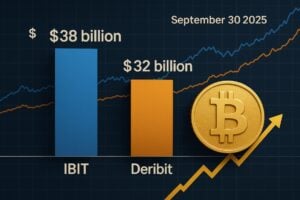
As of September 30, 2025, the open interest on options linked to IBIT reached approximately $38 billion, surpassing Deribit’s $32 billion, according to snapshots from CoinGlass and Skew.

In this context, the overtaking indicates a shift towards regulated markets, recalibrating the liquidity map on Bitcoin; the phenomenon is consistent with institutional flows observed after the launch of spot ETFs.

IBIT (iShares Bitcoin Trust) is managed by BlackRock, as indicated in the official product documentation from BlackRock, and financial analysts have linked the increase in open interest to a greater preference for regulated and reportable custodial vehicles Reuters.

According to the data collected by our analysis team and confirmed by the mentioned snapshots, the growth observed in recent weeks is mainly attributable to volumes on liquid expirations and institutional hedging operations.

Industry analysts note that the transition to regulated venues tends to reduce certain informational asymmetries, while increasing the risk concentrated on a few liquidity nodes.

In brief

  • IBIT is defined as the spot Bitcoin ETF with declared assets amounting to approximately $84 billion and 770,000 BTC held, although these figures require further verification [data to be verified] BlackRock.
  • The options linked to IBIT amount to approximately 340,000 BTC of open interest; the global share stands at IBIT 45%, Deribit 41.9%, and CME around 6% (snapshot as of 09/30/2025).
  • The market leverage, estimated at 45%, is indicated by Checkonchain and is close to recent highs.

The numbers of the overtake: the snapshot

The comparison between crypto-native platforms and regulated channels enters a new phase. Indeed, the growth of options on IBIT attracts institutional flows, particularly attentive to compliance and custody.

Quotes and Volumes — Recent Snapshot

  • Open interest IBIT: approximately $38 billion (snapshot 09/30/2025)
  • Open interest Deribit: approximately $32 billion (snapshot 09/30/2025)
  • Asset IBIT (spot ETF): approximately $84 billion [data to be verified]
  • BTC held by IBIT: 770,000 [data to be verified]
  • OI options linked to IBIT: approximately 340,000 BTC

BTC Options Market Share


| IBIT (options on ETF) | 45% |
| Deribit | 41.9% |
| CME | ~6% |
| Others | ~7% |

Why it matters: institutional players, pricing, and liquidity

The surge of IBIT indicates that a growing portion of the risk on Bitcoin is shifting towards infrastructures with regulatory oversight. For large investors, this results in reduced friction for hedging operations, more manageable margins, and greater clarity in reporting.

For the market, it equates to price formation more anchored to precise rules, while still creating new dependencies on a few liquidity hubs.

Asset managers favor instruments with segregated custody, known clearing, and transparency in requirements, elements that impact implied volatility, skew, and hedging costs.

It should be noted that the immediate effect is greater depth on the most liquid maturities and tighter bid/ask spreads during peak activity.

Growing Risks: Concentration, Leverage, and Correlations

IBIT and Deribit, combined, account for almost 90% of the global open interest in BTC options. This concentration heightens exposure to potential liquidity shocks and synchronized behavior of hedging algorithms.

The relationship between derivatives and the spot market highlights how approximately 340,000 BTC of OI in “IBIT-linked” options are related to the 770,000 BTC held by the ETF, indicative of an estimated leverage of 45% (according to Checkonchain).

That said, a particularly sensitive ecosystem emerges to abrupt price movements, especially near expirations.

What to monitor immediately

  • The gamma exposure of operators and the possibility of a “pin at expiration”.
  • The dynamics of the basis between ETFs, futures, and perpetuals.
  • The flows on CME and the possible migration of volatility from Deribit to regulated venues.
  • Possible misalignments between the open interest on options and the creations/redemptions of the ETF shares.

Deribit, CME and the others: an evolving balance

Deribit maintains its appeal among crypto-native traders, thanks to the depth on exotic strikes and detailed expirations.

The Deribit community continues to provide a significant contribution to price discovery in certain volatility structures, while institutional platforms like CME occupy a more limited share (about 6%) in BTC options.

It is important to note that some news about extraordinary operations or acquisitions (such as the potential purchase of Deribit by Coinbase for $2.9 billion) has not been confirmed by reliable primary sources.

Overall, the competitive comparison is played on liquidity, listing, and quality of infrastructure, rather than on M&A operations.

Essential Timeline

  • 2016: Deribit establishes itself as a leader in BTC options.
  • November 2024: launch of options on spot BTC ETFs, including those linked to IBIT (USA) [data to be verified].
  • September 30, 2025: snapshot showing IBIT above Deribit in terms of open interest on linked contracts.

Glossary and Methodology

  • IBIT: refers to the iShares Bitcoin Trust (spot Bitcoin ETF) with options listed on regulated markets in the USA; data regarding its size and the number of BTC held need further verification [data to be verified].
  • Open interest (OI): represents the value or quantity of open and not closed derivative contracts, expressed in USD or BTC.
  • Leverage (Checkonchain): proprietary indicator that measures the net risk position in the system, calculated as the ratio between open interest and spot value/assets under custody.
  • “IBIT-linked” Options: derivatives based on the IBIT ETF and related structures, used for hedging or arbitrage.
  • Market share: percentage of the global open interest attributable to each platform or product.

Operational Implications

For institutions, using a regulated ETF like IBIT facilitates compliance operations, simplifies margin netting, and allows for mandate-based hedging.

For the retail and OTC market, this could translate into more orderly access, albeit with less extreme leverage compared to typical offshore platforms.

In conclusion, the direction is clear: greater governance and transparency, but also an increased risk of domino effects in case of shock. The sustainability of this configuration will depend on the diversification of venues and the effectiveness of market making.

Market Opportunity
OpenLedger Logo
OpenLedger Price(OPEN)
$0.16472
$0.16472$0.16472
-4.23%
USD
OpenLedger (OPEN) Live Price Chart
Disclaimer: The articles reposted on this site are sourced from public platforms and are provided for informational purposes only. They do not necessarily reflect the views of MEXC. All rights remain with the original authors. If you believe any content infringes on third-party rights, please contact service@support.mexc.com for removal. MEXC makes no guarantees regarding the accuracy, completeness, or timeliness of the content and is not responsible for any actions taken based on the information provided. The content does not constitute financial, legal, or other professional advice, nor should it be considered a recommendation or endorsement by MEXC.

You May Also Like

Why 100 Percent Test Coverage is Not Possible — Lessons from Testing Banking and Healthcare Systems

Why 100 Percent Test Coverage is Not Possible — Lessons from Testing Banking and Healthcare Systems

Quality is not about testing everything; quality is about testing what is most important.
Share
Hackernoon2025/12/26 16:05
US eyes crypto mining at disputed nuclear plant in Russia-Ukraine conflict: report

US eyes crypto mining at disputed nuclear plant in Russia-Ukraine conflict: report

The plant is located in Ukraine and has been under Russian control since 2022, with its future management a key issue in peace talks.
Share
Coinstats2025/12/26 18:58
Google's AP2 protocol has been released. Does encrypted AI still have a chance?

Google's AP2 protocol has been released. Does encrypted AI still have a chance?

Following the MCP and A2A protocols, the AI Agent market has seen another blockbuster arrival: the Agent Payments Protocol (AP2), developed by Google. This will clearly further enhance AI Agents' autonomous multi-tasking capabilities, but the unfortunate reality is that it has little to do with web3AI. Let's take a closer look: What problem does AP2 solve? Simply put, the MCP protocol is like a universal hook, enabling AI agents to connect to various external tools and data sources; A2A is a team collaboration communication protocol that allows multiple AI agents to cooperate with each other to complete complex tasks; AP2 completes the last piece of the puzzle - payment capability. In other words, MCP opens up connectivity, A2A promotes collaboration efficiency, and AP2 achieves value exchange. The arrival of AP2 truly injects "soul" into the autonomous collaboration and task execution of Multi-Agents. Imagine AI Agents connecting Qunar, Meituan, and Didi to complete the booking of flights, hotels, and car rentals, but then getting stuck at the point of "self-payment." What's the point of all that multitasking? So, remember this: AP2 is an extension of MCP+A2A, solving the last mile problem of AI Agent automated execution. What are the technical highlights of AP2? The core innovation of AP2 is the Mandates mechanism, which is divided into real-time authorization mode and delegated authorization mode. Real-time authorization is easy to understand. The AI Agent finds the product and shows it to you. The operation can only be performed after the user signs. Delegated authorization requires the user to set rules in advance, such as only buying the iPhone 17 when the price drops to 5,000. The AI Agent monitors the trigger conditions and executes automatically. The implementation logic is cryptographically signed using Verifiable Credentials (VCs). Users can set complex commission conditions, including price ranges, time limits, and payment method priorities, forming a tamper-proof digital contract. Once signed, the AI Agent executes according to the conditions, with VCs ensuring auditability and security at every step. Of particular note is the "A2A x402" extension, a technical component developed by Google specifically for crypto payments, developed in collaboration with Coinbase and the Ethereum Foundation. This extension enables AI Agents to seamlessly process stablecoins, ETH, and other blockchain assets, supporting native payment scenarios within the Web3 ecosystem. What kind of imagination space can AP2 bring? After analyzing the technical principles, do you think that's it? Yes, in fact, the AP2 is boring when it is disassembled alone. Its real charm lies in connecting and opening up the "MCP+A2A+AP2" technology stack, completely opening up the complete link of AI Agent's autonomous analysis+execution+payment. From now on, AI Agents can open up many application scenarios. For example, AI Agents for stock investment and financial management can help us monitor the market 24/7 and conduct independent transactions. Enterprise procurement AI Agents can automatically replenish and renew without human intervention. AP2's complementary payment capabilities will further expand the penetration of the Agent-to-Agent economy into more scenarios. Google obviously understands that after the technical framework is established, the ecological implementation must be relied upon, so it has brought in more than 60 partners to develop it, almost covering the entire payment and business ecosystem. Interestingly, it also involves major Crypto players such as Ethereum, Coinbase, MetaMask, and Sui. Combined with the current trend of currency and stock integration, the imagination space has been doubled. Is web3 AI really dead? Not entirely. Google's AP2 looks complete, but it only achieves technical compatibility with Crypto payments. It can only be regarded as an extension of the traditional authorization framework and belongs to the category of automated execution. There is a "paradigm" difference between it and the autonomous asset management pursued by pure Crypto native solutions. The Crypto-native solutions under exploration are taking the "decentralized custody + on-chain verification" route, including AI Agent autonomous asset management, AI Agent autonomous transactions (DeFAI), AI Agent digital identity and on-chain reputation system (ERC-8004...), AI Agent on-chain governance DAO framework, AI Agent NPC and digital avatars, and many other interesting and fun directions. Ultimately, once users get used to AI Agent payments in traditional fields, their acceptance of AI Agents autonomously owning digital assets will also increase. And for those scenarios that AP2 cannot reach, such as anonymous transactions, censorship-resistant payments, and decentralized asset management, there will always be a time for crypto-native solutions to show their strength? The two are more likely to be complementary rather than competitive, but to be honest, the key technological advancements behind AI Agents currently all come from web2AI, and web3AI still needs to keep up the good work!
Share
PANews2025/09/18 07:00
