End-to-End Deep Learning Improves CT Material Decomposition
Table of Links
Abstract and 1 Introduction
- Dual-Energy CT Forward Model
- [Model-based Optimization Problem]()
- End-to-End Model-based Deep Learning for Material Decomposition (E2E-Decomp)
- Numerical Results
- Conclusion
- Compliance with Ethical Standards and References
4 End-to-End Model-based Deep Learning for Material Decomposition (E2E-Decomp)
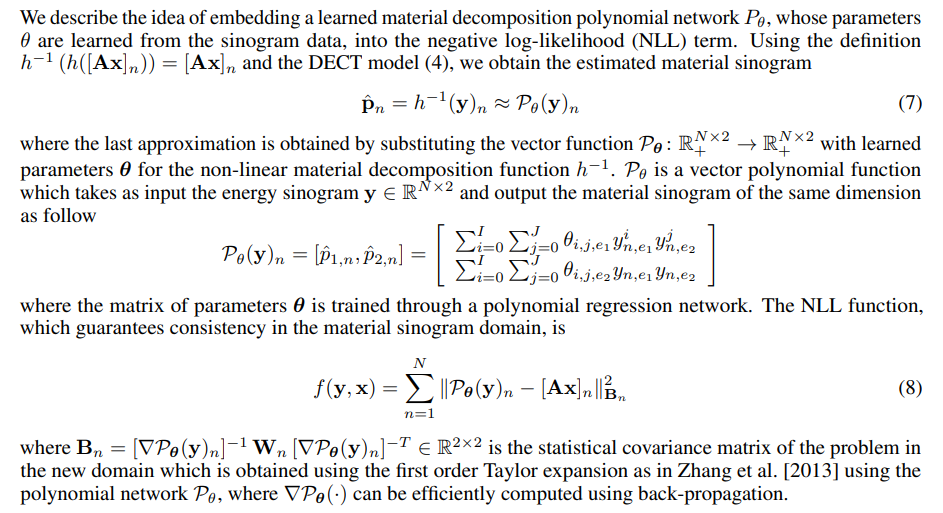
\ 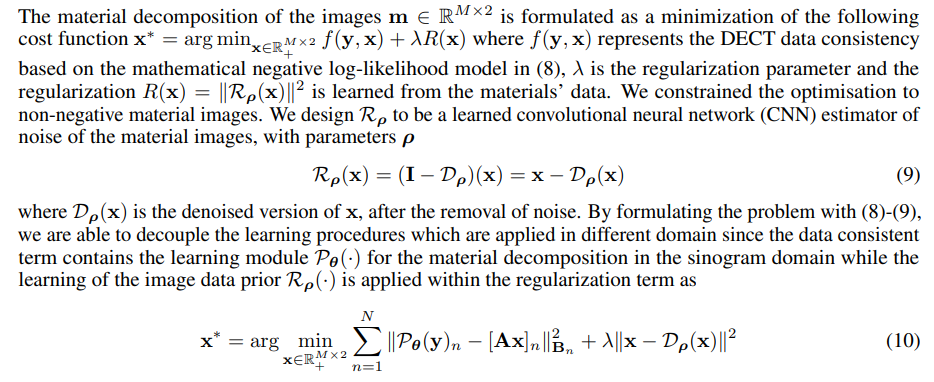
\ 
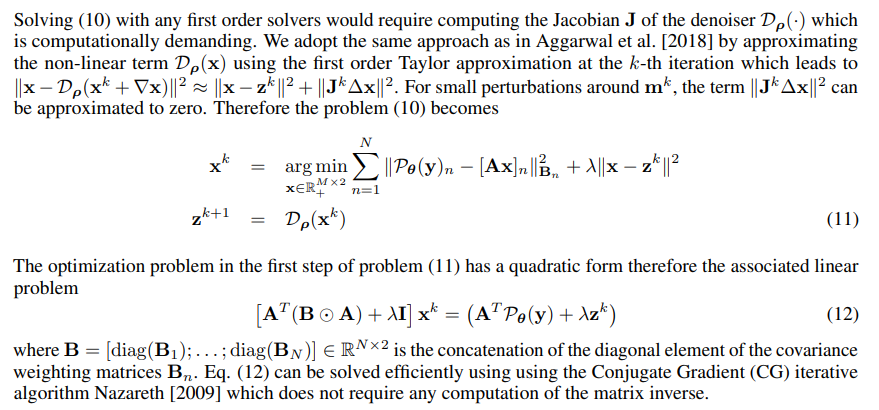
\ 
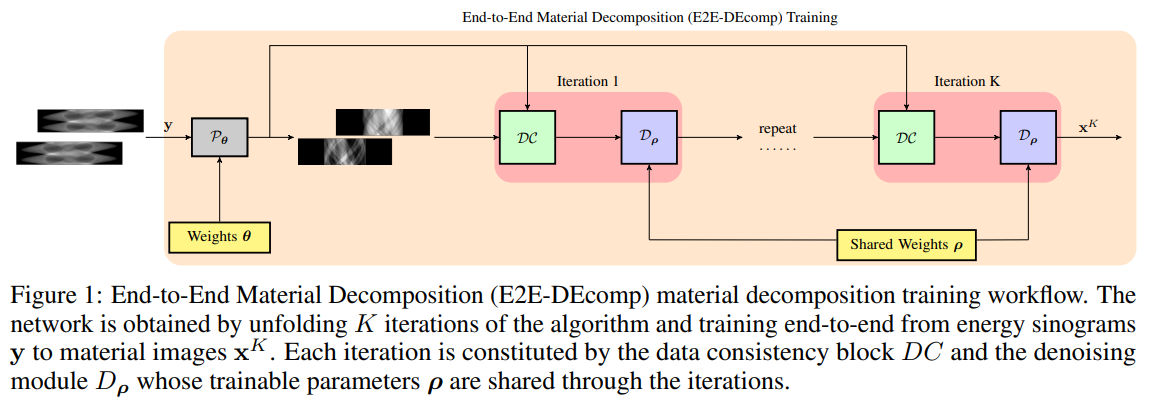
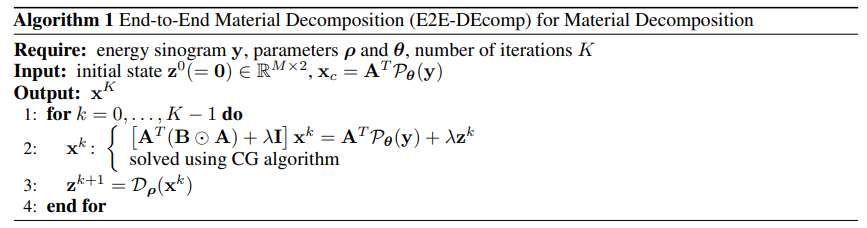
\ The workflow of the E2E-DEcomp algorithm at inference is shown in Fig. 1, and the structure of the E2EDEcomp algorithm for inference is reported in Table 1.
\ 
5 Numerical Results

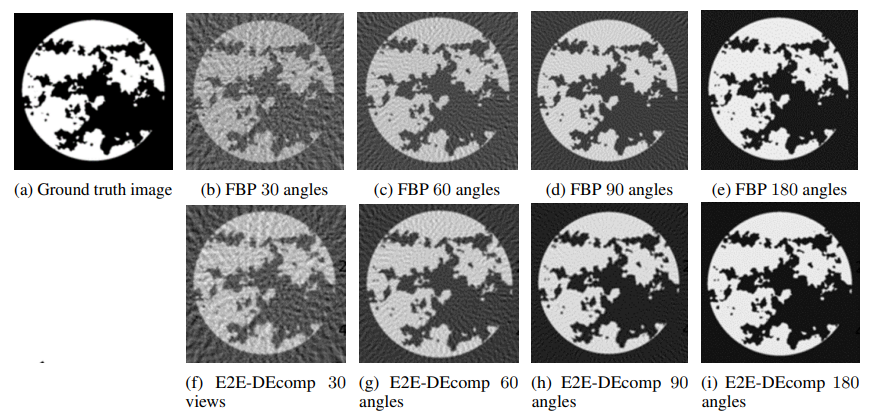
\ In order to reduce the number of learnable parameters we utilise the same architecture for the denoising module D at each iteration k with shared parameters ρ. In Fig. 2 it is shown the qualitative comparison on a test material image of the adipose tissue using filtered back projection (FBP) and E2E-DEcomp while in Fig. 3 is is reported the PSNR error for a set of 10 testing images for the 2 material decomposition.
\ 
\ 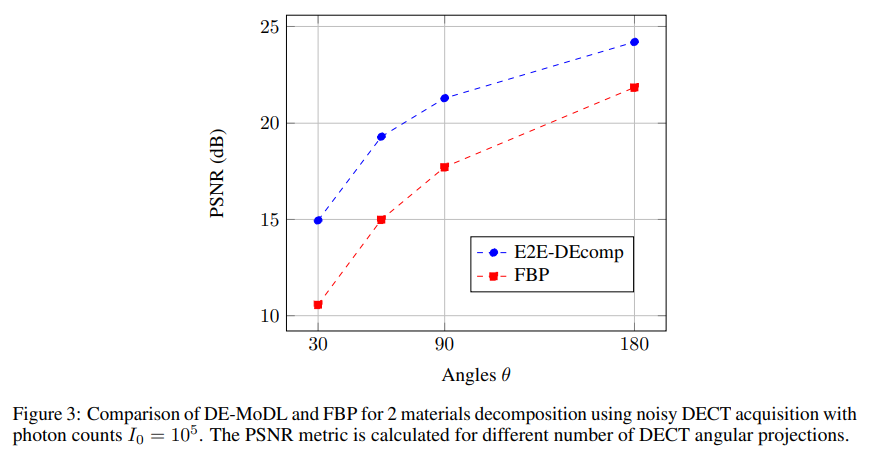
\ It is worth noting that the improvement in the decomposition accuracy are consistent, around 5 dB, across different levels of dose, i.e. from sparse views to higher number of projections. We have also compared the E2E-DEcomp framework with the FBP ConvNet method Jin et al. [2017] and Fig. 4 shows how E2E-DEcomp can achieve a faster convergence in training using fewer epochs.
6 Conclusion
This work proposed a direct method for DECT material decomposition using a model-based optimization able to decouple the learning in the measurement and image domain. Numerical results show the effectiveness
\ 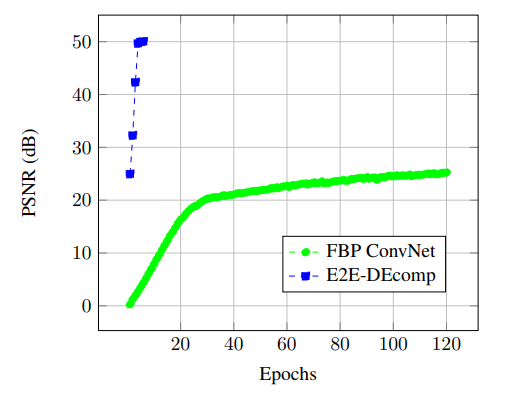
\ of the proposed E2E-DEcomp compared to other supervised approaches since it has fast convergence and excellent performance on low-dose DECT which can lead to further study with clinical dataset.
\
7 Compliance with Ethical Standards
This is a numerical simulation study for which no ethical approval was required.
References
Hemant K Aggarwal, Merry P Mani, and Mathews Jacob. Modl: Model-based deep learning architecture for inverse problems. IEEE transactions on medical imaging, 38(2):394–405, 2018.
\ Robert E Alvarez and Albert Macovski. Energy-selective reconstructions in x-ray computerised tomography. Physics in Medicine & Biology, 21(5):733, 1976.
\ Caifang Cai, Thomas Rodet, Samuel Legoupil, and Ali Mohammad-Djafari. A full-spectral bayesian reconstruction approach based on the material decomposition model applied in dual-energy computed tomography. Medical physics, 40(11):111916, 2013.
\ A. Eguizabal, O. Öktem, and M. Persson. A deep learning one-step solution to material image reconstruction in photon counting spectral CT. In Wei Zhao and Lifeng Yu, editors, Medical Imaging 2022: Physics of Medical Imaging, volume 12031, page 120310Y. International Society for Optics and Photonics, 2022. doi:10.1117/12.2612426.
\ W. Fang, D. Wu, K. Kim, M.K. Kalra, R. Singh, L. Li, and Q. Li. Iterative material decomposition for spectral CT using self-supervised Noise2Noise prior. Phys Med Biol, 66(15):155013, July 2021. doi:10.1088/1361- 6560/ac0afd.
\ Kyong Hwan Jin, Michael T McCann, Emmanuel Froustey, and Michael Unser. Deep convolutional neural network for inverse problems in imaging. IEEE transactions on image processing, 26(9):4509–4522, 2017.
\ Thorsten RC Johnson, Bernhard Krauss, Martin Sedlmair, Michael Grasruck, Herbert Bruder, Dominik Morhard, Christian Fink, Sabine Weckbach, Miriam Lenhard, Bernhard Schmidt, et al. Material differentiation by dual energy ct: initial experience. European radiology, 17:1510–1517, 2007.
\ Yong Long and Jeffrey A Fessler. Multi-material decomposition using statistical image reconstruction for spectral ct. IEEE transactions on medical imaging, 33(8):1614–1626, 2014.
\ Clemens Maaß, Matthias Baer, and Marc Kachelrieß. Image-based dual energy ct using optimized precorrection functions: A practical new approach of material decomposition in image domain. Medical physics, 36(8): 3818–3829, 2009.
\ Korbinian Mechlem, Thorsten Sellerer, Sebastian Ehn, Daniela Münzel, Eva Braig, Julia Herzen, Peter B Noël, and Franz Pfeiffer. Spectral angiography material decomposition using an empirical forward model and a dictionary-based regularization. IEEE transactions on medical imaging, 37(10):2298–2309, 2018.
\ Paulo RS Mendonça, Peter Lamb, and Dushyant V Sahani. A flexible method for multi-material decomposition of dual-energy ct images. IEEE transactions on medical imaging, 33(1):99–116, 2013.
\ Rohan Nadkarni, Alex Allphin, Darin P Clark, and Cristian T Badea. Material decomposition from photoncounting ct using a convolutional neural network and energy-integrating ct training labels. Physics in Medicine & Biology, 67(15):155003, 2022.
\ John L Nazareth. Conjugate gradient method. Wiley Interdisciplinary Reviews: Computational Statistics, 1(3): 348–353, 2009.
\ A. Perelli and M.S. Andersen. Regularization by denoising sub-sampled newton method for spectral CT multi-material decomposition. Philosophical Transactions of the Royal Society A: Mathematical, Physical and Engineering Sciences, 379(2200):20200191, 2021. doi:10.1098/rsta.2020.0191.
\ Zaifeng Shi, Huilong Li, Qingjie Cao, Zhongqi Wang, and Ming Cheng. A material decomposition method for dual-energy ct via dual interactive wasserstein generative adversarial networks. Medical Physics, 48(6): 2891–2905, 2021.
\ Emil Y Sidky and Xiaochuan Pan. Report on the AAPM deep-learning spectral CT grand challenge. Medical Physics, 2023.
\ Wim Van Aarle, Willem Jan Palenstijn, Jeroen Cant, Eline Janssens, Folkert Bleichrodt, Andrei Dabravolski, Jan De Beenhouwer, K Joost Batenburg, and Jan Sijbers. Fast and flexible x-ray tomography using the astra toolbox. Optics express, 24(22):25129–25147, 2016.
\ Ruoqiao Zhang, Jean-Baptiste Thibault, Charles A Bouman, Ken D Sauer, and Jiang Hsieh. Model-based iterative reconstruction for dual-energy x-ray ct using a joint quadratic likelihood model. IEEE transactions on medical imaging, 33(1):117–134, 2013.
\
:::info Authors:
(1) Jiandong Wang, Shenzhen Xilaiheng Medical Electronics, (HORRON), China and Centre for Medical Engineering and Technology, University of Dundee, DD1 4HN, UK (jack@horron.com);
(2) Alessandro Perelli, Centre for Medical Engineering and Technology, University of Dundee, DD1 4HN, UK (aperelli001@dundee.ac.uk).
:::
:::info This paper is available on arxiv under CC BY 4.0 DEED license.
:::
\


You May Also Like

Will Crypto Go Up as the CLARITY Act Targets Late April and Cardano Whales Load 819 Million ADA

Scammers Target Stranded Ships in Strait of Hormuz With Fake Bitcoin Transit Fees