Paranoid Stateful Lambdas (PSLs) bring together cloud and edge computing under a secure, serverless framework. By running distributed workers inside trusted enclaves, PSLs guarantee confidentiality, integrity, and consistency across potentially untrusted providers. They combine a Secure Concurrency Layer, in-enclave database, and global routing to enable scalable, stateful execution. While not immune to side-channel attacks, PSLs mark a step forward in secure FaaS by making statefulness and security first-class citizens.Paranoid Stateful Lambdas (PSLs) bring together cloud and edge computing under a secure, serverless framework. By running distributed workers inside trusted enclaves, PSLs guarantee confidentiality, integrity, and consistency across potentially untrusted providers. They combine a Secure Concurrency Layer, in-enclave database, and global routing to enable scalable, stateful execution. While not immune to side-channel attacks, PSLs mark a step forward in secure FaaS by making statefulness and security first-class citizens.

Are PSLs the Next Big Thing After Serverless? Here’s What You Need to Know

Abstract and I. Introduction

II. Background

III. Paranoid Stateful Lambda

IV. SCL Design

V. Optimizations

VI. PSL with SCL

VII. Implementation

VIII. Evaluation

IX. Related Work

X. Conclusion, Acknowledgment, and References

III. PARANOID STATEFUL LAMBDA

Paranoid Stateful Lambdas (PSLs) provide unifed access to the computation and storage resources of the cloud and edge. They provide access to the abundance of edge servers which have better locality and lower latency than would be available with cloud-only environments. The serverless abstraction enables applications to be transparent about the underlying infrastructure.

\ Paranoid: PSL allows clients to launch a scalable number of distributed workers (i.e. Lambdas) on both cloud clusters and edge servers. Recognizing that servers on the cloud and edge may come from mutually distrustful service providers, PSL executes all the privacy-sensitive programs in secure enclaves, guaranteeing the confidentiality and integrity of all executions.

\ For the threat model, PSL adopts the typical ”cloud/edge attackers” who can listen and tamper with any communications or computations. For example, the attack may come from a compromised operating system kernel or a malicious staff member, both situations in which the attacker has full control over the system. SCL guarantees the confidentiality, integrity, and provenance of any data in execution and in transit. The trusted computation base (TCB) of SCL is limited to the processor chip, PSL code, and sandboxed application code running in an enclave, which explicitly excludes the operating system managed by the cloud provider. The design of SCL guards against message replay attacks and detects DDoS attacks at a granularity of a user-defined time interval (epoch). However, PSL does not guarantee against sidechannel attacks, given that Intel SGX suffers from various side-channel vulnerabilities [11, 13, 36]. However, there are various techniques [11, 31, 36, 37] proposed to mitigate the risk of side channel attacks.

\ Stateful: Beyond other secure FaaS implementations [5], PSL supports stateful execution of distributed workers, meaning that one in-enclave worker is able to communicate with workers in other enclaves or even workers that will be executed in the future [38]. Statefulness has already become a necessity in

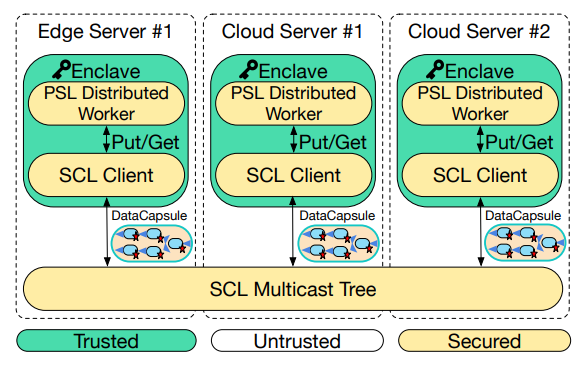
\ Fig. 4: The architecture of SCL. In-enclave workers communicate with each other by interacting with PSL using put() and get() operations. The KVS updates are propagated by SCL with a secure data structure called a DataCapsule.
\ many popular FaaS applications: for example, ExCamera [18], numpywren [33], mplambda [23].

\ In order for Lambdas to be Paranoid and Stateful, PSL consists the following main components: (1) Secure Concurrency Layer (SCL): enables secure communication between multiple enclaves, (2) In-Enclave LSM-tree based DB: provides persistence and durability of the DataCapsule, (3) PSL Secure FaaS: securely attests SCL, distributes cryptographic keys, and dispatches tasks to Worker Enclaves, and (4) Global Data Plane [29]: provides global routing infrastructure.

\ Secure Consistency Layer: In designing PSL, we recognize the need to have a secure layer that allows enclaves to communicate and concurrently share objects. This layer provides security and consistency semantics for transient messages over untrusted and unordered multicast. Consequently, distributed worker programs can use this layer as a form of shared memory, and PSL as a whole can use this layer to dispatch program scripts and coordinate idle secure enclaves. An analogy to this layer is BigTable for Google or Dynamo for Amazon, infrastructure which provides a KVS layer as foundational communication abstraction to higher level applications.

\ To enhance performance, we designed an eventuallyconsistent replicated KVS that presents a shared memory view to all the secure enclaves connected to the same network multicast tree. If an enclave makes KVS updates to the local cache, the changes will be propagated to all other secure enclaves by broadcast. The secure enclaves maintain the same copy of memory cache. SCL partitions the KVS into a memtable that fits in main memory, and PSL has a Log-Structured Merge (LSM) tree inspired by RocksDB [40] that stores inactive keys.

\

:::info Authors:

(1) Kaiyuan Chen, University of California, Berkeley (kych@berkeley.edu);

(2) Alexander Thomas, University of California, Berkeley (alexthomas@berkeley.edu);

(3) Hanming Lu, University of California, Berkeley (hanming lu@berkeley.edu);

(4) William Mullen, University of California, Berkeley (wmullen@berkeley.edu);

(5) Jeff Ichnowski, University of California, Berkeley (jeffi@berkeley.edu);

(6) Rahul Arya, University of California, Berkeley (rahularya@berkeley.edu);

(7) Nivedha Krishnakumar, University of California, Berkeley (nivedha@berkeley.edu);

(8) Ryan Teoh, University of California, Berkeley (ryanteoh@berkeley.edu);

(9) Willis Wang, University of California, Berkeley (williswang@berkeley.edu);

(10) Anthony Joseph, University of California, Berkeley (adj@berkeley.edu);

(11) John Kubiatowicz, University of California, Berkeley (kubitron@berkeley.edu).

:::


:::info This paper is available on arxiv under CC BY 4.0 DEED license.

:::

\

Market Opportunity
Cloud Logo
Cloud Price(CLOUD)
$0.06399
$0.06399$0.06399
+5.87%
USD
Cloud (CLOUD) Live Price Chart
Disclaimer: The articles reposted on this site are sourced from public platforms and are provided for informational purposes only. They do not necessarily reflect the views of MEXC. All rights remain with the original authors. If you believe any content infringes on third-party rights, please contact service@support.mexc.com for removal. MEXC makes no guarantees regarding the accuracy, completeness, or timeliness of the content and is not responsible for any actions taken based on the information provided. The content does not constitute financial, legal, or other professional advice, nor should it be considered a recommendation or endorsement by MEXC.

You May Also Like

House Judiciary Rejects Vote To Subpoena Banks CEOs For Epstein Case

House Judiciary Rejects Vote To Subpoena Banks CEOs For Epstein Case

The post House Judiciary Rejects Vote To Subpoena Banks CEOs For Epstein Case appeared on BitcoinEthereumNews.com. Topline House Judiciary Committee Republicans blocked a Democrat effort Wednesday to subpoena a group of major banks as part of a renewed investigation into late sex offender Jeffrey Epstein’s financial ties. Congressman Jim Jordan, R-OH, is the chairman of the committee. (Photo by Nathan Posner/Anadolu via Getty Images) Anadolu via Getty Images Key Facts A near party-line vote squashed the effort to vote on a subpoena, with Rep. Thomas Massie, R-Ky., who is leading a separate effort to force the Justice Department to release more Epstein case materials, voting alongside Democrats. The vote, if successful, would have resulted in the issuing of subpoenas to JPMorgan Chase CEO Jamie Dimon, Bank of America CEO Brian Moynihan, Deutsche Bank CEO Christian Sewing and Bank of New York Mellon CEO Robin Vince. The subpoenas would have specifically looked into multiple reports that claimed the four banks flagged $1.5 billion in suspicious transactions linked to Epstein. The failed effort from Democrats followed an FBI oversight hearing in which agency director Kash Patel misleadingly claimed the FBI cannot release many of the files it has on Epstein. Get Forbes Breaking News Text Alerts: We’re launching text message alerts so you’ll always know the biggest stories shaping the day’s headlines. Text “Alerts” to (201) 335-0739 or sign up here. Crucial Quote Dimon, who attended a lunch with Senate Republicans before the vote, according to Politico, told reporters, “We regret any association with that man at all. And, of course, if it’s a legal requirement, we would conform to it. We have no issue with that.” Chief Critic “Republicans had the chance to subpoena the CEOs of JPMorgan, Bank of America, Deutsche Bank, and Bank of New York Mellon to expose Epstein’s money trail,” the House Judiciary Democrats said in a tweet. “Instead, they tried to bury…
Share
BitcoinEthereumNews2025/09/18 08:02
Polygon Tops RWA Rankings With $1.1B in Tokenized Assets

Polygon Tops RWA Rankings With $1.1B in Tokenized Assets

The post Polygon Tops RWA Rankings With $1.1B in Tokenized Assets appeared on BitcoinEthereumNews.com. Key Notes A new report from Dune and RWA.xyz highlights Polygon’s role in the growing RWA sector. Polygon PoS currently holds $1.13 billion in RWA Total Value Locked (TVL) across 269 assets. The network holds a 62% market share of tokenized global bonds, driven by European money market funds. The Polygon POL $0.25 24h volatility: 1.4% Market cap: $2.64 B Vol. 24h: $106.17 M network is securing a significant position in the rapidly growing tokenization space, now holding over $1.13 billion in total value locked (TVL) from Real World Assets (RWAs). This development comes as the network continues to evolve, recently deploying its major “Rio” upgrade on the Amoy testnet to enhance future scaling capabilities. This information comes from a new joint report on the state of the RWA market published on Sept. 17 by blockchain analytics firm Dune and data platform RWA.xyz. The focus on RWAs is intensifying across the industry, coinciding with events like the ongoing Real-World Asset Summit in New York. Sandeep Nailwal, CEO of the Polygon Foundation, highlighted the findings via a post on X, noting that the TVL is spread across 269 assets and 2,900 holders on the Polygon PoS chain. The Dune and https://t.co/W6WSFlHoQF report on RWA is out and it shows that RWA is happening on Polygon. Here are a few highlights: – Leading in Global Bonds: Polygon holds 62% share of tokenized global bonds (driven by Spiko’s euro MMF and Cashlink euro issues) – Spiko U.S.… — Sandeep | CEO, Polygon Foundation (※,※) (@sandeepnailwal) September 17, 2025 Key Trends From the 2025 RWA Report The joint publication, titled “RWA REPORT 2025,” offers a comprehensive look into the tokenized asset landscape, which it states has grown 224% since the start of 2024. The report identifies several key trends driving this expansion. According to…
Share
BitcoinEthereumNews2025/09/18 00:40
transcosmos helping Chinese lingerie brand LING LINGERIE’s full-fledged entry into Japan

transcosmos helping Chinese lingerie brand LING LINGERIE’s full-fledged entry into Japan

Executing strategies to help LING LINGERIE, a Chinese brand meeting Gen Z needs, boost awareness TOKYO, Jan. 23, 2026 /PRNewswire/ — transcosmos today announced
Share
AI Journal2026/01/23 19:30