The Ethereum Foundation (EF) has formalized a new leadership structure for its privacy program, elevating privacy from a set of parallel initiatives to a coordinated “Privacy @ EF” cluster that is explicitly organized around real-world use cases and deployability. Ethereum Makes Privacy A Priority In an October 1 post titled “Privacy Cluster Leadership Announcement,” EF […]The Ethereum Foundation (EF) has formalized a new leadership structure for its privacy program, elevating privacy from a set of parallel initiatives to a coordinated “Privacy @ EF” cluster that is explicitly organized around real-world use cases and deployability. Ethereum Makes Privacy A Priority In an October 1 post titled “Privacy Cluster Leadership Announcement,” EF […]

Ethereum Foundation Unveils Next Phase Of Its Privacy Revolution

The Ethereum Foundation (EF) has formalized a new leadership structure for its privacy program, elevating privacy from a set of parallel initiatives to a coordinated “Privacy @ EF” cluster that is explicitly organized around real-world use cases and deployability.

Ethereum Makes Privacy A Priority

In an October 1 post titled “Privacy Cluster Leadership Announcement,” EF said it is “organizing for scale and impact,” naming longtime ecosystem builder Igor Barinov as the coordinator of Privacy @ EF and Andy Guzman as the new coordinator of the PSE (Privacy & Scaling Explorations) team, succeeding Sam Richards. “Together, Igor and Andy will help ensure Ethereum’s privacy work is impactful, coherent, and accountable,” the Foundation wrote.

The announcement reframes EF’s privacy mission as three concrete pillars—“Private Reads,” “Private Writes,” and “Private Proving”—that directly map to user and institutional needs. Private Reads targets surveillance-resistant querying, authentication, and browsing; Private Writes focuses on shielding actions such as payments, governance, and transfers; and Private Proving aims to make proofs “efficient, portable, and usable across contexts like identities, data portability, and client-side proving.”

EF links these pillars to practical compliance and safety requirements, arguing they are “necessary for institutions to comply with data protection standards,” help individuals avoid metadata leaks, and “shield our private financial information.”The Foundation is explicit that privacy will no longer be treated as an abstract research track divorced from shipping software.

“For Ethereum to become a foundation for civilizational infrastructure, privacy cannot be abstract research alone. It must be organized, resourced, and deployed at scale,” the post states—an unusually direct articulation of the program’s end goal and a signal that the cluster will be judged on delivery as much as on research output.

The post closes with a blunt credo—“Privacy is normal, and Ethereum is for privacy”—and an open invitation for builders to connect with Barinov and Guzman and to explore a catalog of “700+ projects” in the on-chain privacy space.

Barinov, best known for founding Blockscout, Gnosis Chain, and zkBob, brings a mix of infrastructure, open-source stewardship, and applied privacy product experience. Guzman, who has been with PSE/EF since 2022, moves from strategy and product leadership into the top operational role for PSE, which EF describes as spanning applied cryptography, research, and engineering.

Substantively, the cluster model is designed to integrate ongoing work on privacy-preserving computation with Ethereum’s public verifiability guarantees. While the post does not enumerate specific deliverables or dates, its emphasis on “portable” and “usable” proving, institutional compliance, and metadata-minimizing reads implies a roadmap that extends beyond shielded transfers toward end-to-end private user journeys—identity, access, payments, and governance—compatible with L1/L2 designs and client-side proving patterns that have been maturing across the ecosystem.

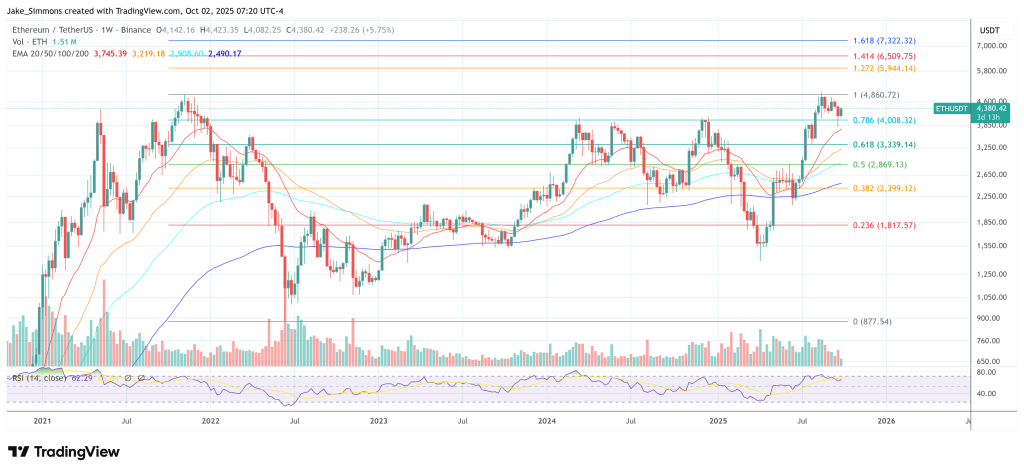
At press time, ETH traded $4,380.
Ethereum price
Market Opportunity
RealLink Logo
RealLink Price(REAL)
$0.0611
$0.0611$0.0611
-3.93%
USD
RealLink (REAL) Live Price Chart
Disclaimer: The articles reposted on this site are sourced from public platforms and are provided for informational purposes only. They do not necessarily reflect the views of MEXC. All rights remain with the original authors. If you believe any content infringes on third-party rights, please contact service@support.mexc.com for removal. MEXC makes no guarantees regarding the accuracy, completeness, or timeliness of the content and is not responsible for any actions taken based on the information provided. The content does not constitute financial, legal, or other professional advice, nor should it be considered a recommendation or endorsement by MEXC.

You May Also Like

OUSG (OUSG) - Complete Fundamental Analysis

OUSG (OUSG) - Complete Fundamental Analysis

OUSG (OUSG) Cryptocurrency Overview ## Core Technology and Blockchain Architecture OUSG is a tokenized short-term U.S. Treasury bills ETF managed by Ondo Finance

Share
Coinstats2026/02/01 09:01
Headwind Helps Best Wallet Token

Headwind Helps Best Wallet Token

The post Headwind Helps Best Wallet Token appeared on BitcoinEthereumNews.com. Google has announced the launch of a new open-source protocol called Agent Payments Protocol (AP2) in partnership with Coinbase, the Ethereum Foundation, and 60 other organizations. This allows AI agents to make payments on behalf of users using various methods such as real-time bank transfers, credit and debit cards, and, most importantly, stablecoins. Let’s explore in detail what this could mean for the broader cryptocurrency markets, and also highlight a presale crypto (Best Wallet Token) that could explode as a result of this development. Google’s Push for Stablecoins Agent Payments Protocol (AP2) uses digital contracts known as ‘Intent Mandates’ and ‘Verifiable Credentials’ to ensure that AI agents undertake only those payments authorized by the user. Mandates, by the way, are cryptographically signed, tamper-proof digital contracts that act as verifiable proof of a user’s instruction. For example, let’s say you instruct an AI agent to never spend more than $200 in a single transaction. This instruction is written into an Intent Mandate, which serves as a digital contract. Now, whenever the AI agent tries to make a payment, it must present this mandate as proof of authorization, which will then be verified via the AP2 protocol. Alongside this, Google has also launched the A2A x402 extension to accelerate support for the Web3 ecosystem. This production-ready solution enables agent-based crypto payments and will help reshape the growth of cryptocurrency integration within the AP2 protocol. Google’s inclusion of stablecoins in AP2 is a massive vote of confidence in dollar-pegged cryptocurrencies and a huge step toward making them a mainstream payment option. This widens stablecoin usage beyond trading and speculation, positioning them at the center of the consumption economy. The recent enactment of the GENIUS Act in the U.S. gives stablecoins more structure and legal support. Imagine paying for things like data crawls, per-task…
Share
BitcoinEthereumNews2025/09/18 01:27
RLUSD Attestation Strengthens Institutional Confidence as Liquidity Venues Expand

RLUSD Attestation Strengthens Institutional Confidence as Liquidity Venues Expand

The post RLUSD Attestation Strengthens Institutional Confidence as Liquidity Venues Expand appeared on BitcoinEthereumNews.com. RLUSD is gaining momentum as independent
Share
BitcoinEthereumNews2026/02/01 09:33