Sam Bankman-Fried acknowledges that his most significant error was that he had given FTX to the new CEO prior to bankruptcy, and he had no final opportunity to. The disgraced founder of FTX, Sam Bankman-Fried, says that his biggest mistake was the one that sent him the reins of the crypto exchange to the new […] The post Crypto News: Bankman-Fried’s Biggest Mistake: Handing FTX to New CEO appeared first on Live Bitcoin News.Sam Bankman-Fried acknowledges that his most significant error was that he had given FTX to the new CEO prior to bankruptcy, and he had no final opportunity to. The disgraced founder of FTX, Sam Bankman-Fried, says that his biggest mistake was the one that sent him the reins of the crypto exchange to the new […] The post Crypto News: Bankman-Fried’s Biggest Mistake: Handing FTX to New CEO appeared first on Live Bitcoin News.

Crypto News: Bankman-Fried’s Biggest Mistake: Handing FTX to New CEO

2025/10/05 01:30

Sam Bankman-Fried acknowledges that his most significant error was that he had given FTX to the new CEO prior to bankruptcy, and he had no final opportunity to.

The disgraced founder of FTX, Sam Bankman-Fried, says that his biggest mistake was the one that sent him the reins of the crypto exchange to the new CEO, John J. Ray III, before the company announced its bankruptcy in November 2022. 

Bankman-Fried became aware of a possible external investment that could have rescued FTX just a few minutes after signing over the exchange and said he could not take his decision back. 

It was revealed in a recent exclusive interview with Mother Jones and shed new light on the dramatic final days of the $32 billion exchange that on November 11, 2022, filed Chapter 11 bankruptcy.

Under the leadership of Ray, FTX went bankrupt quickly, and he hired the law firm Sullivan and Cromwell to provide legal advice. The new CEO has a reputation for handling corporate meltdowns such as Enron. 

The fall of FTX was described as an unprecedented corporate control failure where financial records were chaotic and management practices were poor, which was revealed throughout the bankruptcy process.

The bankruptcy of FTX showed that the company had misused millions of customer funds. Customer funds of the company were misused by the sister company, Alameda Research, and the company suffered billions of dollars of trading losses, the notorious Alameda gap. 

Later on, Bankman-Fried was arrested in the Bahamas and extradited to the U.S., where he was sentenced to 25 years in prison over his part in the collapse and the fraud.

FTX Creditors Approach $1.6 Billion Repayment Milestone

Recently, the FTX bankruptcy estate provided information that it will release 1.6 billion dollars to creditors in the continued repayment process. 
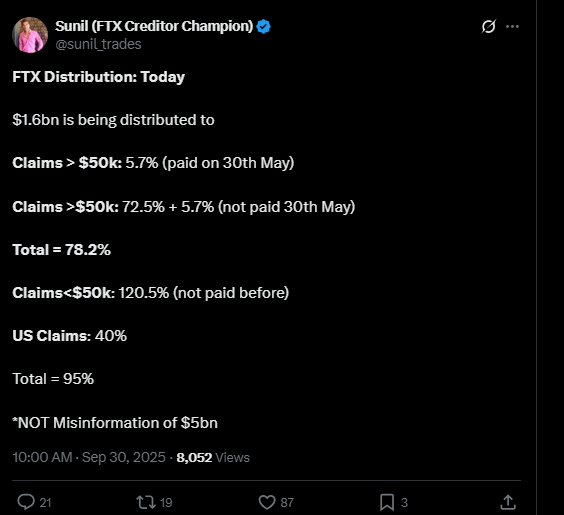
Source – X

This will be the third large tranche after previous repayments in February and May 2025. 

The repayments will be modeled to have high recovery rates for the smaller claimant of more than 120 percent, larger claims of more than 50,000 U.S. claimants will have approximately 60 percent recovery rate, and an overall total repayment rate is near 78.2 percent. 

Such repayments are an indication of a gradual yet progressive bid to pay back creditors following the industry destabilizing meltdown.

Bankman-Fried and his legal team are challenging his conviction, saying the newly appointed CEO mishandled the billion-dollar bankruptcy. 

The law company that made a lot of money out of the costly court cases. This scandal is another twist to the dramatic story of the spectacular collapse of FTX.

The post Crypto News: Bankman-Fried’s Biggest Mistake: Handing FTX to New CEO appeared first on Live Bitcoin News.


Disclaimer: The articles reposted on this site are sourced from public platforms and are provided for informational purposes only. They do not necessarily reflect the views of MEXC. All rights remain with the original authors. If you believe any content infringes on third-party rights, please contact service@support.mexc.com for removal. MEXC makes no guarantees regarding the accuracy, completeness, or timeliness of the content and is not responsible for any actions taken based on the information provided. The content does not constitute financial, legal, or other professional advice, nor should it be considered a recommendation or endorsement by MEXC.

You May Also Like

Three Reasons Why Bull Run Is Not Over Yet

Three Reasons Why Bull Run Is Not Over Yet

The post Three Reasons Why Bull Run Is Not Over Yet appeared on BitcoinEthereumNews.com. Rising stablecoin supply shows investors are still holding funds for the next rally. As major economies shift toward easier financial conditions global liquidity is turning upwards. Analyst states, “Bull run isn’t over, it’s delayed”. Bitcoin suffered a sharp crash after a sudden liquidity shock hit global markets, wiping out about millions in value within minutes. Analysts say the fall was not caused by Bitcoin itself but by a spike in Japanese government bond yields, which disrupted the yen carry trade and forced investors to unwind positions across multiple risk assets. Amid the market instability, the long-held idea that Bitcoin follows a clean four-year halving cycle is losing credibility. According to market analysts, the current slowdown looks more like a delay than the end of a bull run, citing several reasons. Growing Stablecoin Liquidity Even after the recent market pullback, total stablecoin supply continues to increase. This is a sign that large investors have not left the market.  Instead, they are holding capital on the sidelines in stablecoins and waiting for better macro conditions. Rising stablecoin reserves often act as fuel for the next stage of a crypto rally. Global Liquidity Is Turning Upward Several major economies are moving toward easier policy. China has been injecting liquidity for months. Japan recently announced a stimulus package of about $135B and is easing crypto regulations. Canada is also shifting toward looser conditions. In the United States, the Federal Reserve has already stopped quantitative tightening, which historically happens before some form of liquidity expansion. Bitcoin rarely moves against a rising global liquidity cycle. Related: Bitcoin Loses the Payments War: Stablecoins Take the Lead in Global Settlement Upcoming Policies Could Add More Liquidity Policy actions in the U.S. may increase liquidity further. The Treasury’s General Account holds roughly $940B, about $90B above its normal range.…
Share
BitcoinEthereumNews2025/12/07 20:01