Stablecoin Settlement: Why SoFi Moved $25B Onchain
Overview
SoFi has moved stablecoin settlement from a financial experiment into live card infrastructure. On September 22, 2026, SoFi Bank and Mastercard announced that SoFiUSD is now being used to settle transactions across SoFi’s debit and credit card program, which is expected to process more than $25 billion in annualized volume. The figure refers to the transaction volume flowing through the card program, not the market capitalization or circulating supply of SoFiUSD.
The development matters because the blockchain is being inserted into the settlement layer rather than the consumer-facing checkout experience. Cardholders can continue using Mastercard in familiar ways, while merchants do not need to hold a stablecoin simply because SoFi settles its obligations with SoFiUSD. Authorization, card-network messaging and merchant acceptance remain part of Mastercard’s broader payments infrastructure.
That makes this stablecoin settlement model more important than another crypto-payment feature. Stablecoins are beginning to perform a role traditionally handled by bank money inside institutional payment networks. If the model scales, the most significant adoption may happen largely out of sight: consumers continue paying with cards, while banks and payment companies increasingly use programmable digital dollars to move liquidity behind the scenes.
Key Takeaways
- SoFi is migrating a card program expected to exceed $25 billion in annualized volume to SoFiUSD settlement.
- The $25 billion figure represents card transaction volume, not SoFiUSD supply.
- Consumers and merchants do not need to interact directly with a stablecoin.
- The blockchain primarily changes the settlement layer rather than the entire Mastercard payment flow.
- The longer-term opportunity is 24/7 liquidity movement between regulated financial institutions.
Why Is SoFi Moving $25B Into Stablecoin Settlement?
What Exactly Is Moving Onchain?
Card payments are not one single operation. A transaction normally moves through authorization, clearing and settlement. Authorization determines whether a payment should be approved, clearing calculates obligations between participating institutions, and settlement is the stage where value is ultimately transferred between those institutions. SoFi’s announcement is important because it targets this last layer rather than attempting to rebuild the entire card experience around blockchain technology.
Using SoFiUSD for settlement means SoFi can discharge card-related financial obligations with a dollar-denominated blockchain asset issued by SoFi Bank, while Mastercard continues providing the global network connecting issuers, acquirers and merchants. The customer can still tap a card at a store, and the merchant can continue receiving funds through existing payment relationships. What changes is the infrastructure used between financial institutions once transactions need to be financially settled.
That distinction prevents an important misunderstanding. Mastercard transactions have not suddenly become blockchain transactions from end to end. The card network still performs the functions that make Mastercard useful at global scale, while stablecoin settlement provides an alternative rail for moving value between regulated participants.
Why Does Settlement Matter More Than a Crypto Checkout Feature?
Consumer-facing crypto payment products often require users or merchants to make an explicit decision to hold or accept digital assets. That limits adoption because both sides must change behavior. Settlement infrastructure works differently: if a bank can improve its internal liquidity movement using a stablecoin without changing the customer experience, blockchain adoption can scale without requiring millions of users to understand the technology.
This is why SoFi’s move is potentially more consequential than allowing customers to pay directly with stablecoins. The economic function being changed is deep inside the payment stack. SoFiUSD can become part of how institutional obligations are settled even when neither the cardholder nor the merchant thinks of the transaction as a crypto payment.
For payments infrastructure, invisible adoption can be more important than visible adoption. A technology does not need to become a consumer brand if it consistently reduces settlement friction, improves liquidity availability or expands operating hours behind existing financial products.
How Does Stablecoin Settlement Work Inside Mastercard?
Does a Merchant Need to Hold SoFiUSD?
No. The merchant does not need to become a stablecoin holder simply because SoFi is using SoFiUSD for settlement. Mastercard’s network still connects merchant acquirers, issuers and payment-service providers, while stablecoin settlement operates between participating financial institutions.
This preserves one of the largest advantages of existing card infrastructure: merchants do not need to redesign checkout systems every time the settlement asset changes. A merchant can continue accepting Mastercard while banks experiment with different forms of settlement money behind the network.
That architecture also shows why stablecoins may complement rather than replace card networks. Mastercard’s value is not limited to transferring money. It includes acceptance, fraud controls, routing, dispute processes, compliance and relationships with financial institutions around the world. Stablecoins can improve one financial layer while leaving those services intact.
Why Could Stablecoin Settlement Operate 24/7?
Traditional financial settlement is often shaped by bank operating windows, cut-off times, weekends and holidays. Blockchain networks can remain available continuously, which means a stablecoin settlement asset can potentially move outside conventional banking hours.
For a card issuer, that can improve liquidity management. Instead of waiting for the next banking window to reposition settlement funds, an institution may be able to move dollar-denominated liquidity at times when conventional rails are less available. The economic benefit is not simply faster transactions; it is greater control over when capital can move.
However, 24/7 blockchain availability does not mean every component of the payment system automatically becomes 24/7. Banks, compliance processes, redemption mechanisms and external settlement partners still have their own operational constraints. Stablecoin settlement can reduce some timing friction, but it does not eliminate all institutional dependencies.
Why Does the $25 Billion Scale Matter?
The Number Signals a Shift From Pilot to Production Infrastructure
The most important interpretation of the $25 billion figure is operational scale. SoFi says its card program is expected to process more than $25 billion in annualized volume, and the bank is migrating the program to SoFiUSD settlement. That moves the use case beyond a limited blockchain demonstration involving a small group of transactions.
The figure should not be mistaken for $25 billion of SoFiUSD issuance. A settlement asset can support transaction volumes much larger than its outstanding supply because the same unit of money can be reused across many transactions. The relevant metric is therefore how much payment activity flows through the system, not how many stablecoins permanently remain in circulation.
From an infrastructure perspective, this distinction is critical. Stablecoin adoption is often measured through market capitalization, but settlement velocity may eventually become just as important. A relatively small stablecoin balance that repeatedly settles institutional obligations can generate substantial economic activity.
What Should Investors Watch Instead of Stablecoin Supply?
Transaction throughput, liquidity efficiency and settlement frequency may provide more useful signals than circulating supply alone. If SoFiUSD is repeatedly used to settle card obligations, its financial importance could grow even without a dramatic increase in outstanding tokens.
Operational reliability is another key metric. Stablecoin settlement must work through volatile markets, weekends, high transaction volumes and periods of banking stress. Production-scale adoption will depend less on whether blockchain transfers are technically fast and more on whether the full settlement process remains dependable.
The next important milestone would therefore be expansion beyond SoFi’s own card program. If additional banks, fintechs, merchants or Galileo clients begin using SoFiUSD through Mastercard infrastructure, the model could evolve from an internal settlement improvement into a broader payment-network standard.
Stablecoin Settlement vs Traditional Card Settlement
What Actually Changes in the Payment Stack?
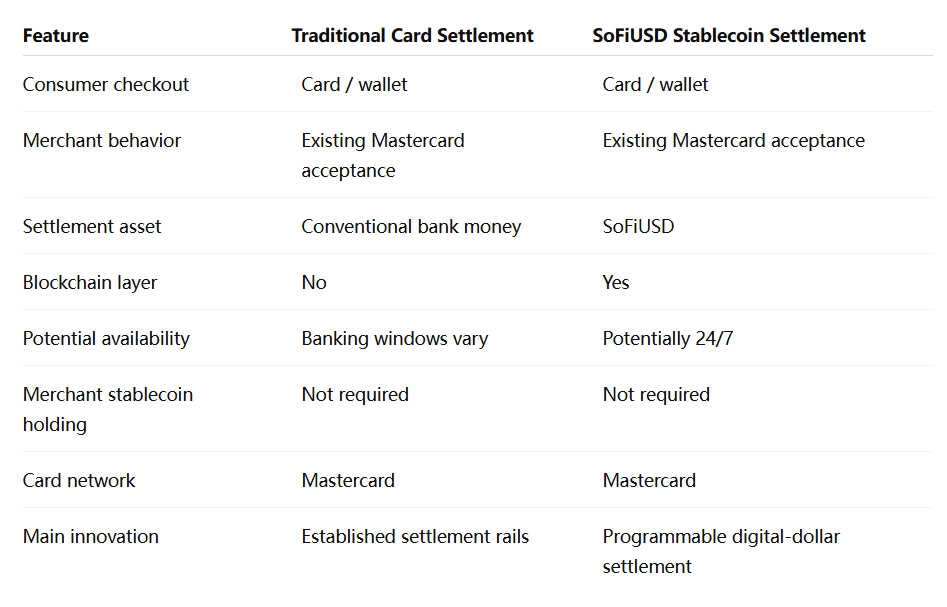
The comparison shows that the SoFi model is evolutionary rather than revolutionary from the consumer’s perspective. The checkout experience remains familiar, while the financial infrastructure underneath it changes.
This is likely to be an important pattern in institutional blockchain adoption. The technologies that scale most successfully may not replace mature interfaces; they may improve the capital movement underneath them.
Why Does a Bank-Issued Stablecoin Change the Risk Profile?
SoFiUSD differs from many crypto-native stablecoins because it is issued by SoFi Bank, N.A., a nationally chartered bank regulated by the Office of the Comptroller of the Currency. SoFi states that the token is redeemable 1:1 for U.S. dollars and supported primarily by cash reserves.
That bank-issued structure may be attractive to institutional users because the stablecoin exists inside an established banking and supervisory framework. It also raises an important distinction between bank-issued stablecoins, tokenized deposits and non-bank stablecoins. These products can all function as digital dollars, but the legal claim, reserve structure and regulatory treatment behind them differ.
Institutional users will therefore evaluate more than transaction speed. Redemption rights, reserve composition, bankruptcy treatment, supervision and interoperability with existing banking systems may ultimately determine which form of digital money becomes preferred for settlement.
What Are the Main Risks and Limits?
Stablecoin Settlement Does Not Remove Financial-System Risk
Moving settlement onto a blockchain does not eliminate liquidity, operational or regulatory risk. A stablecoin still needs reliable reserves and redemption mechanisms, while participating institutions must maintain secure systems capable of moving assets correctly. Blockchain availability is only one part of the end-to-end process.
Interoperability may also become a challenge if many banks issue proprietary stablecoins. A payment system with dozens of separate digital dollars could recreate the fragmentation that blockchain infrastructure is supposed to reduce. Common standards, cross-chain compatibility and reliable conversion between settlement assets would therefore become increasingly important.
There is also a concentration question. If settlement activity becomes dependent on a small number of stablecoin issuers, smart-contract systems or blockchain networks, operational failures could affect larger portions of payment infrastructure than they do today.
Regulatory Clarity Will Shape How Far the Model Can Expand
SoFi’s status as a regulated national bank gives the project a strong institutional foundation, but stablecoin regulation continues to evolve. Rules governing reserves, redemption, capital treatment and cross-border use could affect how banks deploy digital settlement assets.
The largest opportunity may come if regulators allow stablecoin settlement to coexist with conventional payment and banking frameworks without forcing institutions to operate entirely separate systems. The largest constraint would be a fragmented regulatory environment in which the same digital dollar receives materially different treatment across jurisdictions.
For Mastercard, that makes flexibility valuable. Supporting stablecoin settlement as an option rather than a replacement allows the network to adapt gradually as banks and regulators become more comfortable with the model.
MEXC View: Stablecoins Are Becoming Invisible Payment Infrastructure
The strongest form of stablecoin adoption may occur when consumers stop noticing that stablecoins are involved. SoFi’s Mastercard settlement model illustrates that possibility: the customer still uses a card, the merchant still sees a familiar payment network, but a blockchain-based dollar can increasingly sit underneath the transaction as institutional settlement infrastructure.
That changes how stablecoin growth should be measured. Market capitalization will remain important, but transaction velocity, settlement volume and institutional integration may become more meaningful indicators of real economic adoption. A stablecoin that quietly processes billions of dollars in payment obligations could matter more to financial infrastructure than a larger token used primarily for passive holdings.
For the broader crypto industry, the development also suggests that competition may shift from consumer-facing wallets toward back-end financial rails. The stablecoins that gain the deepest institutional adoption may be those that integrate most effectively with banks, card networks, treasury systems and tokenized capital markets.
Stablecoin Settlement Is Moving Into the Core of Payments
SoFi’s decision to migrate a card program expected to exceed $25 billion in annualized volume to stablecoin settlement represents a meaningful shift in how blockchain infrastructure is being used by traditional finance. The important development is not that consumers will suddenly start paying for everyday purchases with a visible stablecoin balance. The change is happening deeper in the system, where banks settle financial obligations after card transactions have already occurred.
That distinction explains why the move matters. Stablecoins are beginning to compete not only as trading assets or remittance tools, but as settlement money inside established payment networks. Mastercard continues to provide the acceptance network, controls and institutional relationships, while SoFiUSD introduces a programmable dollar settlement layer that can potentially operate with greater timing flexibility.
The limits remain important. $25 billion refers to annualized card-program volume rather than stablecoin supply, and blockchain settlement does not remove reserve, regulatory or operational risk. Wider adoption will also depend on whether other institutions find clear economic benefits in moving settlement away from traditional rails.
Even so, this stablecoin settlement model shows how digital dollars could penetrate traditional finance without requiring users to change behavior. If that pattern continues, stablecoins may become most important not when everyone consciously uses them, but when they quietly become part of the infrastructure that moves money between regulated financial institutions.
Sources
Risk Disclaimer: This article is for reference only and does not constitute investment advice. The cryptocurrency market is highly volatile. Please make decisions cautiously based on your individual circumstances.
You May Also Like
Tokenized SpaceX Demand Exposes Why Crypto Stock Products Need Clearer Boundaries

What Is Oura Health? OURA Pre-IPO Futures Are Now Trading on MEXC