Swiss-regulated crypto bank AMINA Bank AG announced that it has become the first regulated financial institution globally to offer staking services for POL, the native token of the Polygon blockchain ecosystem. The Zug-based bank, supervised by Switzerland’s Financial Market Supervisory Authority (FINMA), now provides qualified institutional participants a compliant pathway to participate in network validation while earning up to 15% in staking rewards. Through a partnership with the Polygon Foundation, AMINA’s institutional clients—including family offices, asset managers, pension funds, and corporate treasuries—can now stake POL in a regulated environment. The offering builds on AMINA’s existing crypto custody and trading services, further expanding its institutional-grade digital asset capabilities. Polygon’s Expanding Institutional Footprint The announcement shows Polygon’s growing role as a preferred blockchain infrastructure for major institutions and enterprises. The network supports nearly $3 billion in stablecoin market capitalization, dominates the micro- and small-payment segment for USDC, and is integrated with Stripe, allowing for sub-$0.01 transaction fees and near-instant settlements. Polygon’s Proof-of-Stake (PoS) chain recently surpassed $1 billion in tokenized real-world assets (RWAs) and now hosts several high-profile deployments, including BlackRock’s BUIDL Fund, a tokenized money-market fund, and integrations by JPMorgan and Franklin Templeton. These developments indicate a broader institutional shift toward on-chain finance, where efficiency, transparency, and regulatory alignment are paramount. Institutional Demand Meets Regulated Staking Myles Harrison, chief product officer at AMINA Bank, said the initiative reflects growing institutional interest in blockchain participation beyond passive investment. “Our expansion of POL services provides institutional clients with regulated access to the blockchain, enabling them to be rewarded for providing stability and security to a network used by some of the biggest financial institutions and brands in the world,” he said. The move also provides a bridge between traditional finance and decentralized infrastructure. AMINA’s staking rewards—4–5% standard, plus a Polygon Foundation boost up to 15%—are among the most competitive in the market. The bank’s risk disclosure framework addresses regulatory and market risks, including potential slashing and lockup periods. Polygon’s Market Outlook and Price Action The Polygon Ecosystem Token (POL)—formerly known as MATIC—is currently trading at $0.2369, down 0.77% over the past 24 hours, according to data from CryptoNews. The token has seen mild volatility this week, fluctuating between $0.24 and $0.23, with modest trading volume around 1.45K POL. Since its migration from MATIC earlier this year, POL has served as the upgraded native asset of the Polygon ecosystem, underpinning network security and governance as part of Polygon’s shift toward a multichain ecosystem. Despite short-term price softness, POL remains one of the top 70 cryptocurrencies by market capitalization, with a total supply exceeding 10.5 billion tokens, reflecting steady investor interest as institutional use cases for Polygon continue to grow. Analysts note that institutional integrations like AMINA’s staking program could reinforce long-term confidence in POL’s utility as a core asset underpinning Polygon’s expanding role in real-world asset tokenization and DeFi infrastructure. As Marc Boiron, CEO of Polygon Labs, put it: “Institutions aren’t just buying tokens anymore—they want to participate in the networks that matter. This gives real capital a regulated, bank-grade entry point to secure the internet’s next value layer.”Swiss-regulated crypto bank AMINA Bank AG announced that it has become the first regulated financial institution globally to offer staking services for POL, the native token of the Polygon blockchain ecosystem. The Zug-based bank, supervised by Switzerland’s Financial Market Supervisory Authority (FINMA), now provides qualified institutional participants a compliant pathway to participate in network validation while earning up to 15% in staking rewards. Through a partnership with the Polygon Foundation, AMINA’s institutional clients—including family offices, asset managers, pension funds, and corporate treasuries—can now stake POL in a regulated environment. The offering builds on AMINA’s existing crypto custody and trading services, further expanding its institutional-grade digital asset capabilities. Polygon’s Expanding Institutional Footprint The announcement shows Polygon’s growing role as a preferred blockchain infrastructure for major institutions and enterprises. The network supports nearly $3 billion in stablecoin market capitalization, dominates the micro- and small-payment segment for USDC, and is integrated with Stripe, allowing for sub-$0.01 transaction fees and near-instant settlements. Polygon’s Proof-of-Stake (PoS) chain recently surpassed $1 billion in tokenized real-world assets (RWAs) and now hosts several high-profile deployments, including BlackRock’s BUIDL Fund, a tokenized money-market fund, and integrations by JPMorgan and Franklin Templeton. These developments indicate a broader institutional shift toward on-chain finance, where efficiency, transparency, and regulatory alignment are paramount. Institutional Demand Meets Regulated Staking Myles Harrison, chief product officer at AMINA Bank, said the initiative reflects growing institutional interest in blockchain participation beyond passive investment. “Our expansion of POL services provides institutional clients with regulated access to the blockchain, enabling them to be rewarded for providing stability and security to a network used by some of the biggest financial institutions and brands in the world,” he said. The move also provides a bridge between traditional finance and decentralized infrastructure. AMINA’s staking rewards—4–5% standard, plus a Polygon Foundation boost up to 15%—are among the most competitive in the market. The bank’s risk disclosure framework addresses regulatory and market risks, including potential slashing and lockup periods. Polygon’s Market Outlook and Price Action The Polygon Ecosystem Token (POL)—formerly known as MATIC—is currently trading at $0.2369, down 0.77% over the past 24 hours, according to data from CryptoNews. The token has seen mild volatility this week, fluctuating between $0.24 and $0.23, with modest trading volume around 1.45K POL. Since its migration from MATIC earlier this year, POL has served as the upgraded native asset of the Polygon ecosystem, underpinning network security and governance as part of Polygon’s shift toward a multichain ecosystem. Despite short-term price softness, POL remains one of the top 70 cryptocurrencies by market capitalization, with a total supply exceeding 10.5 billion tokens, reflecting steady investor interest as institutional use cases for Polygon continue to grow. Analysts note that institutional integrations like AMINA’s staking program could reinforce long-term confidence in POL’s utility as a core asset underpinning Polygon’s expanding role in real-world asset tokenization and DeFi infrastructure. As Marc Boiron, CEO of Polygon Labs, put it: “Institutions aren’t just buying tokens anymore—they want to participate in the networks that matter. This gives real capital a regulated, bank-grade entry point to secure the internet’s next value layer.”

AMINA Bank Launches Polygon POL Staking for Institutions – Compliance First, Yield Up to 15%

Swiss-regulated crypto bank AMINA Bank AG announced that it has become the first regulated financial institution globally to offer staking services for POL, the native token of the Polygon blockchain ecosystem.

The Zug-based bank, supervised by Switzerland’s Financial Market Supervisory Authority (FINMA), now provides qualified institutional participants a compliant pathway to participate in network validation while earning up to 15% in staking rewards.

Through a partnership with the Polygon Foundation, AMINA’s institutional clients—including family offices, asset managers, pension funds, and corporate treasuries—can now stake POL in a regulated environment. The offering builds on AMINA’s existing crypto custody and trading services, further expanding its institutional-grade digital asset capabilities.

Polygon’s Expanding Institutional Footprint

The announcement shows Polygon’s growing role as a preferred blockchain infrastructure for major institutions and enterprises. The network supports nearly $3 billion in stablecoin market capitalization, dominates the micro- and small-payment segment for USDC, and is integrated with Stripe, allowing for sub-$0.01 transaction fees and near-instant settlements.

Polygon’s Proof-of-Stake (PoS) chain recently surpassed $1 billion in tokenized real-world assets (RWAs) and now hosts several high-profile deployments, including BlackRock’s BUIDL Fund, a tokenized money-market fund, and integrations by JPMorgan and Franklin Templeton.

These developments indicate a broader institutional shift toward on-chain finance, where efficiency, transparency, and regulatory alignment are paramount.

Institutional Demand Meets Regulated Staking

Myles Harrison, chief product officer at AMINA Bank, said the initiative reflects growing institutional interest in blockchain participation beyond passive investment.

“Our expansion of POL services provides institutional clients with regulated access to the blockchain, enabling them to be rewarded for providing stability and security to a network used by some of the biggest financial institutions and brands in the world,” he said.

The move also provides a bridge between traditional finance and decentralized infrastructure. AMINA’s staking rewards—4–5% standard, plus a Polygon Foundation boost up to 15%—are among the most competitive in the market. The bank’s risk disclosure framework addresses regulatory and market risks, including potential slashing and lockup periods.

Polygon’s Market Outlook and Price Action

The Polygon Ecosystem Token (POL)—formerly known as MATIC—is currently trading at $0.2369, down 0.77% over the past 24 hours, according to data from CryptoNews.
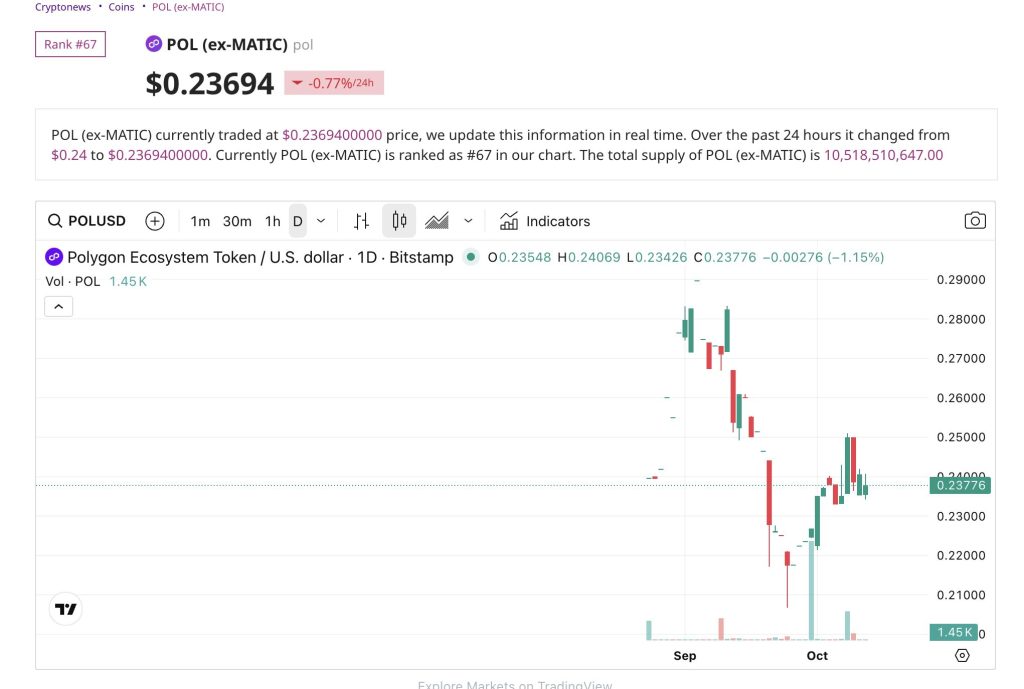
The token has seen mild volatility this week, fluctuating between $0.24 and $0.23, with modest trading volume around 1.45K POL. Since its migration from MATIC earlier this year, POL has served as the upgraded native asset of the Polygon ecosystem, underpinning network security and governance as part of Polygon’s shift toward a multichain ecosystem.

Despite short-term price softness, POL remains one of the top 70 cryptocurrencies by market capitalization, with a total supply exceeding 10.5 billion tokens, reflecting steady investor interest as institutional use cases for Polygon continue to grow.

Analysts note that institutional integrations like AMINA’s staking program could reinforce long-term confidence in POL’s utility as a core asset underpinning Polygon’s expanding role in real-world asset tokenization and DeFi infrastructure.

As Marc Boiron, CEO of Polygon Labs, put it: “Institutions aren’t just buying tokens anymore—they want to participate in the networks that matter. This gives real capital a regulated, bank-grade entry point to secure the internet’s next value layer.”

Market Opportunity
Lorenzo Protocol Logo
Lorenzo Protocol Price(BANK)
$0.05255
$0.05255$0.05255
+0.38%
USD
Lorenzo Protocol (BANK) Live Price Chart
Disclaimer: The articles reposted on this site are sourced from public platforms and are provided for informational purposes only. They do not necessarily reflect the views of MEXC. All rights remain with the original authors. If you believe any content infringes on third-party rights, please contact service@support.mexc.com for removal. MEXC makes no guarantees regarding the accuracy, completeness, or timeliness of the content and is not responsible for any actions taken based on the information provided. The content does not constitute financial, legal, or other professional advice, nor should it be considered a recommendation or endorsement by MEXC.

You May Also Like

The USDC Treasury burned $50 million worth of USDC on the Ethereum blockchain.

The USDC Treasury burned $50 million worth of USDC on the Ethereum blockchain.

PANews reported on January 22 that, according to Whale Alert monitoring, at 15:55 Beijing time, the USDC Treasury destroyed 50,000,000 USDC (approximately $50.01
Share
PANews2026/01/22 15:59
Thunes and UnionPay International Launch Instant Money Transfers to China’s mainland

Thunes and UnionPay International Launch Instant Money Transfers to China’s mainland

SINGAPORE and SHANGHAI, Jan. 22, 2026 /PRNewswire/ — Thunes, the Smart Superhighway to move money around the world, today announces the launch of faster, more reliable
Share
AI Journal2026/01/22 16:31
Adoption Leads Traders to Snorter Token

Adoption Leads Traders to Snorter Token

The post Adoption Leads Traders to Snorter Token appeared on BitcoinEthereumNews.com. Largest Bank in Spain Launches Crypto Service: Adoption Leads Traders to Snorter Token Sign Up for Our Newsletter! For updates and exclusive offers enter your email. Leah is a British journalist with a BA in Journalism, Media, and Communications and nearly a decade of content writing experience. Over the last four years, her focus has primarily been on Web3 technologies, driven by her genuine enthusiasm for decentralization and the latest technological advancements. She has contributed to leading crypto and NFT publications – Cointelegraph, Coinbound, Crypto News, NFT Plazas, Bitcolumnist, Techreport, and NFT Lately – which has elevated her to a senior role in crypto journalism. Whether crafting breaking news or in-depth reviews, she strives to engage her readers with the latest insights and information. Her articles often span the hottest cryptos, exchanges, and evolving regulations. As part of her ploy to attract crypto newbies into Web3, she explains even the most complex topics in an easily understandable and engaging way. Further underscoring her dynamic journalism background, she has written for various sectors, including software testing (TEST Magazine), travel (Travel Off Path), and music (Mixmag). When she’s not deep into a crypto rabbit hole, she’s probably island-hopping (with the Galapagos and Hainan being her go-to’s). Or perhaps sketching chalk pencil drawings while listening to the Pixies, her all-time favorite band. This website uses cookies. By continuing to use this website you are giving consent to cookies being used. Visit our Privacy Center or Cookie Policy. I Agree Source: https://bitcoinist.com/banco-santander-and-snorter-token-crypto-services/
Share
BitcoinEthereumNews2025/09/17 23:45