

Kalshi Raises $300 Million and Launches in 140 Countries

The prediction market platform Kalshi announced on October 10, 2025 that it raised $300 million in a funding round that closed in August, bringing its valuation to $5 billion.
Sequoia Capital and Andreessen Horowitz led the Series D round, with backing from Paradigm, CapitalG, Coinbase Ventures, General Catalyst, and Spark Capital. This represents a 150% increase from Kalshi’s $2 billion valuation just four months earlier when it raised $185 million in June 2025.
How Kalshi Works
Kalshi operates as a CFTC-regulated exchange where users trade on real-world events. Instead of placing bets with a bookmaker, traders buy and sell contracts with each other on outcomes ranging from Federal Reserve interest rate decisions to sports games and political elections.
Each contract costs between $0.01 and $0.99, representing the market’s estimated probability of an event happening. If the event occurs, the contract pays $1. If it doesn’t, it expires worthless. The platform takes a transaction fee but doesn’t act as the house winning when users lose.
Founded in 2018 by MIT graduates Tarek Mansour and Luana Lopes Lara, Kalshi spent over two years obtaining regulatory approval before launching in July 2021. The founders, both first-generation immigrants from Algeria and Brazil, chose to pursue full CFTC regulation rather than operating offshore like competitors.
Trading Volume Explodes
Kalshi now projects $50 billion in annualized trading volume for 2025, up from just $300 million last year. The platform’s trading volume surged 200 times while its user base grew 20 times over the past year.
Sports contracts drove much of this growth. Between February and May 2025, sports wagers comprised 70% of Kalshi’s trading volume, jumping to 75% after the company launched single-game March Madness markets in mid-March. The platform now offers complex parlay bets similar to traditional sportsbooks.
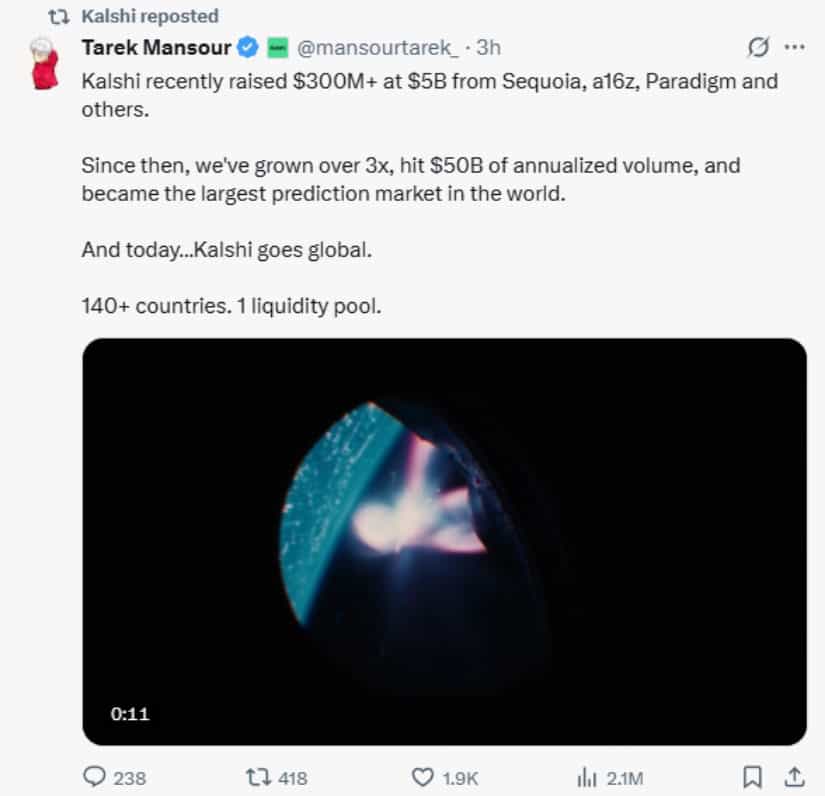
Source: @mansourtarek_
Kalshi claims over 60% of global market share, overtaking rival Polymarket despite competition from the crypto-based platform. Integration with Robinhood and Webull helped expand Kalshi’s reach, with Robinhood users representing 25% to 35% of daily trading on the platform.
Global Expansion Strategy
The international rollout makes Kalshi available in over 140 countries immediately. Users outside the U.S. access the same platform features as American customers. However, 38 jurisdictions remain restricted, including Canada, France, Poland, Russia, Singapore, Taiwan, Thailand, the United Kingdom, and Venezuela.
“Kalshi has emerged as the world’s only unified global prediction market and instantly added billions of new potential customers,” the company stated in its announcement.
Alex Immerman, partner at Andreessen Horowitz’s Growth Fund, praised the founders’ approach: “Tarek and Luana chose the difficult but more responsible path of becoming the first CFTC-regulated prediction market, and their breadth of markets, liquidity, and infrastructure are built for scale.”
The company is also expanding into blockchain infrastructure through partnerships with Solana and Base networks, offering grants and technical support to developers building on its platform. Kalshi now accepts Solana deposits up to $500,000 and supports Bitcoin, USDC, and Worldcoin through partnerships.
State Regulators Push Back
While Kalshi won CFTC approval and operates legally at the federal level, multiple states have challenged its sports contracts. Massachusetts, Nevada, New Jersey, Maryland, Arizona, Montana, Ohio, and Illinois have all taken action against the platform.
Massachusetts Attorney General Andrea Joy Campbell filed a lawsuit in September 2025 alleging Kalshi operates illegal sports betting without proper licensing. The complaint claims Kalshi processed over $1 billion in sports wagers from 3.4 million bets in the first half of 2025.
Federal courts in Nevada and New Jersey sided with Kalshi, issuing preliminary injunctions that prevent state regulators from enforcing gambling laws against the company. Maryland became the first state where a federal judge denied Kalshi’s motion, ruling that state regulators could proceed with enforcement.
The legal question centers on whether Kalshi’s sports contracts constitute financial instruments under federal jurisdiction or gambling under state control. Judges in different jurisdictions have reached conflicting conclusions, setting up potential appeals that could reshape American sports betting.
Three California tribes also sued Kalshi in July 2025, claiming the platform violates tribal gaming rights. The company faces ongoing litigation across multiple states while continuing to operate nationwide.
Competition Heats Up
Just days before Kalshi’s announcement, Polymarket secured a $2 billion investment from Intercontinental Exchange, owner of the New York Stock Exchange, at a $9 billion valuation. Polymarket operates on blockchain technology and was banned from U.S. markets in 2022 but recently obtained regulatory approval to return.
Traditional gambling companies are also entering the space. FanDuel partnered with CME Group to launch prediction markets, while DraftKings explores similar options. The U.S. sports betting industry generated $13.7 billion in revenue last year, with projections reaching $39 billion by 2030.
Kalshi’s regulatory compliance gives it an advantage with institutional investors and mainstream partners, even as unregulated platforms may move faster. The company hired Sara Slane, a former American Gaming Association executive who helped overturn the federal sports betting ban, as head of corporate development.
The Path Forward
Kalshi’s rapid valuation increase from $2 billion to $5 billion in four months reflects investor confidence in prediction markets becoming mainstream financial products. The platform now employs over 70 people and is expanding its engineering and regulatory teams for international growth.
With $415 million in total funding and partnerships spanning traditional finance and crypto, Kalshi is positioned to shape how prediction markets develop worldwide. Whether courts ultimately classify its sports contracts as financial instruments or gambling will determine if the company can maintain operations across all 50 states while expanding internationally.


You May Also Like

Bitcoin 28% Haircut: Moody’s Sets Forced-Selling Trigger

BitGo Launches Stablecoin Minting and Redemption Service for Institutions




