The Bitcoin price has dropped a fraction of a percent in the last 24 hours to trade at $121,310 as of 3.45 a.m. EST. This [...]The Bitcoin price has dropped a fraction of a percent in the last 24 hours to trade at $121,310 as of 3.45 a.m. EST. This [...]

Luxembourg’s Sovereign Wealth Fund Becomes First In Eurozone To Buy Bitcoin
Luxembourg’s sovereign wealth fund has become the first in the Eurozone to invest in Bitcoin after it allocated 1% of its $730 million portfolio to spot BTC ETFs (exchange-traded funds).

The investment follows a revision of a mandate for the Intergenerational Sovereign Wealth Fund (FSIL), which allows it to invest up to 15% of its portfolio into alternative assets, including crypto. It can also buy into other alternative assets such as real estate and private equity. 

The FSIL was launched in 2014 and is intended to build up a reserve for future generations. Most of its capital is allocated to high-quality bonds. 

Symbolic Weight

While the investment is only worth about $7.3 million, it carries symbolic weight and could also motivate other sovereign wealth funds in the Eurozone to invest in the largest crypto by market cap.

“Some might argue that we’re committing too little too late; others will point out the volatility and speculative nature of the investment,” said Bob Kieffer, Director of the Treasury, Luxembourg.

“Yet, given the FSIL’s particular profile and mission, the Fund’s management board concluded that a 1% allocation strikes the right balance, while sending a clear message about Bitcoin’s long-term potential,” Keiffer added. 

The recent move comes amid “measured confidence in a maturing digital-asset market,” according to Luxembourg Finance Agency communications head, Jonathan Westhead.

He said that Bitcoin ETFs offer a way for the fund to gain regulated exposure to BTC, without the operational and technical complexity of custodying coins directly. According to Westhead, the investment products also offer “innovation with accountability.” 

European nations including Finland, Georgia, and the UK currently hold Bitcoin. However, most of this crypto was sourced through criminal seizures, data from Bitbo shows.  

US Spot Bitcoin ETFs Continue Their Inflows Streak

The investment from the FSIL into Bitcoin ETFs comes amid a multi-day positive-flow streak for the investment products in the US. 

After $197.8 million flowed into the US funds on Oct. 9, the products’ inflows streak has been extended to nine days, according to data from Farside Investors. 
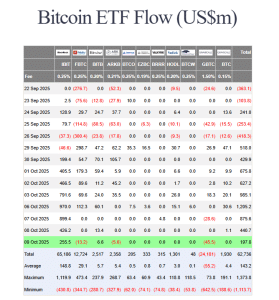
Spot Bitcoin ETF flows

Spot Bitcoin ETF flows (Source: Farside Investors)

The inflows in the latest session were led by BlackRock’s IBIT, which pulled in $255.5 million on the day. 

IBIT is now on the verge of hitting the $100 billion assets under management (AUM) milestone as well, according to Bloomberg ETF analyst Eric Balchunas. In a recent X post, he noted that IBIT’s AUM is around $99 billion. He also said that IBIT managed to overtake “an ETF legend,” VIC, to become the 19th-biggest ETF overall in terms of AUM.

Bitwise’s BITB was the only other US spot Bitcoin ETF to record net positive daily flows yesterday, with $6.6 million added to its reserves. 

Meanwhile, Fidelity’s FBTC, ARK Invest’s ARKB, and Grayscale’s GBTC all recorded net outflows on Oct. 9. FBTC saw $13.2 million outflows, while ARKB and GBTC saw respective outflows of $5.6 million and $45.5 million.

The remaining funds recorded no new flows on the day.

Following yesterday’s inflows, the US spot Bitcoin ETFs have pulled in over $5.9 billion since Sept. 29.

Global Crypto ETFs Attract Record Inflows

The continued inflows for US spot Bitcoin ETFs follows a record week for crypto investment products globally.

In the week ending on Oct. 4, the global inflows for the crypto products hit $5.95 billion. US-based products attracted the majority of this capital, with $5 billion of that inflow.

However, there were also inflows of $563 million in Switzerland, and $312 million in inflows in Germany. Both were new records.

Breaking the inflows down by crypto shows that BTC drew the most. Bitcoin’s inflows reached $4.55 billion. Ethereum saw the next-biggest inflows of $1.48 billion, while Solana and XRP pulled in $706.5 million and $219.4 million, respectively.

Year-to-date inflows for crypto products also recently surpassed the total amount seen in 2024, according to James Butterfill, head of research at CoinShares.


Market Opportunity
FUND Logo
FUND Price(FUND)
$0.012
$0.012$0.012
0.00%
USD
FUND (FUND) Live Price Chart
Disclaimer: The articles reposted on this site are sourced from public platforms and are provided for informational purposes only. They do not necessarily reflect the views of MEXC. All rights remain with the original authors. If you believe any content infringes on third-party rights, please contact service@support.mexc.com for removal. MEXC makes no guarantees regarding the accuracy, completeness, or timeliness of the content and is not responsible for any actions taken based on the information provided. The content does not constitute financial, legal, or other professional advice, nor should it be considered a recommendation or endorsement by MEXC.

You May Also Like

Optum Golf Channel Games Debut In Prime Time

Optum Golf Channel Games Debut In Prime Time

The post Optum Golf Channel Games Debut In Prime Time appeared on BitcoinEthereumNews.com. FARMINGDALE, NEW YORK – SEPTEMBER 28: (L-R) Scottie Scheffler of Team
Share
BitcoinEthereumNews2025/12/18 07:21
Google's AP2 protocol has been released. Does encrypted AI still have a chance?

Google's AP2 protocol has been released. Does encrypted AI still have a chance?

Following the MCP and A2A protocols, the AI Agent market has seen another blockbuster arrival: the Agent Payments Protocol (AP2), developed by Google. This will clearly further enhance AI Agents' autonomous multi-tasking capabilities, but the unfortunate reality is that it has little to do with web3AI. Let's take a closer look: What problem does AP2 solve? Simply put, the MCP protocol is like a universal hook, enabling AI agents to connect to various external tools and data sources; A2A is a team collaboration communication protocol that allows multiple AI agents to cooperate with each other to complete complex tasks; AP2 completes the last piece of the puzzle - payment capability. In other words, MCP opens up connectivity, A2A promotes collaboration efficiency, and AP2 achieves value exchange. The arrival of AP2 truly injects "soul" into the autonomous collaboration and task execution of Multi-Agents. Imagine AI Agents connecting Qunar, Meituan, and Didi to complete the booking of flights, hotels, and car rentals, but then getting stuck at the point of "self-payment." What's the point of all that multitasking? So, remember this: AP2 is an extension of MCP+A2A, solving the last mile problem of AI Agent automated execution. What are the technical highlights of AP2? The core innovation of AP2 is the Mandates mechanism, which is divided into real-time authorization mode and delegated authorization mode. Real-time authorization is easy to understand. The AI Agent finds the product and shows it to you. The operation can only be performed after the user signs. Delegated authorization requires the user to set rules in advance, such as only buying the iPhone 17 when the price drops to 5,000. The AI Agent monitors the trigger conditions and executes automatically. The implementation logic is cryptographically signed using Verifiable Credentials (VCs). Users can set complex commission conditions, including price ranges, time limits, and payment method priorities, forming a tamper-proof digital contract. Once signed, the AI Agent executes according to the conditions, with VCs ensuring auditability and security at every step. Of particular note is the "A2A x402" extension, a technical component developed by Google specifically for crypto payments, developed in collaboration with Coinbase and the Ethereum Foundation. This extension enables AI Agents to seamlessly process stablecoins, ETH, and other blockchain assets, supporting native payment scenarios within the Web3 ecosystem. What kind of imagination space can AP2 bring? After analyzing the technical principles, do you think that's it? Yes, in fact, the AP2 is boring when it is disassembled alone. Its real charm lies in connecting and opening up the "MCP+A2A+AP2" technology stack, completely opening up the complete link of AI Agent's autonomous analysis+execution+payment. From now on, AI Agents can open up many application scenarios. For example, AI Agents for stock investment and financial management can help us monitor the market 24/7 and conduct independent transactions. Enterprise procurement AI Agents can automatically replenish and renew without human intervention. AP2's complementary payment capabilities will further expand the penetration of the Agent-to-Agent economy into more scenarios. Google obviously understands that after the technical framework is established, the ecological implementation must be relied upon, so it has brought in more than 60 partners to develop it, almost covering the entire payment and business ecosystem. Interestingly, it also involves major Crypto players such as Ethereum, Coinbase, MetaMask, and Sui. Combined with the current trend of currency and stock integration, the imagination space has been doubled. Is web3 AI really dead? Not entirely. Google's AP2 looks complete, but it only achieves technical compatibility with Crypto payments. It can only be regarded as an extension of the traditional authorization framework and belongs to the category of automated execution. There is a "paradigm" difference between it and the autonomous asset management pursued by pure Crypto native solutions. The Crypto-native solutions under exploration are taking the "decentralized custody + on-chain verification" route, including AI Agent autonomous asset management, AI Agent autonomous transactions (DeFAI), AI Agent digital identity and on-chain reputation system (ERC-8004...), AI Agent on-chain governance DAO framework, AI Agent NPC and digital avatars, and many other interesting and fun directions. Ultimately, once users get used to AI Agent payments in traditional fields, their acceptance of AI Agents autonomously owning digital assets will also increase. And for those scenarios that AP2 cannot reach, such as anonymous transactions, censorship-resistant payments, and decentralized asset management, there will always be a time for crypto-native solutions to show their strength? The two are more likely to be complementary rather than competitive, but to be honest, the key technological advancements behind AI Agents currently all come from web2AI, and web3AI still needs to keep up the good work!
Share
PANews2025/09/18 07:00
Read Trend And Momentum Across Markets

Read Trend And Momentum Across Markets

The post Read Trend And Momentum Across Markets appeared on BitcoinEthereumNews.com. Widely used in technical analysis, the MACD indicator helps traders read trend
Share
BitcoinEthereumNews2025/12/18 07:14