Total crypto VC funding hit $8 billion in Q3 2025, powered not by hype but by policy stability. The Trump administration’s pro-crypto stance and tokenization’s rise turned regulation from a headwind into alpha. For investors, the shift signals predictable frameworks, institutional exits, and a market no longer ruled by speculation — a structural reset that makes compliance a source of performance. Why Policy Became the Catalyst Why ImportantCryptoRank data show US-based funds drove one-third of crypto VC activity in Q3. Federal clarity on stablecoins, taxation, and compliance drew institutions back, producing the strongest quarter since 2021. The figures confirm that US regulation—rather than liquidity—now shapes venture momentum. Source: CryptoRank Crypto VC Confidence Returns Latest UpdateThe Silicon Valley Venture Capitalist Confidence Index posted one of its steepest drops in two decades, before rebounding in Q2 as tariff anxiety eased. Capital rotated into tokenization, compliance, and AI–crypto convergence — seen as resilient amid uncertainty. The rebound suggests investors are recalibrating, not retreating, trading hype for fundamentals as policy replaces sentiment as the main compass for risk. State Street found that 60% of institutions plan to double their digital-asset exposure within three years, with over half expecting 10–24% of portfolios to be tokenized by 2030. Tokenized private equity and debt are becoming the “first stop” for liquidity-seeking allocators, though LP-token models remain legally gray. Tokenization institutionalizes the venture itself, turning private markets into programmable, tradable capital. Behind the ScenesLlobet noted that funds like a16z, Paradigm, and Pantera now use tokenized side vehicles, letting LPs trade fund shares on compliant platforms. DAO treasuries and decentralized pools are emerging as rivals to traditional VC funding, showing how crypto now finances itself through its own rails. BackgroundRegulatory opacity once kept allocators away. “Legal uncertainty and illiquidity constrained blockchain finance,” as noted by Llobet’s 2025 study. That changed when Washington approved a national stablecoin framework and tax incentives for compliant entities, legitimizing crypto for pensions and sovereign funds. Global Repercussions Wider ImpactCryptoRank’s Q3 data show 275 deals, two-thirds under $10M — clear evidence of discipline over speculation. Source: CryptoRank CeFi and infrastructure absorbed 60% of capital, while GameFi and NFTs fell below 10%. Investors are re-rating risk through cash flow rather than hype — a hallmark of market maturity. MetricQ3 2025SourceTotal VC Funding$8BCryptoRankAvg Deal Size$3–10MCryptoRankInstitutional Allocation+60% planned increaseState StreetConfidence Index3.26 / 5SSRN / SVVCCI State Street expects tokenized funds to be standard by 2030, while CryptoRank projects $18–25B in 2025 inflows — a sustainable, compliance-driven cycle. Regulation now functions less as a constraint than as a competitive edge. Crypto VC Faces Its First Real Stress Test Risks & ChallengesRay Dalio warned that US debt, now about 116% of GDP, mirrors pre–World War II dynamics and could erode risk appetite if fiscal repair stalls. Dalio’s “deficit bomb” and SVVCCI data suggest trade volatility could delay IPOs. Ackerman of DataTribe warned AI euphoria may form a “bubble” that resets valuations and diverts capital from Web3. Policy may anchor sentiment, but macro debt and AI speculation will test whether the sector’s new discipline can hold. “Institutional investors are moving beyond experimentation; digital assets are now a strategic lever for growth,” said Joerg Ambrosius, State Street. “Trade volatility will limit exits short term, but AI and blockchain remain the twin pillars of new value creation,” noted Howard Lee, Founders Equity Partners. “Crypto VC has institutionalized. Tokenized funds are the new standard for liquidity,” said Marçal Llobet, University of Barcelona. Crypto VC has entered a disciplined, institutional phase. Regulatory clarity and tokenization are expanding access while reducing volatility. Yet continued growth depends on macro stability and measured risk-taking. If predictability holds, 2025 may be remembered as the year compliance became alpha.Total crypto VC funding hit $8 billion in Q3 2025, powered not by hype but by policy stability. The Trump administration’s pro-crypto stance and tokenization’s rise turned regulation from a headwind into alpha. For investors, the shift signals predictable frameworks, institutional exits, and a market no longer ruled by speculation — a structural reset that makes compliance a source of performance. Why Policy Became the Catalyst Why ImportantCryptoRank data show US-based funds drove one-third of crypto VC activity in Q3. Federal clarity on stablecoins, taxation, and compliance drew institutions back, producing the strongest quarter since 2021. The figures confirm that US regulation—rather than liquidity—now shapes venture momentum. Source: CryptoRank Crypto VC Confidence Returns Latest UpdateThe Silicon Valley Venture Capitalist Confidence Index posted one of its steepest drops in two decades, before rebounding in Q2 as tariff anxiety eased. Capital rotated into tokenization, compliance, and AI–crypto convergence — seen as resilient amid uncertainty. The rebound suggests investors are recalibrating, not retreating, trading hype for fundamentals as policy replaces sentiment as the main compass for risk. State Street found that 60% of institutions plan to double their digital-asset exposure within three years, with over half expecting 10–24% of portfolios to be tokenized by 2030. Tokenized private equity and debt are becoming the “first stop” for liquidity-seeking allocators, though LP-token models remain legally gray. Tokenization institutionalizes the venture itself, turning private markets into programmable, tradable capital. Behind the ScenesLlobet noted that funds like a16z, Paradigm, and Pantera now use tokenized side vehicles, letting LPs trade fund shares on compliant platforms. DAO treasuries and decentralized pools are emerging as rivals to traditional VC funding, showing how crypto now finances itself through its own rails. BackgroundRegulatory opacity once kept allocators away. “Legal uncertainty and illiquidity constrained blockchain finance,” as noted by Llobet’s 2025 study. That changed when Washington approved a national stablecoin framework and tax incentives for compliant entities, legitimizing crypto for pensions and sovereign funds. Global Repercussions Wider ImpactCryptoRank’s Q3 data show 275 deals, two-thirds under $10M — clear evidence of discipline over speculation. Source: CryptoRank CeFi and infrastructure absorbed 60% of capital, while GameFi and NFTs fell below 10%. Investors are re-rating risk through cash flow rather than hype — a hallmark of market maturity. MetricQ3 2025SourceTotal VC Funding$8BCryptoRankAvg Deal Size$3–10MCryptoRankInstitutional Allocation+60% planned increaseState StreetConfidence Index3.26 / 5SSRN / SVVCCI State Street expects tokenized funds to be standard by 2030, while CryptoRank projects $18–25B in 2025 inflows — a sustainable, compliance-driven cycle. Regulation now functions less as a constraint than as a competitive edge. Crypto VC Faces Its First Real Stress Test Risks & ChallengesRay Dalio warned that US debt, now about 116% of GDP, mirrors pre–World War II dynamics and could erode risk appetite if fiscal repair stalls. Dalio’s “deficit bomb” and SVVCCI data suggest trade volatility could delay IPOs. Ackerman of DataTribe warned AI euphoria may form a “bubble” that resets valuations and diverts capital from Web3. Policy may anchor sentiment, but macro debt and AI speculation will test whether the sector’s new discipline can hold. “Institutional investors are moving beyond experimentation; digital assets are now a strategic lever for growth,” said Joerg Ambrosius, State Street. “Trade volatility will limit exits short term, but AI and blockchain remain the twin pillars of new value creation,” noted Howard Lee, Founders Equity Partners. “Crypto VC has institutionalized. Tokenized funds are the new standard for liquidity,” said Marçal Llobet, University of Barcelona. Crypto VC has entered a disciplined, institutional phase. Regulatory clarity and tokenization are expanding access while reducing volatility. Yet continued growth depends on macro stability and measured risk-taking. If predictability holds, 2025 may be remembered as the year compliance became alpha.

Regulation Becomes Alpha: US Policy Fuels Crypto VC

2025/10/11 10:17
3 min read
For feedback or concerns regarding this content, please contact us at crypto.news@mexc.com

Total crypto VC funding hit $8 billion in Q3 2025, powered not by hype but by policy stability. The Trump administration’s pro-crypto stance and tokenization’s rise turned regulation from a headwind into alpha.

For investors, the shift signals predictable frameworks, institutional exits, and a market no longer ruled by speculation — a structural reset that makes compliance a source of performance.

Why Policy Became the Catalyst

Why ImportantCryptoRank data show US-based funds drove one-third of crypto VC activity in Q3. Federal clarity on stablecoins, taxation, and compliance drew institutions back, producing the strongest quarter since 2021. The figures confirm that US regulation—rather than liquidity—now shapes venture momentum.
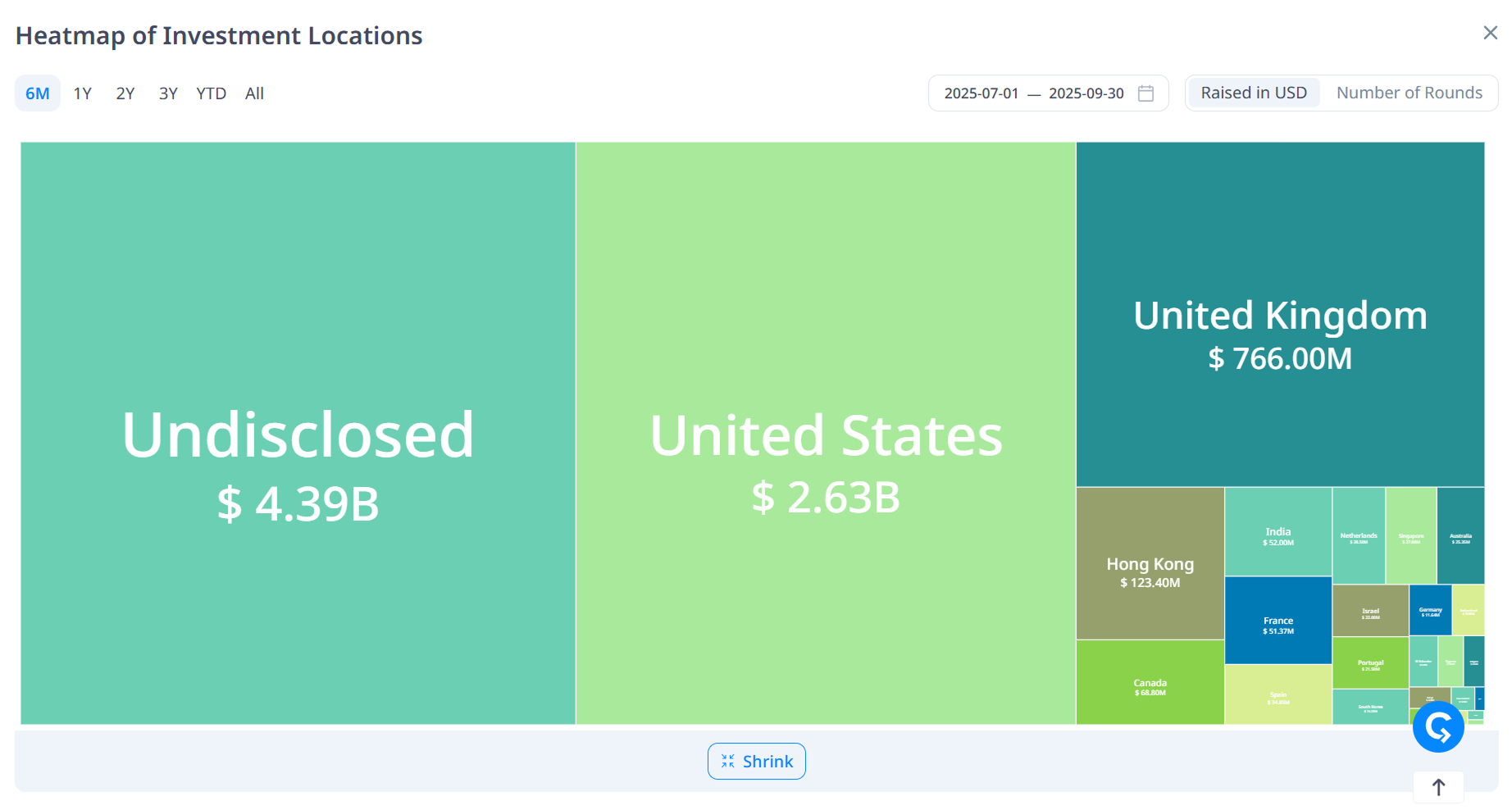
Source: CryptoRank

Crypto VC Confidence Returns

Latest UpdateThe Silicon Valley Venture Capitalist Confidence Index posted one of its steepest drops in two decades, before rebounding in Q2 as tariff anxiety eased. Capital rotated into tokenization, compliance, and AI–crypto convergence — seen as resilient amid uncertainty. The rebound suggests investors are recalibrating, not retreating, trading hype for fundamentals as policy replaces sentiment as the main compass for risk.

State Street found that 60% of institutions plan to double their digital-asset exposure within three years, with over half expecting 10–24% of portfolios to be tokenized by 2030. Tokenized private equity and debt are becoming the “first stop” for liquidity-seeking allocators, though LP-token models remain legally gray. Tokenization institutionalizes the venture itself, turning private markets into programmable, tradable capital.

Behind the ScenesLlobet noted that funds like a16z, Paradigm, and Pantera now use tokenized side vehicles, letting LPs trade fund shares on compliant platforms. DAO treasuries and decentralized pools are emerging as rivals to traditional VC funding, showing how crypto now finances itself through its own rails.

BackgroundRegulatory opacity once kept allocators away. “Legal uncertainty and illiquidity constrained blockchain finance,” as noted by Llobet’s 2025 study. That changed when Washington approved a national stablecoin framework and tax incentives for compliant entities, legitimizing crypto for pensions and sovereign funds.

Global Repercussions

Wider ImpactCryptoRank’s Q3 data show 275 deals, two-thirds under $10M — clear evidence of discipline over speculation.
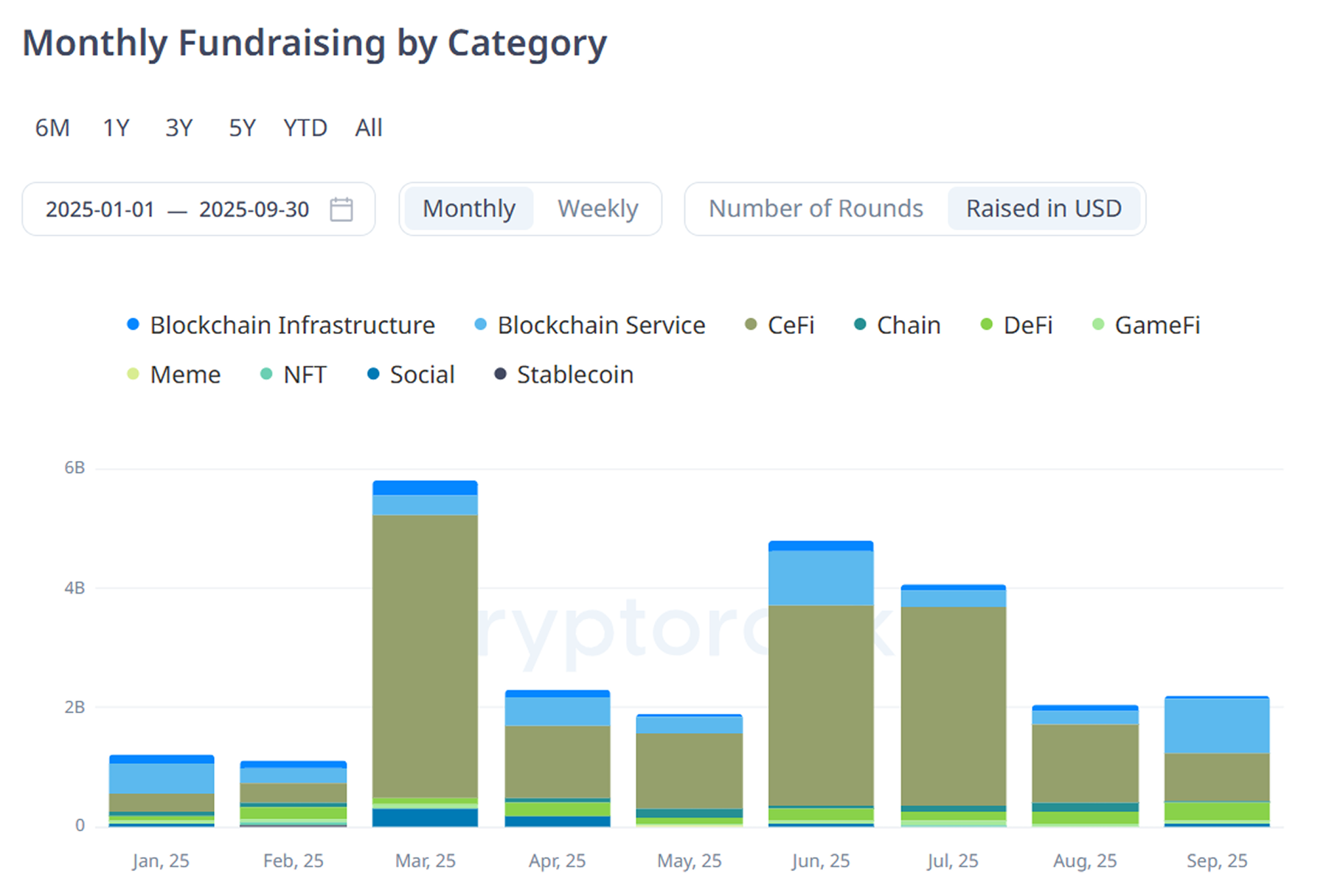
Source: CryptoRank

CeFi and infrastructure absorbed 60% of capital, while GameFi and NFTs fell below 10%. Investors are re-rating risk through cash flow rather than hype — a hallmark of market maturity.

Metric Q3 2025 Source
Total VC Funding $8B CryptoRank
Avg Deal Size $3–10M CryptoRank
Institutional Allocation +60% planned increase State Street
Confidence Index 3.26 / 5 SSRN / SVVCCI

State Street expects tokenized funds to be standard by 2030, while CryptoRank projects $18–25B in 2025 inflows — a sustainable, compliance-driven cycle. Regulation now functions less as a constraint than as a competitive edge.

Crypto VC Faces Its First Real Stress Test

Risks & ChallengesRay Dalio warned that US debt, now about 116% of GDP, mirrors pre–World War II dynamics and could erode risk appetite if fiscal repair stalls.

Dalio’s “deficit bomb” and SVVCCI data suggest trade volatility could delay IPOs. Ackerman of DataTribe warned AI euphoria may form a “bubble” that resets valuations and diverts capital from Web3. Policy may anchor sentiment, but macro debt and AI speculation will test whether the sector’s new discipline can hold.

Crypto VC has entered a disciplined, institutional phase. Regulatory clarity and tokenization are expanding access while reducing volatility. Yet continued growth depends on macro stability and measured risk-taking. If predictability holds, 2025 may be remembered as the year compliance became alpha.

Market Opportunity
Stella Logo
Stella Price(ALPHA)
$0.002809
$0.002809$0.002809
-2.70%
USD
Stella (ALPHA) Live Price Chart
Disclaimer: The articles reposted on this site are sourced from public platforms and are provided for informational purposes only. They do not necessarily reflect the views of MEXC. All rights remain with the original authors. If you believe any content infringes on third-party rights, please contact crypto.news@mexc.com for removal. MEXC makes no guarantees regarding the accuracy, completeness, or timeliness of the content and is not responsible for any actions taken based on the information provided. The content does not constitute financial, legal, or other professional advice, nor should it be considered a recommendation or endorsement by MEXC.

You May Also Like

BlackRock Increases U.S. Stock Exposure Amid AI Surge

BlackRock Increases U.S. Stock Exposure Amid AI Surge

The post BlackRock Increases U.S. Stock Exposure Amid AI Surge appeared on BitcoinEthereumNews.com. Key Points: BlackRock significantly increased U.S. stock exposure. AI sector driven gains boost S&P 500 to historic highs. Shift may set a precedent for other major asset managers. BlackRock, the largest asset manager, significantly increased U.S. stock and AI sector exposure, adjusting its $185 billion investment portfolios, according to a recent investment outlook report.. This strategic shift signals strong confidence in U.S. market growth, driven by AI and anticipated Federal Reserve moves, influencing significant fund flows into BlackRock’s ETFs. The reallocation increases U.S. stocks by 2% while reducing holdings in international developed markets. BlackRock’s move reflects confidence in the U.S. stock market’s trajectory, driven by robust earnings and the anticipation of Federal Reserve rate cuts. As a result, billions of dollars have flowed into BlackRock’s ETFs following the portfolio adjustment. “Our increased allocation to U.S. stocks, particularly in the AI sector, is a testament to our confidence in the growth potential of these technologies.” — Larry Fink, CEO, BlackRock The financial markets have responded favorably to this adjustment. The S&P 500 Index recently reached a historic high this year, supported by AI-driven investment enthusiasm. BlackRock’s decision aligns with widespread market speculation on the Federal Reserve’s next moves, further amplifying investor interest and confidence. AI Surge Propels S&P 500 to Historic Highs At no other time in history has the S&P 500 seen such dramatic gains driven by a single sector as the recent surge spurred by AI investments in 2023. Experts suggest that the strategic increase in U.S. stock exposure by BlackRock may set a precedent for other major asset managers. Historically, shifts of this magnitude have influenced broader market behaviors as others follow suit. Market analysts point to the favorable economic environment and technological advancements that are propelling the AI sector’s momentum. The continued growth of AI technologies is…
Share
BitcoinEthereumNews2025/09/18 02:49
DWF Labs partners with MemeCore, with MemeCore token up 333% since September

DWF Labs partners with MemeCore, with MemeCore token up 333% since September

PANews reported on September 18 that according to official news from DWF Labs, it announced a partnership with MemeCore to support the first L1 project designed specifically for Meme 2.0. The project's token M has risen 20.56% in the past 24 hours and is currently priced at $2.94, up 333% since September.
Share
PANews2025/09/18 15:10
When Accident Victims Typically Seek Legal Help After a Serious Car Crash

When Accident Victims Typically Seek Legal Help After a Serious Car Crash

You usually seek legal help after a serious car crash when problems start escalating. Your injuries may worsen days later with neck pain, headaches, or dizziness
Share
Techbullion2026/03/09 14:15