The global markets were shaken after President Donald Trump announced a 100% tariff on Chinese goods starting November 1, reigniting a full-scale trade war between the two largest economies. With $1.6 trillion already wiped from the US stock market in a single day, the question on every investor’s mind is simple: what happens next for crypto?Why  US–China Tariff Matter for Crypto Market?Unlike traditional equities, cryptocurrencies are not tied to a single economy, but they react sharply to macroeconomic shocks. Tariffs between the US and China hit two pressure points: inflation and liquidity. Higher import costs push inflation up, and central banks may respond with tighter monetary policy, reducing liquidity. For risk assets like Bitcoin and altcoins, reduced liquidity often translates into selling pressure.At the same time, crypto is increasingly viewed as a hedge against geopolitical risk. If trade tensions escalate into broader financial instability, investors may turn to Bitcoin as a digital safe haven, mirroring how gold reacts to crises. This dual role creates volatility: panic selling first, then speculative inflows if confidence in fiat weakens.Chart Analysis: Where Is the Crypto Market Headed?Total Market Cap: TradingViewLooking at the Total Crypto Market Cap chart, the recent candles tell a story of sharp reversal. After testing the upper Bollinger Band near $4.2 trillion, the market plunged below $3.7 trillion, with a massive wick extending towards $3.2 trillion. That wick signals extreme panic liquidation, followed by partial recovery.The Bollinger Bands are widening, which usually signals higher volatility ahead. The mid-band around $3.93 trillion is acting as resistance, while immediate support sits near $3.59 trillion. If this level breaks decisively, the next stop could be $3.2 trillion. On the upside, reclaiming $3.9–4 trillion could set the stage for a rebound rally.Could Rare Earth Politics Spill Into Crypto Market?Image Source: TruthsocialChina’s restrictions on rare earth exports aren’t just about minerals; they’re a geopolitical weapon. Rare earths are essential for high-tech industries, including chips, batteries, and EVs. Any disruption in this supply chain threatens US tech stocks, which are already reeling. When equities are unstable, crypto often becomes collateral damage as institutions de-risk across all volatile asset classes.But here’s the twist: if US–China relations worsen further and global trust in traditional financial systems declines, crypto could see inflows as an alternative store of value. In essence, rare earth disputes may indirectly fuel Bitcoin’s “digital gold” narrative.Short-Term Outlook: More Crypto Market Crash Before Relief?Given the November 1 deadline for tariffs by Donald Trump, markets are bracing for weeks of uncertainty. Expect sharp swings as traders position for worst-case outcomes. The chart suggests crypto market cap could retest $3.5 trillion, with a possible extension to $3.2 trillion if panic deepens.However, if inflation fears push more investors to seek decentralized assets, Bitcoin and Ethereum may lead a relief rally. Historically, crypto thrives when traditional markets lose investor trust.Long-Term View: A Turning Point for Adoption?If the trade war escalates, crypto adoption could accelerate. Both the US and China are heavily invested in blockchain technologies. For China, pushing digital yuan adoption could reduce reliance on dollar-settled trade. For the US, crypto may gain traction as retail and institutional investors seek alternatives to inflation-weakened fiat.The rare earth standoff might also highlight blockchain’s role in securing supply chains, further intertwining crypto with geopolitics.Final TakeThe US–China tariff battle has thrown crypto into a storm of uncertainty. Short-term, volatility and downside risk dominate the charts. But long-term, these geopolitical tensions may be the very fuel that strengthens crypto’s case as a hedge against inflation, trade wars, and broken global trust.The question isn’t just whether crypto will fall or rise in the next few weeks. The deeper question is whether this trade war marks the beginning of crypto’s evolution from speculative asset to essential financial refuge.The global markets were shaken after President Donald Trump announced a 100% tariff on Chinese goods starting November 1, reigniting a full-scale trade war between the two largest economies. With $1.6 trillion already wiped from the US stock market in a single day, the question on every investor’s mind is simple: what happens next for crypto?Why  US–China Tariff Matter for Crypto Market?Unlike traditional equities, cryptocurrencies are not tied to a single economy, but they react sharply to macroeconomic shocks. Tariffs between the US and China hit two pressure points: inflation and liquidity. Higher import costs push inflation up, and central banks may respond with tighter monetary policy, reducing liquidity. For risk assets like Bitcoin and altcoins, reduced liquidity often translates into selling pressure.At the same time, crypto is increasingly viewed as a hedge against geopolitical risk. If trade tensions escalate into broader financial instability, investors may turn to Bitcoin as a digital safe haven, mirroring how gold reacts to crises. This dual role creates volatility: panic selling first, then speculative inflows if confidence in fiat weakens.Chart Analysis: Where Is the Crypto Market Headed?Total Market Cap: TradingViewLooking at the Total Crypto Market Cap chart, the recent candles tell a story of sharp reversal. After testing the upper Bollinger Band near $4.2 trillion, the market plunged below $3.7 trillion, with a massive wick extending towards $3.2 trillion. That wick signals extreme panic liquidation, followed by partial recovery.The Bollinger Bands are widening, which usually signals higher volatility ahead. The mid-band around $3.93 trillion is acting as resistance, while immediate support sits near $3.59 trillion. If this level breaks decisively, the next stop could be $3.2 trillion. On the upside, reclaiming $3.9–4 trillion could set the stage for a rebound rally.Could Rare Earth Politics Spill Into Crypto Market?Image Source: TruthsocialChina’s restrictions on rare earth exports aren’t just about minerals; they’re a geopolitical weapon. Rare earths are essential for high-tech industries, including chips, batteries, and EVs. Any disruption in this supply chain threatens US tech stocks, which are already reeling. When equities are unstable, crypto often becomes collateral damage as institutions de-risk across all volatile asset classes.But here’s the twist: if US–China relations worsen further and global trust in traditional financial systems declines, crypto could see inflows as an alternative store of value. In essence, rare earth disputes may indirectly fuel Bitcoin’s “digital gold” narrative.Short-Term Outlook: More Crypto Market Crash Before Relief?Given the November 1 deadline for tariffs by Donald Trump, markets are bracing for weeks of uncertainty. Expect sharp swings as traders position for worst-case outcomes. The chart suggests crypto market cap could retest $3.5 trillion, with a possible extension to $3.2 trillion if panic deepens.However, if inflation fears push more investors to seek decentralized assets, Bitcoin and Ethereum may lead a relief rally. Historically, crypto thrives when traditional markets lose investor trust.Long-Term View: A Turning Point for Adoption?If the trade war escalates, crypto adoption could accelerate. Both the US and China are heavily invested in blockchain technologies. For China, pushing digital yuan adoption could reduce reliance on dollar-settled trade. For the US, crypto may gain traction as retail and institutional investors seek alternatives to inflation-weakened fiat.The rare earth standoff might also highlight blockchain’s role in securing supply chains, further intertwining crypto with geopolitics.Final TakeThe US–China tariff battle has thrown crypto into a storm of uncertainty. Short-term, volatility and downside risk dominate the charts. But long-term, these geopolitical tensions may be the very fuel that strengthens crypto’s case as a hedge against inflation, trade wars, and broken global trust.The question isn’t just whether crypto will fall or rise in the next few weeks. The deeper question is whether this trade war marks the beginning of crypto’s evolution from speculative asset to essential financial refuge.

US–China Tariff War: Can Crypto Market Survive the New Trade War?

2025/10/11 12:10
4 min read
For feedback or concerns regarding this content, please contact us at crypto.news@mexc.com

The global markets were shaken after President Donald Trump announced a 100% tariff on Chinese goods starting November 1, reigniting a full-scale trade war between the two largest economies. With $1.6 trillion already wiped from the US stock market in a single day, the question on every investor’s mind is simple: what happens next for crypto?

Why  US–China Tariff Matter for Crypto Market?

Unlike traditional equities, cryptocurrencies are not tied to a single economy, but they react sharply to macroeconomic shocks. Tariffs between the US and China hit two pressure points: inflation and liquidity. Higher import costs push inflation up, and central banks may respond with tighter monetary policy, reducing liquidity. For risk assets like Bitcoin and altcoins, reduced liquidity often translates into selling pressure.

At the same time, crypto is increasingly viewed as a hedge against geopolitical risk. If trade tensions escalate into broader financial instability, investors may turn to Bitcoin as a digital safe haven, mirroring how gold reacts to crises. This dual role creates volatility: panic selling first, then speculative inflows if confidence in fiat weakens.

Chart Analysis: Where Is the Crypto Market Headed?
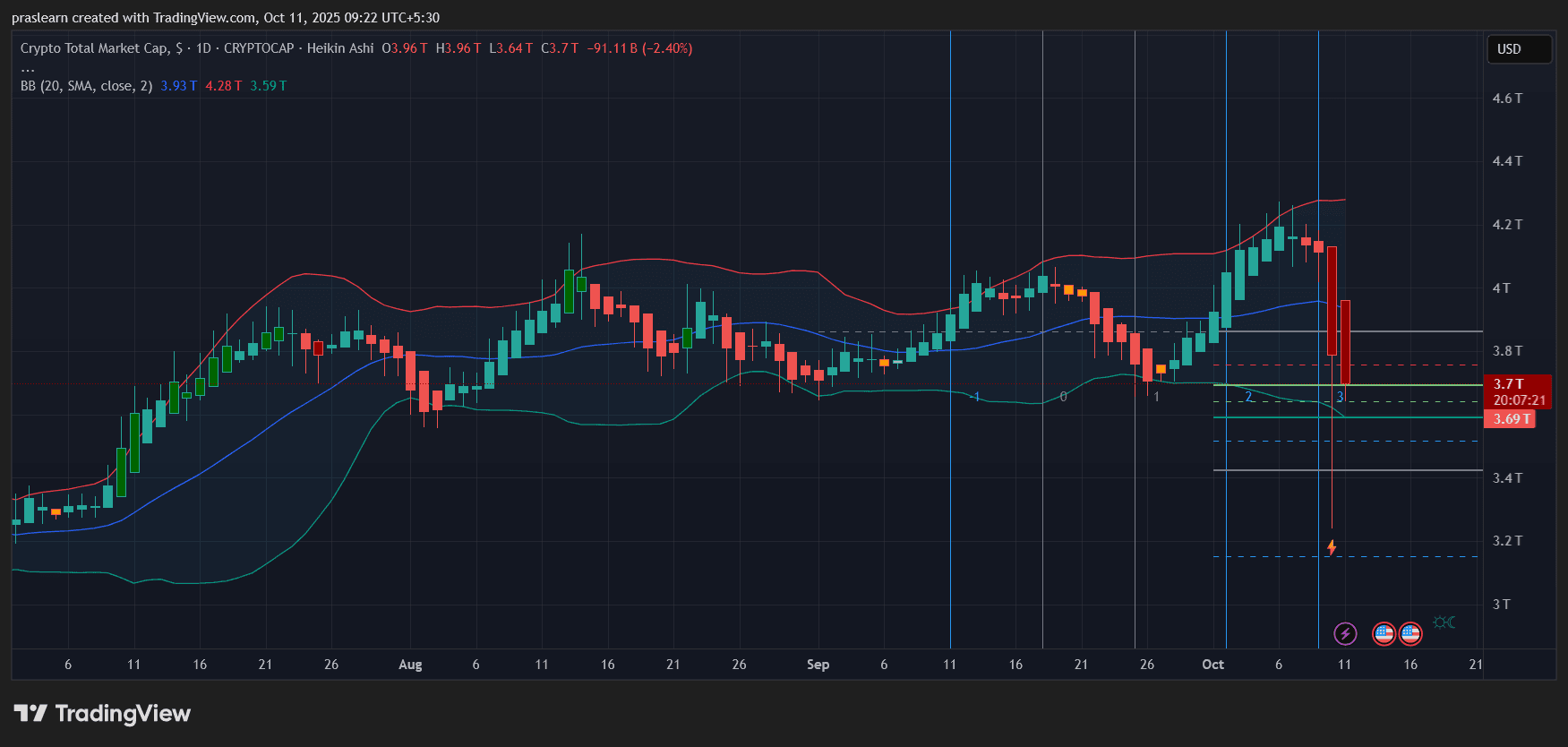
Crypto MarketTotal Market Cap: TradingView

Looking at the Total Crypto Market Cap chart, the recent candles tell a story of sharp reversal. After testing the upper Bollinger Band near $4.2 trillion, the market plunged below $3.7 trillion, with a massive wick extending towards $3.2 trillion. That wick signals extreme panic liquidation, followed by partial recovery.

The Bollinger Bands are widening, which usually signals higher volatility ahead. The mid-band around $3.93 trillion is acting as resistance, while immediate support sits near $3.59 trillion. If this level breaks decisively, the next stop could be $3.2 trillion. On the upside, reclaiming $3.9–4 trillion could set the stage for a rebound rally.

Could Rare Earth Politics Spill Into Crypto Market?
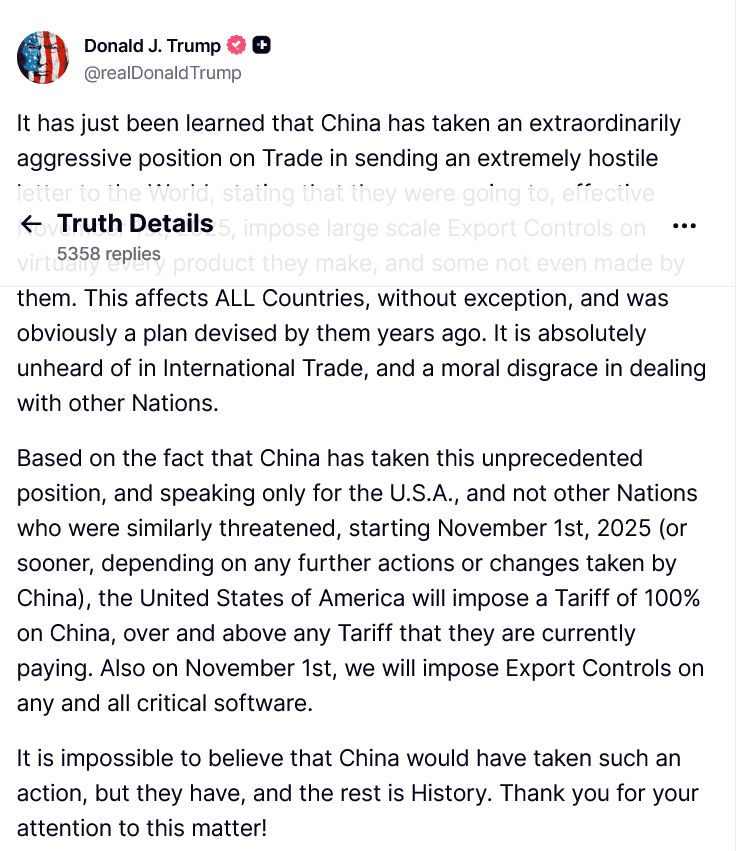
Screenshot 2025-10-11 at 09-35-20 Truth Details Truth Social.pngImage Source: Truthsocial

China’s restrictions on rare earth exports aren’t just about minerals; they’re a geopolitical weapon. Rare earths are essential for high-tech industries, including chips, batteries, and EVs. Any disruption in this supply chain threatens US tech stocks, which are already reeling. When equities are unstable, crypto often becomes collateral damage as institutions de-risk across all volatile asset classes.

But here’s the twist: if US–China relations worsen further and global trust in traditional financial systems declines, crypto could see inflows as an alternative store of value. In essence, rare earth disputes may indirectly fuel Bitcoin’s “digital gold” narrative.

Short-Term Outlook: More Crypto Market Crash Before Relief?

Given the November 1 deadline for tariffs by Donald Trump, markets are bracing for weeks of uncertainty. Expect sharp swings as traders position for worst-case outcomes. The chart suggests crypto market cap could retest $3.5 trillion, with a possible extension to $3.2 trillion if panic deepens.

However, if inflation fears push more investors to seek decentralized assets, Bitcoin and Ethereum may lead a relief rally. Historically, crypto thrives when traditional markets lose investor trust.

Long-Term View: A Turning Point for Adoption?

If the trade war escalates, crypto adoption could accelerate. Both the US and China are heavily invested in blockchain technologies. For China, pushing digital yuan adoption could reduce reliance on dollar-settled trade. For the US, crypto may gain traction as retail and institutional investors seek alternatives to inflation-weakened fiat.

The rare earth standoff might also highlight blockchain’s role in securing supply chains, further intertwining crypto with geopolitics.

Final Take

The US–China tariff battle has thrown crypto into a storm of uncertainty. Short-term, volatility and downside risk dominate the charts. But long-term, these geopolitical tensions may be the very fuel that strengthens crypto’s case as a hedge against inflation, trade wars, and broken global trust.

The question isn’t just whether crypto will fall or rise in the next few weeks. The deeper question is whether this trade war marks the beginning of crypto’s evolution from speculative asset to essential financial refuge.

Market Opportunity
Polytrade Logo
Polytrade Price(TRADE)
$0.03661
$0.03661$0.03661
-1.00%
USD
Polytrade (TRADE) Live Price Chart
Disclaimer: The articles reposted on this site are sourced from public platforms and are provided for informational purposes only. They do not necessarily reflect the views of MEXC. All rights remain with the original authors. If you believe any content infringes on third-party rights, please contact crypto.news@mexc.com for removal. MEXC makes no guarantees regarding the accuracy, completeness, or timeliness of the content and is not responsible for any actions taken based on the information provided. The content does not constitute financial, legal, or other professional advice, nor should it be considered a recommendation or endorsement by MEXC.

You May Also Like

A Netflix ‘KPop Demon Hunters’ Short Film Has Been Rated For Release

A Netflix ‘KPop Demon Hunters’ Short Film Has Been Rated For Release

The post A Netflix ‘KPop Demon Hunters’ Short Film Has Been Rated For Release appeared on BitcoinEthereumNews.com. KPop Demon Hunters Netflix Everyone has wondered what may be the next step for KPop Demon Hunters as an IP, given its record-breaking success on Netflix. Now, the answer may be something exactly no one predicted. According to a new filing with the MPA, something called Debut: A KPop Demon Hunters Story has been rated PG by the ratings body. It’s listed alongside some other films, and this is obviously something that has not been publicly announced. A short film could be well, very short, a few minutes, and likely no more than ten. Even that might be pushing it. Using say, Pixar shorts as a reference, most are between 4 and 8 minutes. The original movie is an hour and 36 minutes. The “Debut” in the title indicates some sort of flashback, perhaps to when HUNTR/X first arrived on the scene before they blew up. Previously, director Maggie Kang has commented about how there were more backstory components that were supposed to be in the film that were cut, but hinted those could be explored in a sequel. But perhaps some may be put into a short here. I very much doubt those scenes were fully produced and simply cut, but perhaps they were finished up for this short film here. When would Debut: KPop Demon Hunters theoretically arrive? I’m not sure the other films on the list are much help. Dead of Winter is out in less than two weeks. Mother Mary does not have a release date. Ne Zha 2 came out earlier this year. I’ve only seen news stories saying The Perfect Gamble was supposed to come out in Q1 2025, but I’ve seen no evidence that it actually has. KPop Demon Hunters Netflix It could be sooner rather than later as Netflix looks to capitalize…
Share
BitcoinEthereumNews2025/09/18 02:23
US Treasury Backs Limited Framework for Crypto Mixers

US Treasury Backs Limited Framework for Crypto Mixers

TLDR The US Treasury Department acknowledged that crypto mixers serve lawful privacy and security purposes. The report stated that mixers can protect personal wealth
Share
Blockonomi2026/03/10 01:15
Hadron Labs Launches Bitcoin Summer on Neutron, Offering 5–10% BTC Yield

Hadron Labs Launches Bitcoin Summer on Neutron, Offering 5–10% BTC Yield

Hadron Labs launches 'Bitcoin Summer' on Neutron, BTC vaults for WBTC, eBTC, solvBTC, uniBTC and USDC. Earn 5–10% BTC via maxBTC, with up to 10x looping.
Share
Blockchainreporter2025/09/18 02:00