When was the last time you heard of a billion-dollar funding round for Web3? On October 7, 2025, the prediction market Polymarket officially announced that the Intercontinental Exchange (ICE), the parent company of the New York Stock Exchange, would make a strategic investment of US$2 billion in it, with a post-investment valuation of up to US$9 billion. This is not only one of the highest financing amounts obtained by a Web3 project in recent years, but also pushes the potential and popularity of the prediction market to the center of the stage. Interestingly, the competition has been accelerating visibly in recent times, whether it’s decentralized players like Hyperliquid joining the fray or compliant latecomers like Kalshi accelerating their efforts to catch up. Behind this, it is not only about who will dominate the future prediction market, but also about how to financialize all uncertainties in the real world. From Polymarket to Kalshi, multiple blossoms Decentralized prediction markets have always been one of the important practical tracks for early blockchain applications. For example, I frequently saw examples of old players such as Augur in many popular science books many years ago. Whether it is elections, weather, inflation, sports or IPOs, users can directly trade "yes/no" contracts on a decentralized platform. But in fact, although the concept was proposed early, it was not until the emergence of Polymarket that the concept was truly broken out of the circle, and this was largely inseparable from the boost from the 2024 US presidential election: Against the backdrop of traditional polls generally favoring one side, Polymarket ultimately demonstrated, with its accurate predictions and verifiable price signals that surpassed polls, that this decentralized prediction market, which uses "real money" to vote, has extremely high reference value for observing market trends. This has also led to Polymarket becoming a frequent probability reference source cited by mainstream media in different events in the past six months. However, the prediction market has been struggling with the shackles of compliance. For example, in 2022, Polymarket was fined $1.4 million by the U.S. Commodity Futures Trading Commission (CFTC) for operating an unregistered derivatives market and was banned from providing services to U.S. users. In the past two years, Kalshi, which was established earlier than Polymarket, has emerged as a dark horse and chosen a path focused on compliance - becoming the first prediction market platform regulated by the U.S. Commodity Futures Trading Commission (CFTC). In October 2024, a federal court also ruled that it was allowed to launch the first regulated election market in the United States, which also made Kalshi's regulatory position more solid. Source: polymarketanalytics As of October 10, 2025, a comparison of Polymarket and Kalshi data shows that, in addition to the total trading volume of Polymarket being $1.3 billion vs $410 million, which is a significant lead, Polymarket has fallen behind Kalshi in terms of the number of markets (10,200 vs 43,500) and open interest (US$170 million vs US$240 million). It is worth noting that in order to return to the US market, Polymarket actually adopted a compliance grafting strategy this year: as early as July, it acquired QCX LLC, a trading platform holding a CFTC license, for US$112 million and has begun self-certification of event contracts including sports events and election markets. This is also likely a combination of the latest $2 billion in financing, and Polymarket CEO Shayne Coplan also posted a tweet with the POLY symbol on October 9, which may become a key variable in the competition between the two giants. From prediction markets to larger parent sets Many people may be curious about why ICE, the parent company of the New York Stock Exchange, made a huge bet of $2 billion on Polymarket? This requires going beyond Web3 and understanding the prediction market from a larger financial perspective. First of all, ICE has been actively deploying in the Crypto field, including deploying crypto financial products through its parent company and multiple affiliated entities over the years, gradually covering targets such as Bitcoin spot and futures contracts, as well as the well-known crypto trading platform Bakkt. Secondly, the prediction market is essentially a subset of the "trading platform", or another form of presentation. For example, Polymarket has many price prediction bets for mainstream crypto assets such as BTC and ETH at different time points such as the end of October and the end of the year. Theoretically, if the time nodes for predicting fulfillment are infinitely subdivided, from the end of the year to the end of today, to 1 minute later, and 1 second later, then this essentially becomes an instant "bet" (buying and selling behavior) on the trading platform. Perhaps what ICE values is this ability to financialize all uncertainties, which can expand the boundaries of existing derivatives markets such as futures and options. Therefore, platforms like Polymarket, with their vast user base and trading volume, can serve as a key entry point for ICE Group's future structured financial products, institutional hedging tools, and information pricing services. In other words, ICE isn't focused on a single application, but rather on the potential of the prediction market to "derivative everything"—the uncertainty. For this reason, in addition to the competition between Polymarket and Kalshi, which is more like a specialized path for event markets, decentralized players such as Hyperliquid have also begun to explore a hybrid path of inserting prediction modules at the entrance of high-performance contract platforms. Both paths have their own advantages and disadvantages, but they may also complement or compete with each other in the future. New variables for decentralized players like Hyperliquid For example, the HIP-3 proposal passed by Hyperliquid introduced a permissionless, developer-deployed perpetual contract market on the core infrastructure. Previously, only the core team could list trading pairs, but now any user who pledges 1 million HYPE can deploy their own market directly on the chain. In short, HIP-3 allows the permissionless creation and listing of derivatives markets for any asset on Hyperliquid, which completely breaks the limitation that Perp DEX could only trade mainstream cryptocurrencies in the past. This not only means an open contract deployment mechanism, but also lays the technical foundation for subsequent prediction market modules. In the future, users on Hyperliquid may be able to directly trade such markets: Will the Fed cut interest rates at its next meeting? "Will BTC break through $70,000 this week?" "Will Arbitrum TVL exceed Base at the end of the month?" Under this architecture, the prediction market is no longer an independent track, but a sub-module in the on-chain high-performance derivatives system. And because it reuses Hyperliquid's matching depth, clearing system and order book logic, it naturally has higher transaction efficiency and capital utilization. In comparison, Polymarket's model is more inclined towards "event trading" and Hyperliquid's model is more inclined towards "price trading" - one starts from information and the other starts from structure, but both point to the same end: allowing future probabilities to be priced instantly by the market. Final Thoughts Overall, with the involvement of heavyweight decentralized players like Hyperliquid and ICE’s $2 billion investment, the prediction market is no longer just a tool for people to “bet” or “predict the future”, but has become a frontier for institutions, analysts, and even central banks to observe market sentiment. This also means that it is no longer just a paradise for speculators, but is rapidly transforming into a highly efficient and highly liquid financial derivatives market, becoming an indispensable financial primitive in the DeFi infrastructure.When was the last time you heard of a billion-dollar funding round for Web3? On October 7, 2025, the prediction market Polymarket officially announced that the Intercontinental Exchange (ICE), the parent company of the New York Stock Exchange, would make a strategic investment of US$2 billion in it, with a post-investment valuation of up to US$9 billion. This is not only one of the highest financing amounts obtained by a Web3 project in recent years, but also pushes the potential and popularity of the prediction market to the center of the stage. Interestingly, the competition has been accelerating visibly in recent times, whether it’s decentralized players like Hyperliquid joining the fray or compliant latecomers like Kalshi accelerating their efforts to catch up. Behind this, it is not only about who will dominate the future prediction market, but also about how to financialize all uncertainties in the real world. From Polymarket to Kalshi, multiple blossoms Decentralized prediction markets have always been one of the important practical tracks for early blockchain applications. For example, I frequently saw examples of old players such as Augur in many popular science books many years ago. Whether it is elections, weather, inflation, sports or IPOs, users can directly trade "yes/no" contracts on a decentralized platform. But in fact, although the concept was proposed early, it was not until the emergence of Polymarket that the concept was truly broken out of the circle, and this was largely inseparable from the boost from the 2024 US presidential election: Against the backdrop of traditional polls generally favoring one side, Polymarket ultimately demonstrated, with its accurate predictions and verifiable price signals that surpassed polls, that this decentralized prediction market, which uses "real money" to vote, has extremely high reference value for observing market trends. This has also led to Polymarket becoming a frequent probability reference source cited by mainstream media in different events in the past six months. However, the prediction market has been struggling with the shackles of compliance. For example, in 2022, Polymarket was fined $1.4 million by the U.S. Commodity Futures Trading Commission (CFTC) for operating an unregistered derivatives market and was banned from providing services to U.S. users. In the past two years, Kalshi, which was established earlier than Polymarket, has emerged as a dark horse and chosen a path focused on compliance - becoming the first prediction market platform regulated by the U.S. Commodity Futures Trading Commission (CFTC). In October 2024, a federal court also ruled that it was allowed to launch the first regulated election market in the United States, which also made Kalshi's regulatory position more solid. Source: polymarketanalytics As of October 10, 2025, a comparison of Polymarket and Kalshi data shows that, in addition to the total trading volume of Polymarket being $1.3 billion vs $410 million, which is a significant lead, Polymarket has fallen behind Kalshi in terms of the number of markets (10,200 vs 43,500) and open interest (US$170 million vs US$240 million). It is worth noting that in order to return to the US market, Polymarket actually adopted a compliance grafting strategy this year: as early as July, it acquired QCX LLC, a trading platform holding a CFTC license, for US$112 million and has begun self-certification of event contracts including sports events and election markets. This is also likely a combination of the latest $2 billion in financing, and Polymarket CEO Shayne Coplan also posted a tweet with the POLY symbol on October 9, which may become a key variable in the competition between the two giants. From prediction markets to larger parent sets Many people may be curious about why ICE, the parent company of the New York Stock Exchange, made a huge bet of $2 billion on Polymarket? This requires going beyond Web3 and understanding the prediction market from a larger financial perspective. First of all, ICE has been actively deploying in the Crypto field, including deploying crypto financial products through its parent company and multiple affiliated entities over the years, gradually covering targets such as Bitcoin spot and futures contracts, as well as the well-known crypto trading platform Bakkt. Secondly, the prediction market is essentially a subset of the "trading platform", or another form of presentation. For example, Polymarket has many price prediction bets for mainstream crypto assets such as BTC and ETH at different time points such as the end of October and the end of the year. Theoretically, if the time nodes for predicting fulfillment are infinitely subdivided, from the end of the year to the end of today, to 1 minute later, and 1 second later, then this essentially becomes an instant "bet" (buying and selling behavior) on the trading platform. Perhaps what ICE values is this ability to financialize all uncertainties, which can expand the boundaries of existing derivatives markets such as futures and options. Therefore, platforms like Polymarket, with their vast user base and trading volume, can serve as a key entry point for ICE Group's future structured financial products, institutional hedging tools, and information pricing services. In other words, ICE isn't focused on a single application, but rather on the potential of the prediction market to "derivative everything"—the uncertainty. For this reason, in addition to the competition between Polymarket and Kalshi, which is more like a specialized path for event markets, decentralized players such as Hyperliquid have also begun to explore a hybrid path of inserting prediction modules at the entrance of high-performance contract platforms. Both paths have their own advantages and disadvantages, but they may also complement or compete with each other in the future. New variables for decentralized players like Hyperliquid For example, the HIP-3 proposal passed by Hyperliquid introduced a permissionless, developer-deployed perpetual contract market on the core infrastructure. Previously, only the core team could list trading pairs, but now any user who pledges 1 million HYPE can deploy their own market directly on the chain. In short, HIP-3 allows the permissionless creation and listing of derivatives markets for any asset on Hyperliquid, which completely breaks the limitation that Perp DEX could only trade mainstream cryptocurrencies in the past. This not only means an open contract deployment mechanism, but also lays the technical foundation for subsequent prediction market modules. In the future, users on Hyperliquid may be able to directly trade such markets: Will the Fed cut interest rates at its next meeting? "Will BTC break through $70,000 this week?" "Will Arbitrum TVL exceed Base at the end of the month?" Under this architecture, the prediction market is no longer an independent track, but a sub-module in the on-chain high-performance derivatives system. And because it reuses Hyperliquid's matching depth, clearing system and order book logic, it naturally has higher transaction efficiency and capital utilization. In comparison, Polymarket's model is more inclined towards "event trading" and Hyperliquid's model is more inclined towards "price trading" - one starts from information and the other starts from structure, but both point to the same end: allowing future probabilities to be priced instantly by the market. Final Thoughts Overall, with the involvement of heavyweight decentralized players like Hyperliquid and ICE’s $2 billion investment, the prediction market is no longer just a tool for people to “bet” or “predict the future”, but has become a frontier for institutions, analysts, and even central banks to observe market sentiment. This also means that it is no longer just a paradise for speculators, but is rapidly transforming into a highly efficient and highly liquid financial derivatives market, becoming an indispensable financial primitive in the DeFi infrastructure.

The "prediction market" breaks through the circle: ICE enters the market, Hyperliquid increases its investment, why are the giants competing for "pricing uncertainty"?

2025/10/11 16:00

When was the last time you heard of a billion-dollar funding round for Web3?

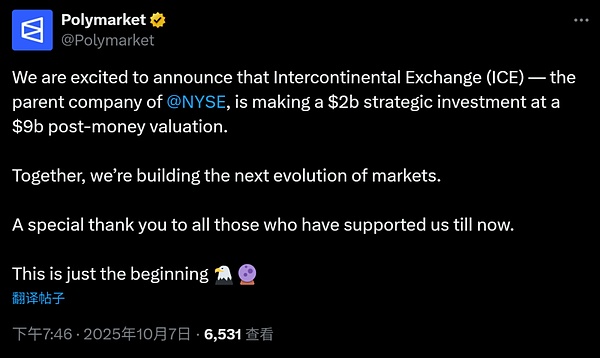
On October 7, 2025, the prediction market Polymarket officially announced that the Intercontinental Exchange (ICE), the parent company of the New York Stock Exchange, would make a strategic investment of US$2 billion in it, with a post-investment valuation of up to US$9 billion. This is not only one of the highest financing amounts obtained by a Web3 project in recent years, but also pushes the potential and popularity of the prediction market to the center of the stage.

Interestingly, the competition has been accelerating visibly in recent times, whether it’s decentralized players like Hyperliquid joining the fray or compliant latecomers like Kalshi accelerating their efforts to catch up.

Behind this, it is not only about who will dominate the future prediction market, but also about how to financialize all uncertainties in the real world.
From Polymarket to Kalshi, multiple blossoms

Decentralized prediction markets have always been one of the important practical tracks for early blockchain applications. For example, I frequently saw examples of old players such as Augur in many popular science books many years ago. Whether it is elections, weather, inflation, sports or IPOs, users can directly trade "yes/no" contracts on a decentralized platform.

But in fact, although the concept was proposed early, it was not until the emergence of Polymarket that the concept was truly broken out of the circle, and this was largely inseparable from the boost from the 2024 US presidential election:

Against the backdrop of traditional polls generally favoring one side, Polymarket ultimately demonstrated, with its accurate predictions and verifiable price signals that surpassed polls, that this decentralized prediction market, which uses "real money" to vote, has extremely high reference value for observing market trends.

This has also led to Polymarket becoming a frequent probability reference source cited by mainstream media in different events in the past six months. However, the prediction market has been struggling with the shackles of compliance. For example, in 2022, Polymarket was fined $1.4 million by the U.S. Commodity Futures Trading Commission (CFTC) for operating an unregistered derivatives market and was banned from providing services to U.S. users.

In the past two years, Kalshi, which was established earlier than Polymarket, has emerged as a dark horse and chosen a path focused on compliance - becoming the first prediction market platform regulated by the U.S. Commodity Futures Trading Commission (CFTC). In October 2024, a federal court also ruled that it was allowed to launch the first regulated election market in the United States, which also made Kalshi's regulatory position more solid.
 Source: polymarketanalytics

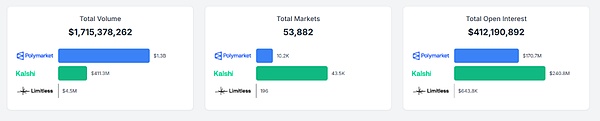
As of October 10, 2025, a comparison of Polymarket and Kalshi data shows that, in addition to the total trading volume of Polymarket being $1.3 billion vs $410 million, which is a significant lead, Polymarket has fallen behind Kalshi in terms of the number of markets (10,200 vs 43,500) and open interest (US$170 million vs US$240 million).

It is worth noting that in order to return to the US market, Polymarket actually adopted a compliance grafting strategy this year: as early as July, it acquired QCX LLC, a trading platform holding a CFTC license, for US$112 million and has begun self-certification of event contracts including sports events and election markets.

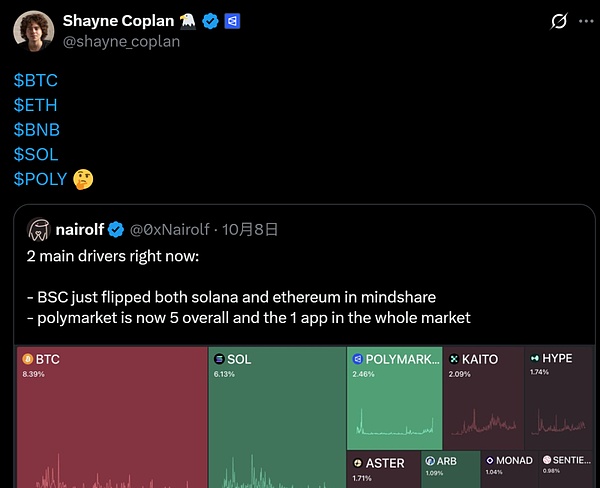
This is also likely a combination of the latest $2 billion in financing, and Polymarket CEO Shayne Coplan also posted a tweet with the POLY symbol on October 9, which may become a key variable in the competition between the two giants.
From prediction markets to larger parent sets

Many people may be curious about why ICE, the parent company of the New York Stock Exchange, made a huge bet of $2 billion on Polymarket?

This requires going beyond Web3 and understanding the prediction market from a larger financial perspective.

First of all, ICE has been actively deploying in the Crypto field, including deploying crypto financial products through its parent company and multiple affiliated entities over the years, gradually covering targets such as Bitcoin spot and futures contracts, as well as the well-known crypto trading platform Bakkt.

Secondly, the prediction market is essentially a subset of the "trading platform", or another form of presentation. For example, Polymarket has many price prediction bets for mainstream crypto assets such as BTC and ETH at different time points such as the end of October and the end of the year.

Theoretically, if the time nodes for predicting fulfillment are infinitely subdivided, from the end of the year to the end of today, to 1 minute later, and 1 second later, then this essentially becomes an instant "bet" (buying and selling behavior) on the trading platform. Perhaps what ICE values is this ability to financialize all uncertainties, which can expand the boundaries of existing derivatives markets such as futures and options.

Therefore, platforms like Polymarket, with their vast user base and trading volume, can serve as a key entry point for ICE Group's future structured financial products, institutional hedging tools, and information pricing services. In other words, ICE isn't focused on a single application, but rather on the potential of the prediction market to "derivative everything"—the uncertainty.

For this reason, in addition to the competition between Polymarket and Kalshi, which is more like a specialized path for event markets, decentralized players such as Hyperliquid have also begun to explore a hybrid path of inserting prediction modules at the entrance of high-performance contract platforms. Both paths have their own advantages and disadvantages, but they may also complement or compete with each other in the future.

New variables for decentralized players like Hyperliquid

For example, the HIP-3 proposal passed by Hyperliquid introduced a permissionless, developer-deployed perpetual contract market on the core infrastructure. Previously, only the core team could list trading pairs, but now any user who pledges 1 million HYPE can deploy their own market directly on the chain.

In short, HIP-3 allows the permissionless creation and listing of derivatives markets for any asset on Hyperliquid, which completely breaks the limitation that Perp DEX could only trade mainstream cryptocurrencies in the past.

This not only means an open contract deployment mechanism, but also lays the technical foundation for subsequent prediction market modules. In the future, users on Hyperliquid may be able to directly trade such markets:

  • Will the Fed cut interest rates at its next meeting?
  • "Will BTC break through $70,000 this week?"
  • "Will Arbitrum TVL exceed Base at the end of the month?"

Under this architecture, the prediction market is no longer an independent track, but a sub-module in the on-chain high-performance derivatives system. And because it reuses Hyperliquid's matching depth, clearing system and order book logic, it naturally has higher transaction efficiency and capital utilization.

In comparison, Polymarket's model is more inclined towards "event trading" and Hyperliquid's model is more inclined towards "price trading" - one starts from information and the other starts from structure, but both point to the same end: allowing future probabilities to be priced instantly by the market.

Final Thoughts

Overall, with the involvement of heavyweight decentralized players like Hyperliquid and ICE’s $2 billion investment, the prediction market is no longer just a tool for people to “bet” or “predict the future”, but has become a frontier for institutions, analysts, and even central banks to observe market sentiment.

This also means that it is no longer just a paradise for speculators, but is rapidly transforming into a highly efficient and highly liquid financial derivatives market, becoming an indispensable financial primitive in the DeFi infrastructure.


Market Opportunity
WHY Logo
WHY Price(WHY)
$0.00000001619
$0.00000001619$0.00000001619
0.00%
USD
WHY (WHY) Live Price Chart
Disclaimer: The articles reposted on this site are sourced from public platforms and are provided for informational purposes only. They do not necessarily reflect the views of MEXC. All rights remain with the original authors. If you believe any content infringes on third-party rights, please contact service@support.mexc.com for removal. MEXC makes no guarantees regarding the accuracy, completeness, or timeliness of the content and is not responsible for any actions taken based on the information provided. The content does not constitute financial, legal, or other professional advice, nor should it be considered a recommendation or endorsement by MEXC.

You May Also Like

Why 100 Percent Test Coverage is Not Possible — Lessons from Testing Banking and Healthcare Systems

Why 100 Percent Test Coverage is Not Possible — Lessons from Testing Banking and Healthcare Systems

Quality is not about testing everything; quality is about testing what is most important.
Share
Hackernoon2025/12/26 16:05
US eyes crypto mining at disputed nuclear plant in Russia-Ukraine conflict: report

US eyes crypto mining at disputed nuclear plant in Russia-Ukraine conflict: report

The plant is located in Ukraine and has been under Russian control since 2022, with its future management a key issue in peace talks.
Share
Coinstats2025/12/26 18:58
Google's AP2 protocol has been released. Does encrypted AI still have a chance?

Google's AP2 protocol has been released. Does encrypted AI still have a chance?

Following the MCP and A2A protocols, the AI Agent market has seen another blockbuster arrival: the Agent Payments Protocol (AP2), developed by Google. This will clearly further enhance AI Agents' autonomous multi-tasking capabilities, but the unfortunate reality is that it has little to do with web3AI. Let's take a closer look: What problem does AP2 solve? Simply put, the MCP protocol is like a universal hook, enabling AI agents to connect to various external tools and data sources; A2A is a team collaboration communication protocol that allows multiple AI agents to cooperate with each other to complete complex tasks; AP2 completes the last piece of the puzzle - payment capability. In other words, MCP opens up connectivity, A2A promotes collaboration efficiency, and AP2 achieves value exchange. The arrival of AP2 truly injects "soul" into the autonomous collaboration and task execution of Multi-Agents. Imagine AI Agents connecting Qunar, Meituan, and Didi to complete the booking of flights, hotels, and car rentals, but then getting stuck at the point of "self-payment." What's the point of all that multitasking? So, remember this: AP2 is an extension of MCP+A2A, solving the last mile problem of AI Agent automated execution. What are the technical highlights of AP2? The core innovation of AP2 is the Mandates mechanism, which is divided into real-time authorization mode and delegated authorization mode. Real-time authorization is easy to understand. The AI Agent finds the product and shows it to you. The operation can only be performed after the user signs. Delegated authorization requires the user to set rules in advance, such as only buying the iPhone 17 when the price drops to 5,000. The AI Agent monitors the trigger conditions and executes automatically. The implementation logic is cryptographically signed using Verifiable Credentials (VCs). Users can set complex commission conditions, including price ranges, time limits, and payment method priorities, forming a tamper-proof digital contract. Once signed, the AI Agent executes according to the conditions, with VCs ensuring auditability and security at every step. Of particular note is the "A2A x402" extension, a technical component developed by Google specifically for crypto payments, developed in collaboration with Coinbase and the Ethereum Foundation. This extension enables AI Agents to seamlessly process stablecoins, ETH, and other blockchain assets, supporting native payment scenarios within the Web3 ecosystem. What kind of imagination space can AP2 bring? After analyzing the technical principles, do you think that's it? Yes, in fact, the AP2 is boring when it is disassembled alone. Its real charm lies in connecting and opening up the "MCP+A2A+AP2" technology stack, completely opening up the complete link of AI Agent's autonomous analysis+execution+payment. From now on, AI Agents can open up many application scenarios. For example, AI Agents for stock investment and financial management can help us monitor the market 24/7 and conduct independent transactions. Enterprise procurement AI Agents can automatically replenish and renew without human intervention. AP2's complementary payment capabilities will further expand the penetration of the Agent-to-Agent economy into more scenarios. Google obviously understands that after the technical framework is established, the ecological implementation must be relied upon, so it has brought in more than 60 partners to develop it, almost covering the entire payment and business ecosystem. Interestingly, it also involves major Crypto players such as Ethereum, Coinbase, MetaMask, and Sui. Combined with the current trend of currency and stock integration, the imagination space has been doubled. Is web3 AI really dead? Not entirely. Google's AP2 looks complete, but it only achieves technical compatibility with Crypto payments. It can only be regarded as an extension of the traditional authorization framework and belongs to the category of automated execution. There is a "paradigm" difference between it and the autonomous asset management pursued by pure Crypto native solutions. The Crypto-native solutions under exploration are taking the "decentralized custody + on-chain verification" route, including AI Agent autonomous asset management, AI Agent autonomous transactions (DeFAI), AI Agent digital identity and on-chain reputation system (ERC-8004...), AI Agent on-chain governance DAO framework, AI Agent NPC and digital avatars, and many other interesting and fun directions. Ultimately, once users get used to AI Agent payments in traditional fields, their acceptance of AI Agents autonomously owning digital assets will also increase. And for those scenarios that AP2 cannot reach, such as anonymous transactions, censorship-resistant payments, and decentralized asset management, there will always be a time for crypto-native solutions to show their strength? The two are more likely to be complementary rather than competitive, but to be honest, the key technological advancements behind AI Agents currently all come from web2AI, and web3AI still needs to keep up the good work!
Share
PANews2025/09/18 07:00