TLDR NHTSA opened an investigation into Tesla’s Full Self-Driving system covering 2.88 million vehicles after receiving reports of traffic violations and crashes. The probe focuses on two main issues: Tesla vehicles running red lights and making improper lane changes into opposing traffic. Tesla stock dropped 8.77% over the past week following the announcement of the [...] The post Tesla (TSLA) Stock Falls as FSD Investigation Threatens Trillion-Dollar Robotaxi Dreams appeared first on CoinCentral.TLDR NHTSA opened an investigation into Tesla’s Full Self-Driving system covering 2.88 million vehicles after receiving reports of traffic violations and crashes. The probe focuses on two main issues: Tesla vehicles running red lights and making improper lane changes into opposing traffic. Tesla stock dropped 8.77% over the past week following the announcement of the [...] The post Tesla (TSLA) Stock Falls as FSD Investigation Threatens Trillion-Dollar Robotaxi Dreams appeared first on CoinCentral.

Tesla (TSLA) Stock Falls as FSD Investigation Threatens Trillion-Dollar Robotaxi Dreams

TLDR

  • NHTSA opened an investigation into Tesla’s Full Self-Driving system covering 2.88 million vehicles after receiving reports of traffic violations and crashes.
  • The probe focuses on two main issues: Tesla vehicles running red lights and making improper lane changes into opposing traffic.
  • Tesla stock dropped 8.77% over the past week following the announcement of the investigation.
  • The agency received 18 reports of FSD-engaged vehicles failing to stop properly at red lights, with six crashes resulting in injuries.
  • Analysts view FSD and Robotaxi technology as critical to Tesla’s future valuation, with some price targets heavily dependent on autonomous driving success.

Tesla shares took a beating this week, dropping 8.77% after federal regulators opened a new investigation into the company’s Full Self-Driving technology. The U.S. National Highway Traffic Safety Administration is examining 2.88 million Tesla vehicles equipped with the FSD system.
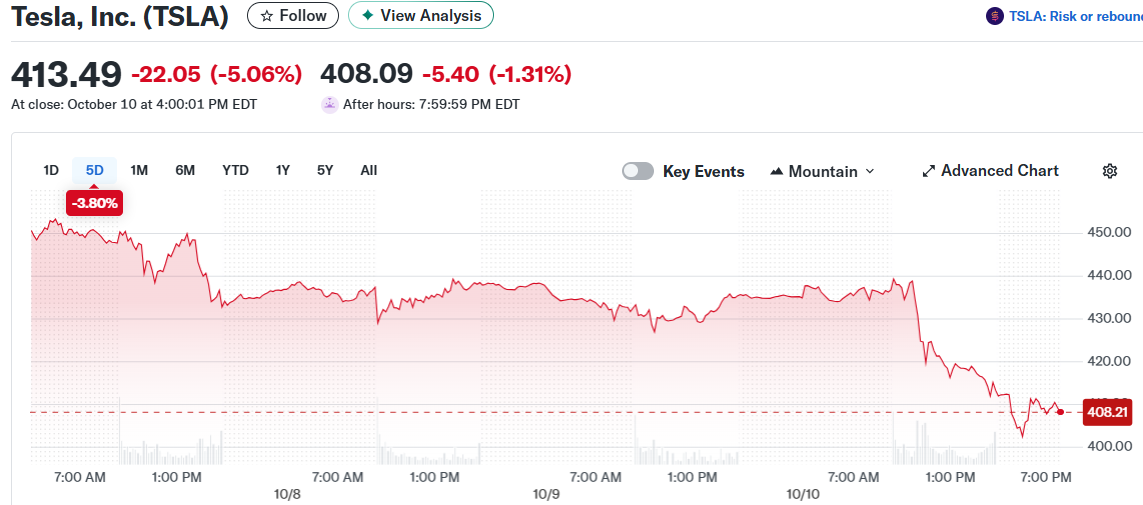
Tesla, Inc. (TSLA)Tesla, Inc. (TSLA)

The timing couldn’t be worse for the electric vehicle maker. Wall Street analysts consider FSD and the upcoming Robotaxi service essential to Tesla’s future growth. Ark Invest CEO Cathie Wood has a five-year price target of $2,600 per share, with much of that valuation riding on autonomous driving technology becoming a commercial reality.

The stock currently trades around $421. That means Wood expects the Robotaxi business alone to multiply Tesla’s trillion-dollar valuation by six times.

What NHTSA Found

The federal probe came after the agency received more than 50 reports of traffic safety violations involving FSD-equipped Teslas. The investigation centers on two specific problems: vehicles running red lights and cars making dangerous lane changes into oncoming traffic.

NHTSA documented 18 reports of Tesla vehicles failing to stop properly at red lights while FSD was engaged. Some didn’t stop at all. Others rolled through intersections or failed to stay stopped for the full duration of the red signal.

Six crashes involved Teslas running red lights with FSD active. Four of those accidents caused injuries. The agency also received complaints about FSD-engaged vehicles swerving into opposing lanes during turns or attempting to drive the wrong way down streets despite clear signage.

One troubling detail stands out. Some complaints alleged that FSD didn’t warn drivers before making these dangerous maneuvers. Tesla has always maintained that FSD requires constant driver attention and intervention when needed.

The investigation will examine whether certain FSD driving inputs interfere with a driver’s ability to supervise the system properly. NHTSA says it has evidence the technology has “induced vehicle behavior that violated traffic safety laws.”

Tesla’s Regulatory Track Record

This marks the fifth open NHTSA investigation involving Tesla. The company now ties with Honda for second place in active federal probes. Only Ford has more with eight investigations.

Earlier this year, the Department of Government Efficiency fired roughly 30 NHTSA workers under Elon Musk’s direction. Many of those employees were responsible for evaluating self-driving car safety. Musk has since been legally removed from his DOGE position.

The agency has been busy with Tesla lately. In October, NHTSA opened an investigation into FSD collisions during reduced visibility conditions like fog and sun glare. That probe followed four crashes, including one fatality.

Tesla missed a June 19 deadline to respond to a detailed FSD questionnaire from NHTSA. The company didn’t submit its answers until days after the due date. In January, regulators opened another investigation covering 2.6 million Tesla vehicles over crashes involving the remote parking feature.

In September, NHTSA announced it was reviewing incident reports Tesla submitted months late. The agency is also in the second phase of potentially recalling Model Y vehicles over an electrical problem that could cause door handles to fail.

What Analysts Think

William Blair analyst Jed Dorsheimer rates Tesla as “market perform” but sees Robotaxi as the key to future value. His firm’s $357.43 price target includes $298.61 attributed solely to the autonomous taxi business.

Investors banking on Tesla’s AI and robotics future now face fresh regulatory uncertainty. The company derives 90% of its revenue and 94% of its gross margin from vehicle sales today. But bulls like Cathie Wood and Wedbush’s Dan Ives believe the real money lies in software and services like FSD.

Tesla recently launched cheaper versions of the Model 3 and Model Y to boost sales. The company has also seen improved EV sales in China and Europe. Wall Street maintains a Hold consensus rating on the stock as analysts await the upcoming third-quarter earnings report.

The post Tesla (TSLA) Stock Falls as FSD Investigation Threatens Trillion-Dollar Robotaxi Dreams appeared first on CoinCentral.


Market Opportunity
Dreams Quest Logo
Dreams Quest Price(DREAMS)
$0.0000167
$0.0000167$0.0000167
-4.02%
USD
Dreams Quest (DREAMS) Live Price Chart
Disclaimer: The articles reposted on this site are sourced from public platforms and are provided for informational purposes only. They do not necessarily reflect the views of MEXC. All rights remain with the original authors. If you believe any content infringes on third-party rights, please contact service@support.mexc.com for removal. MEXC makes no guarantees regarding the accuracy, completeness, or timeliness of the content and is not responsible for any actions taken based on the information provided. The content does not constitute financial, legal, or other professional advice, nor should it be considered a recommendation or endorsement by MEXC.

You May Also Like

Google's AP2 protocol has been released. Does encrypted AI still have a chance?

Google's AP2 protocol has been released. Does encrypted AI still have a chance?

Following the MCP and A2A protocols, the AI Agent market has seen another blockbuster arrival: the Agent Payments Protocol (AP2), developed by Google. This will clearly further enhance AI Agents' autonomous multi-tasking capabilities, but the unfortunate reality is that it has little to do with web3AI. Let's take a closer look: What problem does AP2 solve? Simply put, the MCP protocol is like a universal hook, enabling AI agents to connect to various external tools and data sources; A2A is a team collaboration communication protocol that allows multiple AI agents to cooperate with each other to complete complex tasks; AP2 completes the last piece of the puzzle - payment capability. In other words, MCP opens up connectivity, A2A promotes collaboration efficiency, and AP2 achieves value exchange. The arrival of AP2 truly injects "soul" into the autonomous collaboration and task execution of Multi-Agents. Imagine AI Agents connecting Qunar, Meituan, and Didi to complete the booking of flights, hotels, and car rentals, but then getting stuck at the point of "self-payment." What's the point of all that multitasking? So, remember this: AP2 is an extension of MCP+A2A, solving the last mile problem of AI Agent automated execution. What are the technical highlights of AP2? The core innovation of AP2 is the Mandates mechanism, which is divided into real-time authorization mode and delegated authorization mode. Real-time authorization is easy to understand. The AI Agent finds the product and shows it to you. The operation can only be performed after the user signs. Delegated authorization requires the user to set rules in advance, such as only buying the iPhone 17 when the price drops to 5,000. The AI Agent monitors the trigger conditions and executes automatically. The implementation logic is cryptographically signed using Verifiable Credentials (VCs). Users can set complex commission conditions, including price ranges, time limits, and payment method priorities, forming a tamper-proof digital contract. Once signed, the AI Agent executes according to the conditions, with VCs ensuring auditability and security at every step. Of particular note is the "A2A x402" extension, a technical component developed by Google specifically for crypto payments, developed in collaboration with Coinbase and the Ethereum Foundation. This extension enables AI Agents to seamlessly process stablecoins, ETH, and other blockchain assets, supporting native payment scenarios within the Web3 ecosystem. What kind of imagination space can AP2 bring? After analyzing the technical principles, do you think that's it? Yes, in fact, the AP2 is boring when it is disassembled alone. Its real charm lies in connecting and opening up the "MCP+A2A+AP2" technology stack, completely opening up the complete link of AI Agent's autonomous analysis+execution+payment. From now on, AI Agents can open up many application scenarios. For example, AI Agents for stock investment and financial management can help us monitor the market 24/7 and conduct independent transactions. Enterprise procurement AI Agents can automatically replenish and renew without human intervention. AP2's complementary payment capabilities will further expand the penetration of the Agent-to-Agent economy into more scenarios. Google obviously understands that after the technical framework is established, the ecological implementation must be relied upon, so it has brought in more than 60 partners to develop it, almost covering the entire payment and business ecosystem. Interestingly, it also involves major Crypto players such as Ethereum, Coinbase, MetaMask, and Sui. Combined with the current trend of currency and stock integration, the imagination space has been doubled. Is web3 AI really dead? Not entirely. Google's AP2 looks complete, but it only achieves technical compatibility with Crypto payments. It can only be regarded as an extension of the traditional authorization framework and belongs to the category of automated execution. There is a "paradigm" difference between it and the autonomous asset management pursued by pure Crypto native solutions. The Crypto-native solutions under exploration are taking the "decentralized custody + on-chain verification" route, including AI Agent autonomous asset management, AI Agent autonomous transactions (DeFAI), AI Agent digital identity and on-chain reputation system (ERC-8004...), AI Agent on-chain governance DAO framework, AI Agent NPC and digital avatars, and many other interesting and fun directions. Ultimately, once users get used to AI Agent payments in traditional fields, their acceptance of AI Agents autonomously owning digital assets will also increase. And for those scenarios that AP2 cannot reach, such as anonymous transactions, censorship-resistant payments, and decentralized asset management, there will always be a time for crypto-native solutions to show their strength? The two are more likely to be complementary rather than competitive, but to be honest, the key technological advancements behind AI Agents currently all come from web2AI, and web3AI still needs to keep up the good work!
Share
PANews2025/09/18 07:00
Zama to Conduct Sealed-Bid Dutch Auction Using Encryption Tech

Zama to Conduct Sealed-Bid Dutch Auction Using Encryption Tech

Zama unveils innovative public token auction, using proprietary encryption. Bidding begins January 21, 2026. Key details on protocol and market impact.Read more
Share
Coinstats2026/01/20 18:13
Fed Finally Cuts Interest Rates – Crypto Boom is About to Begin

Fed Finally Cuts Interest Rates – Crypto Boom is About to Begin

The federal funds rate now stands in a range of 4.00% to 4.25%, a level that reflects a delicate balancing […] The post Fed Finally Cuts Interest Rates – Crypto Boom is About to Begin appeared first on Coindoo.
Share
Coindoo2025/09/18 02:01





