This section compares deterministic and randomized allocation functions within discount models where miner ratios and time-based discount rates affect outcomes. It introduces the immediacy-biased allocation class (ρℓ), which prioritizes near-deadline transactions, and shows how it performs optimally in a “semi-myopic” regime. The analysis establishes upper and lower bounds for both deterministic and randomized cases, demonstrating that simple deterministic strategies can nearly match the efficiency of their randomized counterparts under certain conditions.This section compares deterministic and randomized allocation functions within discount models where miner ratios and time-based discount rates affect outcomes. It introduces the immediacy-biased allocation class (ρℓ), which prioritizes near-deadline transactions, and shows how it performs optimally in a “semi-myopic” regime. The analysis establishes upper and lower bounds for both deterministic and randomized cases, demonstrating that simple deterministic strategies can nearly match the efficiency of their randomized counterparts under certain conditions.

Why “Immediacy Bias” Might Be the Secret to Faster, Smarter Blockchain Transactions

Abstract and 1. Introduction

1.1 Our Approach

1.2 Our Results & Roadmap

1.3 Related Work

  1. Model and Warmup and 2.1 Blockchain Model

    2.2 The Miner

    2.3 Game Model

    2.4 Warm Up: The Greedy Allocation Function

  2. The Deterministic Case and 3.1 Deterministic Upper Bound

    3.2 The Immediacy-Biased Class Of Allocation Function

  3. The Randomized Case

  4. Discussion and References

  • A. Missing Proofs for Sections 2, 3
  • B. Missing Proofs for Section 4
  • C. Glossary

3 The Deterministic Case

In this section, we focus on the discount model with miner ratio α ̸= 0 and some discount rate λ. Missing proofs are given in Appendix A.

3.1 Deterministic Upper Bound
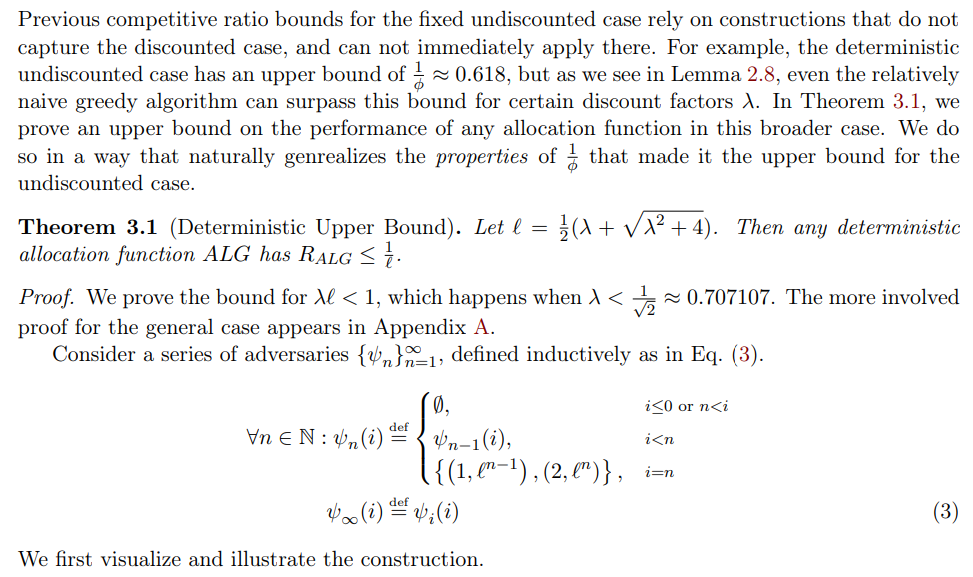
\
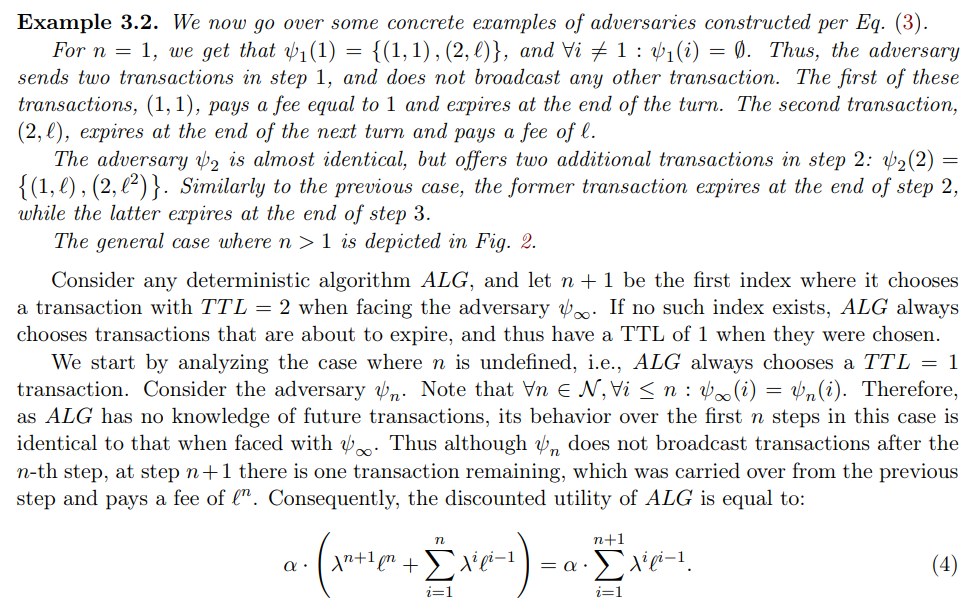
\
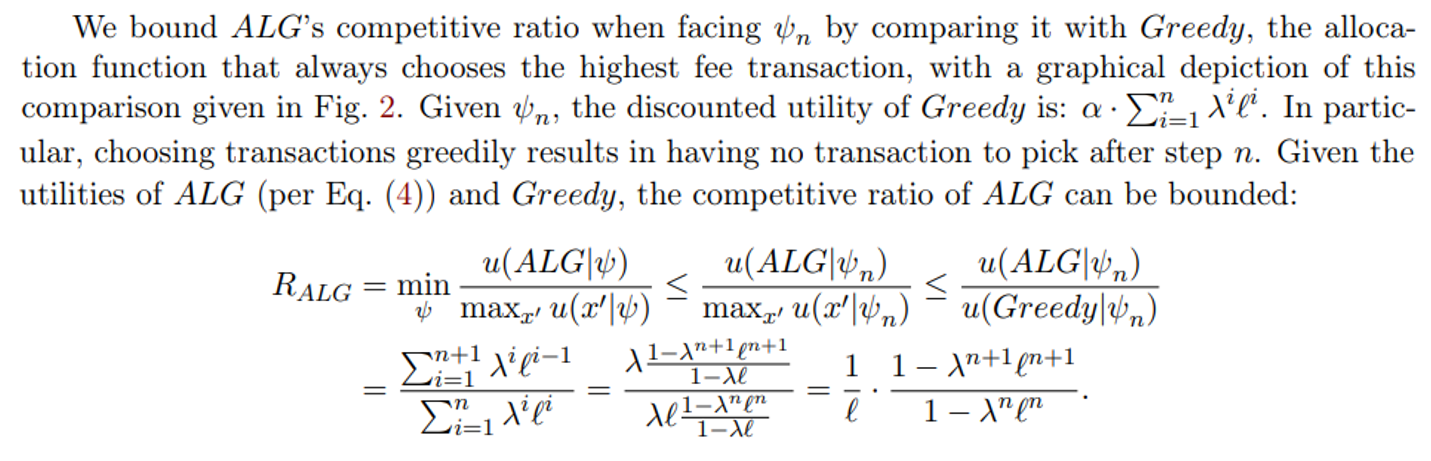
\
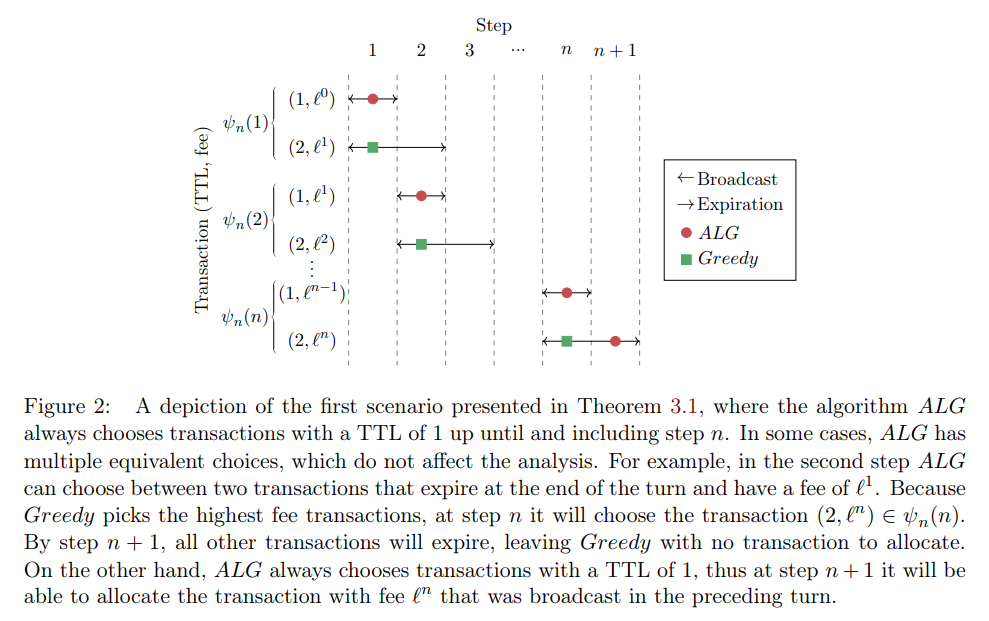
\
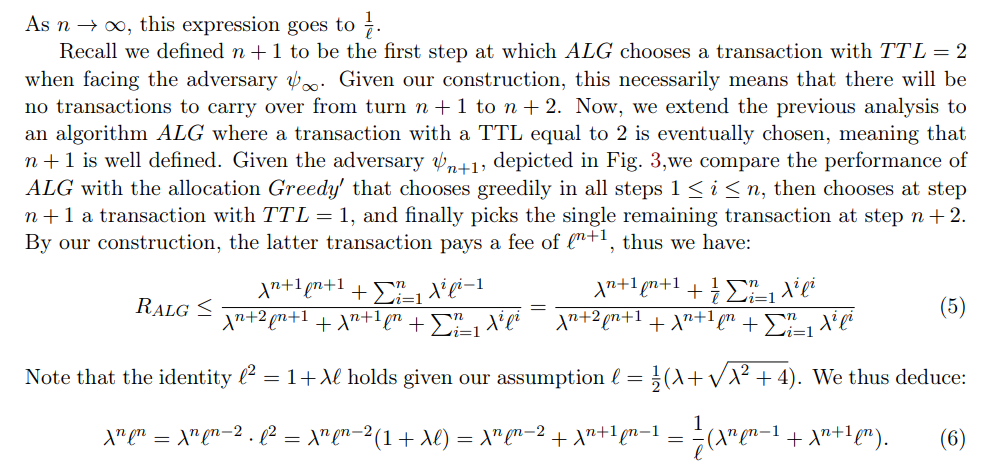
\ Figure 3: The setting described in the proof of Theorem 3.1, for the case where ALG picks a transaction with a TTL equal to 2.
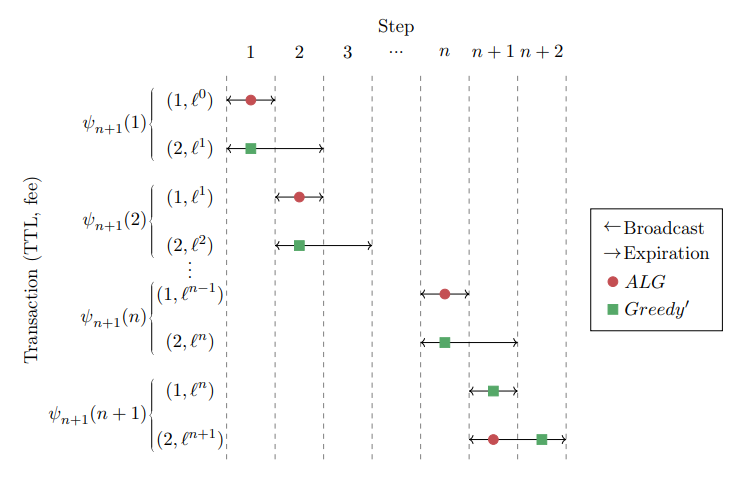
\ By combining Eqs. (5) and (6), the proof is concluded:

\

\

3.2 The Immediacy-Biased Class Of Allocation Function

We proceed by introducing the immediacy-biased ratio class of allocation functions, and identify a regime of discount rates λ which we call the “semi-myopic” regime where it achieves the optimal deterministic competitive ratio. Given a parameter ℓ ∈ R, we denote the corresponding instance of this class as ρℓ and define it in the following manner

\ Definition 3.3 (The ℓ-immediacy-biased ratio allocation function ρℓ). For a set S, let

\ \
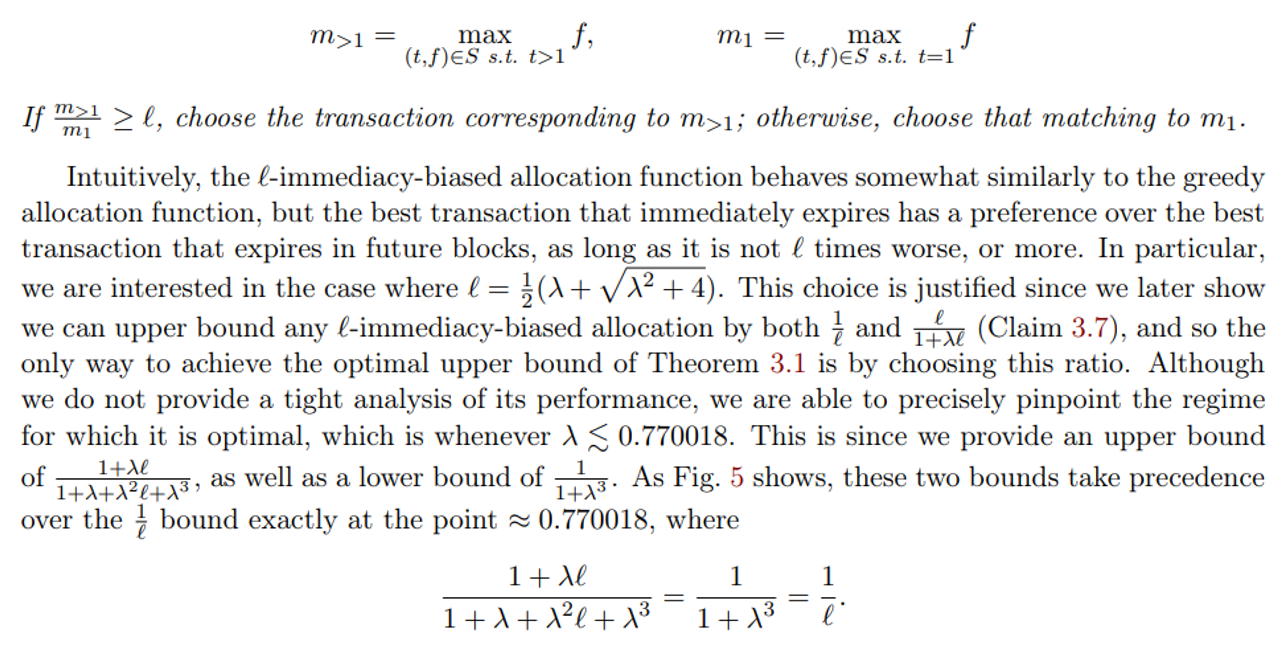
\ \ Before providing the lower and upper bound analysis, we comment on how our algorithm stands in comparison with another algorithm, MG [LSS05]. While the ℓ-immediacy-biased considers only the highest T T L = 1 transaction as a possible candidate to be scheduled instead of the highest-fee transaction, MG considers any earliest-deadline transaction. I.e., the algorithms differ in their behavior when no T T L = 1 transactions are available. However, in terms of competitive analysis, ℓ-immediacy-biased dominates ℓ-MG. That is because at any case that the ℓ-immediacy-biased allocation chooses a T T L = 1 transaction, ℓ-MG would do the same. But any case that ℓ-immediacy-biased allocation chooses the highest-fee transaction; we can force ℓ-MG to do the same by adding a (1, ϵ) with small enough ϵ to the adversary’s schedule at that step. Therefore, we can force ℓ-MG to make the same choices as ℓ-immediacy-biased allocation, without changing the optimal allocation performance.

\ We bound the allocation function’s competitive ratio from below in Lemma 3.4.

\ \
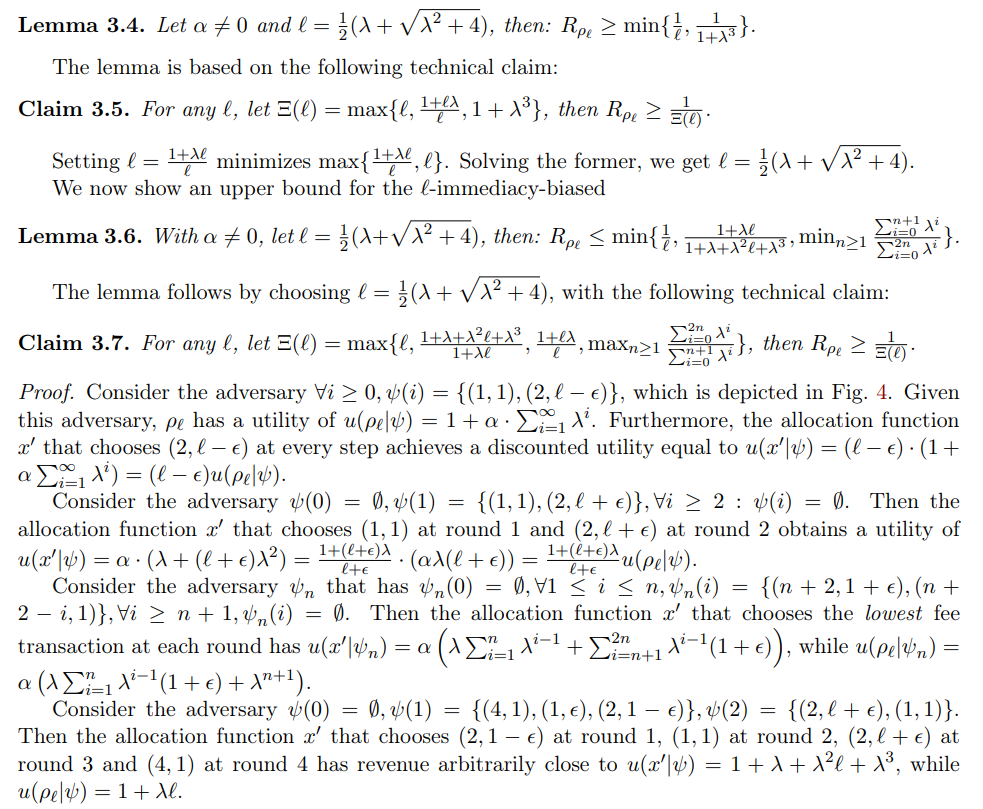
\ \ \ Figure 4: The first adversary used in the proof of Claim 3.7.
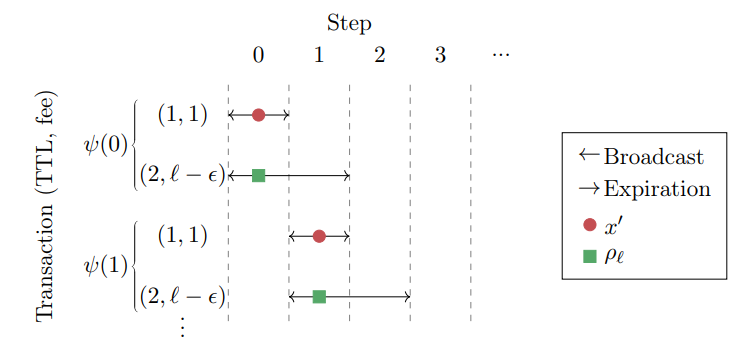
\ \

4 The Randomized Case

Next, Theorem 4.1 obtains an upper bound on the competitive ratio of any allocation function.

4.1 Randomized Upper Bound

Theorem 4.1. Given α ̸= 0, for any (possibly randomized) allocation function ALG:

\ \

\ \ Similarly to the deterministic upper bound, the proof uses a recursive construction of adversaries where the transaction fees grow exponentially. The main technical choice is how to decide the base of the exponent. We guess it by the following equation:

\ \

\

4.2 The RMIXλ Randomized Allocation Function

Next, we show that the best-known randomized allocation function known for the undiscounted case [CCFJST06], extends to the more general discount model.

\ \

\ \ \ Figure 5: Bounds for the competitive ratios of Section 3 and Section 4’s various allocation functions, for miners with a mining ratio α ̸= 0 and discount rates λ ∈ [0, 1].

\ \ \

\ \ Notably, in the semi-myopic range that we identify in Section 3.2, our simple deterministic allocation achieves very similar performance to the above randomized allocation function.

\ Our competitive ratio results are summarized in Fig. 5.

\

:::info Authors:

(1) Yotam Gafni, Weizmann Institute (yotam.gafni@gmail.com);

(2) Aviv Yaish, The Hebrew University, Jerusalem (aviv.yaish@mail.huji.ac.il).

:::


:::info This paper is available on arxiv under CC BY 4.0 DEED license.

:::

\

Market Opportunity
NEAR Logo
NEAR Price(NEAR)
$1.51
$1.51$1.51
-0.13%
USD
NEAR (NEAR) Live Price Chart
Disclaimer: The articles reposted on this site are sourced from public platforms and are provided for informational purposes only. They do not necessarily reflect the views of MEXC. All rights remain with the original authors. If you believe any content infringes on third-party rights, please contact service@support.mexc.com for removal. MEXC makes no guarantees regarding the accuracy, completeness, or timeliness of the content and is not responsible for any actions taken based on the information provided. The content does not constitute financial, legal, or other professional advice, nor should it be considered a recommendation or endorsement by MEXC.

You May Also Like

X3 Acquisition Corp. Ltd. Announces Closing of $200,000,000 Initial Public Offering

X3 Acquisition Corp. Ltd. Announces Closing of $200,000,000 Initial Public Offering

MINNEAPOLIS–(BUSINESS WIRE)–X3 Acquisition Corp. Ltd. (Nasdaq: XCBEU) (the “Company”), a newly organized special purpose acquisition company formed as a Cayman
Share
AI Journal2026/01/23 05:46
North America’s Largest RV Dealers Still Failing Google Core Web Vitals–Overfuel Reports Nearly 79% Failure Rate for Second Year

North America’s Largest RV Dealers Still Failing Google Core Web Vitals–Overfuel Reports Nearly 79% Failure Rate for Second Year

INDIANAPOLIS, Jan. 22, 2026 /PRNewswire/ — Overfuel, a website solutions provider for automotive, powersports and RV dealers, today announced the findings of its
Share
AI Journal2026/01/23 05:15
3 Paradoxes of Altcoin Season in September

3 Paradoxes of Altcoin Season in September

The post 3 Paradoxes of Altcoin Season in September appeared on BitcoinEthereumNews.com. Analyses and data indicate that the crypto market is experiencing its most active altcoin season since early 2025, with many altcoins outperforming Bitcoin. However, behind this excitement lies a paradox. Most retail investors remain uneasy as their portfolios show little to no profit. This article outlines the main reasons behind this situation. Altcoin Market Cap Rises but Dominance Shrinks Sponsored TradingView data shows that the TOTAL3 market cap (excluding BTC and ETH) reached a new high of over $1.1 trillion in September. Yet the share of OTHERS (excluding the top 10) has declined since 2022, now standing at just 8%. OTHERS Dominance And TOTAL3 Capitalization. Source: TradingView. In past cycles, such as 2017 and 2021, TOTAL3 and OTHERS.D rose together. That trend reflected capital flowing not only into large-cap altcoins but also into mid-cap and low-cap ones. The current divergence shows that capital is concentrated in stablecoins and a handful of top-10 altcoins such as SOL, XRP, BNB, DOG, HYPE, and LINK. Smaller altcoins receive far less liquidity, making it hard for their prices to return to levels where investors previously bought. This creates a situation where only a few win while most face losses. Retail investors also tend to diversify across many coins instead of adding size to top altcoins. That explains why many portfolios remain stagnant despite a broader market rally. Sponsored “Position sizing is everything. Many people hold 25–30 tokens at once. A 100x on a token that makes up only 1% of your portfolio won’t meaningfully change your life. It’s better to make a few high-conviction bets than to overdiversify,” analyst The DeFi Investor said. Altcoin Index Surges but Investor Sentiment Remains Cautious The Altcoin Season Index from Blockchain Center now stands at 80 points. This indicates that over 80% of the top 50 altcoins outperformed…
Share
BitcoinEthereumNews2025/09/18 01:43