What to Know: Stripe’s stablecoin arm, Bridge, has applied for a US national trust bank charter under the GENIUS Act, joining Circle, Ripple, Paxos, and Coinbase. The GENIUS Act introduces federal oversight for stablecoin issuers, requiring 100% cash or Treasury reserves and monthly public disclosures. This could mark the start of ‘Stablecoin Season,’ as regulated issuers bridge the gap between banks and blockchain payments. Best Wallet ($BEST) stands to benefit, offering users secure custody, presale access, and up to 80% APY staking rewards. Stablecoins are going legit, and pretty fast. Stripe’s stablecoin arm, Bridge, just filed an application with the US Office of the Comptroller of the Currency (OCC) to form a national trust bank under the newly enacted GENIUS Act. It’s the latest move in what’s shaping up to be ‘Stablecoin Season’: a full-blown regulatory sprint to bring digital dollars under federal oversight. If approved, Bridge’s charter would let Stripe issue, redeem, and custody stablecoins directly under the OCC, instead of juggling dozens of state-level money-transmitter licenses. That means its entire stablecoin business would sit under on federal framework, complete with 100% cash or Treasury-backed reserves and monthly public disclosures, as required by the GENIUS Act. Bridge now joins Circle ($USDC), Ripple ($RLUSD), Paxos ($USDP), and Coinbase ($COIN) in chasing national trust licenses – a race that marks a historic pivot for the US digital asset market. Together, these firms are positioning stablecoins as the regulated backbone of global payments, rather than gray-zone fintech experiments. The timing makes sense. Stablecoins already account for over $315B in circulating value, and Standard Chartered analysts estimate they could pull $1T in deposits away from traditional banks over the next three years. For users and merchants, that shift would make stablecoins the default settlement rail of the internet. They’re faster, cheaper, and now, finally, compliant. For Striple, Bridge isn’t just about compliance; it’s also an infrastructure play. The company recently unveiled Open Issuance, a service that helps apps launch their own stablecoins using Bridge’s back-end. Wallets like Phantom ($CASH), MetaMask ($mUSD), and Hyperliquid ($USDH) already rely on Bridge as their issuance partner. All signs point to a regulated on-chain economy, where digital dollars move under federal supervision and mainstream adoption finally takes hold. So the real question for investors becomes: if stablecoins are about to become the rails of this new system, which tokens will capture user flow at the edge? That’s where Best Wallet Token ($BEST) enters the picture, powering one of the fastest-growing Web3 wallets built to bridge the gap between regulated stablecoins and everyday users. From Stablecoins to Wallet Wars – the New On-Ramp Race The race for federal trust charters isn’t just about who prints the next digital dollar; it’s about who controls the gateway to it. Stripe, Circle, Ripple, and Coinbase are fighting for issuance and compliance. But at the user level, a different war is breaking out… the battle for wallets. Under the new GENIUS framework, stablecoins can finally plug into traditional finance with clear oversight from the OCC. That unlocks direct settlement with banks, cross-chain interoperability, and compliant collateral for lending protocols. This is the pipeline for a regulated DeFi economy. And this is where crypto wallets come in. They’re no longer just storage apps. They’ve become super apps. MetaMask now offers staking, Phantom integrates stablecoin rails, and new players like Best Wallet are going further by blending payments, presales, and rewards inside one secure, Fireblocks-powered interface. Best Wallet Token ($BEST) – The Token Fueling a Web3 Super App Built for the Stablecoin Era As stablecoins edge closer to federal recognition, wallet ecosystems are becoming the frontlines of adoption. Best Wallet is positioning itself at that intersection as a non-custodial wallet app that merges security, yield, and discovery into one seamless platform. Built on Fireblocks’ MPC-CMP framework, the same institutional-grade tech used by major custodians, Best Wallet offers users secure on-chain control without sacrificing usability. It’s a place to store tokens, buy into new crypto presales, stake assets, and soon, spend crypto cash through the Best Card. That card will deliver cashback and fee discounts to anyone staking the native $BEST token. And that token is what powers the entire ecosystem. Holding $BEST unlocks reduced transaction fees, higher staking rewards, and early access to new token launches through the in-app ‘Upcoming Tokens’ feature. Discover how to buy Best Wallet Token in our step-by-step walkthrough. The project has drawn over 57K followers on X and raised $16.5M so far in the presale. Tokens are priced at $0.025795, and with ambitions to capture 40% of the crypto-wallet market by the end of 2026, you can see why we a Best Wallet Token price prediction of $0.05106175 is not unreasonable. As stablecoins come under the OCC’s watch, wallets integrating compliant rails and institutional security will stand out. Best Wallet is built precisely for that world, connecting regulated stablecoin infrastructure with DeFi native opportunities. In that sense, the GENIUS Act sets the stage for wallets like Best Wallet to become the banks of the future, Join the $BEST presale and stake now for up to 80% APY. This article does not constitute financial advice. Crypto carries inherent risks, so please do your own research (DYOR) and never invest more than you are willing to lose. Authored by X, NewsBTC — www.newsbtc.com/news/stablecoin-season-stripe-bridge-impact-best-wallet-tokenWhat to Know: Stripe’s stablecoin arm, Bridge, has applied for a US national trust bank charter under the GENIUS Act, joining Circle, Ripple, Paxos, and Coinbase. The GENIUS Act introduces federal oversight for stablecoin issuers, requiring 100% cash or Treasury reserves and monthly public disclosures. This could mark the start of ‘Stablecoin Season,’ as regulated issuers bridge the gap between banks and blockchain payments. Best Wallet ($BEST) stands to benefit, offering users secure custody, presale access, and up to 80% APY staking rewards. Stablecoins are going legit, and pretty fast. Stripe’s stablecoin arm, Bridge, just filed an application with the US Office of the Comptroller of the Currency (OCC) to form a national trust bank under the newly enacted GENIUS Act. It’s the latest move in what’s shaping up to be ‘Stablecoin Season’: a full-blown regulatory sprint to bring digital dollars under federal oversight. If approved, Bridge’s charter would let Stripe issue, redeem, and custody stablecoins directly under the OCC, instead of juggling dozens of state-level money-transmitter licenses. That means its entire stablecoin business would sit under on federal framework, complete with 100% cash or Treasury-backed reserves and monthly public disclosures, as required by the GENIUS Act. Bridge now joins Circle ($USDC), Ripple ($RLUSD), Paxos ($USDP), and Coinbase ($COIN) in chasing national trust licenses – a race that marks a historic pivot for the US digital asset market. Together, these firms are positioning stablecoins as the regulated backbone of global payments, rather than gray-zone fintech experiments. The timing makes sense. Stablecoins already account for over $315B in circulating value, and Standard Chartered analysts estimate they could pull $1T in deposits away from traditional banks over the next three years. For users and merchants, that shift would make stablecoins the default settlement rail of the internet. They’re faster, cheaper, and now, finally, compliant. For Striple, Bridge isn’t just about compliance; it’s also an infrastructure play. The company recently unveiled Open Issuance, a service that helps apps launch their own stablecoins using Bridge’s back-end. Wallets like Phantom ($CASH), MetaMask ($mUSD), and Hyperliquid ($USDH) already rely on Bridge as their issuance partner. All signs point to a regulated on-chain economy, where digital dollars move under federal supervision and mainstream adoption finally takes hold. So the real question for investors becomes: if stablecoins are about to become the rails of this new system, which tokens will capture user flow at the edge? That’s where Best Wallet Token ($BEST) enters the picture, powering one of the fastest-growing Web3 wallets built to bridge the gap between regulated stablecoins and everyday users. From Stablecoins to Wallet Wars – the New On-Ramp Race The race for federal trust charters isn’t just about who prints the next digital dollar; it’s about who controls the gateway to it. Stripe, Circle, Ripple, and Coinbase are fighting for issuance and compliance. But at the user level, a different war is breaking out… the battle for wallets. Under the new GENIUS framework, stablecoins can finally plug into traditional finance with clear oversight from the OCC. That unlocks direct settlement with banks, cross-chain interoperability, and compliant collateral for lending protocols. This is the pipeline for a regulated DeFi economy. And this is where crypto wallets come in. They’re no longer just storage apps. They’ve become super apps. MetaMask now offers staking, Phantom integrates stablecoin rails, and new players like Best Wallet are going further by blending payments, presales, and rewards inside one secure, Fireblocks-powered interface. Best Wallet Token ($BEST) – The Token Fueling a Web3 Super App Built for the Stablecoin Era As stablecoins edge closer to federal recognition, wallet ecosystems are becoming the frontlines of adoption. Best Wallet is positioning itself at that intersection as a non-custodial wallet app that merges security, yield, and discovery into one seamless platform. Built on Fireblocks’ MPC-CMP framework, the same institutional-grade tech used by major custodians, Best Wallet offers users secure on-chain control without sacrificing usability. It’s a place to store tokens, buy into new crypto presales, stake assets, and soon, spend crypto cash through the Best Card. That card will deliver cashback and fee discounts to anyone staking the native $BEST token. And that token is what powers the entire ecosystem. Holding $BEST unlocks reduced transaction fees, higher staking rewards, and early access to new token launches through the in-app ‘Upcoming Tokens’ feature. Discover how to buy Best Wallet Token in our step-by-step walkthrough. The project has drawn over 57K followers on X and raised $16.5M so far in the presale. Tokens are priced at $0.025795, and with ambitions to capture 40% of the crypto-wallet market by the end of 2026, you can see why we a Best Wallet Token price prediction of $0.05106175 is not unreasonable. As stablecoins come under the OCC’s watch, wallets integrating compliant rails and institutional security will stand out. Best Wallet is built precisely for that world, connecting regulated stablecoin infrastructure with DeFi native opportunities. In that sense, the GENIUS Act sets the stage for wallets like Best Wallet to become the banks of the future, Join the $BEST presale and stake now for up to 80% APY. This article does not constitute financial advice. Crypto carries inherent risks, so please do your own research (DYOR) and never invest more than you are willing to lose. Authored by X, NewsBTC — www.newsbtc.com/news/stablecoin-season-stripe-bridge-impact-best-wallet-token

Stripe’s Bridge Leads the Stablecoin Season, and Could Boost Best Wallet Token

2025/10/15 21:26
5 min read
For feedback or concerns regarding this content, please contact us at crypto.news@mexc.com

What to Know:

  • Stripe’s stablecoin arm, Bridge, has applied for a US national trust bank charter under the GENIUS Act, joining Circle, Ripple, Paxos, and Coinbase.
  • The GENIUS Act introduces federal oversight for stablecoin issuers, requiring 100% cash or Treasury reserves and monthly public disclosures.
  • This could mark the start of ‘Stablecoin Season,’ as regulated issuers bridge the gap between banks and blockchain payments.
  • Best Wallet ($BEST) stands to benefit, offering users secure custody, presale access, and up to 80% APY staking rewards.

Stablecoins are going legit, and pretty fast.

Stripe’s stablecoin arm, Bridge, just filed an application with the US Office of the Comptroller of the Currency (OCC) to form a national trust bank under the newly enacted GENIUS Act.
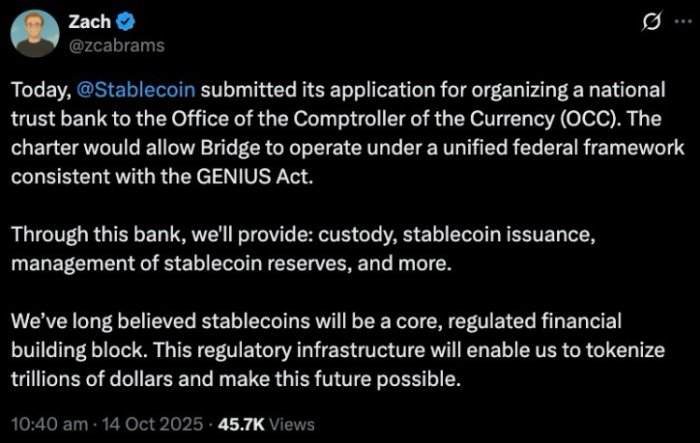
Bridge application to OCC announcement.

It’s the latest move in what’s shaping up to be ‘Stablecoin Season’: a full-blown regulatory sprint to bring digital dollars under federal oversight.

If approved, Bridge’s charter would let Stripe issue, redeem, and custody stablecoins directly under the OCC, instead of juggling dozens of state-level money-transmitter licenses.

That means its entire stablecoin business would sit under on federal framework, complete with 100% cash or Treasury-backed reserves and monthly public disclosures, as required by the GENIUS Act.

Bridge now joins Circle ($USDC), Ripple ($RLUSD), Paxos ($USDP), and Coinbase ($COIN) in chasing national trust licenses – a race that marks a historic pivot for the US digital asset market.

Together, these firms are positioning stablecoins as the regulated backbone of global payments, rather than gray-zone fintech experiments.

The timing makes sense. Stablecoins already account for over $315B in circulating value, and Standard Chartered analysts estimate they could pull $1T in deposits away from traditional banks over the next three years.
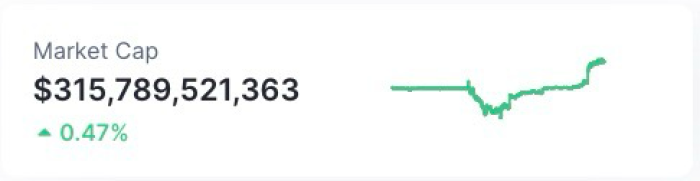
Stablecoins market cap.

For users and merchants, that shift would make stablecoins the default settlement rail of the internet. They’re faster, cheaper, and now, finally, compliant.

For Striple, Bridge isn’t just about compliance; it’s also an infrastructure play.

The company recently unveiled Open Issuance, a service that helps apps launch their own stablecoins using Bridge’s back-end. Wallets like Phantom ($CASH), MetaMask ($mUSD), and Hyperliquid ($USDH) already rely on Bridge as their issuance partner.

All signs point to a regulated on-chain economy, where digital dollars move under federal supervision and mainstream adoption finally takes hold.

So the real question for investors becomes: if stablecoins are about to become the rails of this new system, which tokens will capture user flow at the edge?

That’s where Best Wallet Token ($BEST) enters the picture, powering one of the fastest-growing Web3 wallets built to bridge the gap between regulated stablecoins and everyday users.

From Stablecoins to Wallet Wars – the New On-Ramp Race

The race for federal trust charters isn’t just about who prints the next digital dollar; it’s about who controls the gateway to it. Stripe, Circle, Ripple, and Coinbase are fighting for issuance and compliance. But at the user level, a different war is breaking out… the battle for wallets.

Under the new GENIUS framework, stablecoins can finally plug into traditional finance with clear oversight from the OCC. That unlocks direct settlement with banks, cross-chain interoperability, and compliant collateral for lending protocols. This is the pipeline for a regulated DeFi economy.

And this is where crypto wallets come in. They’re no longer just storage apps. They’ve become super apps.

MetaMask now offers staking, Phantom integrates stablecoin rails, and new players like Best Wallet are going further by blending payments, presales, and rewards inside one secure, Fireblocks-powered interface.

Best Wallet Token ($BEST) – The Token Fueling a Web3 Super App Built for the Stablecoin Era

As stablecoins edge closer to federal recognition, wallet ecosystems are becoming the frontlines of adoption. Best Wallet is positioning itself at that intersection as a non-custodial wallet app that merges security, yield, and discovery into one seamless platform.

Built on Fireblocks’ MPC-CMP framework, the same institutional-grade tech used by major custodians, Best Wallet offers users secure on-chain control without sacrificing usability.

It’s a place to store tokens, buy into new crypto presales, stake assets, and soon, spend crypto cash through the Best Card. That card will deliver cashback and fee discounts to anyone staking the native $BEST token.
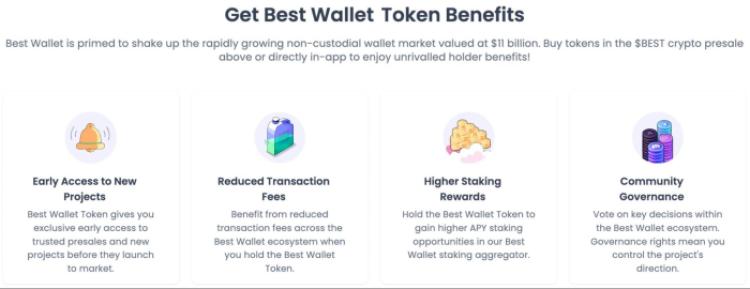
Best Wallet Token ($BEST) benefits for holders.

And that token is what powers the entire ecosystem. Holding $BEST unlocks reduced transaction fees, higher staking rewards, and early access to new token launches through the in-app ‘Upcoming Tokens’ feature.

Discover how to buy Best Wallet Token in our step-by-step walkthrough.

The project has drawn over 57K followers on X and raised $16.5M so far in the presale. Tokens are priced at $0.025795, and with ambitions to capture 40% of the crypto-wallet market by the end of 2026, you can see why we a Best Wallet Token price prediction of $0.05106175 is not unreasonable.

As stablecoins come under the OCC’s watch, wallets integrating compliant rails and institutional security will stand out. Best Wallet is built precisely for that world, connecting regulated stablecoin infrastructure with DeFi native opportunities.

In that sense, the GENIUS Act sets the stage for wallets like Best Wallet to become the banks of the future,

Join the $BEST presale and stake now for up to 80% APY.

This article does not constitute financial advice. Crypto carries inherent risks, so please do your own research (DYOR) and never invest more than you are willing to lose.

Authored by X, NewsBTC — www.newsbtc.com/news/stablecoin-season-stripe-bridge-impact-best-wallet-token

Disclaimer: The articles reposted on this site are sourced from public platforms and are provided for informational purposes only. They do not necessarily reflect the views of MEXC. All rights remain with the original authors. If you believe any content infringes on third-party rights, please contact crypto.news@mexc.com for removal. MEXC makes no guarantees regarding the accuracy, completeness, or timeliness of the content and is not responsible for any actions taken based on the information provided. The content does not constitute financial, legal, or other professional advice, nor should it be considered a recommendation or endorsement by MEXC.

You May Also Like

Here’s How Consumers May Benefit From Lower Interest Rates

Here’s How Consumers May Benefit From Lower Interest Rates

The post Here’s How Consumers May Benefit From Lower Interest Rates appeared on BitcoinEthereumNews.com. Topline The Federal Reserve on Wednesday opted to ease interest rates for the first time in months, leading the way for potentially lower mortgage rates, bond yields and a likely boost to cryptocurrency over the coming weeks. Average long-term mortgage rates dropped to their lowest levels in months ahead of the central bank’s policy shift. Copyright{2018} The Associated Press. All rights reserved. Key Facts The central bank’s policymaking panel voted this week to lower interest rates, which have sat between 4.25% and 4.5% since December, to a new range of 4% and 4.25%. How Will Lower Interest Rates Impact Mortgage Rates? Mortgage rates tend to fall before and during a period of interest rate cuts: The average 30-year fixed-rate mortgage dropped to 6.35% from 6.5% last week, the lowest level since October 2024, mortgage buyer Freddie Mac reported. Borrowing costs on 15-year fixed-rate mortgages also dropped to 5.5% from 5.6% as they neared the year-ago rate of 5.27%. When the Federal Reserve lowered the funds rate to between 0% and 0.25% during the pandemic, 30-year mortgage rates hit record lows between 2.7% and 3% by the end of 2020, according to data published by Freddie Mac. Consumers who refinanced their mortgages in 2020 saved about $5.3 billion annually as rates dropped, according to the Consumer Financial Protection Bureau. Similarly, mortgage rates spiked around 7% as interest rates were hiked in 2022 and 2023, though mortgage rates appeared to react within weeks of the Fed opting to cut or raise rates. How Do Treasury Bonds Respond To Lower Interest Rates? Long-term Treasury yields are more directly influenced by interest rates, as lower rates tend to result in lower yields. When the Fed pushed rates to near zero during the pandemic, 10-year Treasury yields fell to an all-time low of 0.5%. As…
Share
BitcoinEthereumNews2025/09/18 05:59
Tunis–Carthage Airport Expansion Targets Capacity Surge

Tunis–Carthage Airport Expansion Targets Capacity Surge

Tunisia’s Tunis–Carthage airport expansion is set to transform the country’s aviation capacity as authorities plan a $1 billion investment to significantly increase
Share
Furtherafrica2026/03/10 13:00
Hoskinson to Attend Senate Roundtable on Crypto Regulation

Hoskinson to Attend Senate Roundtable on Crypto Regulation

The post Hoskinson to Attend Senate Roundtable on Crypto Regulation appeared on BitcoinEthereumNews.com. Hoskinson confirmed for Senate roundtable on U.S. crypto regulation and market structure. Key topics include SEC vs CFTC oversight split, DeFi regulation, and securities rules. Critics call the roundtable slow, citing Trump’s 2025 executive order as faster. Cardano founder Charles Hoskinson has confirmed that he will attend the Senate Banking Committee roundtable on crypto market structure legislation.  Hoskinson left a hint about his attendance on X while highlighting Journalist Eleanor Terrett’s latest post about the event. Crypto insiders will meet with government officials Terrett shared information gathered from some invitees to the event, noting that a group of leaders from several major cryptocurrency establishments would attend the event. According to Terrett, the group will meet with the Senate Banking Committee leadership in a roundtable to continue talks on market structure regulation. Meanwhile, Terrett noted that the meeting will be held on Thursday, September 18, following an industry review of the committee’s latest approach to distinguishing securities from commodities, DeFi treatment, and other key issues, which has lasted over one week.  Related: Senate Draft Bill Gains Experts’ Praise for Strongest Developer Protections in Crypto Law Notably, the upcoming roundtable between US legislators and crypto industry leaders is a continuation of the process of regularising cryptocurrency regulation in the United States. It is part of the Donald Trump administration’s efforts to provide clarity in the US cryptocurrency ecosystem, which many crypto supporters consider a necessity for the digital asset industry. Despite the ongoing process, some crypto users are unsatisfied with how the US government is handling the issue, particularly the level of bureaucracy involved in creating a lasting cryptocurrency regulatory framework. One such user criticized the process, describing it as a “masterclass in bureaucratic foot-dragging.” According to the critic, America is losing ground to nations already leading in blockchain innovation. He cited…
Share
BitcoinEthereumNews2025/09/18 06:37