Japan plans new regulations to stamp out crypto insider trading. A law enforcement agency in the country, the Securities and Exchange Surveillance Commission (SESC), is to have new powers of crypto trading investigation. Currently, no laws apply to crypto insider trading in FIEA. This void left the space open for regulation. Japan’s Crypto Regulation The Japan Virtual and Crypto Assets Exchange Association (JVCEA), which self-regulates crypto exchanges, lacks the tools to detect insider trading. This is why the government is taking steps to tighten the rules. The Financial Services Agency (FSA), which oversees the SESC, will form a working group to discuss a new regulatory framework. They aim to submit an amendment to the FIEA by next year, bringing cryptocurrencies under the same rules as stocks and bonds. Source: X Insider Trading in Crypto: A Growing Concern The rise of cryptocurrency in Japan has sparked an urgent need for clear regulations. As of August 2025, Japan has 7.88 million active cryptocurrency accounts, an increase of 400% over the past five years.  Also Read: Japan to Secure Cryptocurrencies as Legal Financial Products Crypto insider trading poses unique challenges. Many tokens lack identifiable issuers, making it hard to define who qualifies as an insider. This makes detecting and penalizing insider trading in the crypto market more difficult compared to traditional stock trading. Proposed Regulatory Changes to Address Crypto Insider Trading The SESC is aiming to modify the Financial Instruments and Exchange Act to make room for crypto in insider trading laws. The new rule would be the first time the regulation expressly applies to insider trading on nondisclosed information. Under the recommendations, the FSA would be able to provide specific guidance on what amounts to insider dealing. Such regulations would help prevent the problem of crypto insider trading in a digital age and make it clearer for crypto investors. Challenges in Regulating Crypto Insider Trading As opposed to traditional financial instruments, crypto assets are frequently decentralized. It’s hard to figure out what insider trading looks like when there isn’t a clear issuer for a lot of these tokens. Japan’s regulatory agency is still coming to grips with insider trading in the crypto sector. The country certainly has lots of experience monitoring stock markets, but it is far less clear about crypto: The market remains something of the Wild West. FSA’s Push to Reclassify Crypto Assets New crypto insider trading rules are set to be introduced, along with the possibility of Japan’s Financial Services Agency classifying cryptocurrencies as financial products. This change would put crypto subject to the FIEA, similar to how stocks and bonds are regulated. Reclassifying crypto could reduce to a maximum of 20% the capital gains tax digital assets are subject to, down from as much as 55%, Holger Zschaepitz explains. It would benefit crypto by making it more appealing to investors, and bring Japan’s tax policy in line with international norms. Political Momentum for Crypto Regulation A supporter is rising Key political figure Sanae Takaichi could bring new momentum to the regulation of the crypto asset industry in Japan. The former has openly called for technology sovereignty to be a high government priority. She is also supportive of lower interest rates and tax cuts, moves that might see yet more capital pour into Japan’s crypto sphere. The policies of Takaichi could aid in solidifying Japan as the world’s capital for cryptocurrency regulation. Benefits of Strengthening Crypto Oversight There are a number of persistent problems in the cryptocurrency space that the new regulatory structure would be designed to tackle. These are misleading statements, unregistered activity, and security issues.  Policies that are transparent can help investors trade the crypto market with more assurance. Exchanges would also have to abide by tighter rules to prevent fraud and market manipulation. Conclusion Japan is making significant strides in regulating its crypto market. The country’s approach to crypto insider trading will likely set a precedent for other nations looking to address similar issues. In associating crypto with traditional investment vehicles, Japan is demonstrating its resolve to create a safe and transparent marketplace. This is also an attempt to ensure a fair and transparent crypto ecosystem. Also Read: Ripple Funds Japan’s Web3 Future: $200K Grants Aim to Ignite XRP Ledger Summary Japan to combat crypto insider trading with new regulation, aiming for digital currency to be on par with traditional securities. The SESC will receive renewed authority to investigate and sanction violations, with the goal of promoting greater market transparency and safety. The FSA is also said to weigh the recategorization of cryptocurrencies under the Financial Instruments and Exchange Act, meaning they would become subject to lower capital gains taxes in exchange for better protection of investors.  Appendix: Glossary of Key Terms Crypto Insider Trading: Illegal practice of trading cryptocurrencies based on non-public information. Financial Instruments and Exchange Act (FIEA): Japanese law governing securities and financial markets. Securities and Exchange Surveillance Commission (SESC): Regulatory body responsible for overseeing financial markets in Japan. Financial Services Agency (FSA): Government agency responsible for overseeing Japan’s financial market regulations. Capital Gains Tax: Tax on profits from the sale of assets like crypto. Japan Virtual and Crypto Assets Exchange Association (JVCEA): Self-regulatory body overseeing crypto exchanges in Japan. Frequently Asked Questions Crypto Insider Trading 1: What is Japan’s stance on crypto insider trading? Japan is set to introduce regulations to ban and penalize insider trading in the crypto market, bringing it in line with traditional stock market rules. 2: How will the new regulations impact investors? The new rules aim to protect investors by creating a more transparent and secure crypto market. Insider trading will be punished, making it safer for people to invest. 3: What changes are proposed for crypto taxation in Japan? The FSA plans to reclassify cryptocurrencies as financial products under the FIEA. This could lower the capital gains tax on crypto to a maximum of 20%. 4: How does insider trading in crypto differ from stock trading? Insider trading in crypto is harder to detect because many tokens lack identifiable issuers. This makes it more challenging to define who qualifies as an insider. Read More: Japan to Combat Crypto Insider Trading with New Regulations: Report">Japan to Combat Crypto Insider Trading with New Regulations: ReportJapan plans new regulations to stamp out crypto insider trading. A law enforcement agency in the country, the Securities and Exchange Surveillance Commission (SESC), is to have new powers of crypto trading investigation. Currently, no laws apply to crypto insider trading in FIEA. This void left the space open for regulation. Japan’s Crypto Regulation The Japan Virtual and Crypto Assets Exchange Association (JVCEA), which self-regulates crypto exchanges, lacks the tools to detect insider trading. This is why the government is taking steps to tighten the rules. The Financial Services Agency (FSA), which oversees the SESC, will form a working group to discuss a new regulatory framework. They aim to submit an amendment to the FIEA by next year, bringing cryptocurrencies under the same rules as stocks and bonds. Source: X Insider Trading in Crypto: A Growing Concern The rise of cryptocurrency in Japan has sparked an urgent need for clear regulations. As of August 2025, Japan has 7.88 million active cryptocurrency accounts, an increase of 400% over the past five years.  Also Read: Japan to Secure Cryptocurrencies as Legal Financial Products Crypto insider trading poses unique challenges. Many tokens lack identifiable issuers, making it hard to define who qualifies as an insider. This makes detecting and penalizing insider trading in the crypto market more difficult compared to traditional stock trading. Proposed Regulatory Changes to Address Crypto Insider Trading The SESC is aiming to modify the Financial Instruments and Exchange Act to make room for crypto in insider trading laws. The new rule would be the first time the regulation expressly applies to insider trading on nondisclosed information. Under the recommendations, the FSA would be able to provide specific guidance on what amounts to insider dealing. Such regulations would help prevent the problem of crypto insider trading in a digital age and make it clearer for crypto investors. Challenges in Regulating Crypto Insider Trading As opposed to traditional financial instruments, crypto assets are frequently decentralized. It’s hard to figure out what insider trading looks like when there isn’t a clear issuer for a lot of these tokens. Japan’s regulatory agency is still coming to grips with insider trading in the crypto sector. The country certainly has lots of experience monitoring stock markets, but it is far less clear about crypto: The market remains something of the Wild West. FSA’s Push to Reclassify Crypto Assets New crypto insider trading rules are set to be introduced, along with the possibility of Japan’s Financial Services Agency classifying cryptocurrencies as financial products. This change would put crypto subject to the FIEA, similar to how stocks and bonds are regulated. Reclassifying crypto could reduce to a maximum of 20% the capital gains tax digital assets are subject to, down from as much as 55%, Holger Zschaepitz explains. It would benefit crypto by making it more appealing to investors, and bring Japan’s tax policy in line with international norms. Political Momentum for Crypto Regulation A supporter is rising Key political figure Sanae Takaichi could bring new momentum to the regulation of the crypto asset industry in Japan. The former has openly called for technology sovereignty to be a high government priority. She is also supportive of lower interest rates and tax cuts, moves that might see yet more capital pour into Japan’s crypto sphere. The policies of Takaichi could aid in solidifying Japan as the world’s capital for cryptocurrency regulation. Benefits of Strengthening Crypto Oversight There are a number of persistent problems in the cryptocurrency space that the new regulatory structure would be designed to tackle. These are misleading statements, unregistered activity, and security issues.  Policies that are transparent can help investors trade the crypto market with more assurance. Exchanges would also have to abide by tighter rules to prevent fraud and market manipulation. Conclusion Japan is making significant strides in regulating its crypto market. The country’s approach to crypto insider trading will likely set a precedent for other nations looking to address similar issues. In associating crypto with traditional investment vehicles, Japan is demonstrating its resolve to create a safe and transparent marketplace. This is also an attempt to ensure a fair and transparent crypto ecosystem. Also Read: Ripple Funds Japan’s Web3 Future: $200K Grants Aim to Ignite XRP Ledger Summary Japan to combat crypto insider trading with new regulation, aiming for digital currency to be on par with traditional securities. The SESC will receive renewed authority to investigate and sanction violations, with the goal of promoting greater market transparency and safety. The FSA is also said to weigh the recategorization of cryptocurrencies under the Financial Instruments and Exchange Act, meaning they would become subject to lower capital gains taxes in exchange for better protection of investors.  Appendix: Glossary of Key Terms Crypto Insider Trading: Illegal practice of trading cryptocurrencies based on non-public information. Financial Instruments and Exchange Act (FIEA): Japanese law governing securities and financial markets. Securities and Exchange Surveillance Commission (SESC): Regulatory body responsible for overseeing financial markets in Japan. Financial Services Agency (FSA): Government agency responsible for overseeing Japan’s financial market regulations. Capital Gains Tax: Tax on profits from the sale of assets like crypto. Japan Virtual and Crypto Assets Exchange Association (JVCEA): Self-regulatory body overseeing crypto exchanges in Japan. Frequently Asked Questions Crypto Insider Trading 1: What is Japan’s stance on crypto insider trading? Japan is set to introduce regulations to ban and penalize insider trading in the crypto market, bringing it in line with traditional stock market rules. 2: How will the new regulations impact investors? The new rules aim to protect investors by creating a more transparent and secure crypto market. Insider trading will be punished, making it safer for people to invest. 3: What changes are proposed for crypto taxation in Japan? The FSA plans to reclassify cryptocurrencies as financial products under the FIEA. This could lower the capital gains tax on crypto to a maximum of 20%. 4: How does insider trading in crypto differ from stock trading? Insider trading in crypto is harder to detect because many tokens lack identifiable issuers. This makes it more challenging to define who qualifies as an insider. Read More: Japan to Combat Crypto Insider Trading with New Regulations: Report">Japan to Combat Crypto Insider Trading with New Regulations: Report

Japan to Combat Crypto Insider Trading with New Regulations: Report

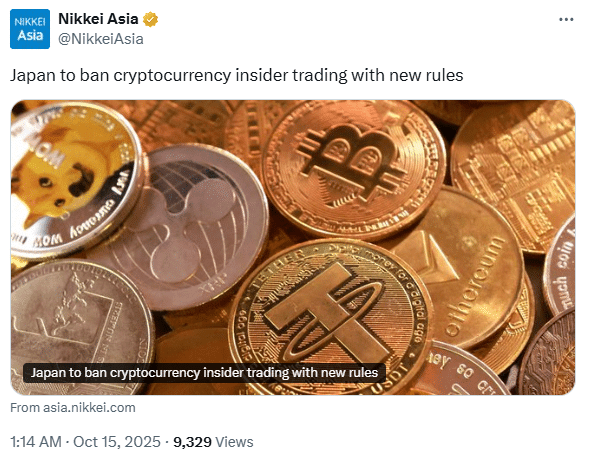
Japan plans new regulations to stamp out crypto insider trading. A law enforcement agency in the country, the Securities and Exchange Surveillance Commission (SESC), is to have new powers of crypto trading investigation.

Currently, no laws apply to crypto insider trading in FIEA. This void left the space open for regulation.

Japan’s Crypto Regulation

The Japan Virtual and Crypto Assets Exchange Association (JVCEA), which self-regulates crypto exchanges, lacks the tools to detect insider trading. This is why the government is taking steps to tighten the rules.

The Financial Services Agency (FSA), which oversees the SESC, will form a working group to discuss a new regulatory framework. They aim to submit an amendment to the FIEA by next year, bringing cryptocurrencies under the same rules as stocks and bonds.
Crypto Insider Trading

Source: X

Insider Trading in Crypto: A Growing Concern

The rise of cryptocurrency in Japan has sparked an urgent need for clear regulations. As of August 2025, Japan has 7.88 million active cryptocurrency accounts, an increase of 400% over the past five years. 

Also Read: Japan to Secure Cryptocurrencies as Legal Financial Products

Crypto insider trading poses unique challenges. Many tokens lack identifiable issuers, making it hard to define who qualifies as an insider. This makes detecting and penalizing insider trading in the crypto market more difficult compared to traditional stock trading.

Proposed Regulatory Changes to Address Crypto Insider Trading

The SESC is aiming to modify the Financial Instruments and Exchange Act to make room for crypto in insider trading laws. The new rule would be the first time the regulation expressly applies to insider trading on nondisclosed information.

Under the recommendations, the FSA would be able to provide specific guidance on what amounts to insider dealing. Such regulations would help prevent the problem of crypto insider trading in a digital age and make it clearer for crypto investors.

Challenges in Regulating Crypto Insider Trading

As opposed to traditional financial instruments, crypto assets are frequently decentralized. It’s hard to figure out what insider trading looks like when there isn’t a clear issuer for a lot of these tokens.

Japan’s regulatory agency is still coming to grips with insider trading in the crypto sector. The country certainly has lots of experience monitoring stock markets, but it is far less clear about crypto: The market remains something of the Wild West.

FSA’s Push to Reclassify Crypto Assets

New crypto insider trading rules are set to be introduced, along with the possibility of Japan’s Financial Services Agency classifying cryptocurrencies as financial products. This change would put crypto subject to the FIEA, similar to how stocks and bonds are regulated.

Japan crypto market oversight

Reclassifying crypto could reduce to a maximum of 20% the capital gains tax digital assets are subject to, down from as much as 55%, Holger Zschaepitz explains. It would benefit crypto by making it more appealing to investors, and bring Japan’s tax policy in line with international norms.

Political Momentum for Crypto Regulation

A supporter is rising Key political figure Sanae Takaichi could bring new momentum to the regulation of the crypto asset industry in Japan. The former has openly called for technology sovereignty to be a high government priority.

She is also supportive of lower interest rates and tax cuts, moves that might see yet more capital pour into Japan’s crypto sphere. The policies of Takaichi could aid in solidifying Japan as the world’s capital for cryptocurrency regulation.

Benefits of Strengthening Crypto Oversight

There are a number of persistent problems in the cryptocurrency space that the new regulatory structure would be designed to tackle. These are misleading statements, unregistered activity, and security issues. 

Policies that are transparent can help investors trade the crypto market with more assurance. Exchanges would also have to abide by tighter rules to prevent fraud and market manipulation.

Conclusion

Japan is making significant strides in regulating its crypto market. The country’s approach to crypto insider trading will likely set a precedent for other nations looking to address similar issues.

In associating crypto with traditional investment vehicles, Japan is demonstrating its resolve to create a safe and transparent marketplace. This is also an attempt to ensure a fair and transparent crypto ecosystem.

Also Read: Ripple Funds Japan’s Web3 Future: $200K Grants Aim to Ignite XRP Ledger

Summary

Japan to combat crypto insider trading with new regulation, aiming for digital currency to be on par with traditional securities. The SESC will receive renewed authority to investigate and sanction violations, with the goal of promoting greater market transparency and safety.

The FSA is also said to weigh the recategorization of cryptocurrencies under the Financial Instruments and Exchange Act, meaning they would become subject to lower capital gains taxes in exchange for better protection of investors. 

Appendix: Glossary of Key Terms

Crypto Insider Trading: Illegal practice of trading cryptocurrencies based on non-public information.

Financial Instruments and Exchange Act (FIEA): Japanese law governing securities and financial markets.

Securities and Exchange Surveillance Commission (SESC): Regulatory body responsible for overseeing financial markets in Japan.

Financial Services Agency (FSA): Government agency responsible for overseeing Japan’s financial market regulations.

Capital Gains Tax: Tax on profits from the sale of assets like crypto.

Japan Virtual and Crypto Assets Exchange Association (JVCEA): Self-regulatory body overseeing crypto exchanges in Japan.

Frequently Asked Questions Crypto Insider Trading

1: What is Japan’s stance on crypto insider trading?

Japan is set to introduce regulations to ban and penalize insider trading in the crypto market, bringing it in line with traditional stock market rules.

2: How will the new regulations impact investors?

The new rules aim to protect investors by creating a more transparent and secure crypto market. Insider trading will be punished, making it safer for people to invest.

3: What changes are proposed for crypto taxation in Japan?

The FSA plans to reclassify cryptocurrencies as financial products under the FIEA. This could lower the capital gains tax on crypto to a maximum of 20%.

4: How does insider trading in crypto differ from stock trading?

Insider trading in crypto is harder to detect because many tokens lack identifiable issuers. This makes it more challenging to define who qualifies as an insider.

Read More: Japan to Combat Crypto Insider Trading with New Regulations: Report">Japan to Combat Crypto Insider Trading with New Regulations: Report


Market Opportunity
Spacecoin Logo
Spacecoin Price(SPACE)
$0.01688
$0.01688$0.01688
+68.80%
USD
Spacecoin (SPACE) Live Price Chart
Disclaimer: The articles reposted on this site are sourced from public platforms and are provided for informational purposes only. They do not necessarily reflect the views of MEXC. All rights remain with the original authors. If you believe any content infringes on third-party rights, please contact service@support.mexc.com for removal. MEXC makes no guarantees regarding the accuracy, completeness, or timeliness of the content and is not responsible for any actions taken based on the information provided. The content does not constitute financial, legal, or other professional advice, nor should it be considered a recommendation or endorsement by MEXC.

You May Also Like

House Judiciary Rejects Vote To Subpoena Banks CEOs For Epstein Case

House Judiciary Rejects Vote To Subpoena Banks CEOs For Epstein Case

The post House Judiciary Rejects Vote To Subpoena Banks CEOs For Epstein Case appeared on BitcoinEthereumNews.com. Topline House Judiciary Committee Republicans blocked a Democrat effort Wednesday to subpoena a group of major banks as part of a renewed investigation into late sex offender Jeffrey Epstein’s financial ties. Congressman Jim Jordan, R-OH, is the chairman of the committee. (Photo by Nathan Posner/Anadolu via Getty Images) Anadolu via Getty Images Key Facts A near party-line vote squashed the effort to vote on a subpoena, with Rep. Thomas Massie, R-Ky., who is leading a separate effort to force the Justice Department to release more Epstein case materials, voting alongside Democrats. The vote, if successful, would have resulted in the issuing of subpoenas to JPMorgan Chase CEO Jamie Dimon, Bank of America CEO Brian Moynihan, Deutsche Bank CEO Christian Sewing and Bank of New York Mellon CEO Robin Vince. The subpoenas would have specifically looked into multiple reports that claimed the four banks flagged $1.5 billion in suspicious transactions linked to Epstein. The failed effort from Democrats followed an FBI oversight hearing in which agency director Kash Patel misleadingly claimed the FBI cannot release many of the files it has on Epstein. Get Forbes Breaking News Text Alerts: We’re launching text message alerts so you’ll always know the biggest stories shaping the day’s headlines. Text “Alerts” to (201) 335-0739 or sign up here. Crucial Quote Dimon, who attended a lunch with Senate Republicans before the vote, according to Politico, told reporters, “We regret any association with that man at all. And, of course, if it’s a legal requirement, we would conform to it. We have no issue with that.” Chief Critic “Republicans had the chance to subpoena the CEOs of JPMorgan, Bank of America, Deutsche Bank, and Bank of New York Mellon to expose Epstein’s money trail,” the House Judiciary Democrats said in a tweet. “Instead, they tried to bury…
Share
BitcoinEthereumNews2025/09/18 08:02
Polygon Tops RWA Rankings With $1.1B in Tokenized Assets

Polygon Tops RWA Rankings With $1.1B in Tokenized Assets

The post Polygon Tops RWA Rankings With $1.1B in Tokenized Assets appeared on BitcoinEthereumNews.com. Key Notes A new report from Dune and RWA.xyz highlights Polygon’s role in the growing RWA sector. Polygon PoS currently holds $1.13 billion in RWA Total Value Locked (TVL) across 269 assets. The network holds a 62% market share of tokenized global bonds, driven by European money market funds. The Polygon POL $0.25 24h volatility: 1.4% Market cap: $2.64 B Vol. 24h: $106.17 M network is securing a significant position in the rapidly growing tokenization space, now holding over $1.13 billion in total value locked (TVL) from Real World Assets (RWAs). This development comes as the network continues to evolve, recently deploying its major “Rio” upgrade on the Amoy testnet to enhance future scaling capabilities. This information comes from a new joint report on the state of the RWA market published on Sept. 17 by blockchain analytics firm Dune and data platform RWA.xyz. The focus on RWAs is intensifying across the industry, coinciding with events like the ongoing Real-World Asset Summit in New York. Sandeep Nailwal, CEO of the Polygon Foundation, highlighted the findings via a post on X, noting that the TVL is spread across 269 assets and 2,900 holders on the Polygon PoS chain. The Dune and https://t.co/W6WSFlHoQF report on RWA is out and it shows that RWA is happening on Polygon. Here are a few highlights: – Leading in Global Bonds: Polygon holds 62% share of tokenized global bonds (driven by Spiko’s euro MMF and Cashlink euro issues) – Spiko U.S.… — Sandeep | CEO, Polygon Foundation (※,※) (@sandeepnailwal) September 17, 2025 Key Trends From the 2025 RWA Report The joint publication, titled “RWA REPORT 2025,” offers a comprehensive look into the tokenized asset landscape, which it states has grown 224% since the start of 2024. The report identifies several key trends driving this expansion. According to…
Share
BitcoinEthereumNews2025/09/18 00:40
transcosmos helping Chinese lingerie brand LING LINGERIE’s full-fledged entry into Japan

transcosmos helping Chinese lingerie brand LING LINGERIE’s full-fledged entry into Japan

Executing strategies to help LING LINGERIE, a Chinese brand meeting Gen Z needs, boost awareness TOKYO, Jan. 23, 2026 /PRNewswire/ — transcosmos today announced
Share
AI Journal2026/01/23 19:30