Dockerized Android is a modular framework that enables Android emulation and control within Docker containers. Its architecture consists of two main layers: the Core, which handles device emulation, networking, and backend operations; and the UI, a React-based frontend that connects via NGINX to the Core for device interaction. Through components like ADB, VNC, and Node.js APIs, it offers a flexible, browser-accessible environment for testing, security research, and automation.Dockerized Android is a modular framework that enables Android emulation and control within Docker containers. Its architecture consists of two main layers: the Core, which handles device emulation, networking, and backend operations; and the UI, a React-based frontend that connects via NGINX to the Core for device interaction. Through components like ADB, VNC, and Node.js APIs, it offers a flexible, browser-accessible environment for testing, security research, and automation.

Dockerized Android Architecture

2025/10/16 05:30
5 min read
For feedback or concerns regarding this content, please contact us at crypto.news@mexc.com

:::info Authors:

(1) Daniele Capone, SecSI srl, Napoli, Italy (daniele.capone@secsi.io);

(2) Francesco Caturano, Dept. of Electrical Engineering and Information, Technology University of Napoli Federico II, Napoli, Italy (francesco.caturano@unina.i)

(3) Angelo Delicato, SecSI srl, Napoli, Italy (angelo.delicato@secsi.io);

(4) Gaetano Perrone, Dept. of Electrical Engineering and Information Technology, University of Napoli Federico II, Napoli, Italy (gaetano.perrone@unina.it)

(5) Simon Pietro Romano, Dept. of Electrical Engineering and Information Technology, University of Napoli Federico II, Napoli, Italy (spromano@unina.it).

:::

Abstract and I. Introduction

II. Related Work

III. Dockerized Android: Design

IV. Dockerized Android Architecture

V. Evaluation

VI. Conclusion and Future Developments, and References

IV. DOCKERIZED ANDROID ARCHITECTURE

This section shows the architecture of Dockerized Android. Fig. 1 provides a high-level view of the Dockerized Android platform that allows identifying the key components it comprises:

\ • Android Mobile Component: is the Android system accessible from the other components. It can be indifferently an emulated device or a real one connected to the machine hosting the container (through a cable or wireless). This component has to provide all of the features related to the Android OS itself, but also the hardware components that can be simulated (like the GPS or the microphone through the integration of an external device);

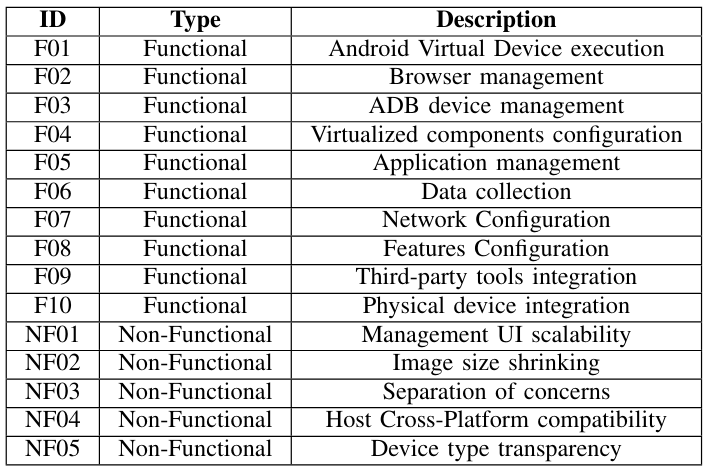
\ TABLE IIDESIGN REQUIREMENTS
\ Fig. 1. Overall Architecture, resources from flaticon.com [18]

\ • adb: is the well-known Android Debug Bridge allowing to control an Android system (either an emulated one or a real one) through a command-line interface. This component allows having a shell on the device, configure options, install applications, etc. It has to be externally accessible to provide a higher level of configuration and increase the end-user experience as well;

\ • Screen Sharing: the goal of this component is to provide a server that can be used by another component in order to give the user a simpler way to access and control the mobile device;

\ • Custom API: as several features are integrated into the system, this component provides access to the external tools with a uniform interface that hides the underlying cumbersome integration mechanisms;

\ • Management UI: is the application front-end that can be accessed by the user to control the mobile device and enable the other features provided by the platform; The UI uses the VNC (Virtual Network Computing) component to let the user control the device through a web browser, the abd component to provide a shell to interact with the device in a more advanced way, and the Custom API to provide access to other features effortless;

\ • Extra Tools: this component encloses the external tools used to add further features to the platform.

\ Fig. 2 shows a in-depth view of the modules implemented in the framework: The architecture can be divided into two parts:

\ Fig. 2. Dockerized Android detailed architecture
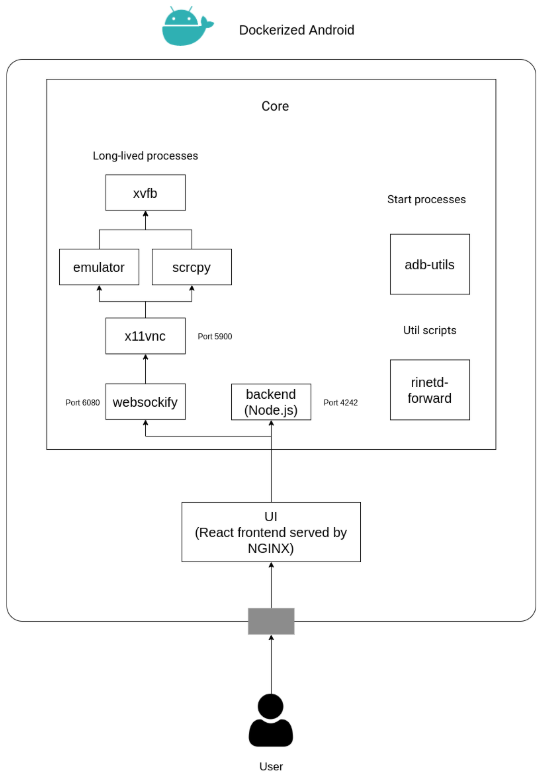
\ • Core: executes all the processes needed to run an Android Component (Emulated or Real) inside a Docker container, also exposing some features to the outside.

\ • UI: gives the user a UI to access the Core component in a simpler way through a web browser.

\ The Core component is composed of several modules that execute “long-lived processes” (i.e., processes that offer several functionalities along with all the Dockerized Android execution), “start processes” (i.e., processes executed during the framework’s bootstrap phase), and “utility scripts”. The internal modules implement several features:

\ • xvdb, srcpy, and x11vnc modules simulate a real display and synchronize the device’s monitor with a virtual X server in the host system (i.e., the computer system that executes Dockerized Android).

\ • The websockify module converts the VNC communication protocol used by x11vnc to Web Socket network protocol; in this way, it is possible to view the mobile’s screen through a Web browser.

\ • The emulator component manages the Android Virtual Device that emulates the mobile device when an emulated device is used.

\ • The backend module written in Node.js implements an extendible interface that allows adding cyber-range focused features, such as the dispatch of a malicious SMS or e-mail to simulate phishing attacks.

\ • The adb-utils module implements several utility scripts that use the ADB tool for implementing other functionality, such as the installation of vulnerable Android applications or instruments the mobile device with mobile security toolkits, such as Frida [19].

\ • The rinetd-forward module manages the emulator’s port forwarding by enabling the network communication between all the components.

\ The UI component is composed of a React Frontend and is served through an NGINX server. The UI is developed using the most recent features provided by the React framework, like Hooks and Context, in order to follow the principle of strong cohesion and loose coupling. The UI provides a simple way to use all the features exposed by the backend and also adds the ability to display and control the device. The user has to manually insert the address of the Core component and the corresponding ports (the port exposed by the backend and the port exposed by websockify. Fig. 3 shows the most interesting Dockerized Android user interface view.

\ The implementation of the above-mentioned architecture is publicly accessible on GitHub [20].

\

:::info This paper is available on arxiv under CC by-SA 4.0 Deed (Attribution-Sahrealike 4.0 International license.

:::

\

Disclaimer: The articles reposted on this site are sourced from public platforms and are provided for informational purposes only. They do not necessarily reflect the views of MEXC. All rights remain with the original authors. If you believe any content infringes on third-party rights, please contact crypto.news@mexc.com for removal. MEXC makes no guarantees regarding the accuracy, completeness, or timeliness of the content and is not responsible for any actions taken based on the information provided. The content does not constitute financial, legal, or other professional advice, nor should it be considered a recommendation or endorsement by MEXC.

You May Also Like

Here’s How Consumers May Benefit From Lower Interest Rates

Here’s How Consumers May Benefit From Lower Interest Rates

The post Here’s How Consumers May Benefit From Lower Interest Rates appeared on BitcoinEthereumNews.com. Topline The Federal Reserve on Wednesday opted to ease interest rates for the first time in months, leading the way for potentially lower mortgage rates, bond yields and a likely boost to cryptocurrency over the coming weeks. Average long-term mortgage rates dropped to their lowest levels in months ahead of the central bank’s policy shift. Copyright{2018} The Associated Press. All rights reserved. Key Facts The central bank’s policymaking panel voted this week to lower interest rates, which have sat between 4.25% and 4.5% since December, to a new range of 4% and 4.25%. How Will Lower Interest Rates Impact Mortgage Rates? Mortgage rates tend to fall before and during a period of interest rate cuts: The average 30-year fixed-rate mortgage dropped to 6.35% from 6.5% last week, the lowest level since October 2024, mortgage buyer Freddie Mac reported. Borrowing costs on 15-year fixed-rate mortgages also dropped to 5.5% from 5.6% as they neared the year-ago rate of 5.27%. When the Federal Reserve lowered the funds rate to between 0% and 0.25% during the pandemic, 30-year mortgage rates hit record lows between 2.7% and 3% by the end of 2020, according to data published by Freddie Mac. Consumers who refinanced their mortgages in 2020 saved about $5.3 billion annually as rates dropped, according to the Consumer Financial Protection Bureau. Similarly, mortgage rates spiked around 7% as interest rates were hiked in 2022 and 2023, though mortgage rates appeared to react within weeks of the Fed opting to cut or raise rates. How Do Treasury Bonds Respond To Lower Interest Rates? Long-term Treasury yields are more directly influenced by interest rates, as lower rates tend to result in lower yields. When the Fed pushed rates to near zero during the pandemic, 10-year Treasury yields fell to an all-time low of 0.5%. As…
Share
BitcoinEthereumNews2025/09/18 05:59
Tunis–Carthage Airport Expansion Targets Capacity Surge

Tunis–Carthage Airport Expansion Targets Capacity Surge

Tunisia’s Tunis–Carthage airport expansion is set to transform the country’s aviation capacity as authorities plan a $1 billion investment to significantly increase
Share
Furtherafrica2026/03/10 13:00
Hoskinson to Attend Senate Roundtable on Crypto Regulation

Hoskinson to Attend Senate Roundtable on Crypto Regulation

The post Hoskinson to Attend Senate Roundtable on Crypto Regulation appeared on BitcoinEthereumNews.com. Hoskinson confirmed for Senate roundtable on U.S. crypto regulation and market structure. Key topics include SEC vs CFTC oversight split, DeFi regulation, and securities rules. Critics call the roundtable slow, citing Trump’s 2025 executive order as faster. Cardano founder Charles Hoskinson has confirmed that he will attend the Senate Banking Committee roundtable on crypto market structure legislation.  Hoskinson left a hint about his attendance on X while highlighting Journalist Eleanor Terrett’s latest post about the event. Crypto insiders will meet with government officials Terrett shared information gathered from some invitees to the event, noting that a group of leaders from several major cryptocurrency establishments would attend the event. According to Terrett, the group will meet with the Senate Banking Committee leadership in a roundtable to continue talks on market structure regulation. Meanwhile, Terrett noted that the meeting will be held on Thursday, September 18, following an industry review of the committee’s latest approach to distinguishing securities from commodities, DeFi treatment, and other key issues, which has lasted over one week.  Related: Senate Draft Bill Gains Experts’ Praise for Strongest Developer Protections in Crypto Law Notably, the upcoming roundtable between US legislators and crypto industry leaders is a continuation of the process of regularising cryptocurrency regulation in the United States. It is part of the Donald Trump administration’s efforts to provide clarity in the US cryptocurrency ecosystem, which many crypto supporters consider a necessity for the digital asset industry. Despite the ongoing process, some crypto users are unsatisfied with how the US government is handling the issue, particularly the level of bureaucracy involved in creating a lasting cryptocurrency regulatory framework. One such user criticized the process, describing it as a “masterclass in bureaucratic foot-dragging.” According to the critic, America is losing ground to nations already leading in blockchain innovation. He cited…
Share
BitcoinEthereumNews2025/09/18 06:37