SEC Chair Paul Atkins has acknowledged that the U.S. is ’10 Years Behind’ in crypto regulation and pledges to fast-track crypto progress. According to him, “The crypto aspect is our job one,” marking it as a priority for the regulatory body. During the DC Fintech Week event at Amazon HQ on Wednesday, Atkins stated that the SEC intends to build a robust framework to bring back industry participants who may have left the country, enabling innovation to flourish. Atkins Vows to Fast-Track U.S. Crypto Progress “I like to say that we’re the securities and innovation commission now,” he added.Source: YouTube When asked how regulatory bodies support innovation, Atkins responded that the past approach to the digital asset industry had been somewhat disingenuous, but confirmed the situation has changed. The SEC is now working full-time on crypto regulation and will introduce an “innovation exemption” to permit experimentation with new ideas. “We at SEC with respect to our statutes have pretty broad authority for exemptions to be made, and so I think we can be, you know, very forward-leaning in that in order to accommodate new ideas,” he said. “And if the ideas are not good, the free market reaction would tell.” He noted that the crypto industry benefits from having pro-crypto executives at the SEC, like “crypto mama,” whose understanding of the space helps the agency embrace innovation. He emphasized that crypto is the agency’s top priority to close the 10-year gap created by previous regulatory approaches. When questioned about tokenization and real-world assets, Atkins replied that tokenization is essential because blockchain technology is the most exciting aspect of crypto. “Tokenization is not necessarily the numerous crypto coins as many would come and go, but I think putting things on-chain presents huge potential benefits for the financial industry and elsewhere.” He added that blockchain’s transparency makes it incredibly powerful for solving compliance issues. The 1946 Howey Test Struggles With Modern Crypto Atkins’ comments have renewed attention on how existing securities laws, particularly the Securities Act of 1933 and the Securities Exchange Act of 1934, apply to digital assets. Under the 1933 Act, any asset classified as a “security” must be registered with the SEC unless an exemption applies. The 1934 Act extends oversight to secondary markets, regulating broker-dealers, exchanges, and market manipulation. The classification question often depends on the Howey Test, a 1946 Supreme Court standard determining whether a transaction constitutes an “investment contract.”Source: Kyrian Alex The SEC has used this test to pursue enforcement actions against token issuers like Ripple and Coinbase, arguing that many crypto offerings meet these criteria. However, the test’s application to decentralized networks remains disputed. Critics argue that blockchain tokens, which can power networks, enable governance, or represent stable value, don’t fit neatly into the traditional definition of a security. SEC’s Innovation Exemption Coming by Year-End Atkins acknowledged that the regulatory lag is hurting U.S. competitiveness, as jurisdictions like the UAE and Singapore advance clearer digital asset frameworks. He hinted at moving away from the agency’s enforcement-first strategy toward a more collaborative framework balancing investor protection with innovation. This may include expanding no-action letters and closer coordination with the CFTC and the Treasury Department. In September, Atkins said the SEC is working closely with Congress to provide technical support on securities law. “We want to see this get over the finish line,” he said, pointing to the GENIUS Act’s passage, which gave statutory recognition to stablecoins, as evidence of growing momentum. Speaking on Fox Business, Atkins confirmed that by year-end, the agency intends to roll out an “innovation exemption” designed to let crypto firms bring new products to market without immediately facing burdensome requirementsSEC Chair Paul Atkins has acknowledged that the U.S. is ’10 Years Behind’ in crypto regulation and pledges to fast-track crypto progress. According to him, “The crypto aspect is our job one,” marking it as a priority for the regulatory body. During the DC Fintech Week event at Amazon HQ on Wednesday, Atkins stated that the SEC intends to build a robust framework to bring back industry participants who may have left the country, enabling innovation to flourish. Atkins Vows to Fast-Track U.S. Crypto Progress “I like to say that we’re the securities and innovation commission now,” he added.Source: YouTube When asked how regulatory bodies support innovation, Atkins responded that the past approach to the digital asset industry had been somewhat disingenuous, but confirmed the situation has changed. The SEC is now working full-time on crypto regulation and will introduce an “innovation exemption” to permit experimentation with new ideas. “We at SEC with respect to our statutes have pretty broad authority for exemptions to be made, and so I think we can be, you know, very forward-leaning in that in order to accommodate new ideas,” he said. “And if the ideas are not good, the free market reaction would tell.” He noted that the crypto industry benefits from having pro-crypto executives at the SEC, like “crypto mama,” whose understanding of the space helps the agency embrace innovation. He emphasized that crypto is the agency’s top priority to close the 10-year gap created by previous regulatory approaches. When questioned about tokenization and real-world assets, Atkins replied that tokenization is essential because blockchain technology is the most exciting aspect of crypto. “Tokenization is not necessarily the numerous crypto coins as many would come and go, but I think putting things on-chain presents huge potential benefits for the financial industry and elsewhere.” He added that blockchain’s transparency makes it incredibly powerful for solving compliance issues. The 1946 Howey Test Struggles With Modern Crypto Atkins’ comments have renewed attention on how existing securities laws, particularly the Securities Act of 1933 and the Securities Exchange Act of 1934, apply to digital assets. Under the 1933 Act, any asset classified as a “security” must be registered with the SEC unless an exemption applies. The 1934 Act extends oversight to secondary markets, regulating broker-dealers, exchanges, and market manipulation. The classification question often depends on the Howey Test, a 1946 Supreme Court standard determining whether a transaction constitutes an “investment contract.”Source: Kyrian Alex The SEC has used this test to pursue enforcement actions against token issuers like Ripple and Coinbase, arguing that many crypto offerings meet these criteria. However, the test’s application to decentralized networks remains disputed. Critics argue that blockchain tokens, which can power networks, enable governance, or represent stable value, don’t fit neatly into the traditional definition of a security. SEC’s Innovation Exemption Coming by Year-End Atkins acknowledged that the regulatory lag is hurting U.S. competitiveness, as jurisdictions like the UAE and Singapore advance clearer digital asset frameworks. He hinted at moving away from the agency’s enforcement-first strategy toward a more collaborative framework balancing investor protection with innovation. This may include expanding no-action letters and closer coordination with the CFTC and the Treasury Department. In September, Atkins said the SEC is working closely with Congress to provide technical support on securities law. “We want to see this get over the finish line,” he said, pointing to the GENIUS Act’s passage, which gave statutory recognition to stablecoins, as evidence of growing momentum. Speaking on Fox Business, Atkins confirmed that by year-end, the agency intends to roll out an “innovation exemption” designed to let crypto firms bring new products to market without immediately facing burdensome requirements

“We’re 10 Years Behind”, SEC Chair Vows to Fast-Track U.S. Crypto Progress

SEC Chair Paul Atkins has acknowledged that the U.S. is ’10 Years Behind’ in crypto regulation and pledges to fast-track crypto progress.

According to him, “The crypto aspect is our job one,” marking it as a priority for the regulatory body.

During the DC Fintech Week event at Amazon HQ on Wednesday, Atkins stated that the SEC intends to build a robust framework to bring back industry participants who may have left the country, enabling innovation to flourish.

Atkins Vows to Fast-Track U.S. Crypto Progress

“I like to say that we’re the securities and innovation commission now,” he added.
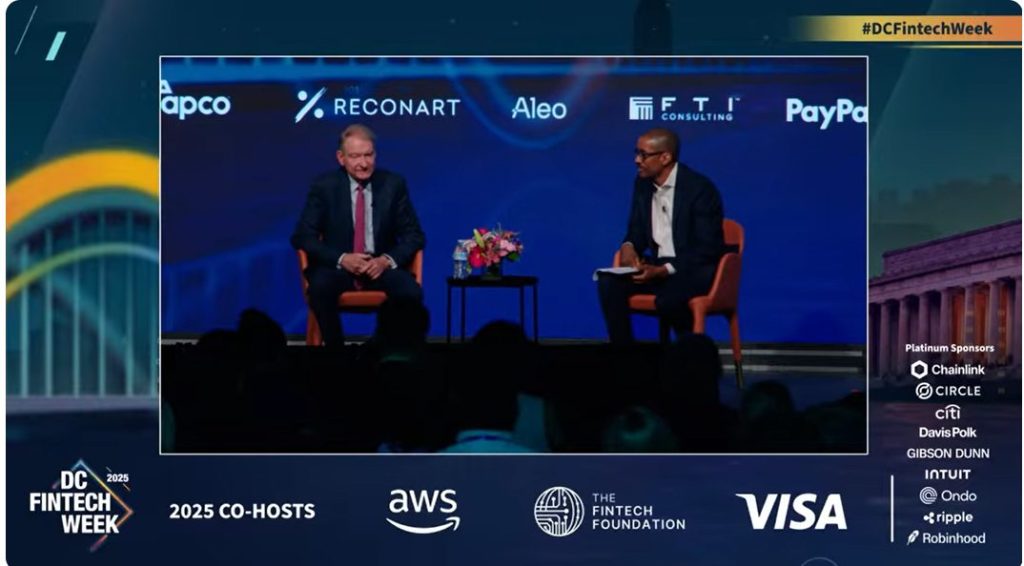
“We’re 10 Years Behind”, SEC Chair Vows to Fast-Track U.S. Crypto ProgressSource: YouTube

When asked how regulatory bodies support innovation, Atkins responded that the past approach to the digital asset industry had been somewhat disingenuous, but confirmed the situation has changed.

The SEC is now working full-time on crypto regulation and will introduce an “innovation exemption” to permit experimentation with new ideas.

“We at SEC with respect to our statutes have pretty broad authority for exemptions to be made, and so I think we can be, you know, very forward-leaning in that in order to accommodate new ideas,” he said.

“And if the ideas are not good, the free market reaction would tell.”

He noted that the crypto industry benefits from having pro-crypto executives at the SEC, like “crypto mama,” whose understanding of the space helps the agency embrace innovation.

He emphasized that crypto is the agency’s top priority to close the 10-year gap created by previous regulatory approaches.

When questioned about tokenization and real-world assets, Atkins replied that tokenization is essential because blockchain technology is the most exciting aspect of crypto.

“Tokenization is not necessarily the numerous crypto coins as many would come and go, but I think putting things on-chain presents huge potential benefits for the financial industry and elsewhere.”

He added that blockchain’s transparency makes it incredibly powerful for solving compliance issues.

The 1946 Howey Test Struggles With Modern Crypto

Atkins’ comments have renewed attention on how existing securities laws, particularly the Securities Act of 1933 and the Securities Exchange Act of 1934, apply to digital assets.

Under the 1933 Act, any asset classified as a “security” must be registered with the SEC unless an exemption applies.

The 1934 Act extends oversight to secondary markets, regulating broker-dealers, exchanges, and market manipulation.

The classification question often depends on the Howey Test, a 1946 Supreme Court standard determining whether a transaction constitutes an “investment contract.”

“We’re 10 Years Behind”, SEC Chair Vows to Fast-Track U.S. Crypto ProgressSource: Kyrian Alex

The SEC has used this test to pursue enforcement actions against token issuers like Ripple and Coinbase, arguing that many crypto offerings meet these criteria.

However, the test’s application to decentralized networks remains disputed.

Critics argue that blockchain tokens, which can power networks, enable governance, or represent stable value, don’t fit neatly into the traditional definition of a security.

SEC’s Innovation Exemption Coming by Year-End

Atkins acknowledged that the regulatory lag is hurting U.S. competitiveness, as jurisdictions like the UAE and Singapore advance clearer digital asset frameworks.

He hinted at moving away from the agency’s enforcement-first strategy toward a more collaborative framework balancing investor protection with innovation.

This may include expanding no-action letters and closer coordination with the CFTC and the Treasury Department.

In September, Atkins said the SEC is working closely with Congress to provide technical support on securities law.

“We want to see this get over the finish line,” he said, pointing to the GENIUS Act’s passage, which gave statutory recognition to stablecoins, as evidence of growing momentum.

Speaking on Fox Business, Atkins confirmed that by year-end, the agency intends to roll out an “innovation exemption” designed to let crypto firms bring new products to market without immediately facing burdensome requirements.


Market Opportunity
Union Logo
Union Price(U)
$0.002517
$0.002517$0.002517
+1.98%
USD
Union (U) Live Price Chart
Disclaimer: The articles reposted on this site are sourced from public platforms and are provided for informational purposes only. They do not necessarily reflect the views of MEXC. All rights remain with the original authors. If you believe any content infringes on third-party rights, please contact service@support.mexc.com for removal. MEXC makes no guarantees regarding the accuracy, completeness, or timeliness of the content and is not responsible for any actions taken based on the information provided. The content does not constitute financial, legal, or other professional advice, nor should it be considered a recommendation or endorsement by MEXC.

You May Also Like

Ukraine Gains Leverage With Strikes On Russian Refineries

Ukraine Gains Leverage With Strikes On Russian Refineries

The post Ukraine Gains Leverage With Strikes On Russian Refineries appeared on BitcoinEthereumNews.com. Screen captures from a video posted on social media on September 13, 2025. The video claims to show a Ukrainian drone strike on the Novo-Ufa oil refinery in Russia. Social Media Capture Earlier this year, peace negotiations between Russia and Ukraine stalled, with some claiming that Ukraine had entered the talks with “no cards” to play. Since then, Ukraine has strengthened its position, launching a series of successful drone strikes against Russian refineries, eroding one of Russia’s most important sources of revenue. At the same time, Russia is pouring increasing resources into its summer offensive and strategic drone strikes, while achieving minimal results. This combination creates a financially unfavorable situation for the Russians and provides Ukraine with much-needed leverage for the next round of peace negotiations. Ukraine’s Strategic Strikes Against Russian Oil Refineries Throughout this past summer, Ukraine has launched a coordinated series of long-range drone attacks against Russian oil refineries, causing major disruptions to the country’s fuel infrastructure. Reports indicate that more than ten refineries were struck during August, shutting down about 17 percent of Russia’s refining capacity, or approximately 1.1 million barrels per day. Repeated strikes on the Ryazan refinery in the Moscow area and the Novokuibyshevsk refinery in the Samara region disabled several key distillation units. Meanwhile the Volgograd plant in southern Russia had to suspend processing oil after a recent strike. Other refineries across the country have also been targeted. These attacks have continued into September, with additional facilities hit and many struck multiple times. Long-range drones An-196 Liutyi of the Defence Intelligence of Ukraine stand in line before takeoff in undisclosed location, Ukraine, Feb. 28, 2025. (AP Photo/Evgeniy Maloletka) Copyright 2025 The Associated Press. All rights reserved Ukraine’s ability to strike deep targets in Russia stems from advances in its drone industry. Many of these…
Share
BitcoinEthereumNews2025/09/20 16:55
Why Emotional Security Matters as Much as Physical Care for Seniors

Why Emotional Security Matters as Much as Physical Care for Seniors

You ensure that your aging parents or loved ones get the best physical care. Regular checkups, nutritious meals, and safe living conditions are key. These basics
Share
Techbullion2026/01/23 19:54
Wall Street braced for a private credit meltdown. The risk is rising

Wall Street braced for a private credit meltdown. The risk is rising

The post Wall Street braced for a private credit meltdown. The risk is rising appeared on BitcoinEthereumNews.com. The sudden collapse last fall of a string of
Share
BitcoinEthereumNews2026/01/23 20:21