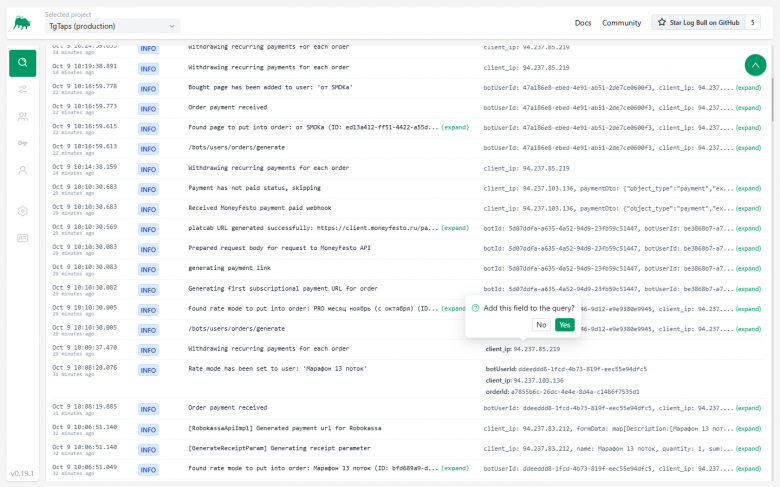
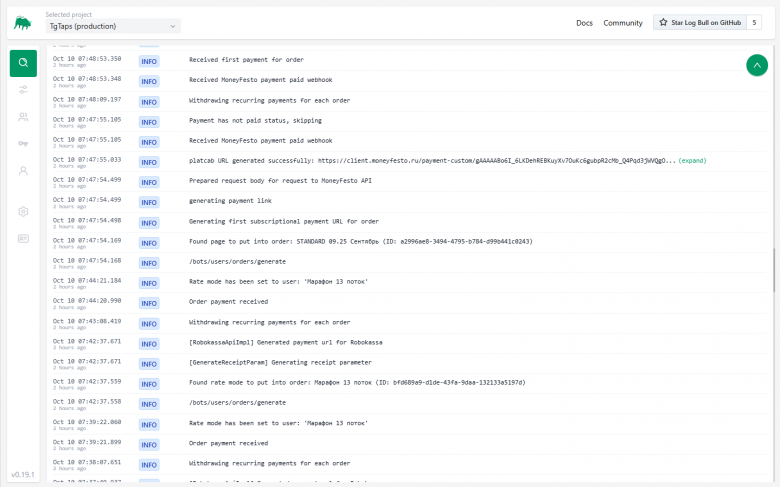
Log Bull is a log collection system with an emphasis on ease of use. It can be deployed via a .sh script, via Docker and via Docker Compose. The project is completely open source under the Apache 2.0 license.Log Bull is a log collection system with an emphasis on ease of use. It can be deployed via a .sh script, via Docker and via Docker Compose. The project is completely open source under the Apache 2.0 license.

ELK, Loki, and Graylog Were Overkill, So I built Log Bull

2025/10/16 23:31

For about five years, I have faced the task of collecting logs, typically from small to medium-sized codebases. Sending logs from code is not a problem: Java and Go have libraries for this practically out of the box. But deploying something to collect them is a headache. I understand that it's a solvable task (even before ChatGPT, and now even more so). Still, all logging systems are primarily geared toward the large enterprise world and its requirements, ~~r~~ather than small teams or single developers with a few sticks, glue, and a “yesterday” deadline.

Launching ELK is a challenge for me every time: a bunch of settings, a non-trivial deployment, and when I enter the UI, my eyes run wild from the tabs. With Loki and Graylog, it's a little easier, but there are still way more features than I need. At the same time, separating logs between projects and adding other users to the system so that they don't see anything they shouldn't, is not the most obvious process either.

So about a year ago, I decided to make my own log collection system. One that is as easy to use and launch as possible. It would be deployed on the server with a single command, without any configuration or unnecessary tabs in the interface. That's how Log Bull came about, and now it's open source: a log collection system for developers with mid-sized projects.

Table of contents:

  • About the project
  • How to deploy Log Bull?
  • How to send logs?
  • How to view logs?
  • Conclusion

About the project

Log Bull is a log collection system with an emphasis on ease of use (minimal configuration, minimal features, zero-config at startup). The project is completely open source under the Apache 2.0 license. My main priority was to create a solution that would allow a junior developer to easily figure out how to start the system, how to send logs to it, and how to view them in about 15 minutes.
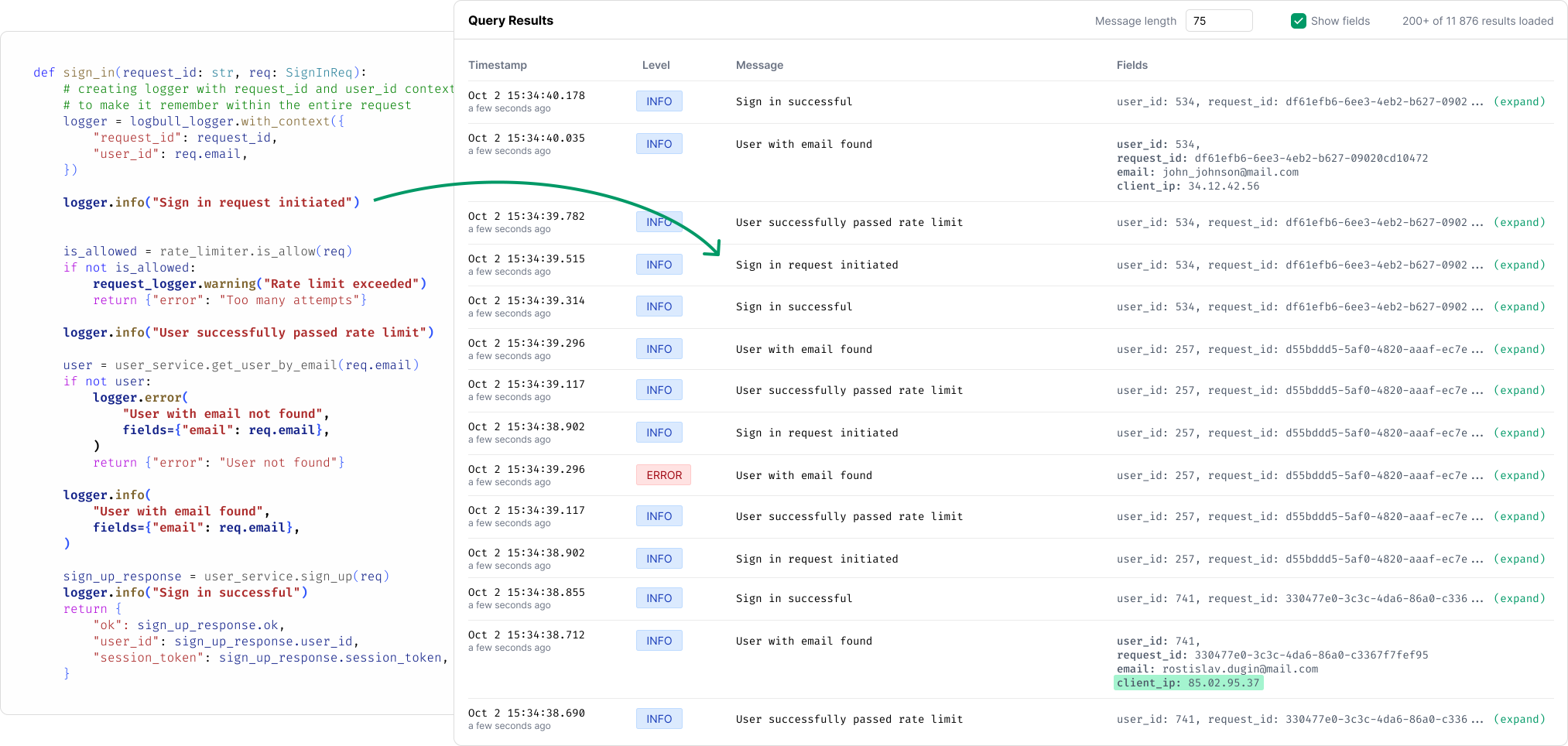
Key features of the project:

  • Deployed with a single command via a .sh script or a Docker command.
  • You can create multiple isolated projects for collecting logs (and add users to them).
  • Extremely simple interface with minimal configuration, and no configuration required at all when starting (zero-config).
  • Libraries for Python, Java, Go, JavaScript (TS \ NodeJS), PHP, C#. Rust and Ruby are planned.
  • Free, open source and self-hosted.
  • No need to know LogQL, Kibana DSL or other query languages to search logs.

https://www.youtube.com/watch?v=8H8jF8nVzJE&embedable=true

The project is developed in Go and built on OpenSearch.

Project website - https://logbull.com

Project GitHub - https://github.com/logbull/logbull

P.S. If you find the project useful and have a GitHub account, please give it a star ⭐️. The first stars are hard to collect. I would be extremely grateful for your support!

How to deploy Log Bull?

There are three ways to deploy a project: via a .sh script (which I recommend), via Docker and via Docker Compose.

Method 1: Installation via script

The script will install Docker, place the project in the /opt/logbull folder, and configure autostart when the system is restarted. Installation command:

sudo apt-get install -y curl && \ sudo curl -sSL https://raw.githubusercontent.com/logbull/logbull/main/install-logbull.sh \ | sudo bash 

Method 2: Launch via Docker Compose

Create file docker-compose.yml with the following content:

services:   logbull:     container_name: logbull     image: logbull/logbull:latest     ports:       - "4005:4005"     volumes:       - ./logbull-data:/logbull-data     restart: unless-stopped     healthcheck:       test: ["CMD", "curl", "-f", "http://localhost:4005/api/v1/system/health"]       interval: 5s       timeout: 5s       retries: 30 

And run the command docker compose up -d. The system will start on port 4005.

Method 3: Launch via Docker command

Run the following command in the terminal (the system will also start on port 4005):

docker run -d \   --name logbull \   -p 4005:4005 \   -v ./logbull-data:/logbull-data \   --restart unless-stopped \   --health-cmd="curl -f http://localhost:4005/api/v1/system/health || exit 1" \   --health-interval=5s \   --health-retries=30 \   logbull/logbull:latest 

How to send logs?

I designed the project with convenience in mind, primarily for developers. That's why I created libraries for most popular development languages. I did this with the idea that Log Bull can be connected to any popular library as a processor without changing the current code base.

I highly recommend checking out the examples on the website, because there is an interactive panel for selecting a language:
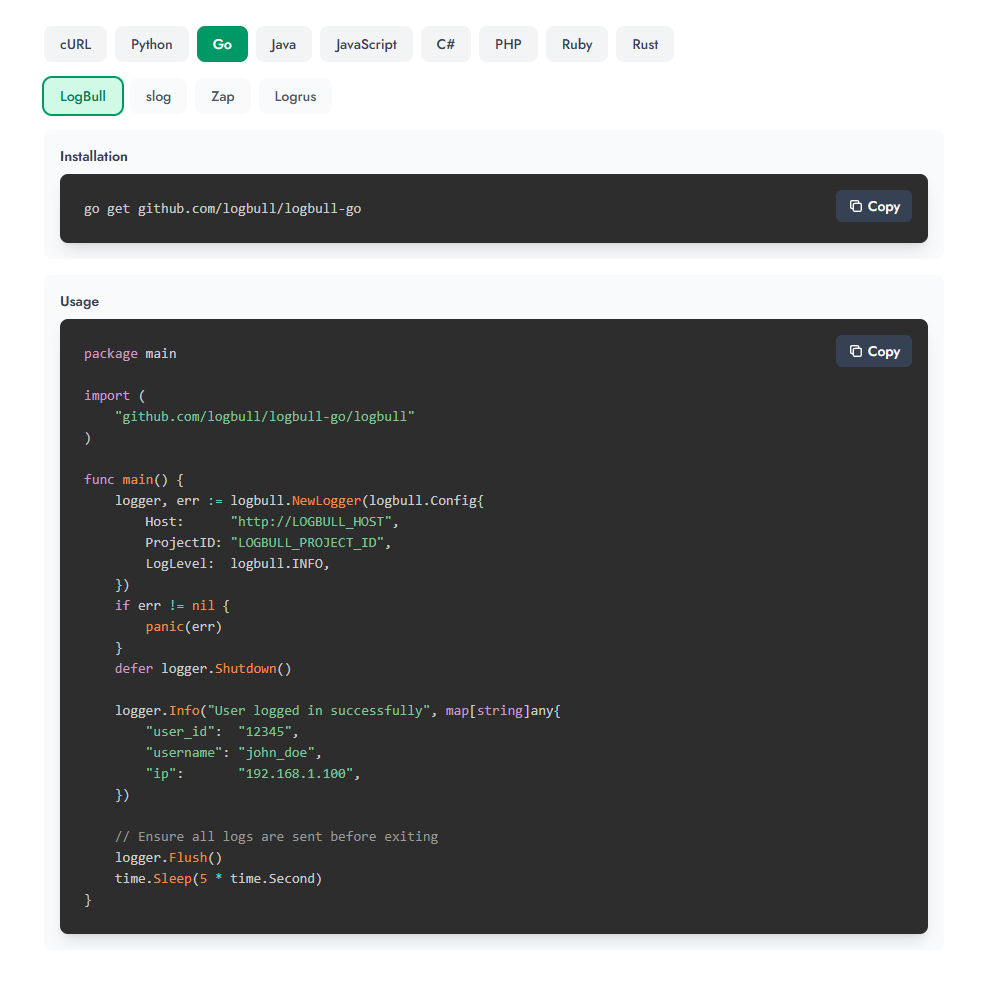
Code examples picler

Let's take Python as an example. First, you need to install the library (although you can also send it via HTTP; there are examples for cURL):

pip install logbull 

Then send from code:

import time from logbull import LogBullLogger  # Initialize logger logger = LogBullLogger(     host="http://LOGBULL_HOST",     project_id="LOGBULL_PROJECT_ID", )  # Log messages (printed to console AND sent to LogBull) logger.info("User logged in successfully", fields={     "user_id": "12345",     "username": "john_doe",     "ip": "192.168.1.100" })  # With context session_logger = logger.with_context({     "session_id": "sess_abc123",     "user_id": "user_456" })  session_logger.info("Processing request", fields={     "action": "purchase" })  # Ensure all logs are sent before exiting logger.flush() time.sleep(5) 

How to view logs?

All logs are displayed immediately on the main screen. You can:

  • Reduce the size of messages (by cutting the line to ~50-100 characters).

  • Expand the list of sent fields (userid, orderid, etc.).

  • Click on a field and add it to the filter. Logs search with conditions:
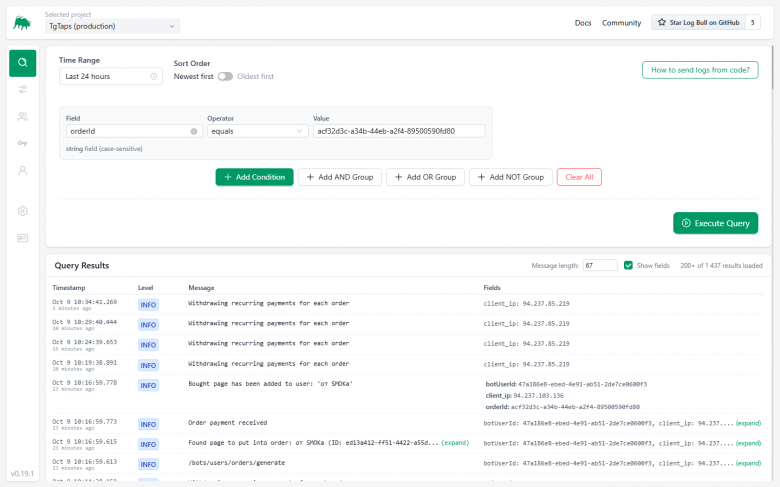
    Logs search with conditions

    Regular logs view

    Viewing messages text only (you can cut extra fields):

You can also collect groups of conditions (for example, the message includes certain text, but excludes a specific server IP address).

Conclusion

I hope my log collection system will be useful to those developers who do not want or cannot (due to limited project resources) implement “heavyweight” solutions such as ELK. I am already using Log Bull in production projects, and everything is going well. I welcome feedback, suggestions for improvement, and issues on GitHub.


Disclaimer: The articles reposted on this site are sourced from public platforms and are provided for informational purposes only. They do not necessarily reflect the views of MEXC. All rights remain with the original authors. If you believe any content infringes on third-party rights, please contact service@support.mexc.com for removal. MEXC makes no guarantees regarding the accuracy, completeness, or timeliness of the content and is not responsible for any actions taken based on the information provided. The content does not constitute financial, legal, or other professional advice, nor should it be considered a recommendation or endorsement by MEXC.

You May Also Like

Fed Decides On Interest Rates Today—Here’s What To Watch For

Fed Decides On Interest Rates Today—Here’s What To Watch For

The post Fed Decides On Interest Rates Today—Here’s What To Watch For appeared on BitcoinEthereumNews.com. Topline The Federal Reserve on Wednesday will conclude a two-day policymaking meeting and release a decision on whether to lower interest rates—following months of pressure and criticism from President Donald Trump—and potentially signal whether additional cuts are on the way. President Donald Trump has urged the central bank to “CUT INTEREST RATES, NOW, AND BIGGER” than they might plan to. Getty Images Key Facts The central bank is poised to cut interest rates by at least a quarter-point, down from the 4.25% to 4.5% range where they have been held since December to between 4% and 4.25%, as Wall Street has placed 100% odds of a rate cut, according to CME’s FedWatch, with higher odds (94%) on a quarter-point cut than a half-point (6%) reduction. Fed governors Christopher Waller and Michelle Bowman, both Trump appointees, voted in July for a quarter-point reduction to rates, and they may dissent again in favor of a large cut alongside Stephen Miran, Trump’s Council of Economic Advisers’ chair, who was sworn in at the meeting’s start on Tuesday. It’s unclear whether other policymakers, including Kansas City Fed President Jeffrey Schmid and St. Louis Fed President Alberto Musalem, will favor larger cuts or opt for no reduction. Fed Chair Jerome Powell said in his Jackson Hole, Wyoming, address last month the central bank would likely consider a looser monetary policy, noting the “shifting balance of risks” on the U.S. economy “may warrant adjusting our policy stance.” David Mericle, an economist for Goldman Sachs, wrote in a note the “key question” for the Fed’s meeting is whether policymakers signal “this is likely the first in a series of consecutive cuts” as the central bank is anticipated to “acknowledge the softening in the labor market,” though they may not “nod to an October cut.” Mericle said he…
Share
BitcoinEthereumNews2025/09/18 00:23
Facts Vs. Hype: Analyst Examines XRP Supply Shock Theory

Facts Vs. Hype: Analyst Examines XRP Supply Shock Theory

Prominent analyst Cheeky Crypto (203,000 followers on YouTube) set out to verify a fast-spreading claim that XRP’s circulating supply could “vanish overnight,” and his conclusion is more nuanced than the headline suggests: nothing in the ledger disappears, but the amount of XRP that is truly liquid could be far smaller than most dashboards imply—small enough, in his view, to set the stage for an abrupt liquidity squeeze if demand spikes. XRP Supply Shock? The video opens with the host acknowledging his own skepticism—“I woke up to a rumor that XRP supply could vanish overnight. Sounds crazy, right?”—before committing to test the thesis rather than dismiss it. He frames the exercise as an attempt to reconcile a long-standing critique (“XRP’s supply is too large for high prices”) with a rival view taking hold among prominent community voices: that much of the supply counted as “circulating” is effectively unavailable to trade. His first step is a straightforward data check. Pulling public figures, he finds CoinMarketCap showing roughly 59.6 billion XRP as circulating, while XRPScan reports about 64.7 billion. The divergence prompts what becomes the video’s key methodological point: different sources count “circulating” differently. Related Reading: Analyst Sounds Major XRP Warning: Last Chance To Get In As Accumulation Balloons As he explains it, the higher on-ledger number likely includes balances that aggregators exclude or treat as restricted, most notably Ripple’s programmatic escrow. He highlights that Ripple still “holds a chunk of XRP in escrow, about 35.3 billion XRP locked up across multiple wallets, with a nominal schedule of up to 1 billion released per month and unused portions commonly re-escrowed. Those coins exist and are accounted for on-ledger, but “they aren’t actually sitting on exchanges” and are not immediately available to buyers. In his words, “for all intents and purposes, that escrow stash is effectively off of the market.” From there, the analysis moves from headline “circulating supply” to the subtler concept of effective float. Beyond escrow, he argues that large strategic holders—banks, fintechs, or other whales—may sit on material balances without supplying order books. When you strip out escrow and these non-selling stashes, he says, “the effective circulating supply… is actually way smaller than the 59 or even 64 billion figure.” He cites community estimates in the “20 or 30 billion” range for what might be truly liquid at any given moment, while emphasizing that nobody has a precise number. That effective-float framing underpins the crux of his thesis: a potential supply shock if demand accelerates faster than fresh sell-side supply appears. “Price is a dance between supply and demand,” he says; if institutional or sovereign-scale users suddenly need XRP and “the market finds that there isn’t enough XRP readily available,” order books could thin out and prices could “shoot on up, sometimes violently.” His phrase “circulating supply could collapse overnight” is presented not as a claim that tokens are destroyed or removed from the ledger, but as a market-structure scenario in which available inventory to sell dries up quickly because holders won’t part with it. How Could The XRP Supply Shock Happen? On the demand side, he anchors the hypothetical to tokenization. He points to the “very early stages of something huge in finance”—on-chain tokenization of debt, stablecoins, CBDCs and even gold—and argues the XRP Ledger aims to be “the settlement layer” for those assets.He references Ripple CTO David Schwartz’s earlier comments about an XRPL pivot toward tokenized assets and notes that an institutional research shop (Bitwise) has framed XRP as a way to play the tokenization theme. In his construction, if “trillions of dollars in value” begin settling across XRPL rails, working inventories of XRP for bridging, liquidity and settlement could rise sharply, tightening effective float. Related Reading: XRP Bearish Signal: Whales Offload $486 Million In Asset To illustrate, he offers two analogies. First, the “concert tickets” model: you think there are 100,000 tickets (100B supply), but 50,000 are held by the promoter (escrow) and 30,000 by corporate buyers (whales), leaving only 20,000 for the public; if a million people want in, prices explode. Second, a comparison to Bitcoin’s halving: while XRP has no programmatic halving, he proposes that a sudden adoption wave could function like a de facto halving of available supply—“XRP’s version of a halving could actually be the adoption event.” He also updates the narrative context that long dogged XRP. Once derided for “too much supply,” he argues the script has “totally flipped.” He cites the current cycle’s optics—“XRP is sitting above $3 with a market cap north of around $180 billion”—as evidence that raw supply counts did not cap price as tightly as critics claimed, and as a backdrop for why a scarcity narrative is gaining traction. Still, he declines to publish targets or timelines, repeatedly stressing uncertainty and risk. “I’m not a financial adviser… cryptocurrencies are highly volatile,” he reminds viewers, adding that tokenization could take off “on some other platform,” unfold more slowly than enthusiasts expect, or fail to get to “sudden shock” scale. The verdict he offers is deliberately bound. The theory that “XRP supply could vanish overnight” is imprecise on its face; the ledger will not erase coins. But after examining dashboard methodologies, escrow mechanics and the behavior of large holders, he concludes that the effective float could be meaningfully smaller than headline supply figures, and that a fast-developing tokenization use case could, under the right conditions, stress that float. “Overnight is a dramatic way to put it,” he concedes. “The change could actually be very sudden when it comes.” At press time, XRP traded at $3.0198. Featured image created with DALL.E, chart from TradingView.com
Share
NewsBTC2025/09/18 11:00