The WormHole algorithm demonstrates that efficient routing in large graphs can be achieved with minimal error and limited queries. By maintaining a sublinear “inner ring” that still contains the Chung–Lu core, WormHole ensures routing paths deviate by at most O(log log n) from the true shortest path, even in worst-case scenarios. The paper further bounds its query complexity under the node query model, proving that high-accuracy results can be obtained with a fraction of the exploration cost.The WormHole algorithm demonstrates that efficient routing in large graphs can be achieved with minimal error and limited queries. By maintaining a sublinear “inner ring” that still contains the Chung–Lu core, WormHole ensures routing paths deviate by at most O(log log n) from the true shortest path, even in worst-case scenarios. The paper further bounds its query complexity under the node query model, proving that high-accuracy results can be obtained with a fraction of the exploration cost.

Understanding Approximation Error and Query Complexity in WormHole Routing

2025/10/16 20:00
2 min read
For feedback or concerns regarding this content, please contact us at crypto.news@mexc.com

Abstract and 1. Introduction

1.1 Our Contribution

1.2 Setting

1.3 The algorithm

  1. Related Work

  2. Algorithm

    3.1 The Structural Decomposition Phase

    3.2 The Routing Phase

    3.3 Variants of WormHole

  3. Theoretical Analysis

    4.1 Preliminaries

    4.2 Sublinearity of Inner Ring

    4.3 Approximation Error

    4.4 Query Complexity

  4. Experimental Results

    5.1 WormHole𝐸, WormHole𝐻 and BiBFS

    5.2 Comparison with index-based methods

    5.3 WormHole as a primitive: WormHole𝑀

References

4.3 Approximation Error

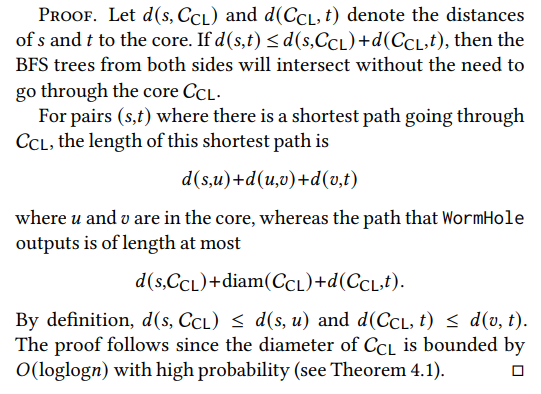
Now that we have a sublinear inner ring that contains the Chung-Lu core, we must show that routing paths through it incurs only a small penalty. Intuitively, the larger the inner ring, the easier this is to satisfy: if the inner ring is the whole graph, the statement holds trivially. Therefore the challenge lies in showing that we can achieve a strong guarantee in terms of accuracy even with a sublinear inner ring. We prove that WormHole incurs an additive error at most 𝑂(loglog𝑛) for all pairs, which is much smaller than the diameter Θ(log𝑛).

\

\ The above result holds with high probability even in the worst case. Namely, for all pairs (𝑠,𝑡) of vertices in the graph, the length of the path returned by WormHole is at most𝑂(loglog𝑛) higher than the actual distance between 𝑠 and 𝑡. This trivially implies that the average additive error of WormHole is, with high probability, bounded by the same amount.

\
\

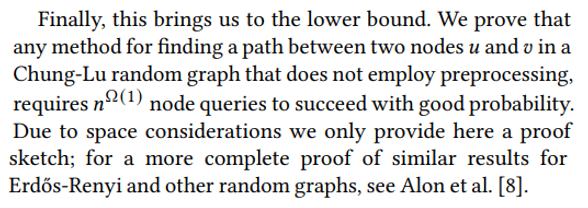
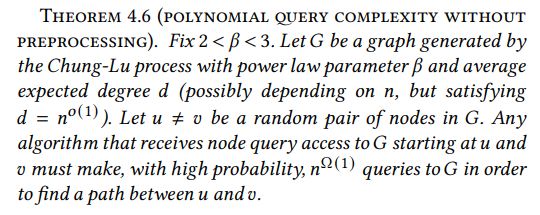
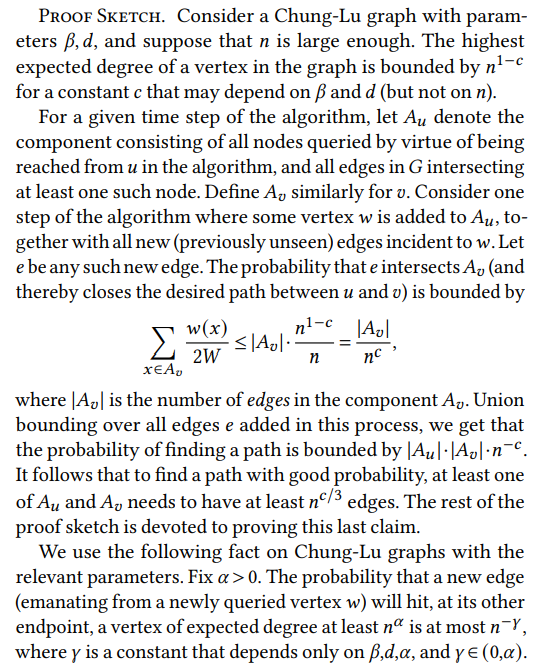
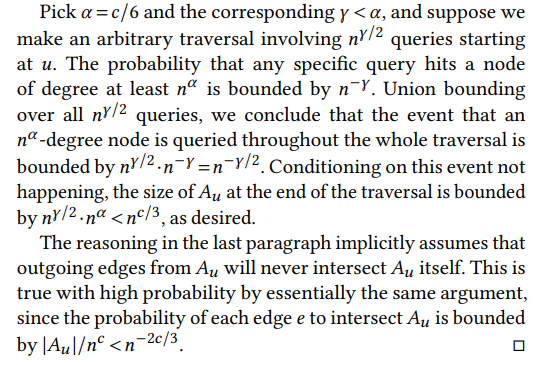
4.4 Query Complexity

Recall the node query model in this paper (see §1.2): starting from a single node, we are allowed to iteratively make queries, where each query retrieves the neighbor list of a node 𝑣 of our choice. We are interested in the query complexity, i.e., the number of queries required to conduct certain operations.

\ \
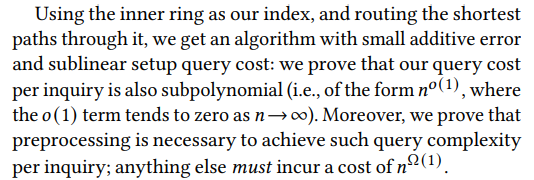
\ \ The first result is the upper bound on our performance.

\ \
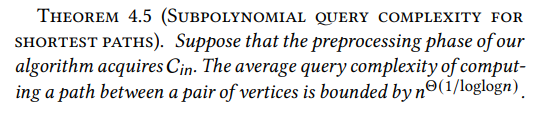
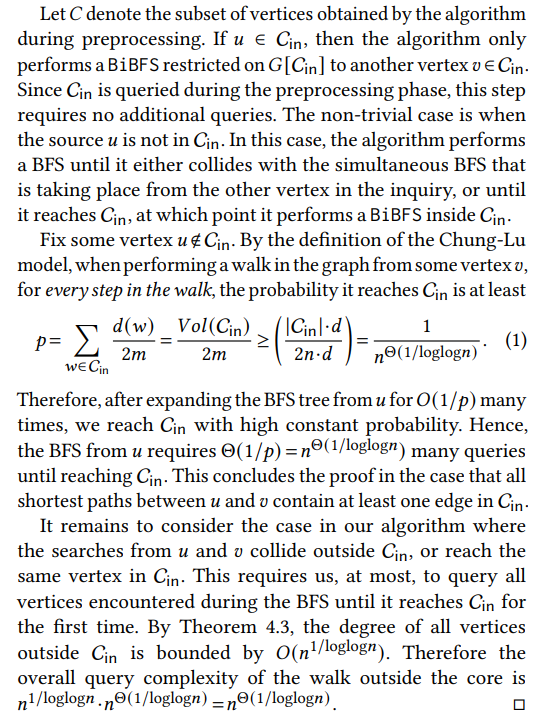
\ \ Proof Sketch. For a given inquiry SP(𝑢, 𝑣), we give an upper bound on the query complexity of the BFS that starts at 𝑢, and similarly for𝑣; the total query complexity is the sum of these two quantities.

\ \
\ \ \
\ \ \
\ \ \
\ \ \
\ \

:::info Authors:

(1) Talya Eden, Bar-Ilan University (talyaa01@gmail.com);

(2) Omri Ben-Eliezer, MIT (omrib@mit.edu);

(3) C. Seshadhri, UC Santa Cruz (sesh@ucsc.edu).

:::


:::info This paper is available on arxiv under CC BY 4.0 license.

:::

\

Market Opportunity
Core DAO Logo
Core DAO Price(CORE)
$0.08151
$0.08151$0.08151
-1.27%
USD
Core DAO (CORE) Live Price Chart
Disclaimer: The articles reposted on this site are sourced from public platforms and are provided for informational purposes only. They do not necessarily reflect the views of MEXC. All rights remain with the original authors. If you believe any content infringes on third-party rights, please contact crypto.news@mexc.com for removal. MEXC makes no guarantees regarding the accuracy, completeness, or timeliness of the content and is not responsible for any actions taken based on the information provided. The content does not constitute financial, legal, or other professional advice, nor should it be considered a recommendation or endorsement by MEXC.

You May Also Like

Vitalik Buterin Reveals Ethereum’s Long-Term Focus on Quantum Resistance

Vitalik Buterin Reveals Ethereum’s Long-Term Focus on Quantum Resistance

TLDR Ethereum focuses on quantum resistance to secure the blockchain’s future. Vitalik Buterin outlines Ethereum’s long-term development with security goals. Ethereum aims for improved transaction efficiency and layer-2 scalability. Ethereum maintains a strong market position with price stability above $4,000. Vitalik Buterin, the co-founder of Ethereum, has shared insights into the blockchain’s long-term development. During [...] The post Vitalik Buterin Reveals Ethereum’s Long-Term Focus on Quantum Resistance appeared first on CoinCentral.
Share
Coincentral2025/09/18 00:31
XAG/USD Plunges To Near $89.00 As Resilient US Dollar Exerts Pressure

XAG/USD Plunges To Near $89.00 As Resilient US Dollar Exerts Pressure

The post XAG/USD Plunges To Near $89.00 As Resilient US Dollar Exerts Pressure appeared on BitcoinEthereumNews.com. Silver Price Forecast: XAG/USD Plunges To Near
Share
BitcoinEthereumNews2026/03/03 11:18
First Multi-Asset Crypto ETP Opens Door to Institutional Adoption

First Multi-Asset Crypto ETP Opens Door to Institutional Adoption

The post First Multi-Asset Crypto ETP Opens Door to Institutional Adoption appeared on BitcoinEthereumNews.com. The US Securities and Exchange Commission (SEC) has officially approved the Grayscale Digital Large Cap Fund (GDLC) for trading on the stock exchange. The decision comes as the SEC also relaxes ETF listing standards. This approval provides easier access for traditional investors and signals a major regulatory shift, paving the way for institutional capital to flow into the crypto market. Grayscale Races to Launch the First Multi-Asset Crypto ETP According to Grayscale CEO Peter Mintzberg, the Grayscale Digital Large Cap Fund ($GDLC) and the Generic Listing Standards have just been approved for trading. Sponsored Sponsored Grayscale Digital Large Cap Fund $GDLC was just approved for trading along with the Generic Listing Standards. The Grayscale team is working expeditiously to bring the FIRST multi #crypto asset ETP to market with Bitcoin, Ethereum, XRP, Solana, and Cardano#BTC #ETH $XRP $SOL… — Peter Mintzberg (@PeterMintzberg) September 17, 2025 The Grayscale Digital Large Cap Fund (GDLC) is the first multi-asset crypto Exchange-Traded Product (ETP). It includes Bitcoin (BTC), Ethereum (ETH), XRP, Solana (SOL), and Cardano (ADA). As of September, the portfolio allocation was 72.23%, 12.17%, 5.62%, 4.03%, and 1% respectively. Grayscale Digital Large Cap Fund (GDLC) Portfolio Allocation. Source: Grayscale Grayscale Investments launched GDLC in 2018. The fund’s primary goal is to expose investors to the most significant digital assets in the market without requiring them to buy, store, or secure the coins directly. In July, the SEC delayed its decision to convert GDLC from an OTC fund into an exchange-listed ETP on NYSE Arca, citing further review. However, the latest developments raise investors’ hopes that a multi-asset crypto ETP from Grayscale will soon become a reality. Approval under the Generic Listing Standards will help “streamline the process,” opening the door for more crypto ETPs. Ethereum, Solana, XRP, and ADA investors are the most…
Share
BitcoinEthereumNews2025/09/18 13:31




