OpenSea, once the face of the NFT boom, has undergone a dramatic transformation as the sector sees trading volumes collapse by more than 90% from their 2021 highs. The NFT marketplace has rebranded itself as a multi-chain crypto trading aggregator, expanding beyond digital collectibles into the wider world of token trading. Under CEO Devin Finzer, OpenSea has pivoted toward becoming a “trade-any-crypto” platform that now supports 22 blockchains. The shift follows one of the sharpest declines in the NFT sector’s history, a market that once reached a $20 billion capitalization in early 2022 before plunging to roughly $4.87 billion by October 2025, according to CoinGecko.Source: CoinGecko Finzer said the shift toward crypto aggregation is both a survival strategy and a bet on where the industry is headed. “You can’t fight the macro trend,” he said. “People want to trade everything—not just digital art.” The new business model aggregates buy and sell orders from decentralized exchanges such as Uniswap and Meteora, generating around $16 million in revenue over the same period through a 0.9% transaction fee. According to him, OpenSea does not perform know-your-customer checks, arguing that they are incompatible with its non-custodial model, though it uses blockchain analytics to flag suspicious transactions. The platform’s evolution into a multi-asset aggregator reflects a wider trend among former NFT-focused firms adapting to the changing crypto economy. Earlier this year, Solana-based marketplace Magic Eden acquired trading platform Slingshot to expand beyond NFTs. OpenSea’s Trading Volume Hits 3-Year High as Platform Reinvents Itself At the height of the NFT frenzy in January 2022, OpenSea generated $125 million in monthly revenue and was valued at $13.3 billion, making it one of the most valuable startups in crypto. But by late 2023, as interest in digital collectibles evaporated, its monthly revenue had fallen to just $3 million. The company was forced to lay off more than half of its staff, shrinking from about 175 employees to around 60 today. The downturn was accelerated by competition from rival marketplace Blur, which captured traders with zero fees and no royalties for creators. OpenSea’s response, loosening its own royalty structure, backfired, sparking backlash from artists and collectors who accused the company of abandoning its roots. Facing dwindling market share and financial strain, Finzer initiated a major reset. The company has since relocated its headquarters to Miami, with most staff working remotely. Additionally, in the first two weeks of October 2025, the company handled $1.6 billion in crypto trades and $230 million in NFT transactions, its biggest month in more than three years. Also, in an X post, Finzer noted that OpenSea saw massive demand with about $2.6 billion in trading volume this month, with over 90% from token trading. OpenSea Prepares Token Launch, Eyes Recovery After NFT Market Collapse OpenSea’s resurgence comes amid shifting investor appetite across the digital asset space. While Bitcoin and other cryptocurrencies have rallied, NFT trading remains a fraction of what it once was. Blue-chip collections such as Bored Ape Yacht Club have seen floor prices tumble from around $400,000 at their peak to about $32,000.Source: CoinGecko Blur, the platform that once dethroned OpenSea, has also seen its activity collapse, from over $1 billion in monthly volume in early 2023 to just $92 million last month, according to DappRadar. Despite the slump, the NFT market has shown intermittent signs of recovery in 2025. DappRadar reported that July saw NFT market capitalization rise 94% to $6.6 billion, driven by renewed interest in blue-chip assets like CryptoPunks and Pudgy Penguins. CryptoPunks alone saw a 53% floor price increase, while Pudgy Penguins overtook Bored Ape Yacht Club by market cap. Even so, trading volumes remain volatile. After a resurgence in mid-2025, NFT sales have slowed again, with daily volumes hovering around $8 million, according to CoinGecko.Source: NFTpulse Base, Coinbase’s Layer-2 network, now dominates NFT activity, accounting for more than half of total transactions across blockchains, followed by Ethereum, Polygon, and Solana. OpenSea’s “2.0” vision includes plans for a mobile app and an independent foundation that will issue an OpenSea token. Finzer says the goal is to make trading as intuitive as Robinhood but fully self-custodial, allowing users to maintain control of their assets across chainsOpenSea, once the face of the NFT boom, has undergone a dramatic transformation as the sector sees trading volumes collapse by more than 90% from their 2021 highs. The NFT marketplace has rebranded itself as a multi-chain crypto trading aggregator, expanding beyond digital collectibles into the wider world of token trading. Under CEO Devin Finzer, OpenSea has pivoted toward becoming a “trade-any-crypto” platform that now supports 22 blockchains. The shift follows one of the sharpest declines in the NFT sector’s history, a market that once reached a $20 billion capitalization in early 2022 before plunging to roughly $4.87 billion by October 2025, according to CoinGecko.Source: CoinGecko Finzer said the shift toward crypto aggregation is both a survival strategy and a bet on where the industry is headed. “You can’t fight the macro trend,” he said. “People want to trade everything—not just digital art.” The new business model aggregates buy and sell orders from decentralized exchanges such as Uniswap and Meteora, generating around $16 million in revenue over the same period through a 0.9% transaction fee. According to him, OpenSea does not perform know-your-customer checks, arguing that they are incompatible with its non-custodial model, though it uses blockchain analytics to flag suspicious transactions. The platform’s evolution into a multi-asset aggregator reflects a wider trend among former NFT-focused firms adapting to the changing crypto economy. Earlier this year, Solana-based marketplace Magic Eden acquired trading platform Slingshot to expand beyond NFTs. OpenSea’s Trading Volume Hits 3-Year High as Platform Reinvents Itself At the height of the NFT frenzy in January 2022, OpenSea generated $125 million in monthly revenue and was valued at $13.3 billion, making it one of the most valuable startups in crypto. But by late 2023, as interest in digital collectibles evaporated, its monthly revenue had fallen to just $3 million. The company was forced to lay off more than half of its staff, shrinking from about 175 employees to around 60 today. The downturn was accelerated by competition from rival marketplace Blur, which captured traders with zero fees and no royalties for creators. OpenSea’s response, loosening its own royalty structure, backfired, sparking backlash from artists and collectors who accused the company of abandoning its roots. Facing dwindling market share and financial strain, Finzer initiated a major reset. The company has since relocated its headquarters to Miami, with most staff working remotely. Additionally, in the first two weeks of October 2025, the company handled $1.6 billion in crypto trades and $230 million in NFT transactions, its biggest month in more than three years. Also, in an X post, Finzer noted that OpenSea saw massive demand with about $2.6 billion in trading volume this month, with over 90% from token trading. OpenSea Prepares Token Launch, Eyes Recovery After NFT Market Collapse OpenSea’s resurgence comes amid shifting investor appetite across the digital asset space. While Bitcoin and other cryptocurrencies have rallied, NFT trading remains a fraction of what it once was. Blue-chip collections such as Bored Ape Yacht Club have seen floor prices tumble from around $400,000 at their peak to about $32,000.Source: CoinGecko Blur, the platform that once dethroned OpenSea, has also seen its activity collapse, from over $1 billion in monthly volume in early 2023 to just $92 million last month, according to DappRadar. Despite the slump, the NFT market has shown intermittent signs of recovery in 2025. DappRadar reported that July saw NFT market capitalization rise 94% to $6.6 billion, driven by renewed interest in blue-chip assets like CryptoPunks and Pudgy Penguins. CryptoPunks alone saw a 53% floor price increase, while Pudgy Penguins overtook Bored Ape Yacht Club by market cap. Even so, trading volumes remain volatile. After a resurgence in mid-2025, NFT sales have slowed again, with daily volumes hovering around $8 million, according to CoinGecko.Source: NFTpulse Base, Coinbase’s Layer-2 network, now dominates NFT activity, accounting for more than half of total transactions across blockchains, followed by Ethereum, Polygon, and Solana. OpenSea’s “2.0” vision includes plans for a mobile app and an independent foundation that will issue an OpenSea token. Finzer says the goal is to make trading as intuitive as Robinhood but fully self-custodial, allowing users to maintain control of their assets across chains

OpenSea Reinvents Itself as Crypto Aggregator Amid 90% NFT Volume Crash

4 min read

OpenSea, once the face of the NFT boom, has undergone a dramatic transformation as the sector sees trading volumes collapse by more than 90% from their 2021 highs.

The NFT marketplace has rebranded itself as a multi-chain crypto trading aggregator, expanding beyond digital collectibles into the wider world of token trading.

Under CEO Devin Finzer, OpenSea has pivoted toward becoming a “trade-any-crypto” platform that now supports 22 blockchains.

The shift follows one of the sharpest declines in the NFT sector’s history, a market that once reached a $20 billion capitalization in early 2022 before plunging to roughly $4.87 billion by October 2025, according to CoinGecko.
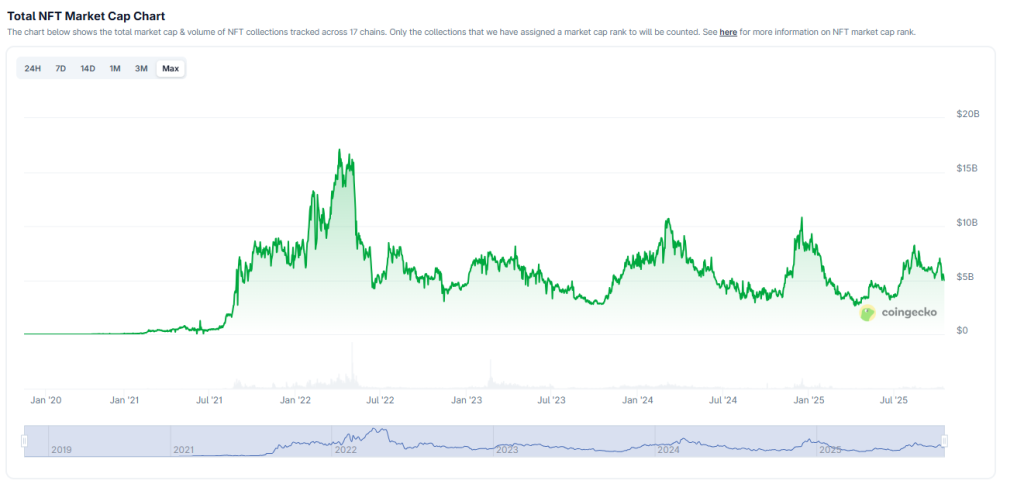
Source: CoinGecko

Finzer said the shift toward crypto aggregation is both a survival strategy and a bet on where the industry is headed. “You can’t fight the macro trend,” he said. “People want to trade everything—not just digital art.”

The new business model aggregates buy and sell orders from decentralized exchanges such as Uniswap and Meteora, generating around $16 million in revenue over the same period through a 0.9% transaction fee.

According to him, OpenSea does not perform know-your-customer checks, arguing that they are incompatible with its non-custodial model, though it uses blockchain analytics to flag suspicious transactions.

The platform’s evolution into a multi-asset aggregator reflects a wider trend among former NFT-focused firms adapting to the changing crypto economy.

Earlier this year, Solana-based marketplace Magic Eden acquired trading platform Slingshot to expand beyond NFTs.

OpenSea’s Trading Volume Hits 3-Year High as Platform Reinvents Itself

At the height of the NFT frenzy in January 2022, OpenSea generated $125 million in monthly revenue and was valued at $13.3 billion, making it one of the most valuable startups in crypto.

But by late 2023, as interest in digital collectibles evaporated, its monthly revenue had fallen to just $3 million. The company was forced to lay off more than half of its staff, shrinking from about 175 employees to around 60 today.

The downturn was accelerated by competition from rival marketplace Blur, which captured traders with zero fees and no royalties for creators.

OpenSea’s response, loosening its own royalty structure, backfired, sparking backlash from artists and collectors who accused the company of abandoning its roots.

Facing dwindling market share and financial strain, Finzer initiated a major reset. The company has since relocated its headquarters to Miami, with most staff working remotely.

Additionally, in the first two weeks of October 2025, the company handled $1.6 billion in crypto trades and $230 million in NFT transactions, its biggest month in more than three years.

Also, in an X post, Finzer noted that OpenSea saw massive demand with about $2.6 billion in trading volume this month, with over 90% from token trading.

OpenSea Prepares Token Launch, Eyes Recovery After NFT Market Collapse

OpenSea’s resurgence comes amid shifting investor appetite across the digital asset space. While Bitcoin and other cryptocurrencies have rallied, NFT trading remains a fraction of what it once was.

Blue-chip collections such as Bored Ape Yacht Club have seen floor prices tumble from around $400,000 at their peak to about $32,000.

Source: CoinGecko

Blur, the platform that once dethroned OpenSea, has also seen its activity collapse, from over $1 billion in monthly volume in early 2023 to just $92 million last month, according to DappRadar.

Despite the slump, the NFT market has shown intermittent signs of recovery in 2025.

DappRadar reported that July saw NFT market capitalization rise 94% to $6.6 billion, driven by renewed interest in blue-chip assets like CryptoPunks and Pudgy Penguins.

CryptoPunks alone saw a 53% floor price increase, while Pudgy Penguins overtook Bored Ape Yacht Club by market cap.

Even so, trading volumes remain volatile. After a resurgence in mid-2025, NFT sales have slowed again, with daily volumes hovering around $8 million, according to CoinGecko.

Source: NFTpulse

Base, Coinbase’s Layer-2 network, now dominates NFT activity, accounting for more than half of total transactions across blockchains, followed by Ethereum, Polygon, and Solana.

OpenSea’s “2.0” vision includes plans for a mobile app and an independent foundation that will issue an OpenSea token.

Finzer says the goal is to make trading as intuitive as Robinhood but fully self-custodial, allowing users to maintain control of their assets across chains.


Disclaimer: The articles reposted on this site are sourced from public platforms and are provided for informational purposes only. They do not necessarily reflect the views of MEXC. All rights remain with the original authors. If you believe any content infringes on third-party rights, please contact service@support.mexc.com for removal. MEXC makes no guarantees regarding the accuracy, completeness, or timeliness of the content and is not responsible for any actions taken based on the information provided. The content does not constitute financial, legal, or other professional advice, nor should it be considered a recommendation or endorsement by MEXC.

You May Also Like

Tesla Stock Forecast: Will $1.25T SpaceX-xAI Merge Boost TSLA?

Tesla Stock Forecast: Will $1.25T SpaceX-xAI Merge Boost TSLA?

Tesla shares closed at $421.96 as of February 4, holding flat while broader markets slipped. The muted move came as investors digested reports that SpaceX and xAI
Share
Coinstats2026/02/04 19:10
Moku Pledges $1M to Launch Grand Arena Season One, a 24/7 AI-Athlete Fantasy Platform

Moku Pledges $1M to Launch Grand Arena Season One, a 24/7 AI-Athlete Fantasy Platform

Enjoy the videos and music you love, upload original content, and share it all with friends, family, and the world on YouTube.
Share
Blockchainreporter2025/09/22 22:20
Long-Awaited NikeSKIMS Launches To Reignite Nike’s Women’s Business

Long-Awaited NikeSKIMS Launches To Reignite Nike’s Women’s Business

The post Long-Awaited NikeSKIMS Launches To Reignite Nike’s Women’s Business appeared on BitcoinEthereumNews.com. Topline After delays due to product issues in its scheduled May release, the first NikeSKIMS activewear collections – the strategic partnership between the sportswear giant and Kim Kardashian’s $4 billion disruptive shapewear venture – will launch on both companies’ websites and in select Nike and SKIMS stores this Friday, September 26. Serena Williams for NikeSKIMS Courtesy of Nike Key Facts NikeSKIMS’ first outing will include three core activewear collections, along with four seasonal collections, all designed to support women with high-performance fabrication expected from Nike and the body-conscious styling SKIMS is known for. The introductory offering features 58 items in neutral colorways that can be combined into more than 10,000 different looks suited for an intense gym workout or a coffee run. An all-star cast of 50 elite female athletes star in the “Bodies at Work” release video, including Jordan Chiles, Romane Dicko, Beatriz Hatz, Chloe Kim, Nelly Korda, Sha’Carri Richardson, Madisen Skinner and Serena Williams, as well as Kardashian and members of UCLA and USC women’s teams. Prices will range from $38 for a bra to $128 for footed leggings, with the sweet spot for the collection in the $50 to $70 range, about even or slightly below the list price of premium activewear brands such as Lululemon and Alo Yoga. Crucial Quote “NikeSKIMS is more than a collaboration – It’s a new brand redefining activewear. With this launch, we are establishing a platform to grow NikeSKIMS, reach consumers worldwide and set a new benchmark for how activewear is experienced across retail, digital and cultural touch points,” said Jens Grede, SKIMS’ co-founder and CEO, in a statement. Key Background Nike has a lot riding on the success of the SKIMS-style meets Nike-function launch of NikeSKIMS. Nike brand revenues dropped 9% to $44.7 billion in fiscal year ended May 31…
Share
BitcoinEthereumNews2025/09/23 22:30