Bitcoin’s “four-year law” may be breaking for the first time. Despite record inflows into spot ETFs and swelling corporate treasuries, the market is no longer moving in lockstep with the halving cycle. Instead, liquidity shocks, sovereign wealth allocations, and derivatives growth are emerging as the new anchors of price discovery. This shift raises a critical question for 2026: can institutions still rely on cycle playbooks, or must they rewrite the rules entirely? Has the cycle finally snapped? With these forces now setting the pace, the question is not whether the old cycle still matters but whether it has already been replaced. BeInCrypto spoke with James Check, Co-Founder and on-chain analyst at Checkonchain Analytics and former Lead On-Chain Analyst at Glassnode, to test this thesis. For years, Bitcoin investors treated the four-year halving cycle as gospel. That rhythm now faces its toughest test. In September 2025, CoinShares tracked $1.9 billion in ETF inflows—nearly half of it into Bitcoin—while Glassnode flagged $108,000–$114,000 as a make-or-break zone. At the same time, CryptoQuant recorded exchange inflows collapsing to historic lows, even as Bitcoin pushed into fresh all-time highs. ETF inflows: fresh demand or reshuffling? September’s ETF inflows highlighted robust demand, but investors need to know whether this is genuinely new capital or simply existing holders rotating from vehicles like GBTC. That distinction affects how much structural support the rally has. Source: Checkonchain “There is absolutely going to be some holders who are migrating from holding on-chain into the ETFs. This is definitely happening. However, it is not the majority… the demand has actually been incredible and massive. We’re talking about tens of billions of dollars, really serious capital coming on board. The difference is that we have a lot of sell side.” James noted that ETFs have already absorbed around $60 billion in total inflows. Market data shows this figure is overshadowed by monthly realized profit-taking of $30–100 billion from long-term holders, underscoring why prices have not climbed as quickly as ETF demand alone might suggest. Exchange flows: signal or noise? CryptoQuant shows that exchange inflows reached record lows at Bitcoin’s 2025 highs. At face value, this could mean structural scarcity. However, James cautioned against over-reliance on these metrics. Source: Checkonchain “You won’t see me actually use exchange data very often because I think it’s just not a highly useful tool. The exchanges have I think it’s like 3.4 million bitcoin. A lot of these data providers simply don’t have all the wallet addresses because it’s a really, really hard job to find them all.” Analysis confirms this limitation, noting that long-term holder supply—currently 15.68 million BTC, or about 78.5% of circulating supply, and all in profit—is a more reliable gauge of scarcity than exchange balances. Do miners still move the market? For years, mining was shorthand for downside risk. Yet with ETF and treasury flows now dominating, their influence may be far more negligible than many assume. Source: Checkonchain “For the Bitcoin network, that sell side I mentioned before, I’ve got some charts… you just got to keep zooming in to see it because it looks like the zero line. It’s so small compared to old hand selling, ETF flows. So I would say that the halving doesn’t matter. And it hasn’t mattered, I would say for a couple of cycles. That’s one of those narratives that I think is dead.” The roughly 450 BTC issued daily by miners is negligible compared with the revived supply from long-term holders, which can reach 10,000–40,000 BTC per day in peak rallies. This imbalance illustrates why miner flows no longer define market structure. From cycles to liquidity regimes Asked whether Bitcoin still respects its four-year cycle or has shifted into a liquidity-driven regime, James pointed to structural pivots in adoption. Source: Checkonchain “There’s been two major pivot points in the world of Bitcoin. The first one was the 2017 all-time high… The end of 2022 or the start of 23, that is where Bitcoin became a much more mature asset. Nowadays, Bitcoin responds to the world, rather than the world respond to Bitcoin.” Analysis supports this view, noting that volatility compression and the rise of ETFs and derivatives have shifted Bitcoin into a more index-like role in global markets. It also stressed that liquidity conditions, not halving cycles, now set the pace. Realized Price and new bear-market floors Traditionally, the realized price acted as a reliable cycle diagnostic. Fidelity’s models suggest post-halving corrections occur 12–18 months after the event. James, however, argued that the metric is now outdated—and that investors should watch where the marginal cost bases cluster instead. Source: Checkonchain “Typically a bear market ends when the price comes down to the realized price. Now, I think the realized price is somewhere around 52,000. But I actually think that metric is outdated because it includes Satoshi and lost coins… I don’t think Bitcoin goes back down to 30K. If we would have a bear market right now, I think we would go down to something like 80,000. That to me is where bear market floors would start to form. 75–80K, something like that.” Their data show a clustering of cost bases around $74,000–$80,000—covering ETFs, corporate treasuries, and actual market averages—indicating that this range now anchors potential bear-market floors. MVRV and the limits of metrics By contrast, MVRV Z-Score has not broken, but its thresholds have drifted with market depth and instrument mix. James advised flexibility. Source: Checkonchain “I think all the metrics are still reliable, but the past thresholds are not reliable. People need to think about the metrics as a source of information, not as an indicator that’s going to tell you the answer. It’s easy to spot a blow-off top when all metrics are through the roof. What’s really hard to spot is when the bull market just runs out of steam and rolls over.” Their data shows MVRV cooling near +1σ and then plateauing, rather than reaching historical extremes—reinforcing James’s view that context beats fixed cut-offs. Sovereign flows and custody risk As sovereign wealth funds and pensions consider exposure, concentration risk has become a key concern. James acknowledged that Coinbase holds most of the Bitcoin, but argued that proof-of-work offsets systemic risk. Source: Checkonchain “If there’s one area that’s probably the biggest concentration risk, it would be Coinbase, simply because they custody pretty much all of the Bitcoin from the ETFs. But because Bitcoin uses proof of work, it doesn’t actually matter where the coins are… There’s no threshold of risk that breaks the system. The market just sorts itself out.” Data confirms that Coinbase serves as custodian for most US spot ETFs, illustrating the degree of concentration and why James frames it as a market rather than a security risk. Options, ETFs, and U.S. dominance James pointed to derivatives as the decisive factor in Vanguard’s potential entry into ETF and tokenized markets. Source: Checkonchain “The most important thing is actually got nothing to do with the ETFs themselves. It’s actually the options market being built on top of them… As of October 2024, IBIT started tearing ahead of all the others. It is now the only one seeing appreciable inflows. The US has like 90% dominance in terms of ETF holdings.” Market analysis shows BlackRock’s IBIT capturing most of AUM share after launching options in late 2024, with US ETFs commanding nearly 90% of global flows—underscoring derivatives as the actual driver of market dynamics. IBIT dominance aligns with reports of US ETFs shaping almost all new inflows, reinforcing the country’s outsized role. Closing thoughts “Everybody is always looking for the perfect metric to predict the future. There is no such thing. The only thing you can control is your decisions. If it goes down to 75, make sure you have a plan for that. If it goes up to 150, make sure you have a plan for that as well.” James argued that preparing strategies for downside and upside scenarios is the most practical way to navigate volatility through 2026 and beyond. His analysis suggests that Bitcoin’s four-year halving cycle may no longer define its trajectory. ETF inflows and sovereign-scale capital have introduced new structural drivers, while long-term holder behavior remains the key constraint. Metrics like Realized Price and MVRV require reinterpretation, with $75,000–$80,000 emerging as the likely floor in a modern bear market. For institutions, the focus in 2026 should shift toward liquidity regimes, custody dynamics, and the derivatives markets now forming on top of ETFs.Bitcoin’s “four-year law” may be breaking for the first time. Despite record inflows into spot ETFs and swelling corporate treasuries, the market is no longer moving in lockstep with the halving cycle. Instead, liquidity shocks, sovereign wealth allocations, and derivatives growth are emerging as the new anchors of price discovery. This shift raises a critical question for 2026: can institutions still rely on cycle playbooks, or must they rewrite the rules entirely? Has the cycle finally snapped? With these forces now setting the pace, the question is not whether the old cycle still matters but whether it has already been replaced. BeInCrypto spoke with James Check, Co-Founder and on-chain analyst at Checkonchain Analytics and former Lead On-Chain Analyst at Glassnode, to test this thesis. For years, Bitcoin investors treated the four-year halving cycle as gospel. That rhythm now faces its toughest test. In September 2025, CoinShares tracked $1.9 billion in ETF inflows—nearly half of it into Bitcoin—while Glassnode flagged $108,000–$114,000 as a make-or-break zone. At the same time, CryptoQuant recorded exchange inflows collapsing to historic lows, even as Bitcoin pushed into fresh all-time highs. ETF inflows: fresh demand or reshuffling? September’s ETF inflows highlighted robust demand, but investors need to know whether this is genuinely new capital or simply existing holders rotating from vehicles like GBTC. That distinction affects how much structural support the rally has. Source: Checkonchain “There is absolutely going to be some holders who are migrating from holding on-chain into the ETFs. This is definitely happening. However, it is not the majority… the demand has actually been incredible and massive. We’re talking about tens of billions of dollars, really serious capital coming on board. The difference is that we have a lot of sell side.” James noted that ETFs have already absorbed around $60 billion in total inflows. Market data shows this figure is overshadowed by monthly realized profit-taking of $30–100 billion from long-term holders, underscoring why prices have not climbed as quickly as ETF demand alone might suggest. Exchange flows: signal or noise? CryptoQuant shows that exchange inflows reached record lows at Bitcoin’s 2025 highs. At face value, this could mean structural scarcity. However, James cautioned against over-reliance on these metrics. Source: Checkonchain “You won’t see me actually use exchange data very often because I think it’s just not a highly useful tool. The exchanges have I think it’s like 3.4 million bitcoin. A lot of these data providers simply don’t have all the wallet addresses because it’s a really, really hard job to find them all.” Analysis confirms this limitation, noting that long-term holder supply—currently 15.68 million BTC, or about 78.5% of circulating supply, and all in profit—is a more reliable gauge of scarcity than exchange balances. Do miners still move the market? For years, mining was shorthand for downside risk. Yet with ETF and treasury flows now dominating, their influence may be far more negligible than many assume. Source: Checkonchain “For the Bitcoin network, that sell side I mentioned before, I’ve got some charts… you just got to keep zooming in to see it because it looks like the zero line. It’s so small compared to old hand selling, ETF flows. So I would say that the halving doesn’t matter. And it hasn’t mattered, I would say for a couple of cycles. That’s one of those narratives that I think is dead.” The roughly 450 BTC issued daily by miners is negligible compared with the revived supply from long-term holders, which can reach 10,000–40,000 BTC per day in peak rallies. This imbalance illustrates why miner flows no longer define market structure. From cycles to liquidity regimes Asked whether Bitcoin still respects its four-year cycle or has shifted into a liquidity-driven regime, James pointed to structural pivots in adoption. Source: Checkonchain “There’s been two major pivot points in the world of Bitcoin. The first one was the 2017 all-time high… The end of 2022 or the start of 23, that is where Bitcoin became a much more mature asset. Nowadays, Bitcoin responds to the world, rather than the world respond to Bitcoin.” Analysis supports this view, noting that volatility compression and the rise of ETFs and derivatives have shifted Bitcoin into a more index-like role in global markets. It also stressed that liquidity conditions, not halving cycles, now set the pace. Realized Price and new bear-market floors Traditionally, the realized price acted as a reliable cycle diagnostic. Fidelity’s models suggest post-halving corrections occur 12–18 months after the event. James, however, argued that the metric is now outdated—and that investors should watch where the marginal cost bases cluster instead. Source: Checkonchain “Typically a bear market ends when the price comes down to the realized price. Now, I think the realized price is somewhere around 52,000. But I actually think that metric is outdated because it includes Satoshi and lost coins… I don’t think Bitcoin goes back down to 30K. If we would have a bear market right now, I think we would go down to something like 80,000. That to me is where bear market floors would start to form. 75–80K, something like that.” Their data show a clustering of cost bases around $74,000–$80,000—covering ETFs, corporate treasuries, and actual market averages—indicating that this range now anchors potential bear-market floors. MVRV and the limits of metrics By contrast, MVRV Z-Score has not broken, but its thresholds have drifted with market depth and instrument mix. James advised flexibility. Source: Checkonchain “I think all the metrics are still reliable, but the past thresholds are not reliable. People need to think about the metrics as a source of information, not as an indicator that’s going to tell you the answer. It’s easy to spot a blow-off top when all metrics are through the roof. What’s really hard to spot is when the bull market just runs out of steam and rolls over.” Their data shows MVRV cooling near +1σ and then plateauing, rather than reaching historical extremes—reinforcing James’s view that context beats fixed cut-offs. Sovereign flows and custody risk As sovereign wealth funds and pensions consider exposure, concentration risk has become a key concern. James acknowledged that Coinbase holds most of the Bitcoin, but argued that proof-of-work offsets systemic risk. Source: Checkonchain “If there’s one area that’s probably the biggest concentration risk, it would be Coinbase, simply because they custody pretty much all of the Bitcoin from the ETFs. But because Bitcoin uses proof of work, it doesn’t actually matter where the coins are… There’s no threshold of risk that breaks the system. The market just sorts itself out.” Data confirms that Coinbase serves as custodian for most US spot ETFs, illustrating the degree of concentration and why James frames it as a market rather than a security risk. Options, ETFs, and U.S. dominance James pointed to derivatives as the decisive factor in Vanguard’s potential entry into ETF and tokenized markets. Source: Checkonchain “The most important thing is actually got nothing to do with the ETFs themselves. It’s actually the options market being built on top of them… As of October 2024, IBIT started tearing ahead of all the others. It is now the only one seeing appreciable inflows. The US has like 90% dominance in terms of ETF holdings.” Market analysis shows BlackRock’s IBIT capturing most of AUM share after launching options in late 2024, with US ETFs commanding nearly 90% of global flows—underscoring derivatives as the actual driver of market dynamics. IBIT dominance aligns with reports of US ETFs shaping almost all new inflows, reinforcing the country’s outsized role. Closing thoughts “Everybody is always looking for the perfect metric to predict the future. There is no such thing. The only thing you can control is your decisions. If it goes down to 75, make sure you have a plan for that. If it goes up to 150, make sure you have a plan for that as well.” James argued that preparing strategies for downside and upside scenarios is the most practical way to navigate volatility through 2026 and beyond. His analysis suggests that Bitcoin’s four-year halving cycle may no longer define its trajectory. ETF inflows and sovereign-scale capital have introduced new structural drivers, while long-term holder behavior remains the key constraint. Metrics like Realized Price and MVRV require reinterpretation, with $75,000–$80,000 emerging as the likely floor in a modern bear market. For institutions, the focus in 2026 should shift toward liquidity regimes, custody dynamics, and the derivatives markets now forming on top of ETFs.

Halving Cycle? Exchange Inflows? Forget Them — The Post-ETF Era Playbook

Bitcoin’s “four-year law” may be breaking for the first time. Despite record inflows into spot ETFs and swelling corporate treasuries, the market is no longer moving in lockstep with the halving cycle.

Instead, liquidity shocks, sovereign wealth allocations, and derivatives growth are emerging as the new anchors of price discovery. This shift raises a critical question for 2026: can institutions still rely on cycle playbooks, or must they rewrite the rules entirely?

Has the cycle finally snapped?

With these forces now setting the pace, the question is not whether the old cycle still matters but whether it has already been replaced. BeInCrypto spoke with James Check, Co-Founder and on-chain analyst at Checkonchain Analytics and former Lead On-Chain Analyst at Glassnode, to test this thesis.

For years, Bitcoin investors treated the four-year halving cycle as gospel. That rhythm now faces its toughest test. In September 2025, CoinShares tracked $1.9 billion in ETF inflows—nearly half of it into Bitcoin—while Glassnode flagged $108,000–$114,000 as a make-or-break zone. At the same time, CryptoQuant recorded exchange inflows collapsing to historic lows, even as Bitcoin pushed into fresh all-time highs.

ETF inflows: fresh demand or reshuffling?

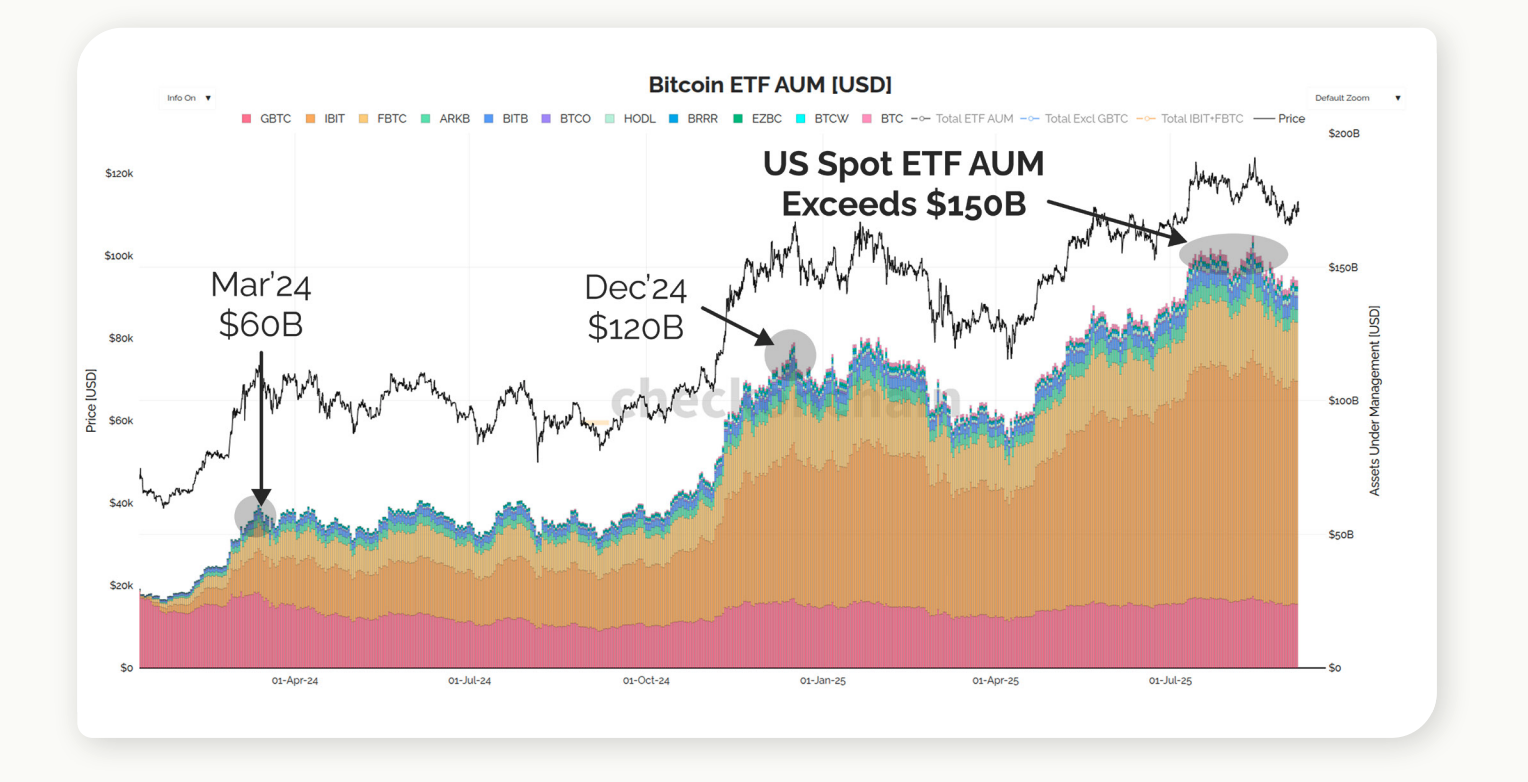
September’s ETF inflows highlighted robust demand, but investors need to know whether this is genuinely new capital or simply existing holders rotating from vehicles like GBTC. That distinction affects how much structural support the rally has.
Source: Checkonchain

James noted that ETFs have already absorbed around $60 billion in total inflows. Market data shows this figure is overshadowed by monthly realized profit-taking of $30–100 billion from long-term holders, underscoring why prices have not climbed as quickly as ETF demand alone might suggest.

Exchange flows: signal or noise?

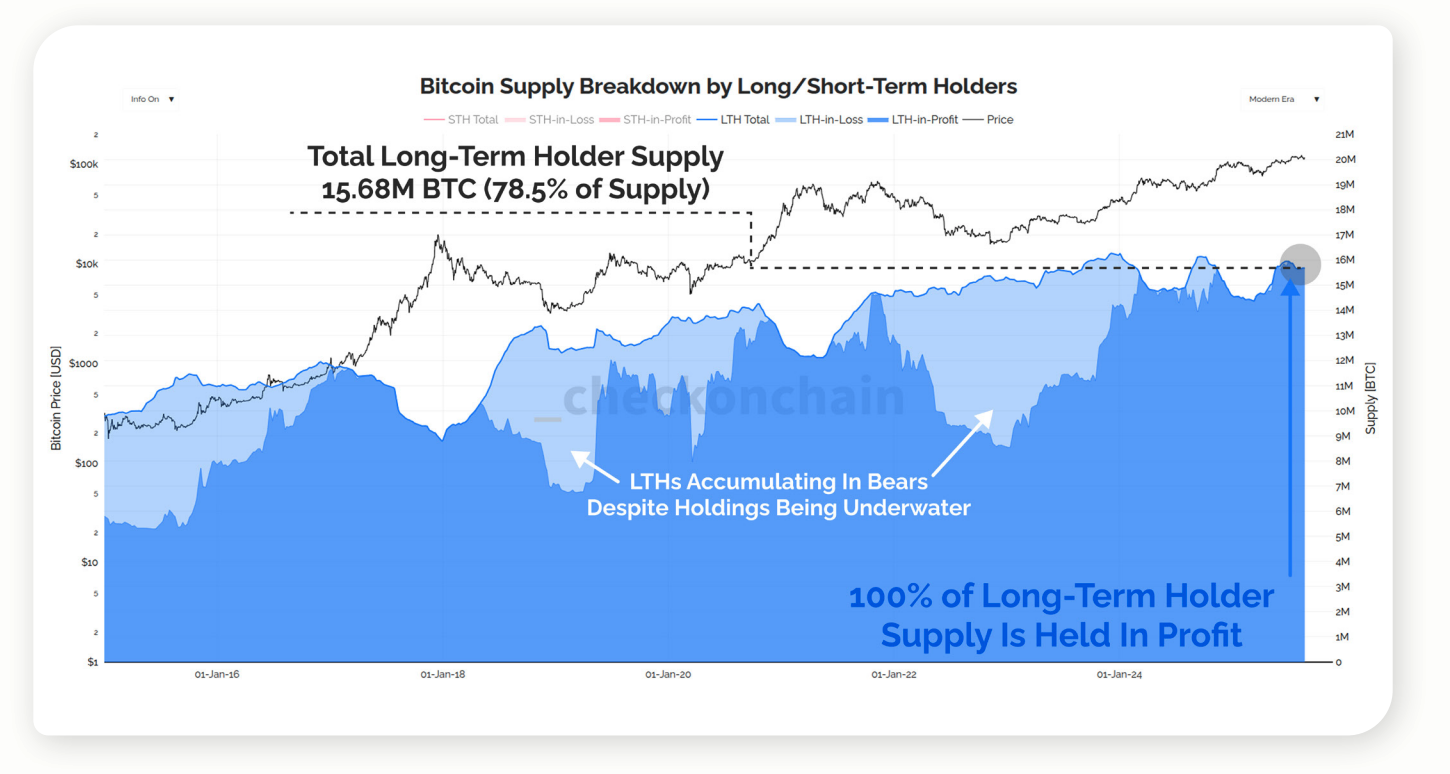
CryptoQuant shows that exchange inflows reached record lows at Bitcoin’s 2025 highs. At face value, this could mean structural scarcity. However, James cautioned against over-reliance on these metrics.
Source: Checkonchain

Analysis confirms this limitation, noting that long-term holder supply—currently 15.68 million BTC, or about 78.5% of circulating supply, and all in profit—is a more reliable gauge of scarcity than exchange balances.

Do miners still move the market?

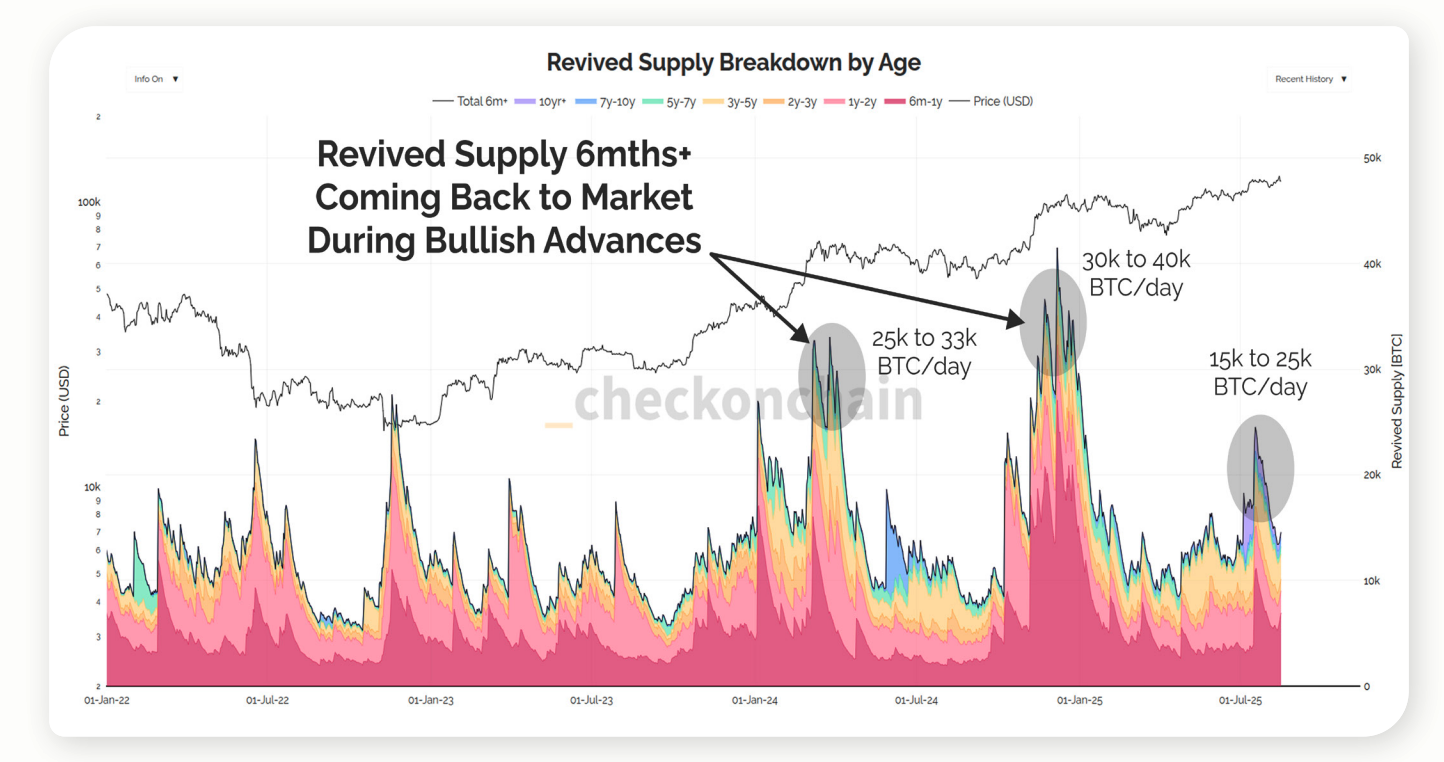
For years, mining was shorthand for downside risk. Yet with ETF and treasury flows now dominating, their influence may be far more negligible than many assume.
Source: Checkonchain

The roughly 450 BTC issued daily by miners is negligible compared with the revived supply from long-term holders, which can reach 10,000–40,000 BTC per day in peak rallies. This imbalance illustrates why miner flows no longer define market structure.

From cycles to liquidity regimes

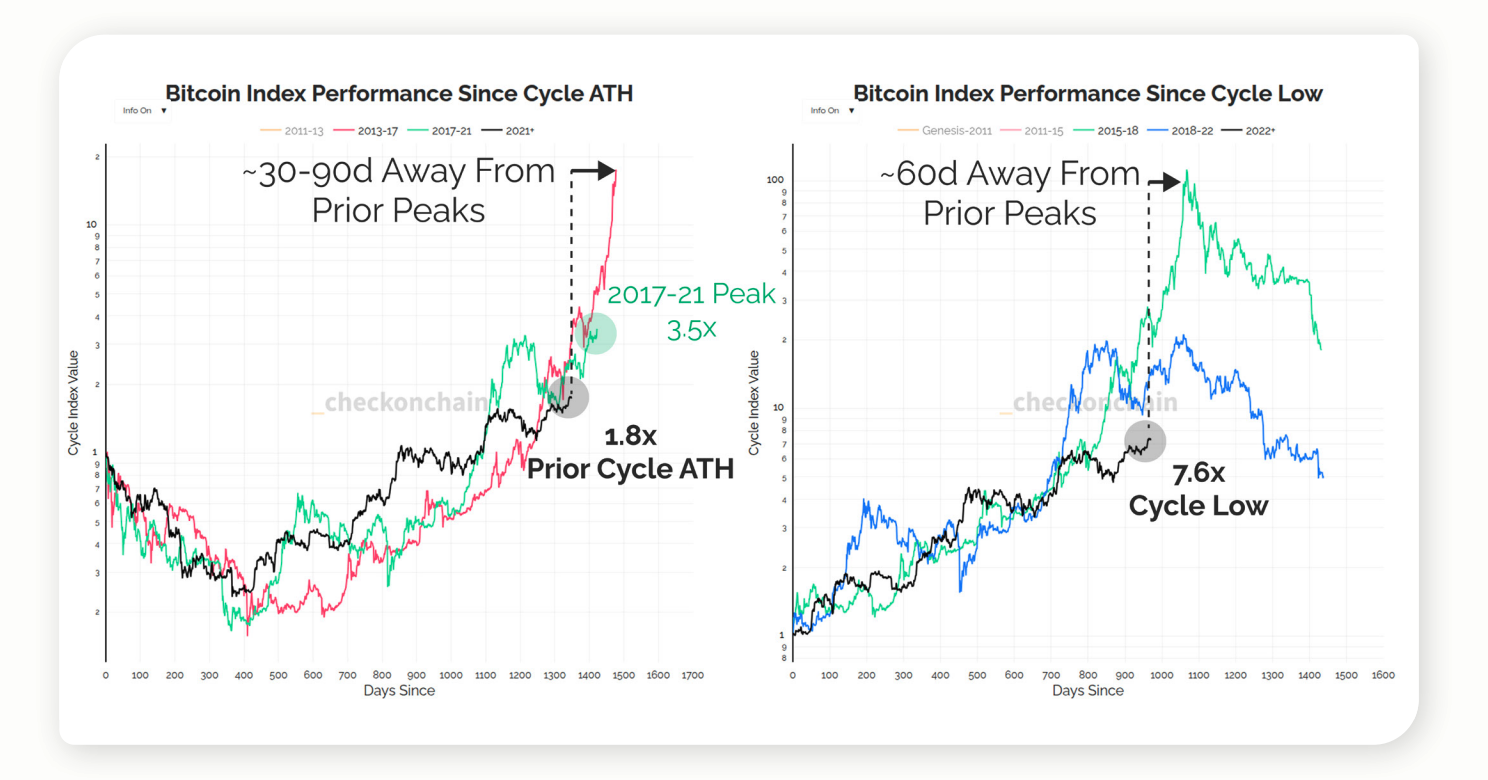
Asked whether Bitcoin still respects its four-year cycle or has shifted into a liquidity-driven regime, James pointed to structural pivots in adoption.
Source: Checkonchain

Analysis supports this view, noting that volatility compression and the rise of ETFs and derivatives have shifted Bitcoin into a more index-like role in global markets. It also stressed that liquidity conditions, not halving cycles, now set the pace.

Realized Price and new bear-market floors

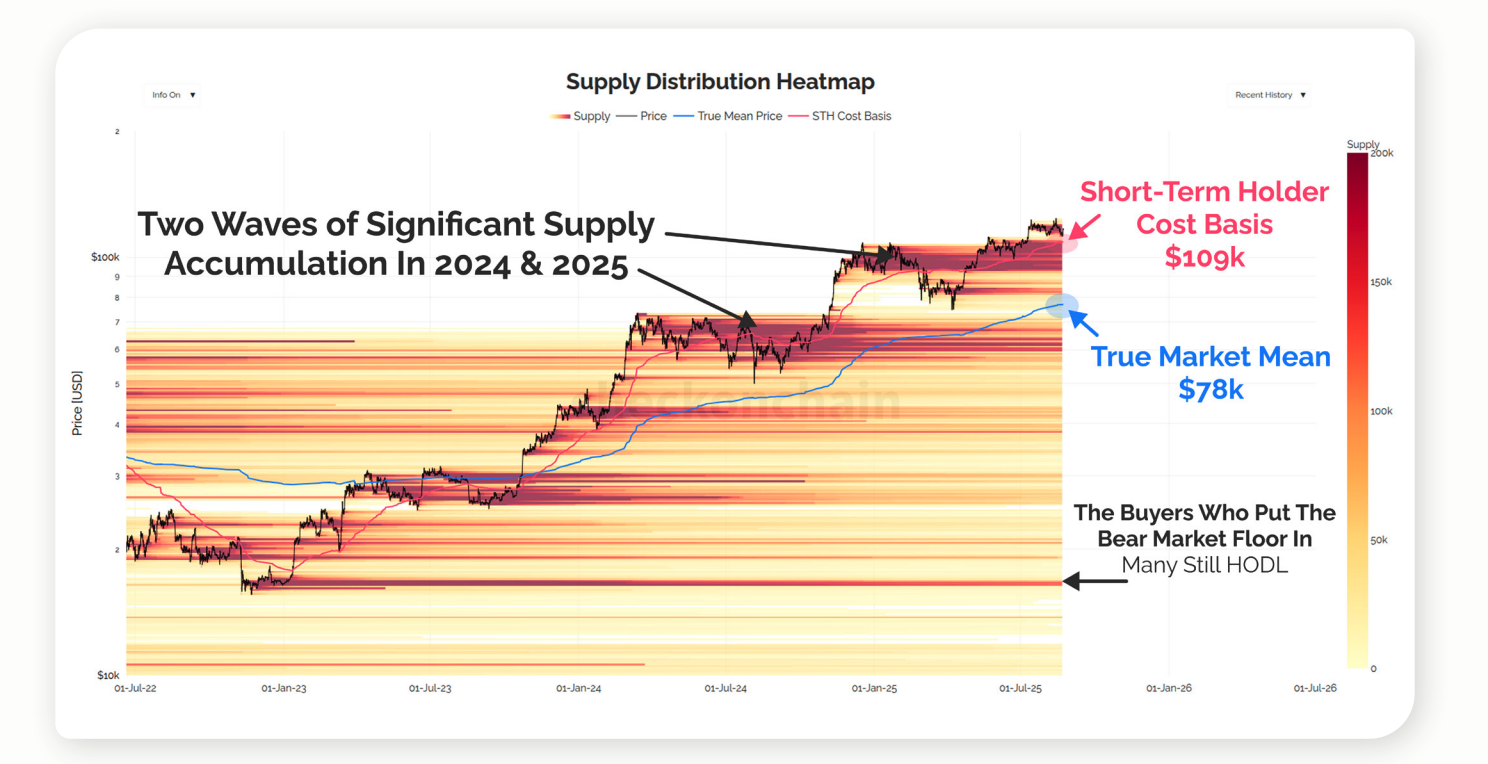
Traditionally, the realized price acted as a reliable cycle diagnostic. Fidelity’s models suggest post-halving corrections occur 12–18 months after the event. James, however, argued that the metric is now outdated—and that investors should watch where the marginal cost bases cluster instead.
Source: Checkonchain

Their data show a clustering of cost bases around $74,000–$80,000—covering ETFs, corporate treasuries, and actual market averages—indicating that this range now anchors potential bear-market floors.

MVRV and the limits of metrics

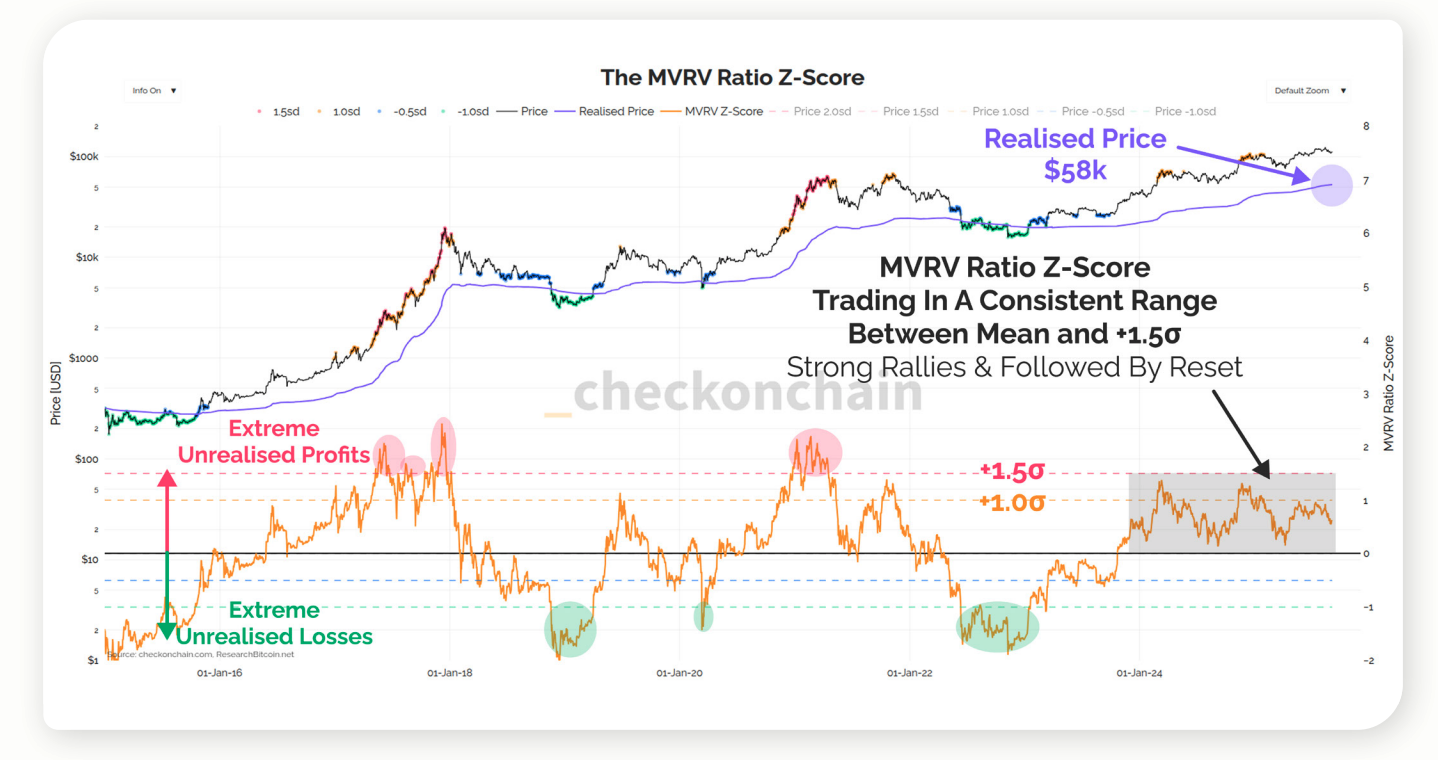
By contrast, MVRV Z-Score has not broken, but its thresholds have drifted with market depth and instrument mix. James advised flexibility.
Source: Checkonchain

Their data shows MVRV cooling near +1σ and then plateauing, rather than reaching historical extremes—reinforcing James’s view that context beats fixed cut-offs.

Sovereign flows and custody risk

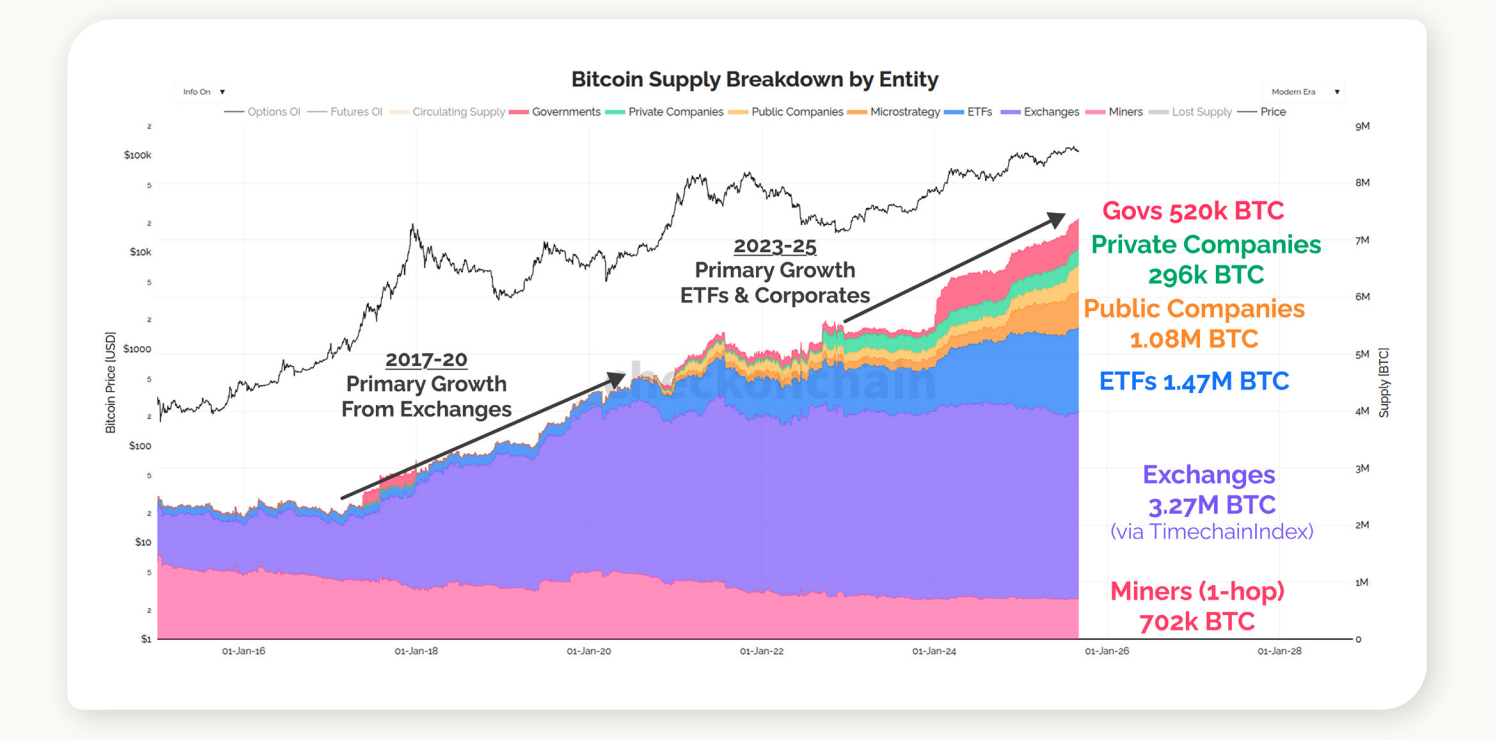
As sovereign wealth funds and pensions consider exposure, concentration risk has become a key concern. James acknowledged that Coinbase holds most of the Bitcoin, but argued that proof-of-work offsets systemic risk.
Source: Checkonchain

Data confirms that Coinbase serves as custodian for most US spot ETFs, illustrating the degree of concentration and why James frames it as a market rather than a security risk.

Options, ETFs, and U.S. dominance

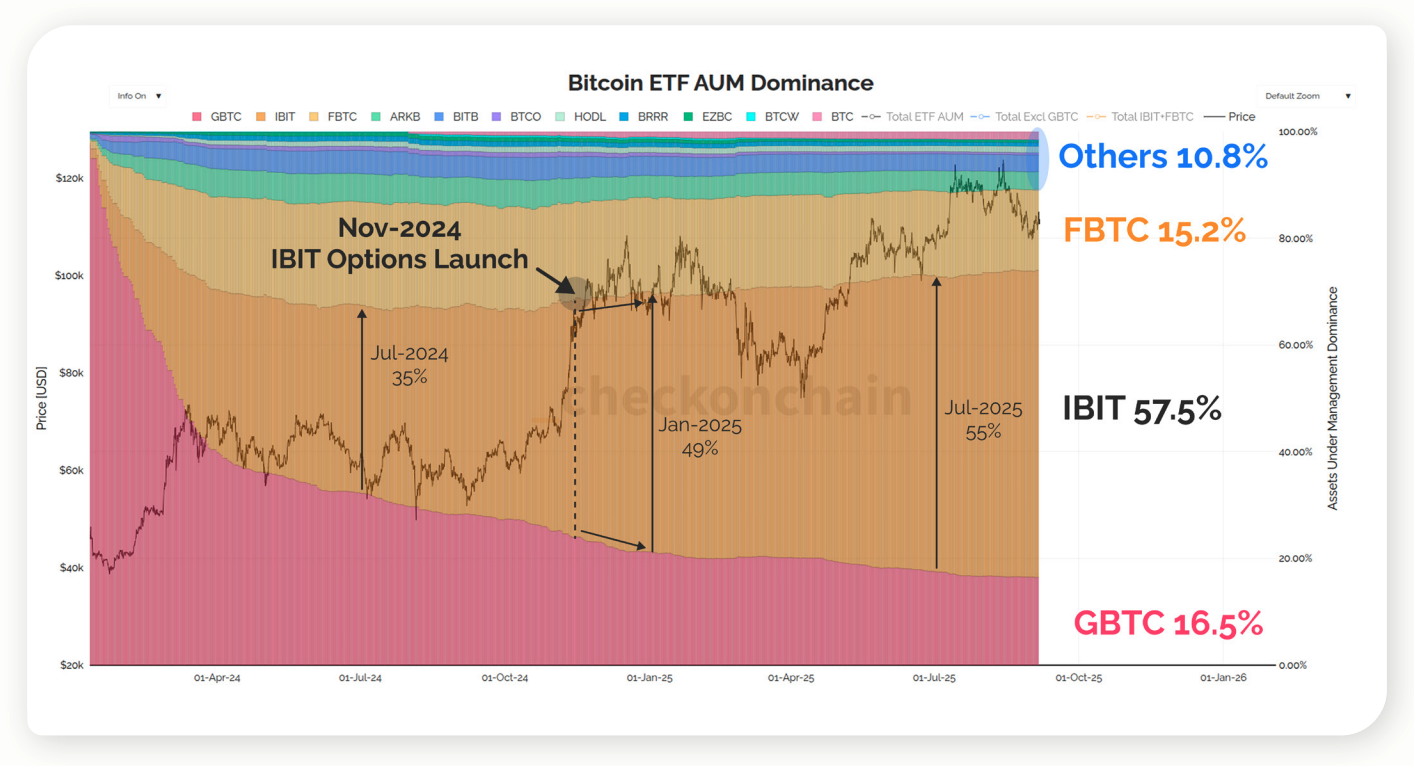
James pointed to derivatives as the decisive factor in Vanguard’s potential entry into ETF and tokenized markets.
Source: Checkonchain

Market analysis shows BlackRock’s IBIT capturing most of AUM share after launching options in late 2024, with US ETFs commanding nearly 90% of global flows—underscoring derivatives as the actual driver of market dynamics. IBIT dominance aligns with reports of US ETFs shaping almost all new inflows, reinforcing the country’s outsized role.

Closing thoughts

James argued that preparing strategies for downside and upside scenarios is the most practical way to navigate volatility through 2026 and beyond.

His analysis suggests that Bitcoin’s four-year halving cycle may no longer define its trajectory. ETF inflows and sovereign-scale capital have introduced new structural drivers, while long-term holder behavior remains the key constraint.

Metrics like Realized Price and MVRV require reinterpretation, with $75,000–$80,000 emerging as the likely floor in a modern bear market. For institutions, the focus in 2026 should shift toward liquidity regimes, custody dynamics, and the derivatives markets now forming on top of ETFs.


Market Opportunity
ERA Logo
ERA Price(ERA)
$0.1936
$0.1936$0.1936
+0.25%
USD
ERA (ERA) Live Price Chart
Disclaimer: The articles reposted on this site are sourced from public platforms and are provided for informational purposes only. They do not necessarily reflect the views of MEXC. All rights remain with the original authors. If you believe any content infringes on third-party rights, please contact service@support.mexc.com for removal. MEXC makes no guarantees regarding the accuracy, completeness, or timeliness of the content and is not responsible for any actions taken based on the information provided. The content does not constitute financial, legal, or other professional advice, nor should it be considered a recommendation or endorsement by MEXC.

You May Also Like

Watch Out: Numerous Economic Developments and Altcoin Events This Week! Here’s the Day-by-Day, Hour-by-Hour List

Watch Out: Numerous Economic Developments and Altcoin Events This Week! Here’s the Day-by-Day, Hour-by-Hour List

The post Watch Out: Numerous Economic Developments and Altcoin Events This Week! Here’s the Day-by-Day, Hour-by-Hour List appeared on BitcoinEthereumNews.com.
Share
BitcoinEthereumNews2025/12/22 03:39
UK and US Seal $42 Billion Tech Pact Driving AI and Energy Future

UK and US Seal $42 Billion Tech Pact Driving AI and Energy Future

The post UK and US Seal $42 Billion Tech Pact Driving AI and Energy Future appeared on BitcoinEthereumNews.com. Key Highlights Microsoft and Google pledge billions as part of UK US tech partnership Nvidia to deploy 120,000 GPUs with British firm Nscale in Project Stargate Deal positions UK as an innovation hub rivaling global tech powers UK and US Seal $42 Billion Tech Pact Driving AI and Energy Future The UK and the US have signed a “Technological Prosperity Agreement” that paves the way for joint projects in artificial intelligence, quantum computing, and nuclear energy, according to Reuters. Donald Trump and King Charles review the guard of honour at Windsor Castle, 17 September 2025. Image: Kirsty Wigglesworth/Reuters The agreement was unveiled ahead of U.S. President Donald Trump’s second state visit to the UK, marking a historic moment in transatlantic technology cooperation. Billions Flow Into the UK Tech Sector As part of the deal, major American corporations pledged to invest $42 billion in the UK. Microsoft leads with a $30 billion investment to expand cloud and AI infrastructure, including the construction of a new supercomputer in Loughton. Nvidia will deploy 120,000 GPUs, including up to 60,000 Grace Blackwell Ultra chips—in partnership with the British company Nscale as part of Project Stargate. Google is contributing $6.8 billion to build a data center in Waltham Cross and expand DeepMind research. Other companies are joining as well. CoreWeave announced a $3.4 billion investment in data centers, while Salesforce, Scale AI, BlackRock, Oracle, and AWS confirmed additional investments ranging from hundreds of millions to several billion dollars. UK Positions Itself as a Global Innovation Hub British Prime Minister Keir Starmer said the deal could impact millions of lives across the Atlantic. He stressed that the UK aims to position itself as an investment hub with lighter regulations than the European Union. Nvidia spokesman David Hogan noted the significance of the agreement, saying it would…
Share
BitcoinEthereumNews2025/09/18 02:22
Aave DAO to Shut Down 50% of L2s While Doubling Down on GHO

Aave DAO to Shut Down 50% of L2s While Doubling Down on GHO

The post Aave DAO to Shut Down 50% of L2s While Doubling Down on GHO appeared on BitcoinEthereumNews.com. Aave DAO is gearing up for a significant overhaul by shutting down over 50% of underperforming L2 instances. It is also restructuring its governance framework and deploying over $100 million to boost GHO. This could be a pivotal moment that propels Aave back to the forefront of on-chain lending or sparks unprecedented controversy within the DeFi community. Sponsored Sponsored ACI Proposes Shutting Down 50% of L2s The “State of the Union” report by the Aave Chan Initiative (ACI) paints a candid picture. After a turbulent period in the DeFi market and internal challenges, Aave (AAVE) now leads in key metrics: TVL, revenue, market share, and borrowing volume. Aave’s annual revenue of $130 million surpasses the combined cash reserves of its competitors. Tokenomics improvements and the AAVE token buyback program have also contributed to the ecosystem’s growth. Aave global metrics. Source: Aave However, the ACI’s report also highlights several pain points. First, regarding the Layer-2 (L2) strategy. While Aave’s L2 strategy was once a key driver of success, it is no longer fit for purpose. Over half of Aave’s instances on L2s and alt-L1s are not economically viable. Based on year-to-date data, over 86.6% of Aave’s revenue comes from the mainnet, indicating that everything else is a side quest. On this basis, ACI proposes closing underperforming networks. The DAO should invest in key networks with significant differentiators. Second, ACI is pushing for a complete overhaul of the “friendly fork” framework, as most have been unimpressive regarding TVL and revenue. In some cases, attackers have exploited them to Aave’s detriment, as seen with Spark. Sponsored Sponsored “The friendly fork model had a good intention but bad execution where the DAO was too friendly towards these forks, allowing the DAO only little upside,” the report states. Third, the instance model, once a smart…
Share
BitcoinEthereumNews2025/09/18 02:28