In the context of yield compression and bear market in the crypto market, how can investors manage risks and adjust strategies to avoid falling into the trap of blindly chasing returns.In the context of yield compression and bear market in the crypto market, how can investors manage risks and adjust strategies to avoid falling into the trap of blindly chasing returns.

A practical guide to surviving a bear market: How to avoid the yield trap?

2025/04/07 14:30
4 min read
For feedback or concerns regarding this content, please contact us at crypto.news@mexc.com

Author: Santisa , Crypto KOL

Compiled by: Felix, PANews

Before starting the content of this article, let’s take a look at the following story (or reality).

A “never-ending” list of tariffs was announced. Then the market crashed and altcoins collapsed.

Your original low-risk "mine" yield has dropped from 30% to near the level of a Treasury bill (note: T-bill, a short-term debt security issued by the government).

This is unacceptable to you. You originally planned to retire with $300,000, and the annual "mining" income is $90,000. Therefore, the rate of return must be high.

So you start moving down the risk curve, chasing imaginary levels of return that the market would favor you.

You traded your blue chip for an unknown new project; you increased your yield by deploying your assets into a riskier new fixed-term protocol or AMM. You started to feel secretly proud.

After a few weeks, you start to question why you were so risk-averse in the first place. This was apparently a “safe and sure” way to make money.

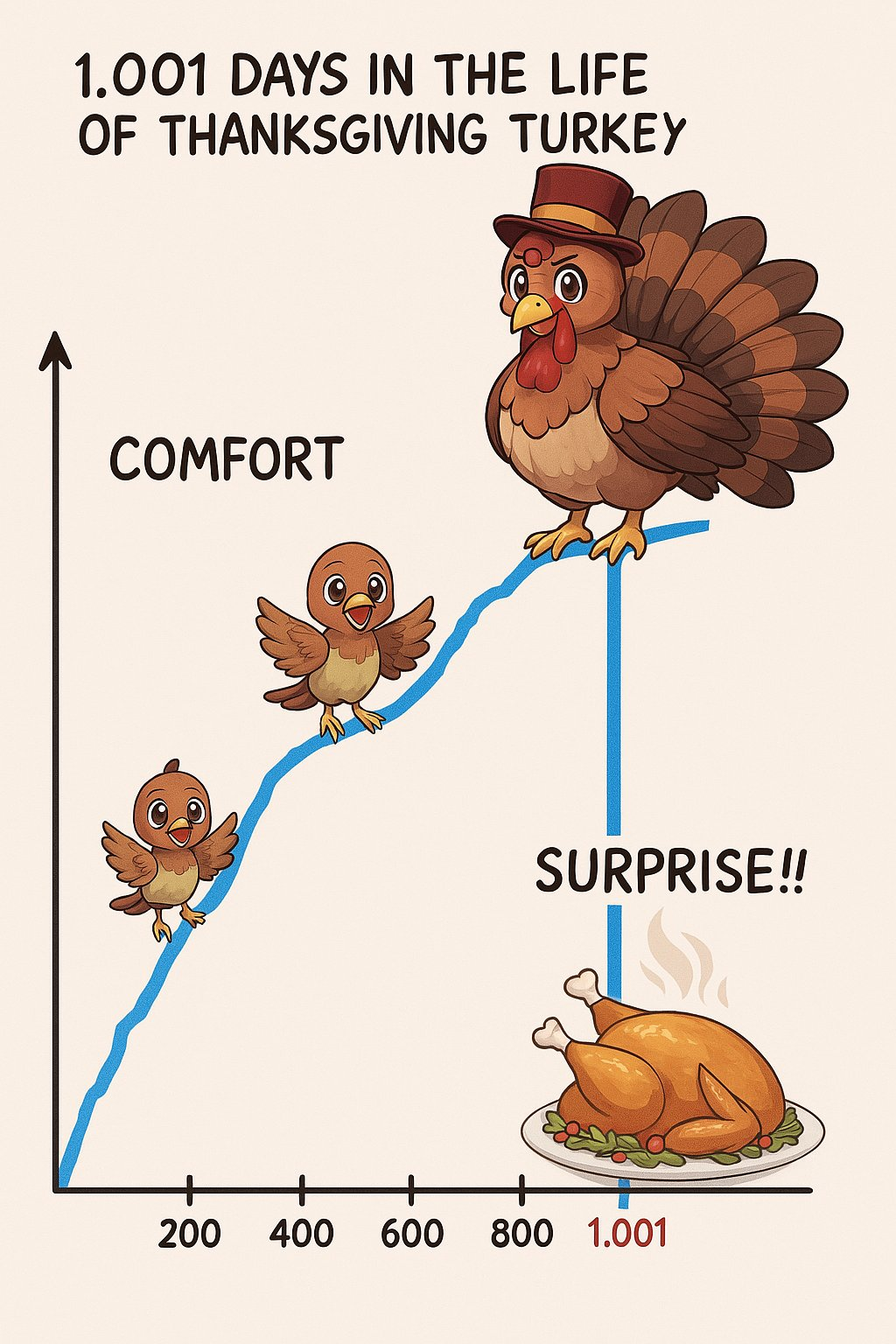
Then, the surprise came.
A practical guide to surviving a bear market: How to avoid the yield trap?

The custodial, leveraged, L2 wrapped, ultra-liquid foundational trading project you entrusted your life savings to collapsed, and now you have lost 70% of your PT-shitUSD-27AUG2025. You got some vested governance tokens, and a few months later the project was abandoned.

Although this story is exaggerated, it reflects the reality that has been played out many times during bear market when yields are compressed. Based on this, this article will try to provide a manual on how to survive a yield bear market.

As people try to adjust to the new reality, in the face of a market crash, they increase risk to make up for the difference in returns, while ignoring the potential costs of these decisions.

Market neutral investors are also speculators whose advantage is to find unadjusted interest rates. Unlike their directional trading partners, these speculators face only two outcomes: either making a little money every day or losing a lot of money all at once.

I personally believe that the neutral rate in the crypto market will be seriously misaligned on the way up, providing an alpha that is higher than its true risk, but the opposite is true on the way down, providing returns below the risk-free rate (RFR) while taking on a lot of risk.

Obviously, there is a time to take risks and a time to avoid them. Those who fail to see this will become someone else's "Thanksgiving dinner".

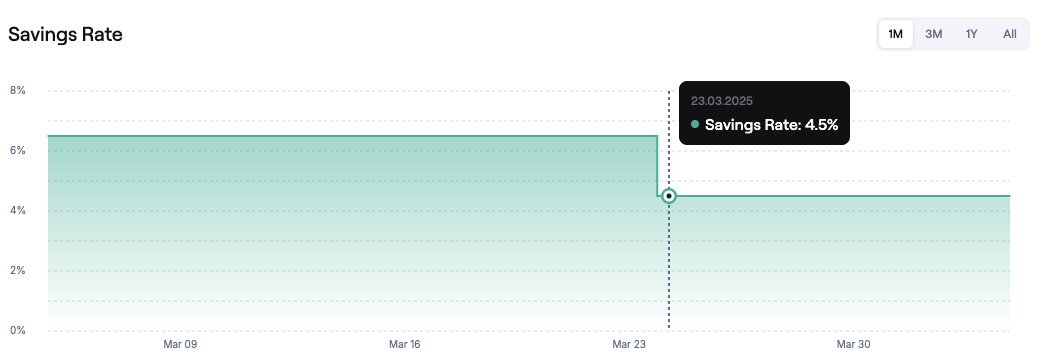
For example, at the time of writing, AAVE’s USDC yield is 2.7% and sUSDS yields 4.5%.

  • AAVE USDC bears 60% of the RFR and also assumes smart contract, oracle, custody and financial risks.

A practical guide to surviving a bear market: How to avoid the yield trap?

 source
  • Maker incurs fees 25 basis points above the RFR while taking on the risks of smart contracts, custody, and actively investing in higher-risk projects.
A practical guide to surviving a bear market: How to avoid the yield trap?

 source

When analyzing the interest rates of DeFi market-neutral investments, you need to consider:

  • Custody Risk
  • Financial risks
  • Smart Contract Risks
  • Risk-free rate

You can assign an annual risk percentage to each risk, add the RFR, and arrive at the required "risk-adjusted return" for each investment opportunity. Anything above that rate is alpha, and anything below that rate is not alpha.

Maker’s required risk-adjusted return was calculated a while ago and came up with a fair compensation of 9.56%.

Maker’s interest rate is currently around 4.5%.

Both AAVE and Maker hold secondary capital (~1% of total deposits), but even with significant insurance, yields below the RFR should not be acceptable to depositors.

In the age of Blackroll T-bills and regulated on-chain issuers, this is the result of laziness, lost keys, and stupid money.

So what to do? It depends on your size.

If you have a smaller portfolio (less than $5 million), there are still attractive options. Check out the safer protocols for all-chain deployments; they often offer incentives on lesser-known chains with lower TVL, or do some base trading on high-yield, low-liquidity perpetual contracts.

If you have a large sum of money (over $20 million):

Buy short-term Treasuries and wait and see. Favorable market conditions will eventually return. You can also search for OTC exchanges; quite a few projects are still looking around for TVL and are willing to significantly dilute their holders.

If you have LPs, let them know this and even ask them to exit. On-chain treasuries are still lower than real trading. Don't get carried away by the unadjusted risk-return. Good opportunities are obvious. Keep it simple and avoid greed. You should be here for the long term and manage your risk-return properly; if not, the market will figure it out for you.

Related reading: Comprehensive data analysis of the capital flows behind the trillion-dollar growth of stablecoins. If altcoins did not rise, where did the money go?


Disclaimer: The articles reposted on this site are sourced from public platforms and are provided for informational purposes only. They do not necessarily reflect the views of MEXC. All rights remain with the original authors. If you believe any content infringes on third-party rights, please contact crypto.news@mexc.com for removal. MEXC makes no guarantees regarding the accuracy, completeness, or timeliness of the content and is not responsible for any actions taken based on the information provided. The content does not constitute financial, legal, or other professional advice, nor should it be considered a recommendation or endorsement by MEXC.

You May Also Like

Neom terminates $1bn tunnel contract at heart of The Line

Neom terminates $1bn tunnel contract at heart of The Line

Saudi Arabia’s Neom has cancelled a roughly $1 billion tunnelling contract at the heart of its flagship “The Line” giga-project, according to public documents.
Share
Agbi2026/03/18 11:28
Gold continues to hit new highs. How to invest in gold in the crypto market?

Gold continues to hit new highs. How to invest in gold in the crypto market?

As Bitcoin encounters a "value winter", real-world gold is recasting the iron curtain of value on the blockchain.
Share
PANews2025/04/14 17:12
These Are The XRP Price Targets You Need To Know Now: Cubic Analytics Founder

These Are The XRP Price Targets You Need To Know Now: Cubic Analytics Founder

Cubic Analytics founder Caleb Franzen says XRP is entering a decisive phase after months of compression, with the price structure implying a path toward the $6–$11 zone so long as the market defends what he calls the key risk line at $2.68. XRP Price Targets In a wide-ranging discussion on the Thinking Crypto podcast with host Tony Edward, Franzen stressed that his conclusions are grounded in “price, structure, and statistical signals” rather than narrative. “It’s the chart itself. It’s the structure itself,” he said. “So long as we stay above $2.68, we’re going much higher.” Franzen’s XRP view comes out of the same template he applies across digital assets: identify trend integrity, map the impulse-consolidation rhythm, and translate it into a ladder of Fibonacci extension targets on a logarithmic scale. In XRP’s case, he argues the market traced higher highs and then “tightened up” into a controlled series of lower highs—what he calls a classic volatility coil that “allows price to reset… for the next leg higher.” Related Reading: Social Media Turns Bearish On XRP: Is This A Buy Signal? He then anchors objective targets to that structure: using the most recent consolidation leg, he cites the 161.8% extension near roughly $4.40 and the 261.8% extension around $6. From the larger Q1 swing—Q1 highs to Q1 lows—he adds a second band of objectives at approximately $5.40 and $11.55. The message, in his words: “Those are the price targets that you have to be aware of if you’re holding and investing in XRP… so long as we stay above $2.68.” Risk management is central to how Franzen frames the trade. Rather than a maximalist forecast, he sets a clear invalidation level and treats it as a mechanical decision point. “If we fall below $2.68, you can get stopped out. You can reduce some of your exposure. You can slow down your DCA,” he said. “It’s okay to be wrong. It’s just not okay to stay wrong.” The Macro Angle Although the podcast also covered Bitcoin, Ethereum and Solana, Franzen’s macro and cross-asset framework is meant to contextualize, not overshadow, the XRP setup. He repeatedly described himself as “time agnostic,” declining to pin outcomes to a specific month or quarter and insisting that the tape, not the calendar, dictates probability. “I’ve been sharing [cycle] targets since the middle of 2023,” he noted, adding that the prudent path is to keep raising targets within an uptrend while letting invalidation handle the rest. That stance is informed by what he characterizes as resilient, supportive macro conditions—good enough for risk assets to trend without demanding a weak US dollar as a crutch. He pointed to strong real activity data and improving earnings assumptions as evidence that risk appetite is not being forced; it’s developing naturally. Related Reading: XRP Ready For $9 Blast — ‘Break $3.10 And It’s Game Over,’ Says Analyst Among the specific markers he flagged: Q2 real GDP growth at 3.8% with expectations of roughly 3.9% for Q3; prime-age unemployment near historic lows at about 3.8%; labor force participation rising; and both real and nominal wage growth, with wages around 4.1% year over year. In credit, he underscored tight spreads and high-yield corporates printing multi-year highs—“and if we adjust them for the dividend yield, they’re trading at all-time highs”—a combination that, in his experience, does not occur when markets are bracing for imminent stress. “As we’re looking at the weight of the evidence here, everything is coming together,” he said. “Higher highs and higher lows, increasing risk appetite, decent macro conditions, the Fed is cutting interest rates… We have to continue to have an upward bias.” That macro lens matters for XRP, he argues, because it reinforces the primacy of structure over story. He criticized a common assumption that crypto rallies must coincide with a falling dollar, highlighting that the US Dollar Index (DXY) has been roughly flat since mid-April while Bitcoin—and, by extension, broader crypto beta—advanced materially. He also described a composite lens that prices Bitcoin against a basket of global currencies (effectively offsetting BTC/USD by DXY) and said that index is making fresh all-time highs too, reflecting “weak global fiat currencies, not necessarily just a weak dollar.” The implication for XRP: if the broader liquidity and risk backdrop continues to reward trend persistence, then the technical coil and extension ladder have a cleaner runway. At press time, XRP traded at $2.8593. Featured image created with DALL.E, chart from TradingView.com
Share
NewsBTC2025/10/08 21:30