Dogecoin is confronting a dense supply overhang at the $0.21 neighborhood, where on-chain data show a striking concentration of realized cost. Market analyst Ali Martinez (@ali_charts) highlighted a Glassnode cost-basis distribution heatmap showing a heavy band at that level Dogecoin Bulls Face $2.2 Billion Wall “10.50 billion $DOGE were accumulated at $0.21. That’s a big resistance zone forming. Keep this level on your radar!” he wrote. The underlying tooltip on Ali’s chart (timestamped Oct. 19, 2025, UTC) pinpoints a Cost Basis Range: $0.21062334–$0.21144839 with Supply: 10,575,420,761.332544 DOGE clustered there. At $0.21, that cohort represents roughly $2.22 billion in supply. The technical context around that same band adds weight to the on-chain reading. In a separate TradingView chart shared Oct. 20, Ali noted that Dogecoin “just bounced off the channel support and looks set to climb. Eyes on $0.29 first, then $0.45 and $0.86.” Related Reading: Is The Dogecoin Bull Run Over? Analyst Sees Echoes Of 2021 His channel overlay tracks price respecting an ascending structure across multiple tests since 2023, with intermediate waypoints aligning closely to classical retracement and extension levels. Notably, the $0.21 area intersects the 0.618 retracement at ~$0.21205 on his plot—an overlap of technical and realized-price resistance that helps explain the current stall and the importance of clearing this shelf with convincing volume. DOGE Whales Continue To Accumulate A separate on-chain lens from Cryptollica (@Cryptollica) focuses on holder concentration dynamics. Sharing a long-horizon chart titled “Percent of Supply Held by Top 1% Addresses,” the analyst observed, “The supply held %1 data downward trend has not yet been seen as the price moves toward a new all-time high. To the moon > Target: $1.30.” The graphic shows the top-1% cohort maintaining an elevated—and recently rising—share of supply as price has recovered from the cycle lows. While such concentration is often interpreted as a proxy for large-holder conviction or tighter float, it can simultaneously amplify directional moves when those balances rotate; for now, the absence of a downtrend in the metric suggests no broad distribution from the largest addresses has materialized. Related Reading: Next Dogecoin Stop Could Be $0.33 If This Level Holds, Analyst Says Read together, the three signals sketch a coherent near-term battleground. First, the cost-basis heatmap identifies a thick realized-supply node precisely where spot is grappling—$0.21—implying latent sell pressure from holders looking to exit at break-even and equally strong validation if price can flip the level into support. Second, Ali’s price structure marks that same zone as Fibonacci resistance within an established rising channel, sharpening the inflection. Third, top-holder concentration has not rolled over, reducing evidence (so far) of heavy distribution into strength. If bulls absorb the ~$2.2 billion equivalent sitting at $0.21 and reclaim the 0.618 band, Ali’s stepped upside $0.29 (0.786 Fib), $0.46 (1.0 Fib) and $0.86 (1.272 Fib extension) path provides a clear roadmap of overhead targets; if they fail, the confluence argues for a renewed retest of channel support before any larger move. At press time, DOGE traded at $0.195. Featured image created with DALL.E, chart from TradingView.comDogecoin is confronting a dense supply overhang at the $0.21 neighborhood, where on-chain data show a striking concentration of realized cost. Market analyst Ali Martinez (@ali_charts) highlighted a Glassnode cost-basis distribution heatmap showing a heavy band at that level Dogecoin Bulls Face $2.2 Billion Wall “10.50 billion $DOGE were accumulated at $0.21. That’s a big resistance zone forming. Keep this level on your radar!” he wrote. The underlying tooltip on Ali’s chart (timestamped Oct. 19, 2025, UTC) pinpoints a Cost Basis Range: $0.21062334–$0.21144839 with Supply: 10,575,420,761.332544 DOGE clustered there. At $0.21, that cohort represents roughly $2.22 billion in supply. The technical context around that same band adds weight to the on-chain reading. In a separate TradingView chart shared Oct. 20, Ali noted that Dogecoin “just bounced off the channel support and looks set to climb. Eyes on $0.29 first, then $0.45 and $0.86.” Related Reading: Is The Dogecoin Bull Run Over? Analyst Sees Echoes Of 2021 His channel overlay tracks price respecting an ascending structure across multiple tests since 2023, with intermediate waypoints aligning closely to classical retracement and extension levels. Notably, the $0.21 area intersects the 0.618 retracement at ~$0.21205 on his plot—an overlap of technical and realized-price resistance that helps explain the current stall and the importance of clearing this shelf with convincing volume. DOGE Whales Continue To Accumulate A separate on-chain lens from Cryptollica (@Cryptollica) focuses on holder concentration dynamics. Sharing a long-horizon chart titled “Percent of Supply Held by Top 1% Addresses,” the analyst observed, “The supply held %1 data downward trend has not yet been seen as the price moves toward a new all-time high. To the moon > Target: $1.30.” The graphic shows the top-1% cohort maintaining an elevated—and recently rising—share of supply as price has recovered from the cycle lows. While such concentration is often interpreted as a proxy for large-holder conviction or tighter float, it can simultaneously amplify directional moves when those balances rotate; for now, the absence of a downtrend in the metric suggests no broad distribution from the largest addresses has materialized. Related Reading: Next Dogecoin Stop Could Be $0.33 If This Level Holds, Analyst Says Read together, the three signals sketch a coherent near-term battleground. First, the cost-basis heatmap identifies a thick realized-supply node precisely where spot is grappling—$0.21—implying latent sell pressure from holders looking to exit at break-even and equally strong validation if price can flip the level into support. Second, Ali’s price structure marks that same zone as Fibonacci resistance within an established rising channel, sharpening the inflection. Third, top-holder concentration has not rolled over, reducing evidence (so far) of heavy distribution into strength. If bulls absorb the ~$2.2 billion equivalent sitting at $0.21 and reclaim the 0.618 band, Ali’s stepped upside $0.29 (0.786 Fib), $0.46 (1.0 Fib) and $0.86 (1.272 Fib extension) path provides a clear roadmap of overhead targets; if they fail, the confluence argues for a renewed retest of channel support before any larger move. At press time, DOGE traded at $0.195. Featured image created with DALL.E, chart from TradingView.com

Dogecoin Slams Into $2.22 Billion Wall At $0.21 But Targets Above Are Explosive

2025/10/22 10:00
3 min read
For feedback or concerns regarding this content, please contact us at crypto.news@mexc.com

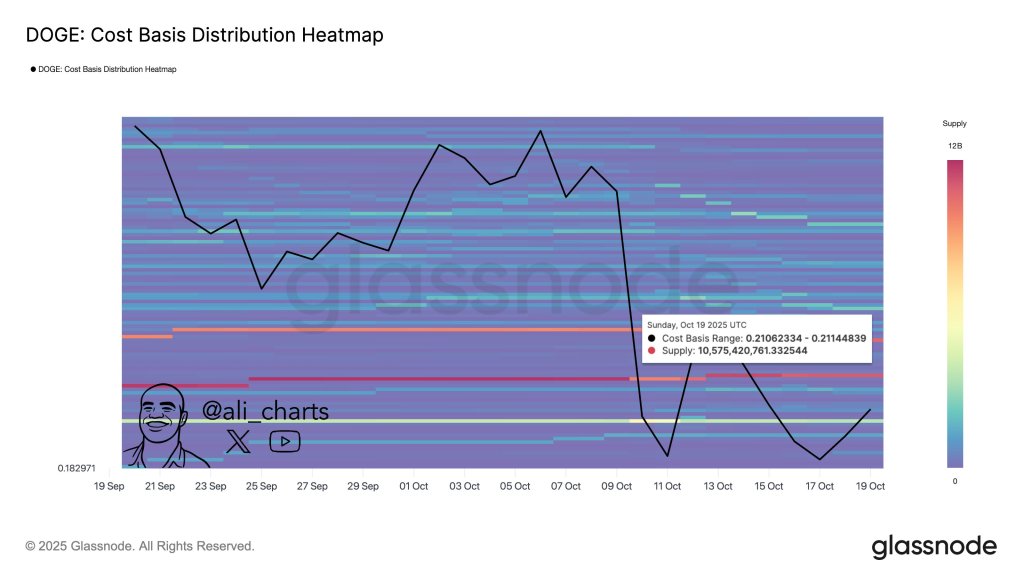
Dogecoin is confronting a dense supply overhang at the $0.21 neighborhood, where on-chain data show a striking concentration of realized cost. Market analyst Ali Martinez (@ali_charts) highlighted a Glassnode cost-basis distribution heatmap showing a heavy band at that level

Dogecoin Bulls Face $2.2 Billion Wall

“10.50 billion $DOGE were accumulated at $0.21. That’s a big resistance zone forming. Keep this level on your radar!” he wrote. The underlying tooltip on Ali’s chart (timestamped Oct. 19, 2025, UTC) pinpoints a Cost Basis Range: $0.21062334–$0.21144839 with Supply: 10,575,420,761.332544 DOGE clustered there. At $0.21, that cohort represents roughly $2.22 billion in supply.
Bitcoin Cost Basis Distribution Heatmap

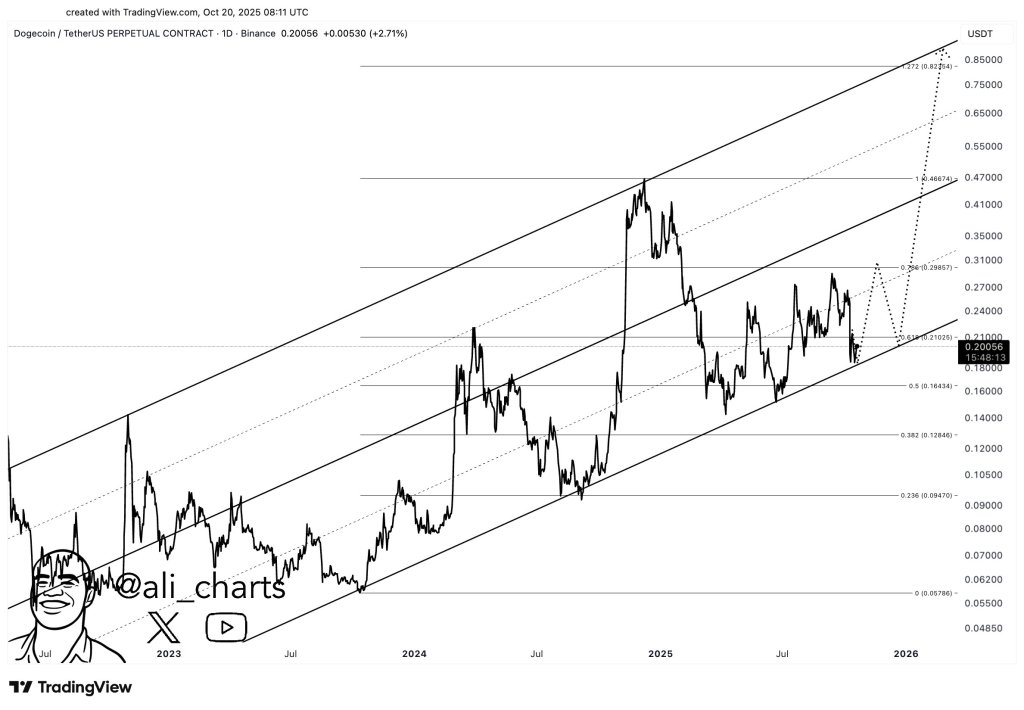
The technical context around that same band adds weight to the on-chain reading. In a separate TradingView chart shared Oct. 20, Ali noted that Dogecoin “just bounced off the channel support and looks set to climb. Eyes on $0.29 first, then $0.45 and $0.86.”

Related Reading: Is The Dogecoin Bull Run Over? Analyst Sees Echoes Of 2021

His channel overlay tracks price respecting an ascending structure across multiple tests since 2023, with intermediate waypoints aligning closely to classical retracement and extension levels. Notably, the $0.21 area intersects the 0.618 retracement at ~$0.21205 on his plot—an overlap of technical and realized-price resistance that helps explain the current stall and the importance of clearing this shelf with convincing volume.
Bitcoin price analysis

DOGE Whales Continue To Accumulate

A separate on-chain lens from Cryptollica (@Cryptollica) focuses on holder concentration dynamics. Sharing a long-horizon chart titled “Percent of Supply Held by Top 1% Addresses,” the analyst observed, “The supply held %1 data downward trend has not yet been seen as the price moves toward a new all-time high. To the moon > Target: $1.30.”
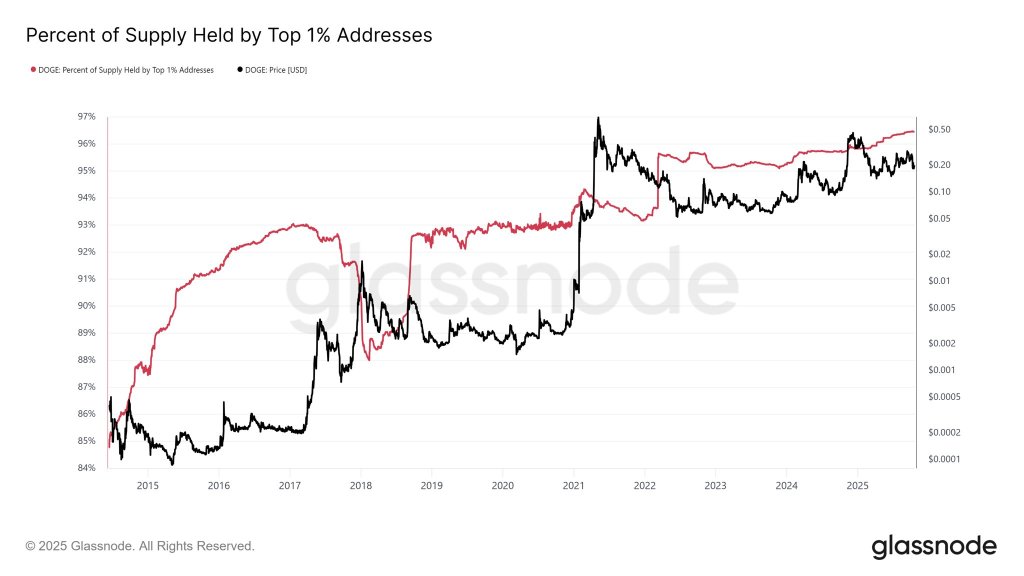
Dogecoin percent of supply held by top 1% addresses

The graphic shows the top-1% cohort maintaining an elevated—and recently rising—share of supply as price has recovered from the cycle lows. While such concentration is often interpreted as a proxy for large-holder conviction or tighter float, it can simultaneously amplify directional moves when those balances rotate; for now, the absence of a downtrend in the metric suggests no broad distribution from the largest addresses has materialized.

Read together, the three signals sketch a coherent near-term battleground. First, the cost-basis heatmap identifies a thick realized-supply node precisely where spot is grappling—$0.21—implying latent sell pressure from holders looking to exit at break-even and equally strong validation if price can flip the level into support.

Second, Ali’s price structure marks that same zone as Fibonacci resistance within an established rising channel, sharpening the inflection. Third, top-holder concentration has not rolled over, reducing evidence (so far) of heavy distribution into strength.

If bulls absorb the ~$2.2 billion equivalent sitting at $0.21 and reclaim the 0.618 band, Ali’s stepped upside $0.29 (0.786 Fib), $0.46 (1.0 Fib) and $0.86 (1.272 Fib extension) path provides a clear roadmap of overhead targets; if they fail, the confluence argues for a renewed retest of channel support before any larger move.

At press time, DOGE traded at $0.195.
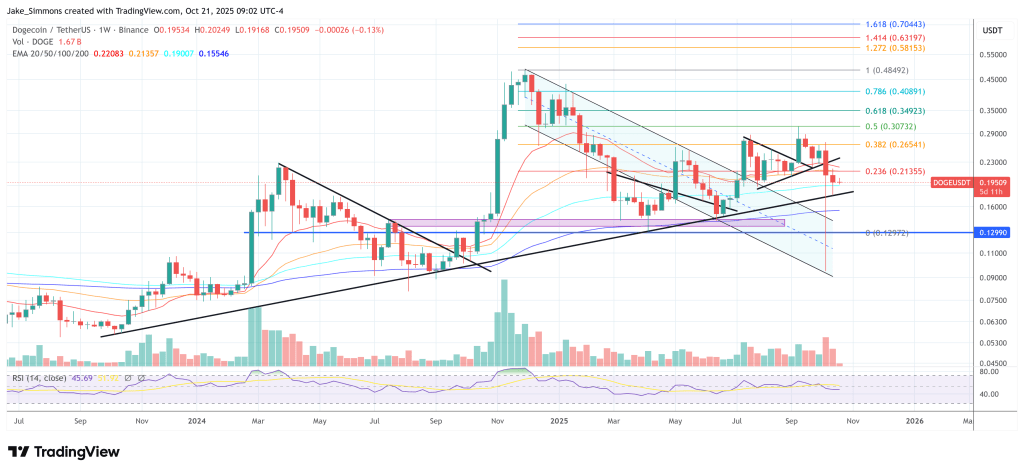
Dogecoin price
Disclaimer: The articles reposted on this site are sourced from public platforms and are provided for informational purposes only. They do not necessarily reflect the views of MEXC. All rights remain with the original authors. If you believe any content infringes on third-party rights, please contact crypto.news@mexc.com for removal. MEXC makes no guarantees regarding the accuracy, completeness, or timeliness of the content and is not responsible for any actions taken based on the information provided. The content does not constitute financial, legal, or other professional advice, nor should it be considered a recommendation or endorsement by MEXC.

You May Also Like

[Finterest] How do you start saving with Pag-IBIG’s MP2 program?

[Finterest] How do you start saving with Pag-IBIG’s MP2 program?

MP2 may be right for you if you have a conservative risk appetite and an investment horizon of at least 5 years
Share
Rappler2026/03/12 13:05
XRP steadies near $1.38 as Bollinger squeeze hints at breakout before CPI

XRP steadies near $1.38 as Bollinger squeeze hints at breakout before CPI

Markets Share Share this article
Copy linkX (Twitter)LinkedInFacebookEmail
XRP steadies near $1.38 as Bollinger squeeze
Share
Coindesk2026/03/12 13:15
Google's AP2 protocol has been released. Does encrypted AI still have a chance?

Google's AP2 protocol has been released. Does encrypted AI still have a chance?

Following the MCP and A2A protocols, the AI Agent market has seen another blockbuster arrival: the Agent Payments Protocol (AP2), developed by Google. This will clearly further enhance AI Agents' autonomous multi-tasking capabilities, but the unfortunate reality is that it has little to do with web3AI. Let's take a closer look: What problem does AP2 solve? Simply put, the MCP protocol is like a universal hook, enabling AI agents to connect to various external tools and data sources; A2A is a team collaboration communication protocol that allows multiple AI agents to cooperate with each other to complete complex tasks; AP2 completes the last piece of the puzzle - payment capability. In other words, MCP opens up connectivity, A2A promotes collaboration efficiency, and AP2 achieves value exchange. The arrival of AP2 truly injects "soul" into the autonomous collaboration and task execution of Multi-Agents. Imagine AI Agents connecting Qunar, Meituan, and Didi to complete the booking of flights, hotels, and car rentals, but then getting stuck at the point of "self-payment." What's the point of all that multitasking? So, remember this: AP2 is an extension of MCP+A2A, solving the last mile problem of AI Agent automated execution. What are the technical highlights of AP2? The core innovation of AP2 is the Mandates mechanism, which is divided into real-time authorization mode and delegated authorization mode. Real-time authorization is easy to understand. The AI Agent finds the product and shows it to you. The operation can only be performed after the user signs. Delegated authorization requires the user to set rules in advance, such as only buying the iPhone 17 when the price drops to 5,000. The AI Agent monitors the trigger conditions and executes automatically. The implementation logic is cryptographically signed using Verifiable Credentials (VCs). Users can set complex commission conditions, including price ranges, time limits, and payment method priorities, forming a tamper-proof digital contract. Once signed, the AI Agent executes according to the conditions, with VCs ensuring auditability and security at every step. Of particular note is the "A2A x402" extension, a technical component developed by Google specifically for crypto payments, developed in collaboration with Coinbase and the Ethereum Foundation. This extension enables AI Agents to seamlessly process stablecoins, ETH, and other blockchain assets, supporting native payment scenarios within the Web3 ecosystem. What kind of imagination space can AP2 bring? After analyzing the technical principles, do you think that's it? Yes, in fact, the AP2 is boring when it is disassembled alone. Its real charm lies in connecting and opening up the "MCP+A2A+AP2" technology stack, completely opening up the complete link of AI Agent's autonomous analysis+execution+payment. From now on, AI Agents can open up many application scenarios. For example, AI Agents for stock investment and financial management can help us monitor the market 24/7 and conduct independent transactions. Enterprise procurement AI Agents can automatically replenish and renew without human intervention. AP2's complementary payment capabilities will further expand the penetration of the Agent-to-Agent economy into more scenarios. Google obviously understands that after the technical framework is established, the ecological implementation must be relied upon, so it has brought in more than 60 partners to develop it, almost covering the entire payment and business ecosystem. Interestingly, it also involves major Crypto players such as Ethereum, Coinbase, MetaMask, and Sui. Combined with the current trend of currency and stock integration, the imagination space has been doubled. Is web3 AI really dead? Not entirely. Google's AP2 looks complete, but it only achieves technical compatibility with Crypto payments. It can only be regarded as an extension of the traditional authorization framework and belongs to the category of automated execution. There is a "paradigm" difference between it and the autonomous asset management pursued by pure Crypto native solutions. The Crypto-native solutions under exploration are taking the "decentralized custody + on-chain verification" route, including AI Agent autonomous asset management, AI Agent autonomous transactions (DeFAI), AI Agent digital identity and on-chain reputation system (ERC-8004...), AI Agent on-chain governance DAO framework, AI Agent NPC and digital avatars, and many other interesting and fun directions. Ultimately, once users get used to AI Agent payments in traditional fields, their acceptance of AI Agents autonomously owning digital assets will also increase. And for those scenarios that AP2 cannot reach, such as anonymous transactions, censorship-resistant payments, and decentralized asset management, there will always be a time for crypto-native solutions to show their strength? The two are more likely to be complementary rather than competitive, but to be honest, the key technological advancements behind AI Agents currently all come from web2AI, and web3AI still needs to keep up the good work!
Share
PANews2025/09/18 07:00