This article presents an ablation study confirming that disentangling motion latents into upper and lower halves significantly enhances 3D avatar reconstruction accuracyThis article presents an ablation study confirming that disentangling motion latents into upper and lower halves significantly enhances 3D avatar reconstruction accuracy

The Importance of Disentanglement: SAGE Outperforms Unified VQ-VAE Baselines in Full-Body Motion

Abstract and 1. Introduction

  1. Related Work

    2.1. Motion Reconstruction from Sparse Input

    2.2. Human Motion Generation

  2. SAGE: Stratified Avatar Generation and 3.1. Problem Statement and Notation

    3.2. Disentangled Motion Representation

    3.3. Stratified Motion Diffusion

    3.4. Implementation Details

  3. Experiments and Evaluation Metrics

    4.1. Dataset and Evaluation Metrics

    4.2. Quantitative and Qualitative Results

    4.3. Ablation Study

  4. Conclusion and References

\ Supplementary Material

A. Extra Ablation Studies

B. Implementation Details

4.3. Ablation Study

We perform ablation study under S1 to justify the design choice of each component in our SAGE Net.

\ Table 4. Evaluation results under setting S3.

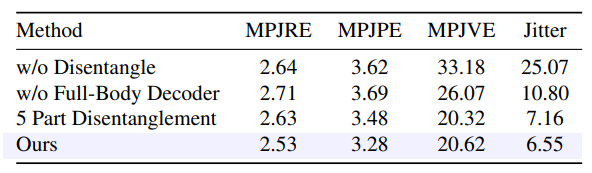
\ Table 5. Ablation results of different components in SAGE Net under setting S1.

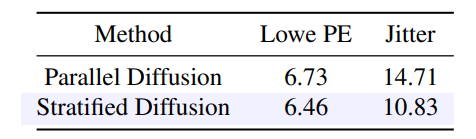
\ Table 6. Evaluation results on the conditional strategy of the diffusion model under setting S1.

\ Disentangled Codebook: We establish a baseline using a unified motion representation to evaluate the disentangle strategy. Specifically, we developed a full-body VQ-VAE model that encodes full-body motion into a single, unified discrete codebook. Other components are the same as the original model. Results shown in the first and the last rows in Table 5, demonstrate that our approach employing disentangled latents significantly outperforms the baseline on all evaluation metrics. This demonstrates that the disentanglement can simplify the learning process by allowing the model to focus on a more limited set of movements and interactions. Additionally, Fig. 5 shows the visualization comparison between our model and baseline model, verifying that the disentangle can significantly improve the reconstruction results for the most challenging lower motions.

\
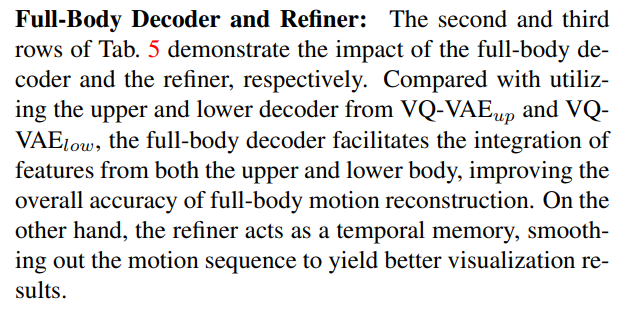
\ Disentanglement Strategy: To investigate the optimal disentanglement strategy, we explore an extreme disentanglement configuration by following the path from the root

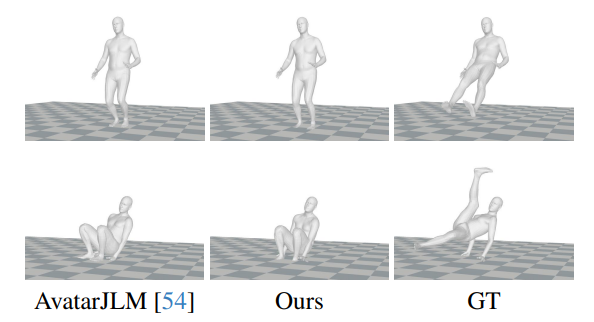
\ Figure 6. Failure cases. All models are trained under setting S1.
\ (Pelvis) node to each leaf node along the kinematic tree. Specifically, we break down the body into five segments: the paths from the root to the left hand (a), right hand (b), head (c), left foot (d), and right foot (e). As reported in the last two rows of Tab. 5, the natural joint interconnections within the upper (or lower) body were disrupted when further disentangling the human body, resulting in performance drops and complicating the model design.

\
\ Limitation: In Fig. 6, both the previous state-of-the-art method and our model encounter difficulties in two main situations: (1) External Force-Induced Movements (the top row). (2) Unconventional Poses (the bottom row). The addition of more varied samples to the training dataset can potentially enhance the model’s performance in these areas.

\

:::info Authors:

(1) Han Feng, equal contributions, ordered by alphabet from Wuhan University;

(2) Wenchao Ma, equal contributions, ordered by alphabet from Pennsylvania State University;

(3) Quankai Gao, University of Southern California;

(4) Xianwei Zheng, Wuhan University;

(5) Nan Xue, Ant Group (xuenan@ieee.org);

(6) Huijuan Xu, Pennsylvania State University.

:::


:::info This paper is available on arxiv under CC BY 4.0 DEED license.

:::

\

Disclaimer: The articles reposted on this site are sourced from public platforms and are provided for informational purposes only. They do not necessarily reflect the views of MEXC. All rights remain with the original authors. If you believe any content infringes on third-party rights, please contact service@support.mexc.com for removal. MEXC makes no guarantees regarding the accuracy, completeness, or timeliness of the content and is not responsible for any actions taken based on the information provided. The content does not constitute financial, legal, or other professional advice, nor should it be considered a recommendation or endorsement by MEXC.

You May Also Like

CME Group plans to roll out XRP and Solana futures options in October

CME Group plans to roll out XRP and Solana futures options in October

CME Group will roll out options for XRP and Solana (SOL) futures on October 13, with expiries available daily, monthly and quarterly, adding an extra layer of exposure for investors.
Share
Fxstreet2025/09/18 09:17
DOGE ETF Hype Fades as Whales Sell and Traders Await Decline

DOGE ETF Hype Fades as Whales Sell and Traders Await Decline

The post DOGE ETF Hype Fades as Whales Sell and Traders Await Decline appeared on BitcoinEthereumNews.com. Leading meme coin Dogecoin (DOGE) has struggled to gain momentum despite excitement surrounding the anticipated launch of a US-listed Dogecoin ETF this week. On-chain data reveals a decline in whale participation and a general uptick in coin selloffs across exchanges, hinting at the possibility of a deeper price pullback in the coming days. Sponsored Sponsored DOGE Faces Decline as Whales Hold Back, Traders Sell The market is anticipating the launch of Rex-Osprey’s Dogecoin ETF (DOJE) tomorrow, which is expected to give traditional investors direct exposure to Dogecoin’s price movements.  However, DOGE’s price performance has remained muted ahead of the milestone, signaling a lack of enthusiasm from traders. According to on-chain analytics platform Nansen, whale accumulation has slowed notably over the past week. Large investors, with wallets containing DOGE coins worth more than $1 million, appear unconvinced by the ETF narrative and have reduced their holdings by over 4% in the past week.  For token TA and market updates: Want more token insights like this? Sign up for Editor Harsh Notariya’s Daily Crypto Newsletter here. Dogecoin Whale Activity. Source: Nansen When large holders reduce their accumulation, it signals a bearish shift in market sentiment. This reduced DOGE demand from significant players can lead to decreased buying pressure, potentially resulting in price stagnation or declines in the near term. Sponsored Sponsored Furthermore, DOGE’s exchange reserve has risen steadily in the past week, suggesting that more traders are transferring DOGE to exchanges with the intent to sell. As of this writing, the altcoin’s exchange balance sits at 28 billion DOGE, climbing by 12% in the past seven days. DOGE Balance on Exchanges. Source: Glassnode A rising exchange balance indicates that holders are moving their assets to trading platforms to sell rather than to hold. This influx of coins onto exchanges increases the available supply in…
Share
BitcoinEthereumNews2025/09/18 05:07
The Role of Reference Points in Achieving Equilibrium Efficiency in Fair and Socially Just Economies

The Role of Reference Points in Achieving Equilibrium Efficiency in Fair and Socially Just Economies

This article explores how a simple change in the reference point can achieve a Pareto-efficient equilibrium in both free and fair economies and those with social justice.
Share
Hackernoon2025/09/17 22:30